How Yamuna Made the God of Death Promise to Protect Her Brother
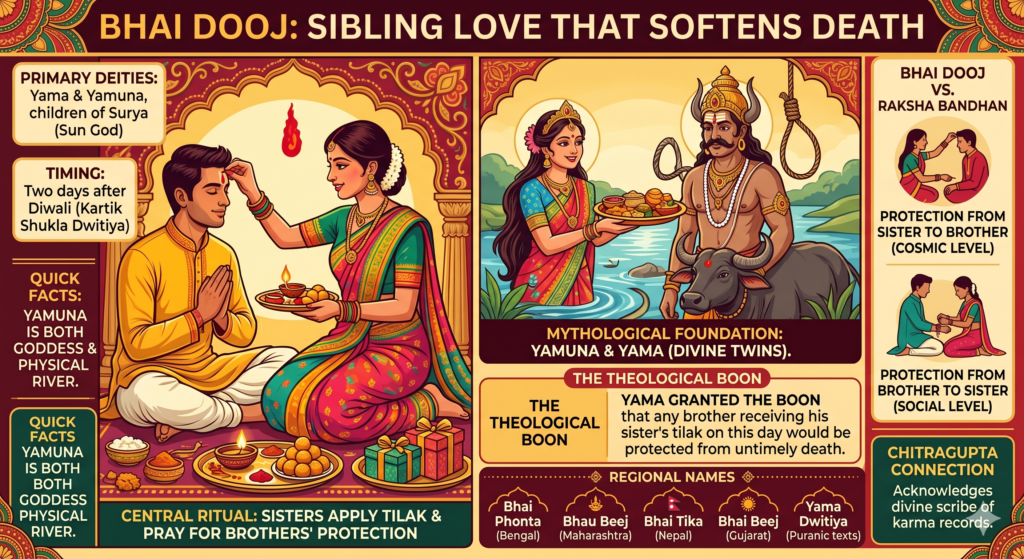
On the second day after Diwali, across the length and breadth of India and wherever Indian communities have carried their traditions, sisters prepare a tilak, a mark of sacred protection, and place it on their brother’s forehead while praying that death itself will pass him by for another year. The ritual is called Bhai Dooj, and the story behind it is older and stranger and more cosmologically layered than most people who observe it realise. It begins with a goddess visiting her brother who happens to be the god of death, with a meal cooked in love, and with a promise made at the threshold of the underworld that has been renewed every year in kitchens and living rooms across India for as long as anyone can remember. There is something quietly radical about a festival whose central theological claim is that a sister’s love can soften the god of death.
The Twins of the Sun
Yama and Yamuna are the twin children of Surya, the sun god, and his wife Sanjna, the daughter of the divine craftsman Vishwakarma. Their origin story begins with a problem of unbearable radiance.
Sanjna, despite being a divine being herself, found her husband Surya’s solar brilliance too intense to endure in close proximity. Unable to leave Surya openly, she created a shadow double of herself called Chhaya and installed this shadow-self in her place in the divine household, then retreated in secret to her father’s house, where she spent years in meditation in the form of a mare in the forests of Uttarakuru.
The twins Yama and Yamuna were born to Sanjna before her departure, making them the children of the full solar radiance and its proper consort. This origin matters theologically. Yama and Yamuna carry within their divine natures the complete inheritance of solar parentage, the light, the heat, the generative power, and the temporal authority of the sun.
Yama became the first mortal to die and through that first experience became the ruler of death, the one who knows the path to the other world because he was the first to walk it. In the Rigveda, Yama is not a terrifying figure but a compassionate king who rules the realm of the ancestors with justice. The more fearsome aspects of his personality developed in the later Puranic tradition as the theological imagination became more preoccupied with the relationship between individual moral choices and their cosmic consequences.
Yamuna became the river. This is not a metaphor in the Indian theological understanding. She is the river Yamuna that flows from the Yamunotri glacier in the Himalayas southward through the plains of northern India to meet the Ganga at Prayagraj. The river and the goddess are the same being, simultaneously a physical geographical reality and a divine presence whose waters carry her specific blessings of protection and purification.
Tarnetar Fair: The Umbrella Processions That Carry Gujarat’s Soul
The Story Behind the Festival
The mythological narrative that the tradition identifies as the origin of Bhai Dooj exists in several versions across regional traditions, with the core elements consistent and the details varying in ways that reflect the different communities that have held the story across generations.
Yama, the god of death, had not visited his sister Yamuna for a long time. The demands of his cosmic office, ruling the realm of the dead and maintaining the records of human karma, had repeatedly prevented him from accepting her invitations. On the second day of the bright fortnight of Kartik, Yama finally came.
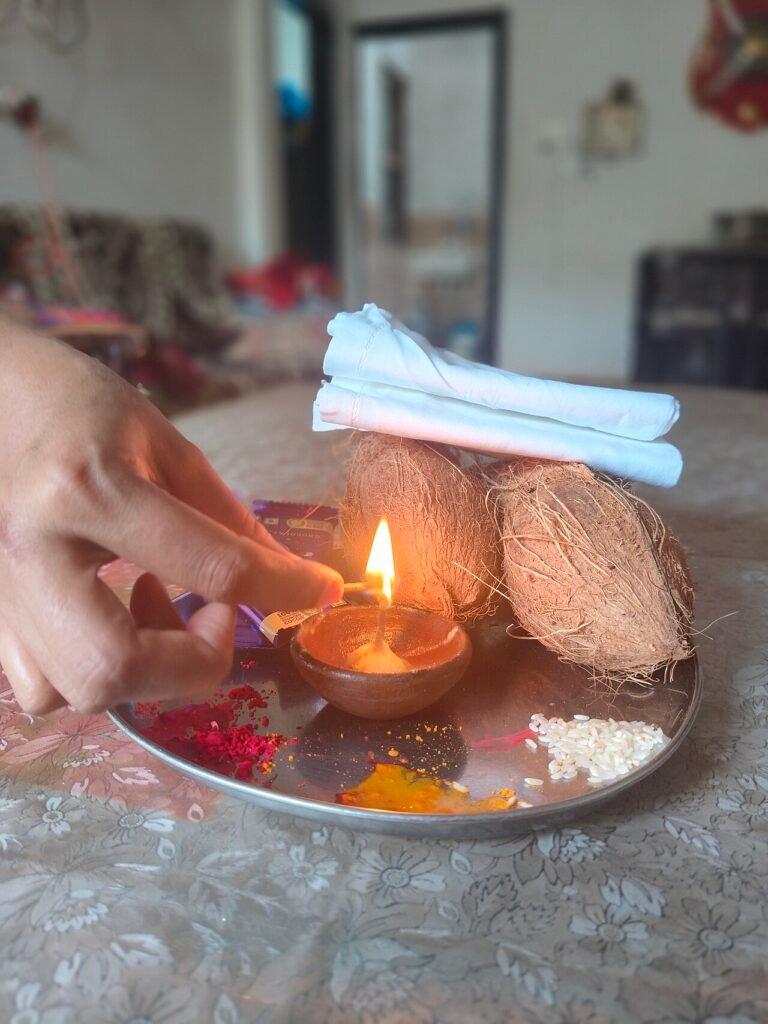
Yamuna received him with the fullness of a sister’s joy at seeing a long-absent brother. She bathed him, anointed him with fragrant oils, placed a tilak of protection on his forehead, performed aarti with a lighted lamp, fed him a meal she had cooked herself with the specific foods she knew he loved, and gave him gifts. She prayed for his wellbeing, which carries a particular irony that the tradition handles with characteristic directness: the sister praying for the long life and happiness of the brother whose office is death itself.
Yama was moved. The god of death, who deals daily in the ending of things, was moved by his sister’s love in the way that even the most powerful beings are moved by affection that has no agenda, no request, no negotiation behind it. Pure love, offered without conditions, has a specific effect on those who encounter it, whether they are human or divine.
He asked Yamuna what she wanted. She said she wanted all brothers who visit their sisters on this day and receive their sister’s tilak and love to be protected from untimely death. Yama granted the boon.
The theological structure of this exchange is precisely calibrated. Yamuna does not ask for her own benefit. She asks for a universal boon, a protection that will extend from this moment forward to every brother who participates in the ritual she and Yama have just enacted. Yama, in granting the boon, is not diminishing his own power or making an exception to the laws of death. He is extending a specific protection from untimely death to those brothers whose sisters love them enough to perform the ritual with genuine devotion. The laws of karma and cosmic order remain intact. What changes is the specific relationship between a protected individual and the timing of his encounter with Yama’s realm.
Yama in the Vedic Imagination
In the Rigveda, Yama is one of the most ancient and most significant figures in the Indian divine imagination. He appears in the tenth mandala in a celebrated dialogue with his twin sister Yami, in which Yami proposes an intimate union that Yama refuses on the grounds of cosmic law and moral order. This dialogue, the Yama-Yami Samvada, is one of the oldest recorded conversations in Sanskrit literature and establishes the relationship between the divine twins as one of deep affection existing within the constraints of dharmic law.
The Rigvedic hymns to Yama are addressed to him with respect and without fear, asking him to receive the recently dead with compassion and to provide them with the pleasures appropriate to a righteous soul in the world of the ancestors. The more fearsome Yama of later tradition, the god of death who dispatches emissaries to collect souls and who delivers judgment on the moral quality of each life, developed as the theological imagination became more preoccupied with individual moral consequences.
Both Yamas are present in the Bhai Dooj story. It is the Puranic Yama who needs to be softened by his sister’s love, who is busy with the terrifying work of his office and has neglected the simple human pleasure of visiting family. And it is the Rigvedic Yama who responds to Yamuna’s love with the generosity and justice of the ancestor-king who wants what is good for the living as well as the dead.
Related to article: How the Sibling Bond of Yama and Yamuna Created Bhai Dooj · Source: Wikimedia Commons · Bhaiyaji Smile 123 · CC BY-SA 4.0
Yamuna and the River’s Double Identity
Yamuna’s role in the Bhai Dooj story is inseparable from her identity as the river, and this connection generates a set of specific ritual practices associated with the festival that make sense only when the river goddess dimension of her identity is kept clearly in view.
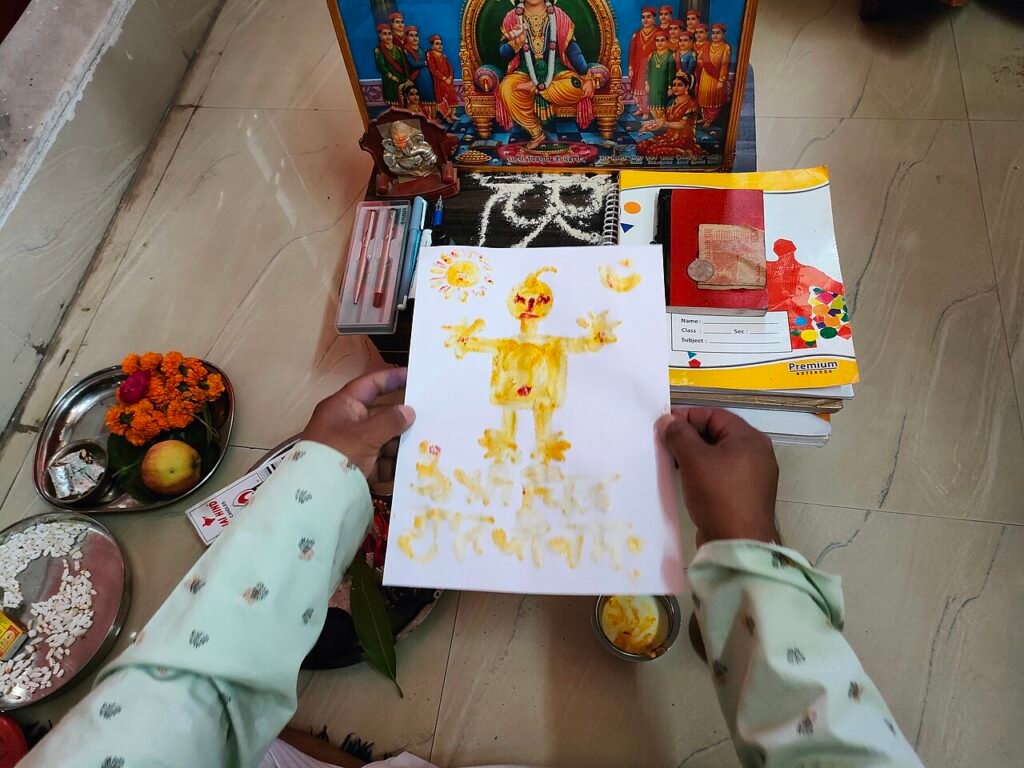
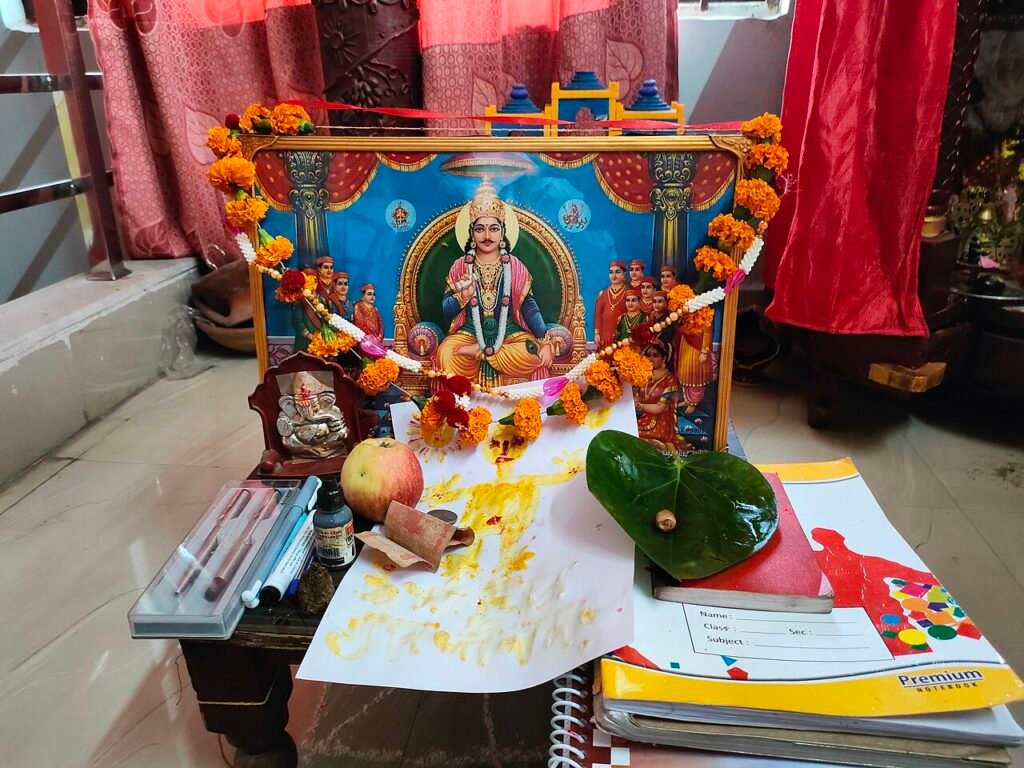
The tradition of bathing in the Yamuna river on the day of Bhai Dooj is one of the festival’s oldest associated practices. The Skanda Purana and the Bhavishya Purana both contain specific verses about the spiritual merit of bathing in the Yamuna on Yama Dwitiya, the second day of Kartik’s bright fortnight, stating that such bathing provides protection from the fear of Yama, that is, from the fear of untimely death.
The logic of this connection is direct. Yamuna is the sister. Her waters carry her specific blessings. On the day that she hosted her brother Yama and received from him the boon of protection for brothers who receive their sister’s love, bathing in her waters is understood as a way of entering into that boon, of placing oneself within the protective relationship between the divine siblings.
The specific phrase that appears in the textual tradition, yamuna yamuna dwitiya, which connects the river’s name to the festival’s name for the day, reflects how completely the geographical and divine dimensions of Yamuna’s identity are fused in the theological imagination. Bhai Dooj is simultaneously a festival about a divine sibling relationship and a festival about a river, and these two dimensions are not separate but expressions of the same theological reality.
Cities on the Yamuna river, including Mathura and Vrindavan where Yamuna’s divine identity as a goddess is most actively worshipped throughout the year, observe Bhai Dooj with particular intensity, the festival’s connection to the river goddess giving the local celebration a dimension unavailable in communities distant from the physical river.
Rann Utsav Under the Full Moon: Where the Salt Desert Comes Alive
Related to article: How the Sibling Bond of Yama and Yamuna Created Bhai Dooj · Source: Wikimedia Commons · Bhaiyaji Smile 123 · CC BY-SA 4.0
The Tilak and Its Meaning
The central ritual act of Bhai Dooj, the application of a tilak on the brother’s forehead by his sister, is not a casual greeting gesture. It is a specific act of protective marking with roots in both Vedic and Tantric ritual understanding whose meaning, when examined carefully, reveals the theological sophistication embedded in what appears to be a simple domestic ceremony.
The tilak is typically made from a combination of vermilion, sandalwood paste, rice grains, and sometimes curd, applied to the Ajna chakra, the point between the eyebrows that the yogic tradition identifies as the seat of intuition and the point at which individual consciousness meets the cosmic. The act of marking this point with auspicious substances is understood as a form of blessing that activates the protective energies associated with the marked point.
In the specific context of Bhai Dooj, the tilak applied by the sister carries the protective boon granted by Yama to Yamuna. The sister who applies the tilak is performing, in her own person, the act that Yamuna performed for Yama on the day that established the festival. She is Yamuna. Her brother is, in this ritual moment, under the same protection that Yamuna secured from Yama for all brothers who receive their sister’s love.
This identification of the sister with Yamuna is not merely symbolic. In the theological framework of the festival, the sister’s intention and devotion, her genuine love for her brother expressed through the preparation and performance of the ritual, is what gives the tilak its protective efficacy. A tilak applied without love, as a social obligation met without feeling, carries different weight from one applied by a sister who genuinely wants her brother to live a long and protected life.
The aarti that follows the tilak, the waving of a lighted lamp before the brother’s face, extends the protective marking into a ceremony of light, connecting the festival’s intimate domestic ritual to the Vedic solar theology in which Surya’s light is the source of life and protection. The sister, performing aarti for her brother, invokes the light of their shared divine ancestor to illuminate and protect him.
The meal that the sister cooks for her brother on Bhai Dooj is the most direct re-enactment of Yamuna’s hospitality to Yama. The act of cooking for the brother, of nourishing him with food prepared by her own hands as an expression of her care, is understood as a continuation of the specific act of love through which Yamuna established the festival’s boon.
Hemis Festival: Sacred Cham Dances That Offer Liberation in Ladakh
Related to article: How the Sibling Bond of Yama and Yamuna Created Bhai Dooj · Source: Wikimedia Commons · Dipta’s World · CC BY-SA 4.0
Regional Voices and Complementary Rituals
One of the most revealing features of Bhai Dooj as a pan-Indian festival is the way its core theological content has found different expressive forms in different regional cultural contexts while maintaining its essential meaning with remarkable consistency.
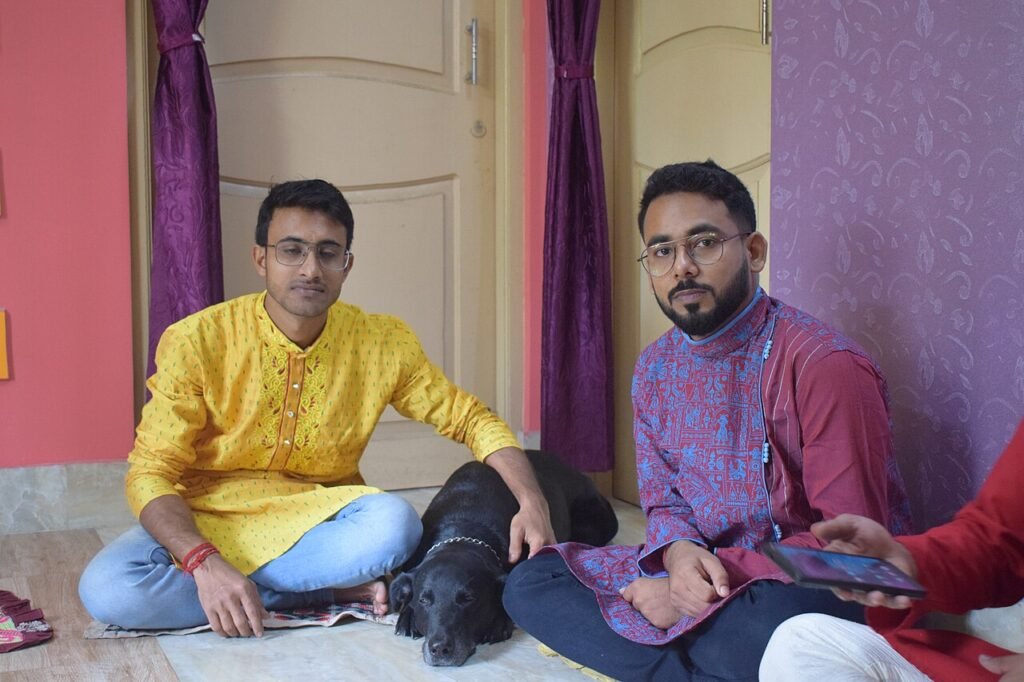
In West Bengal, the festival is called Bhai Phonta. The tilak becomes the Phonta, a specific mark drawn with sandalwood paste while the sister recites a verse in Bengali that addresses Yama directly, asking him to go away and leave her brother alone, invoking Yamuna’s name and authority. In Nepal, the festival is Bhai Tika and is observed as a public holiday with elaborate ceremony. The Tika applied is a multicoloured mark incorporating five colours representing the five elements. In Maharashtra, it is Bhau Beej, with Bhau meaning brother in Marathi, reflecting the directness of its focus on the sibling relationship. In Gujarat, it is Bhai Beej, and in some northern communities it carries the name Yama Dwitiya that most directly reflects its mythological foundation.
Bhai Dooj and Raksha Bandhan, the two most widely observed sibling festivals in the Indian calendar, address the brother-sister relationship from complementary angles. In Raksha Bandhan, the sister ties a protective thread on the brother’s wrist and receives his promise of protection in return. The direction of protection runs primarily from brother to sister in the social world. In Bhai Dooj, the sister provides the protective element, the tilak that carries Yamuna’s boon, while the brother receives it. The protection runs from sister to brother in the cosmic world. Together, the two festivals create a complete theological portrait of the sibling relationship: in one direction the brother protects the sister in the social world; in the other the sister protects the brother in the cosmic world, through her connection to the divine and her capacity for a quality of love that can negotiate with death itself.
Poush Mela and the Baul Singers Who Keep Shantiniketan’s Soul Alive
Death, Love, and the Domestic Sacred
What makes Bhai Dooj theologically extraordinary is the audacity of its central premise: that the domestic space of the sister’s home, with its cooking pots and oil lamps and plates of sweets, is a space powerful enough to receive the god of death as a guest and to soften him with love.
Most religious traditions maintain a careful separation between the sacred and the domestic. Sacred space is set apart. The domestic space of ordinary life is where you prepare to encounter the sacred, not where you encounter cosmic forces directly. Bhai Dooj collapses this separation completely. The divine encounter happens in the kitchen and the living room. Yama sits in his sister’s home and eats her cooking. The sacred space is not set apart from the domestic space. The domestic space, charged by the sister’s love and her ritual intention, becomes the sacred space.
This is a profoundly theological position. It says that the love and labour of women in domestic spaces has cosmic significance. That cooking for someone you love is a sacred act. That the care taken in preparing food, the attention given to making a tilak, the devotion expressed in lighting a lamp and moving it in circles before a beloved face, has the power to negotiate with the most fundamental force in the cosmos.
The god of death came to his sister’s house, ate her cooking, accepted her tilak, and gave her a boon that has protected brothers across India for millennia. He did not go to a temple to do this. He went home. That is the full theological statement of Bhai Dooj. And it is considerably more radical, and considerably more tender, than a simple sibling festival has any obvious reason to be.
Every year, across India and wherever Indian communities have carried their traditions, sisters place their fingers in vermilion and draw the mark of protection on their brothers’ foreheads. They are re-enacting Yamuna’s gesture. They are renewing the boon. They are telling Yama, gently and firmly and with all the authority of love, that their brothers are spoken for. The god of death, who has seen everything and lost nothing, nods and accepts the gift.
The tilak holds. It always has.
Related to article: How the Sibling Bond of Yama and Yamuna Created Bhai Dooj · Source: Wikimedia Commons · GymPediaWarrior · CC BY 4.0
How the Karaga Bearers Balance the Floral Pyramid in Karnataka
If you think you have remembered everything about this topic take this QUIZ
Results


#1. In which Hindu calendar month is the festival of Bhai Dooj observed?
#2. According to Vedic cosmology, who are the parents of the divine twins Yama and Yamuna?
#3. Which Puranic text contains the specific story details of Sanjna creating her shadow-double Chhaya due to Surya’s unbearable radiance?
#4. In which mandala of the Rigveda does the celebrated dialogue known as the Yama-Yami Samvada appear?
#5. What specific name is given to the Bhai Dooj festival in West Bengal, where sisters recite a direct verse asking Yama to go away?
#6. Which deity’s worship is observed alongside Bhai Dooj by the Kayastha community to address the moral ledger and accounts of human karma?
#7. How does the directional flow of protection in Bhai Dooj structurally compare to Raksha Bandhan?
#8. Which specific journal features research by Vedic scholars examining the complex figures of Yama across ancient texts and traditions?
What is the mythological origin of Bhai Dooj and why is it connected to Yama and Yamuna?
Bhai Dooj originates in the story of Yamuna, the river goddess, and her twin brother Yama, the god of death, who are the children of Surya the sun god and his wife Sanjna in Vedic cosmology. According to the tradition recorded in texts including the Skanda Purana and Bhavishya Purana, Yama visited his sister Yamuna’s home on the second day of the bright fortnight of Kartik, where she bathed him, applied a tilak on his forehead, performed aarti, fed him and gave him gifts. Moved by her love, Yama granted her the boon that any brother who receives his sister’s tilak and love on this day will be protected from untimely death. This divine sibling visit became the model for the festival observed across India every year.
Why does Bhai Dooj involve the worship of Yama, the god of death, in a festival about sibling love?
The involvement of Yama in a sibling love festival reflects the theological sophistication of the tradition. The festival’s central claim is that a sister’s genuine love has the power to negotiate with death itself, specifically to secure protection from untimely death for the brother who receives her devotion. By placing Yama at the centre of the festival’s mythology rather than hiding him, the tradition acknowledges death as a real and powerful force while asserting that love, expressed through specific ritual acts of care and devotion, has a specific protective efficacy in relation to it. The festival does not pretend death does not exist. It makes a claim about what love can do in relation to it.
How is Bhai Dooj different from Raksha Bandhan if both are sibling festivals?
Bhai Dooj and Raksha Bandhan address the brother-sister relationship from complementary directions. In Raksha Bandhan, the sister ties a protective thread on the brother’s wrist and receives his promise of protection in the social world. The protection flows primarily from brother to sister. In Bhai Dooj, the sister applies the protective tilak on the brother’s forehead, invoking Yamuna’s boon to protect him from untimely death. The protection flows from sister to brother through her ritual and her love. Together, the two festivals create a complete portrait of the sibling relationship as one of mutual protection operating simultaneously on the human and cosmic levels.
What is the significance of the tilak applied during Bhai Dooj?
The tilak applied by the sister on her brother’s forehead during Bhai Dooj is not a social greeting gesture but a specific act of protective marking rooted in Vedic and Tantric ritual understanding. Applied to the Ajna chakra between the eyebrows using a combination of vermilion, sandalwood paste, rice, and sometimes curd, it carries the protective boon that Yama granted Yamuna for all brothers who receive their sister’s love on this day. The sister performing the tilak is understood to be re-enacting Yamuna’s original gesture, and the efficacy of the protection is understood to depend on the genuine quality of love she brings to the ritual act.
Why is the river Yamuna specifically significant to Bhai Dooj and why do some traditions prescribe bathing in it on this day?
The river Yamuna is significant to Bhai Dooj because the goddess Yamuna, Yama’s sister whose visit established the festival’s boon, is simultaneously a divine being and the physical river Yamuna that flows through northern India. This dual identity means that the river’s waters carry Yamuna’s specific blessings, and bathing in the Yamuna on the day of Bhai Dooj is prescribed in texts including the Skanda Purana and Bhavishya Purana as a means of entering the protective boon that Yamuna secured from Yama. Cities on the Yamuna such as Mathura and Vrindavan therefore observe the festival with a specific connection to the river that communities distant from it cannot replicate in the same form.
Sources & References
Bhai Dooj mythology and Yama-Yamuna relationship — Bhai Dooj originates in the story recorded in texts including the Skanda Purana and Bhavishya Purana of Yamuna, the river goddess and twin sister of Yama the god of death, who hosted her brother in her home on the second day of Kartik’s bright fortnight and secured a boon that all brothers receiving their sister’s tilak and love on this day will be protected from untimely death.
Yama and Yamuna as children of Surya — Yama and Yamuna are the twin children of Surya the sun god and his wife Sanjna in Vedic cosmology, with their shared parentage placing Bhai Dooj within the same theological family as other Kartik festivals centered on Surya worship, both rooted in the solar cosmology of the Rigveda.
The Yama-Yami dialogue and Vedic sibling relationship — The Yama-Yami Samvada in the tenth mandala of the Rigveda is one of the oldest recorded conversations in Sanskrit literature, establishing the divine siblings’ relationship as one of deep affection existing within the constraints of dharmic law, and providing the theological foundation for understanding how Yama can respond to his sister’s love while maintaining the cosmic order.
Yamuna’s dual identity as goddess and river — Yamuna is simultaneously a divine being and the physical river Yamuna flowing from the Yamunotri glacier through northern India to Prayagraj, making Bhai Dooj one of the few Indian festivals whose central goddess is also a living geographical reality that pilgrims bathe in on the festival day to receive the boon of protection.
Pan-Indian regional variations and complementary festival structure — Bhai Dooj is known by at least six regional names across India including Bhai Phonta (West Bengal), Bhai Tika (Nepal), Bhau Beej (Maharashtra), and Yama Dwitiya (Sanskrit texts), and functions theologically alongside Raksha Bandhan to create complete portrait of sibling protection: Raksha Bandhan with brother protecting sister in the social world, Bhai Dooj with sister protecting brother in the cosmic world.