How Shantiniketan Keeps 180 Years of Spiritual Search Alive
The red laterite soil of Birbhum district in West Bengal has a particular colour that photographers come from across the world to capture. It is not quite red and not quite orange but something between the two, and in the winter light of December it glows with a warmth that makes the bare sal trees and the open fields look like a landscape from a painting rather than a lived-in countryside. Into this landscape, every year since 1843, the Poush Mela arrives.
And with it, the Bauls.
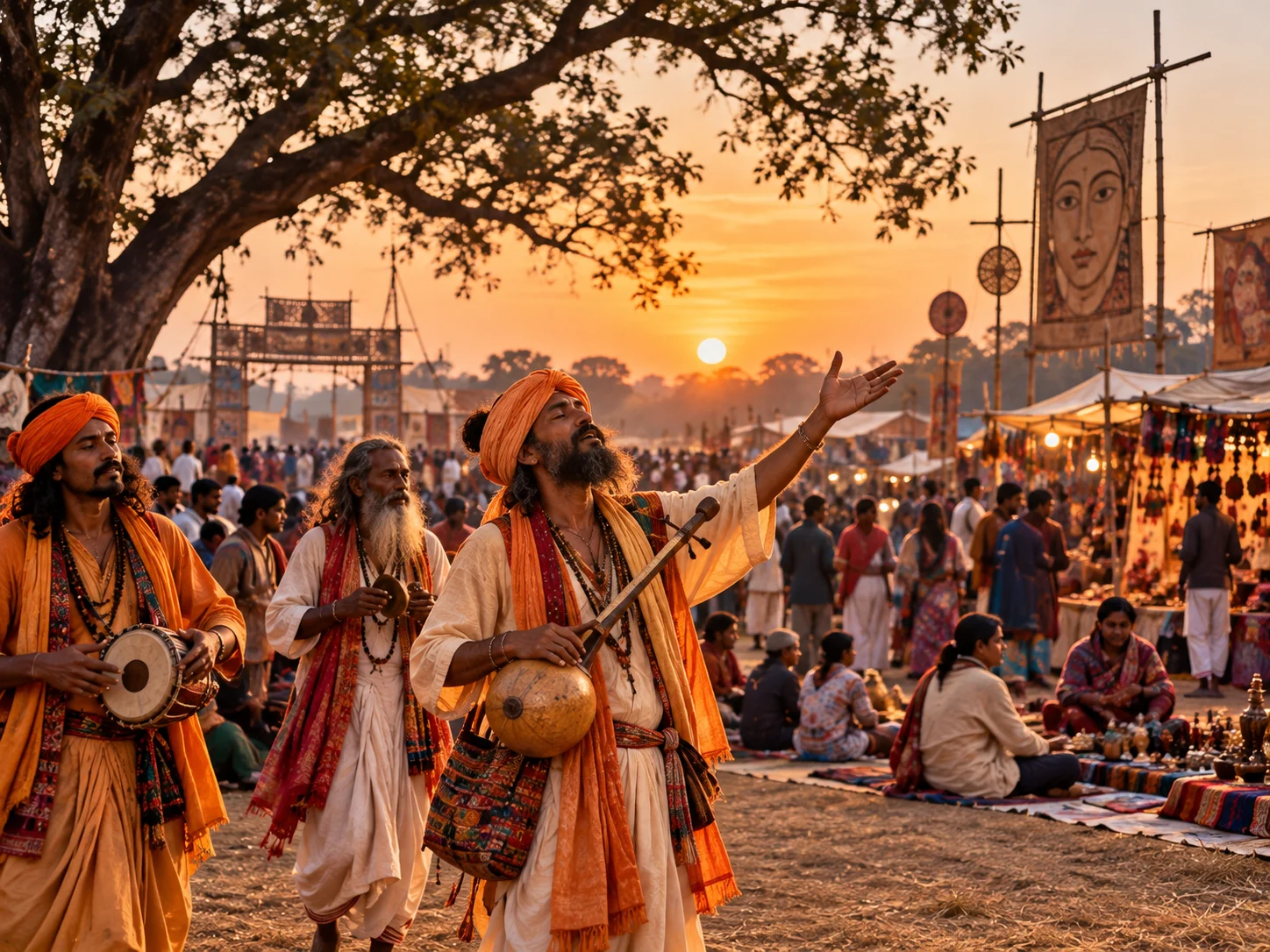
They are not easy to describe to someone who has never encountered them. The Baul singers of Bengal occupy a category that does not translate neatly into any standard religious or cultural vocabulary. They are mystics but not monks. They are musicians but not performers in the professional sense. They are philosophers but their philosophy is expressed entirely through song and refuses to be separated from it. They are wanderers by both practice and conviction, moving through the villages of Bengal and beyond with their patchwork robes, their ektara single-string instruments, and their particular quality of presence that is simultaneously otherworldly and completely grounded in the most immediate human experience.
Poush Mela is a four to five day annual fair held in Shantiniketan, West Bengal, during the Bengali month of Poush, founded by Maharshi Debendranath Tagore in 1843 as a Brahmo Samaj spiritual gathering. Over nearly two centuries, it has evolved into one of India’s most culturally significant festivals, celebrated above all for its preservation and celebration of Baul music, the mystical folk tradition of Bengal. With Baul music inscribed on UNESCO’s Representative List of Intangible Cultural Heritage of Humanity in 2008, Poush Mela stands as the living heartbeat of a tradition that has shaped Bengali cultural identity for centuries.
Mysterious Bird Deaths In Jatinga Valley That Science Cannot Fully Explain
The Man Who Started It All
To understand Poush Mela, you must begin with Maharshi Debendranath Tagore, father of Rabindranath Tagore and one of the most remarkable spiritual figures of nineteenth century Bengal. Debendranath was a leader of the Brahmo Samaj, the reformist Hindu movement founded by Ram Mohan Roy that rejected idol worship, caste hierarchy, and religious superstition in favour of a rational, monotheistic spirituality grounded in the Upanishads.
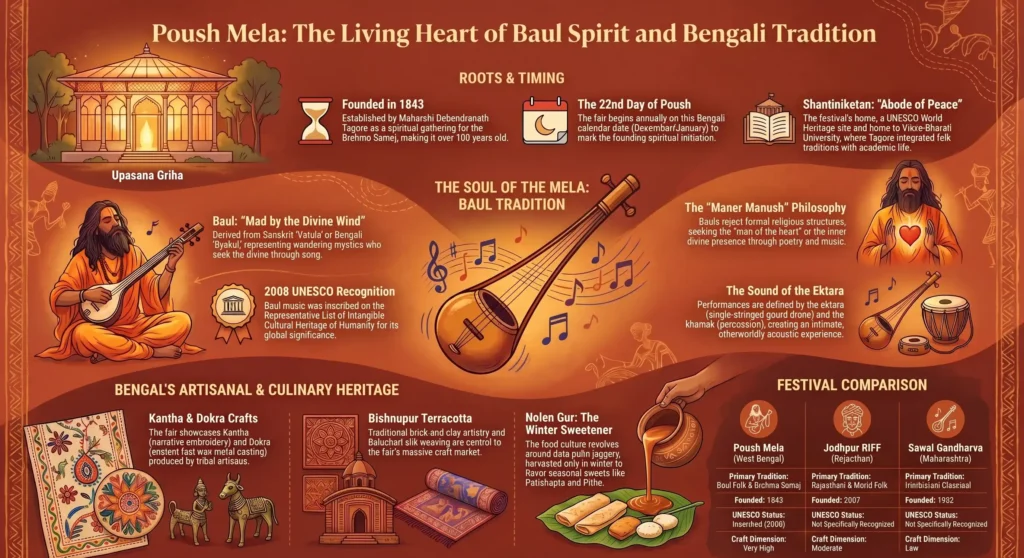
In 1843, Debendranath underwent a spiritual initiation into the Brahmo Samaj on the twenty-second day of the Bengali month of Poush. To commemorate this occasion, he established an annual gathering at Shantiniketan, the land he had acquired in Birbhum district and named, meaning abode of peace, as a place of meditation and spiritual community. That gathering was the first Poush Mela.
The original fair was a modest spiritual assembly. Brahmo Samaj members gathered for prayer, devotional singing, and philosophical discussion. The commercial and cultural dimensions that now define Poush Mela developed gradually, organically, over subsequent decades, as the fair’s reputation grew and the community around Shantiniketan expanded.
When Rabindranath Tagore established Visva-Bharati University at Shantiniketan in 1921, the Poush Mela acquired an institutional home and a significantly expanded cultural mandate. Tagore’s vision for Visva-Bharati was of a university where the boundaries between formal education and living cultural practice would be dissolved, where students would learn classical music, dance, and the visual arts alongside conventional academic subjects, and where the folk traditions of rural Bengal would be treated with the same seriousness as the high cultural forms of the classical tradition.
The Bauls fitted perfectly into this vision. Tagore had a profound personal connection to Baul music and philosophy. He drew from Baul poetry in his own work, acknowledged the Baul influence on his Gitanjali poems that won him the Nobel Prize for Literature in 1913, and actively worked to bring the Baul tradition into the cultural life of Shantiniketan. The Poush Mela became the annual occasion when this connection between Tagore’s institution and the Baul tradition found its most public and most joyful expression.
Who the Bauls Are and What They Believe
Bhangarh Fort: Legends Behind India’s Most Haunted Ruins
The Baul tradition of Bengal is one of the most intellectually extraordinary folk spiritual movements in South Asian history. The word Baul is believed to derive from the Sanskrit Vatula, meaning one who is driven mad by the divine wind, or from the Bengali Byakul, meaning restless or eager with longing. Both derivations capture something essential about the Baul character: these are people in whom the search for the divine has become so urgent that ordinary social convention has become impossible to sustain.
The Bauls reject the formal structures of both Hinduism and Islam, the two dominant religious traditions of Bengal. They reject temple worship and mosque prayer equally. They reject caste hierarchy. They reject the authority of scriptures over the authority of direct experience. Their theology, if it can be called that, is centred on the Maner Manush, the man of the heart or the inner divine presence, a concept that has no exact equivalent in any orthodox religious tradition but which carries echoes of Sufi mysticism, Tantric Shaivism, and Vaishnava devotionalism simultaneously.
This theological position is expressed entirely through music and poetry. The Bauls do not write systematic philosophy. They sing it. Their songs, called Baul songs or Baul gaan, are composed in Bengali and use the imagery of rivers, boats, birds, and the human body as a landscape of spiritual search. The body itself is central to Baul practice in ways that connect the tradition to Tantric currents in Bengali spirituality, with the physical understood as the site where the divine is most immediately accessible rather than as an obstacle to spiritual realisation.
The Baul tradition has produced a body of poetry of extraordinary beauty and philosophical depth. Poets including Lalon Fakir, Pagla Kanai, and Duddu Shah composed songs that are sung across Bengal today, both in their original mystical contexts and in the popular music of the region. Lalon Fakir, the most celebrated Baul poet-musician of the nineteenth century, composed over two thousand songs and is venerated by Hindus and Muslims alike in both India and Bangladesh, a fact that speaks directly to the tradition’s deliberate transcendence of religious boundaries.
The Sound of the Ektara Under an Open Sky
The Magnetic Hill of Ladakh That Defies the Laws of Gravity
There is a specific acoustic quality to Baul music performed in the open air that no recording has ever fully captured. Part of this is the ektara, the single-stringed gourd instrument that is the Baul’s primary accompaniment. The ektara produces a drone note that sustains beneath the singing, creating a continuous harmonic ground against which the voice moves with extraordinary freedom. The sound is intimate even at a distance, which is itself slightly paradoxical and entirely characteristic of the Baul musical experience. The ektara is traditionally made by the Baul musicians themselves, with the act of making the instrument understood as itself a spiritual practice rather than a preliminary to one.
The other primary instrument of Baul performance is the duggi or khamak, a small percussion instrument held against the body and struck with one hand while the other controls the tension of the string, producing a speaking-drum quality that punctuates the vocal line with rhythmic commentary. Together, the ektara and khamak create a sonic world that is immediately recognisable as Baul and that carries, even in its first few notes, a quality of spiritual seriousness that is inseparable from its aesthetic pleasure.
At Poush Mela, Baul performances happen continuously across the fair’s duration, in multiple locations simultaneously. The most celebrated Baul singers perform on the main stage, but the fair’s most memorable musical encounters often happen in smaller, more intimate settings, a group of Bauls singing under a tree, a single musician sitting at the edge of the fairground with a small gathered audience, an impromptu exchange of songs between two practitioners who have not met in several years.
This informality is not accidental. It reflects the Baul understanding of music as a living practice rather than a performed art form. The distinction matters enormously. A living practice belongs to the practitioner and emerges from their interior life. A performed art form belongs to the audience and is shaped by their expectations. Baul music, at its most authentic, insists on being the former even when it finds itself in the conditions of the latter.
Tagore’s Shadow and Its Weight
Shantiniketan cannot be discussed without confronting the extraordinary presence of Rabindranath Tagore, who lived, worked, taught, and died here and whose influence on every dimension of the place is so pervasive that it sometimes threatens to overshadow the living culture it helped to nurture.
Tagore’s relationship to the Baul tradition was genuine and transformative in both directions. He learned from the Bauls, incorporated their philosophy and musical sensibility into his own creative work, and used his enormous cultural authority to legitimise a tradition that the Bengali educated class of his era tended to regard with condescension. The Bauls, in turn, were shaped by the attention of Shantiniketan, gaining a platform and an audience that extended their reach well beyond the rural Bengal circuit they would otherwise have occupied.
But the relationship between a tradition and its most famous patron is always complicated. There is a version of the Baul story in which Tagore’s embrace of the tradition helped save it from obscurity. There is another version in which the institutionalisation of Baul music within the Visva-Bharati cultural framework began a process of aestheticisation that has, over time, separated some aspects of Baul performance from the living spiritual practice that gives it its depth.
Both versions contain truth, and the tension between them is one of the most intellectually interesting dynamics visible at Poush Mela today, where you can encounter in the same afternoon a Baul singer whose practice is inseparable from a genuine lived spiritual commitment and a trained performer whose Baul-influenced presentation has been refined for stage delivery in ways that are beautiful but have lost some connection to the wandering, searching quality that defines the tradition at its roots.
The Fair Beyond the Music
The Mysterious 500 Year Old Mummy of Sangha Tenzin in Spiti Valley
Poush Mela is more than a Baul music festival, and the full experience of the fair requires engagement with its other dimensions as well.
The craft market at Poush Mela is one of the finest in eastern India. Artisans from across West Bengal and the neighbouring states bring work that represents the full range of Bengal’s extraordinary craft heritage. Kantha embroidery, the tradition of stitching worn saris into quilts and decorative textiles using a running stitch that creates detailed narrative pictorial panels, is available in forms ranging from traditional household use to contemporary design expressions. Kantha traditions are held in collections including the Victoria and Albert Museum in London.
Dokra metalwork, the lost-wax casting tradition practiced by tribal artisans in West Bengal, Odisha, and Chhattisgarh, is present at the fair in extraordinary variety. The Dokra figures of animals, deities, and everyday life produced by artisans from Bankura district and the Bastar region have become among the most recognised symbols of Indian tribal craft internationally, and the Poush Mela market provides a direct point of contact between these artisans and buyers who might otherwise only encounter their work through retail intermediaries.
The terracotta traditions of Bishnupur, the medieval capital of the Malla kings of Bankura district whose extraordinary brick temples are among the finest examples of Bengali terracotta architecture surviving anywhere, are represented at Poush Mela through both traditional religious figurines and the Baluchari silk weaving tradition that developed in the region. The Baluchari narrative figured borders depicting scenes from the Mahabharata and Ramayana represent one of Bengal’s highest textile achievements.
The agricultural dimension of Poush Mela, which reflects its origins as a rural seasonal fair marking the beginning of the winter harvest, remains present in the displays of regional produce, livestock, and agricultural implements that occupy sections of the fairground. This dimension of the fair is the least photographed and the most honest reminder that Poush Mela grew from the rhythms of rural life rather than from cultural programming.
The food culture of the fair deserves specific mention. The winter months in Bengal produce an extraordinary abundance of seasonal ingredients, including the date palm jaggery called Nolen Gur whose production peaks in December and January and which flavours a range of traditional Bengali sweets including Sandesh, Patishapta crepes, and Pithe rice preparations. The Nolen Gur is harvested only during the cold months when the sap flow from date palms reaches its sweetest concentration, making it a genuinely seasonal product unavailable at any other time of year. The food stalls at Poush Mela serve as a seasonal map of Bengal’s sweetmaking traditions, and the combination of Nolen Gur sweetness and cold December air is one of those specific sensory combinations that visitors remember for years.
The Brahmo Samaj at the Centre
At the heart of Poush Mela, often overlooked by visitors focused on the Baul performances and the craft market, is the Brahmo Samaj ceremony that remains the festival’s founding religious act. On the twenty-second of Poush each year, a prayer meeting is held at the Upasana Griha, the prayer hall established by Debendranath Tagore, that directly commemorates the spiritual initiation of 1843. This prayer ceremony has been conducted on the twenty-second of Poush without interruption since 1843, making it one of the longest continuously observed religious commemorations in modern Bengali history.
The ceremony is simple, unornamented, and deeply sincere. There are no idols. There is no elaborate ritual. There is devotional singing of Brahmo hymns, called Brahmo sangeet, a tradition of devotional composition that Rabindranath Tagore developed into a sophisticated musical form, and there is prayer conducted in the spirit of the Upanishadic tradition that Debendranath Tagore revered.
This ceremony is the original Poush Mela. Everything else the fair has become grew around it. Attending the Brahmo prayer meeting at the Upasana Griha on the twenty-second of Poush is to encounter the fair’s truest self, a small community gathering in a spirit of rational devotion that has not fundamentally changed since the nineteenth century, surrounded by a festival that has grown into one of India’s most celebrated cultural events while remaining anchored to this quiet, sincere act of remembrance.
Preservation and the Threat of Popularity
Poush Mela has, in recent years, attracted a volume of visitors that presents genuine challenges to the fair’s essential character. Shantiniketan is a small settlement built around a university campus. The infrastructure of Bolpur, the nearest town, was not designed to accommodate the hundreds of thousands of visitors who now attend the fair during its peak days. Traffic, waste management, crowd safety, and the commercialisation of the fairground have become pressing practical concerns.
More significantly, the growth in the fair’s profile has brought the Baul tradition into contact with a mass audience that relates to it primarily as entertainment. The Bauls themselves navigate this relationship with varying degrees of comfort and resistance. Some senior Baul practitioners have spoken publicly about their concern that the festival stage format, with its fixed performance slots, amplification systems, and large audiences, fundamentally misrepresents a tradition whose meaning depends on intimacy, spontaneity, and the genuine spiritual engagement of both singer and listener.
These concerns are not new. The tension between preservation and popularity is one that every living tradition faces when it encounters the attention of a culture that values experience as consumption. What distinguishes the Baul tradition’s situation at Poush Mela is the clarity with which the most thoughtful practitioners articulate this tension and the specific, grounded ways in which they continue to resist it, by insisting on the primacy of their wandering practice, by maintaining the rituals of their daily spiritual discipline regardless of festival performance commitments, and by transmitting their tradition to younger practitioners through the direct, personal, and non-institutional channels through which it has always been transmitted.
The Visva-Bharati University administration, which oversees the Poush Mela through its cultural management structures, has in recent years worked with the West Bengal state government and independent cultural organisations to develop visitor management protocols that attempt to balance the fair’s growing popularity with the preservation of its essential character. The outcomes of these efforts remain mixed, and the conversation about what Poush Mela should be in its third century is ongoing and unresolved.
What Poush Mela Gives That Cannot Be Replicated
There is a specific kind of knowledge that Poush Mela transmits that cannot be acquired through recordings, academic papers, museum collections, or any other form of mediated encounter with the Baul tradition. It is the knowledge that comes from sitting close enough to a Baul singer to see their face while they sing, to watch the physical effort and the spiritual absorption that coexist in the performance, to feel the drone of the ektara in your chest rather than simply hearing it through speakers, and to notice, in the faces of the people sitting around you, that you are all experiencing something together that none of you could have anticipated or manufactured.
This is what the Poush Mela has been offering since 1843. The names of the singers have changed. The size of the crowd has grown enormously. The world around the fair has transformed beyond recognition. But the essential encounter, between a human being searching for the divine through song and another human being willing to sit still and listen, has remained constant.
That encounter is the reason Poush Mela matters. Not the craft market, not the Nolen Gur sweets, not the red laterite soil in the December light, not even the memory of Tagore walking these same paths a century ago, though all of these things are real and valuable and worth travelling for.
The reason Poush Mela matters is the Baul sitting under the open sky of Shantiniketan, singing about the Maner Manush, the man of the heart, in a voice that has no interest in performing and every interest in finding.
Poush Mela has lasted over 180 years because it has never tried to be more than it is. It began as a spiritual gathering in a quiet field in Birbhum district, and at its centre it remains exactly that, a community coming together in the cold December air to remember something important about the relationship between the human being and the divine. Everything that has grown around that centre is real and valuable and worth protecting. But the centre holds because it was never complicated to begin with.
That singer will be there next December. And the December after that. This is the promise that Poush Mela has kept, without interruption, since 1843.
Why Peer Ali Khan Chose the Gallows Over Betraying His City
If you think you have remembered everything about this topic take this QUIZ
Results


#1. In which year did Maharshi Debendranath Tagore found the annual spiritual gathering that eventually evolved into the historic Poush Mela?
#2. Which core concept or inner divine presence forms the focal point of the radical, non-orthodox theology of the Baul tradition?
#3. Which Nobel Prize-winning collection of poetry by Rabindranath Tagore was directly influenced by the lyrics and philosophy of Bengal’s Baul singers?
#4. What is the name of the iconic single-stringed gourd instrument that Baul musicians traditionally craft themselves as a spiritual practice?
#5. In which year did UNESCO recognize the immense global value of Baul music by inscribing it on the Representative List of Intangible Cultural Heritage?
#6. Which celebrated nineteenth-century Baul poet-musician composed over two thousand songs and remains venerated by Hindus and Muslims alike?
#7. What famous seasonal date palm jaggery peaks in production during December and January, defining the rich food culture of the Poush Mela?
#8. According to the text, which landmark distinction was formally awarded to Shantiniketan in the year 2023?
What is the significance of Poush Mela and why is it held at Shantiniketan?
Poush Mela was founded in 1843 by Maharshi Debendranath Tagore to commemorate his initiation into the Brahmo Samaj on the twenty-second day of the Bengali month of Poush. He established the gathering at Shantiniketan, the land he had named as an abode of peace in Birbhum district, as an annual spiritual assembly. Over nearly two centuries, it evolved into one of India’s most significant cultural fairs, now overseen by Visva-Bharati University, and is celebrated above all for its central role in preserving and celebrating the Baul music tradition of Bengal.
Who are the Baul singers and what makes their music spiritually significant?
The Bauls are wandering mystic musician-philosophers of Bengal who reject the formal structures of both Hinduism and Islam in favour of a direct, personal search for the divine through music and poetry. Their philosophy centres on the concept of the Maner Manush, the divine presence within the human heart, and is expressed entirely through song using instruments including the single-stringed ektara and the percussion khamak. UNESCO recognised Baul music by inscribing it on the Representative List of Intangible Cultural Heritage of Humanity in 2008, acknowledging it as a tradition of outstanding significance shared between India and Bangladesh.
What crafts and cultural experiences can visitors find at Poush Mela beyond the music?
Poush Mela hosts one of eastern India’s finest craft markets, showcasing Bengal’s extraordinary heritage including Kantha embroidery, Dokra lost-wax metalwork from tribal artisan communities, Bishnupur terracotta work, and Baluchari silk weaving with narrative figured borders. The fair’s food culture centres on seasonal Bengali sweets made with Nolen Gur date palm jaggery, available only during the December to January harvest period. The Brahmo Samaj prayer ceremony at the Upasana Griha on the twenty-second of Poush provides the fair’s founding devotional anchor.
How did Rabindranath Tagore influence the connection between Poush Mela and Baul music?
Rabindranath Tagore had a profound personal and artistic relationship with the Baul tradition, drawing directly from Baul poetry and philosophy in his own creative work including the Gitanjali poems that won him the Nobel Prize for Literature in 1913. When he established Visva-Bharati University at Shantiniketan in 1921, he integrated the Baul tradition into the institution’s cultural life, using the Poush Mela as the primary annual occasion for celebrating this connection. Tagore’s cultural authority helped legitimise the Baul tradition in the eyes of the Bengali educated class while giving Baul practitioners a platform that extended their reach significantly.
When is the best time to visit Poush Mela and how should visitors prepare?
Poush Mela is held for four to five days during the Bengali month of Poush, which falls in late December to early January in the Gregorian calendar. The exact dates vary annually according to the Bengali lunar calendar. Visitors should book accommodation in Shantiniketan or nearby Bolpur well in advance as the fair draws very large crowds. Arriving early in the morning provides the best access to craft stalls and more intimate Baul performances before the afternoon crowds arrive. Modest, warm clothing is appropriate for the cold December evenings, particularly for the open-air Baul performances that continue after sunset.
Sources & References
Poush Mela founding and Brahmo Samaj connection — Founded in 1843 by Maharshi Debendranath Tagore to commemorate his initiation into the Brahmo Samaj on the twenty-second of Poush, the fair has remained one of India’s oldest continuously running cultural festivals for over 180 years. The Brahmo prayer ceremony at the Upasana Griha has been conducted without interruption since 1843, anchoring the fair’s essential spiritual character.
Baul tradition: philosophy, poetry, and the Maner Manush — Bauls reject orthodox religious structures in favour of direct experience, centring their theology on the Maner Manush (the divine presence within the human heart) expressed entirely through music and poetry. Lalon Fakir, the most celebrated Baul poet, composed over two thousand songs sung across India and Bangladesh by Hindus and Muslims alike, demonstrating the tradition’s deliberate transcendence of religious boundaries.
Ektara, khamak, and the acoustic intimacy of performance — The single-stringed ektara and percussion khamak create the distinctive sonic foundation of Baul performance, both traditionally made by the musicians themselves as spiritual practice. The ektara drone sustains beneath singing while the khamak punctuates with rhythmic commentary, creating an acoustic world that carries spiritual seriousness inseparable from aesthetic pleasure.
Tagore’s influence and the tension between institutionalization and authenticity — Rabindranath Tagore drew directly from Baul poetry in his Nobel Prize-winning Gitanjali and actively integrated the tradition into Visva-Bharati University (founded 1921), giving Baul musicians a platform that extended their reach. This elevation also risked aestheticizing the tradition, creating ongoing tension between institutionalized stage performance and the living spiritual practice from which Baul music emerges.
Craft traditions, food culture, and preservation challenges — Poush Mela hosts one of eastern India’s finest craft markets featuring Kantha embroidery, Dokra lost-wax metalwork, Bishnupur terracotta, and Baluchari silk weaving. The seasonal Nolen Gur date palm jaggery defines the fair’s food culture (harvested only December-January). Growing visitor numbers create challenges to preserving the fair’s essential character while supporting artisan livelihoods and Baul transmission.