Peer Ali Khan was a Patna bookseller who became one of the most significant organizers of anti-British resistance in Bihar during the uprising of 1857, coordinating a network of revolutionary activity in the city and its surrounding areas in the months leading to the June 1857 uprising attempt. Captured after the attempt failed, he was offered a pardon by the British authorities in exchange for identifying his co-conspirators and refused, choosing death over the betrayal of the people who had trusted him with their lives. He was hanged on July 7, 1857, along with fourteen other men, and his name and his refusal have remained in the historical memory of Patna as the most complete available expression of what genuine commitment to a cause actually requires.| Detail | Information |
|---|---|
| Full Name | Peer Ali Khan |
| Born | Circa 1812, Patna, Bihar, India |
| Died | July 7, 1857, Patna, Bihar, India |
| Occupation | Bookseller, revolutionary organizer |
| Role in 1857 | Organizer of anti-British resistance in Patna |
| Arrest | June 1857, following the Patna uprising attempt |
| Trial | Summary trial by British colonial authorities |
| Sentence | Death by hanging |
| Executed With | Fourteen other revolutionaries |
| Offered | Pardon in exchange for naming co-conspirators |
| Response | Refused to name any associate |
| Legacy | Among the first martyrs of the 1857 uprising in Bihar |
The Bookseller Who Read the Right Things
There is something specifically appropriate about the fact that Peer Ali Khan was a bookseller. The man who organized one of the most significant revolutionary networks in Bihar during the uprising of 1857 made his living in a trade that deals in the circulation of ideas, and the ideas that were circulating through his shop and through the networks he built around it were ideas about freedom, about the illegitimacy of foreign rule, and about what ordinary men could do if they were organized and determined enough to act on what they believed.
The Patna of the 1850s was not a politically quiet city. It was a center of Islamic scholarship and of the Wahhabi movement that had been challenging British authority in various forms since the early decades of the nineteenth century. The Faraizi movement, the reform current within Indian Islam that Syed Ahmad Barelvi had set in motion, had deep roots in the Bihar region, and the network of revolutionary organization that Peer Ali Khan built drew on the organizational infrastructure that the religious reform movement had created while directing it toward the specific political project of coordinated resistance to British colonial rule.
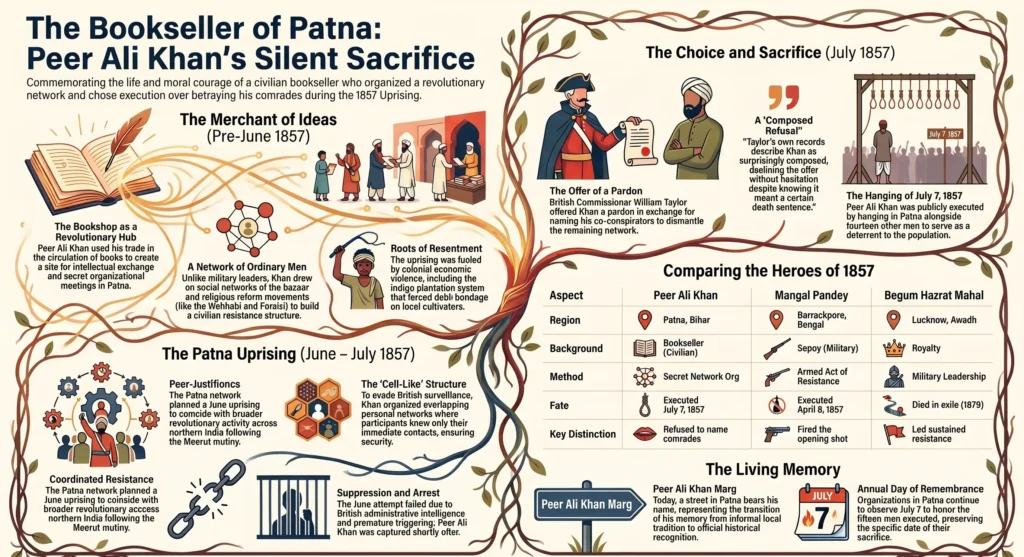
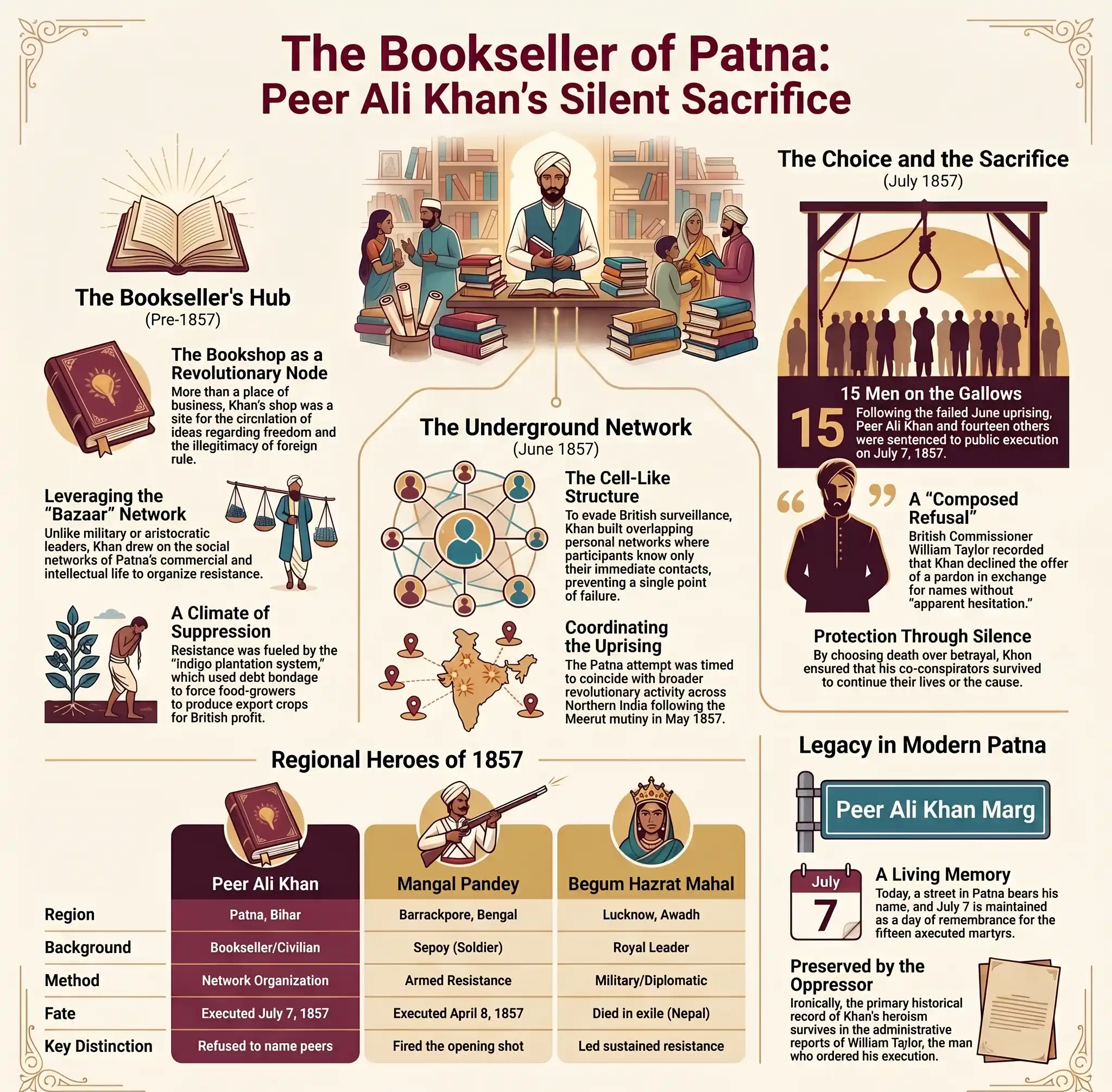
Peer Ali Khan himself was not primarily a religious revolutionary in the narrow sense. He was a man of the bazaar, of the bookselling trade, of the practical world of Patna’s commercial and intellectual life, and his organization of resistance drew on the specific social networks of that world as much as on the broader political currents of the era. The bookshop was a meeting place, a site of intellectual exchange, and a point of connection in a network that extended through the alleys and the neighborhoods of Patna to the surrounding districts of Bihar.
He read. He discussed. He organized. And when the moment came in 1857, he acted.
Patna in 1857 and the World That Produced the Uprising
The uprising of 1857 is most frequently narrated through its most dramatic theaters, the siege of Lucknow, the fall of Delhi, the massacre at Kanpur, the resistance of Jhansi. The Bihar dimension of the uprising, which was significant and which had its own specific character rooted in the particular social and political conditions of the region, receives considerably less attention than these more celebrated sites of conflict.
Bihar in the 1850s was a region under the full weight of British colonial economic extraction. The indigo plantation system, which forced cultivators to grow indigo for export rather than food for consumption under conditions of effective debt bondage, was a primary instrument of colonial economic violence in the region. The land revenue system imposed systematic pressure on agricultural communities whose already limited margins were further reduced by the demands of a colonial administration that had no interest in their welfare and every interest in their productive capacity.
The Muslim scholarly community of Patna, centered on the Madrasa institutions and the networks of the Wahhabi movement, had been under surveillance and periodic suppression by the British administration for decades, with several of the movement’s leaders having been arrested and tried for sedition in the years before 1857. This history of organized resistance and organized suppression gave the Patna Muslim community a more developed consciousness of the colonial situation and a more prepared organizational capacity for resistance than many other communities in Bihar possessed.
Peer Ali Khan operated within this environment and drew from it the specific contacts, the specific organizational resources, and the specific political consciousness that made it possible for him to build a revolutionary network capable of attempting a coordinated uprising in June 1857.
The network he built connected Patna to the broader uprising that was already unfolding elsewhere in northern India by the time the Bihar attempt was organized. The sepoy mutinies that had begun in Meerut in May 1857 and spread rapidly across the cantonment towns of northern India provided both the immediate trigger for organized civilian resistance and the context within which the Patna network understood its own actions as part of a larger movement toward the end of British rule.
The Organization of Resistance
The specific mechanics of how Peer Ali Khan organized the resistance network in Patna are not fully documented in the historical record, which was assembled primarily from the perspective of the British administration that suppressed the uprising and tried its participants. What the surviving records do allow is a partial reconstruction of the network’s character and extent.
The network was not a single unified organization with a clear hierarchy and a formal structure. It was, like most effective underground resistance movements in conditions of colonial surveillance, a set of overlapping personal networks connected by shared purpose and mutual trust, in which each participant knew their immediate contacts but not necessarily the full extent of the organization. This cell-like structure provided a degree of security against the kind of comprehensive exposure that a single point of failure could produce in a more formally structured organization.
Peer Ali Khan’s role in this network appears to have been that of a central connector, someone whose social position as a bookseller gave him legitimate reasons to maintain contact with a wide range of people across different sectors of Patna’s society, and whose personal relationships and organizational capacity allowed him to coordinate planning across the different nodes of the network.
The British administrative records of the period, particularly the reports of William Taylor, the Commissioner of Patna who conducted the investigation and trials following the suppression of the uprising attempt, describe Peer Ali Khan as one of the principal organizers of the planned revolt in Patna, attributing to him a central role in the planning of the June 1857 attempt.
The planned uprising in Patna was coordinated with the broader calendar of revolutionary activity across northern India, with the intention of creating simultaneous pressure on British authority across multiple cities and regions. The failure of the Patna attempt, which was suppressed before it could develop into the sustained resistance that its organizers intended, was the result of a combination of British administrative intelligence, the premature triggering of the attempt, and the organizational limitations that any clandestine movement operating under active surveillance inevitably faces.
The Arrest and the Offer
Peer Ali Khan was arrested in June 1857 following the failure of the Patna uprising attempt. The British administration’s response to the uprising across Bihar was swift, severe, and deliberately exemplary in its violence, intended to demonstrate to the population at large the consequences of resistance and to deter further organization.
The trials that followed the arrests were not designed to establish guilt or innocence in any conventional legal sense. The British administration operated under emergency provisions that suspended the normal processes of law and permitted summary proceedings. The outcome was not uncertain. The question before the authorities was not whether to punish the accused but how to use the punishment most effectively to serve the administrative purposes of suppression and deterrence.
Within this context, the offer made to Peer Ali Khan, a pardon in exchange for the names of his co-conspirators, was not a gesture of mercy. It was an administrative strategy, an attempt to use the threat of death to extract information that would allow the administration to extend its suppression more comprehensively across the network he had built.
The logic of the offer was clear and rational from the administration’s perspective. Peer Ali Khan knew who was in the network. He knew the names of the people who had trusted him with their participation in a project that had now failed and whose participants were at risk of exactly the fate that he himself was facing. The information he possessed was operationally valuable. His death was a message to others. His cooperation was worth more, from the administration’s perspective, than his death alone.
He refused. The record of his refusal, preserved in Taylor’s administrative reports, describes a man who understood perfectly what was being offered and what the refusal meant, and who declined without apparent hesitation.
The specifics of the conversation between Peer Ali Khan and the British authorities who offered him the pardon are not recorded in the kind of detail that would allow a full reconstruction of what was said and how. What is recorded is the outcome: he did not name anyone. He went to the gallows without having provided information that would have sent others there.
William Taylor and the Record of a Refusal
William Taylor, the Commissioner of Patna who administered the suppression of the 1857 uprising in Bihar and conducted the trials of the accused, is not a sympathetic figure in the history of the period. His administration of the post-uprising repression was marked by the kind of summary justice and deliberate exemplary violence that characterized British colonial responses to resistance across northern India in the second half of 1857.
But Taylor was also a careful administrator and a precise recorder, and the documents he produced during the trials and their aftermath constitute the primary surviving record of what happened in Patna during those months. It is through Taylor’s records that the outline of Peer Ali Khan’s story has been preserved, and it is in Taylor’s own account that the refusal that defines that story is documented.
Taylor’s account of Peer Ali Khan describes, with the specificity of someone recording a fact that surprised him, a man who maintained his composure throughout the proceedings against him and who declined to provide the information requested in terms that left no ambiguity about his decision. The refusal, in Taylor’s account, was not passionate or rhetorical. It was composed. It was the refusal of someone who had already decided what they would do and did not find the execution of that decision difficult, even under the conditions of a death sentence.
This quality of composed refusal is one of the most interesting features of the account. Revolutionary martyrs are often romanticized in the tradition of memory as figures of dramatic heroism, whose courage expresses itself in grand gestures and stirring speeches. What Taylor’s account records is something different and in some ways more demanding, the courage of a man who simply did what he had decided to do, without drama, under conditions where the cost of the decision was as clear and as immediate as it is possible for any cost to be.
The Hanging of July 7, 1857
Peer Ali Khan was executed by hanging on July 7, 1857, in Patna, along with fourteen other men who had been convicted in the summary proceedings following the June uprising attempt. The public execution was itself an administrative act designed to communicate a message to the population of Patna and the surrounding region about the consequences of resistance.
The fifteen men executed on July 7 were not the only people who paid with their lives for their participation in the 1857 uprising in Bihar. The broader repression that followed the suppression of the uprising across the region claimed lives through formal executions, summary killings, and the displacement and impoverishment of communities associated with resistance. The scale of the violence inflicted on the population of Bihar in the second half of 1857 has not been fully documented but was substantial.
Within this broader context of colonial violence and suppression, the execution of Peer Ali Khan and his fourteen companions was one moment in a sustained campaign of repression. What distinguishes it in the historical memory of the period is the specific quality of the choice that Peer Ali Khan made before his execution, the refusal that preserved the people who had trusted him at the cost of his own life.
The people he did not name survived, or at least did not face the specific consequences that his testimony would have brought to them. Whether they went on to continue the resistance, to build families, to live ordinary lives, or to find other ways of serving the cause that had brought them into Peer Ali Khan’s network, is not fully documented. What is documented is that they did not go to the gallows on July 7 along with the man who had chosen not to send them there.
The Memory That Patna Kept
Patna’s memory of Peer Ali Khan has been maintained across the century and a half since his execution through a combination of oral tradition, local historical scholarship, and the commemorative practices of the communities that have continued to regard his choice as exemplary.
The commemoration of Peer Ali Khan’s martyrdom is part of a broader pattern in which the 1857 uprising and its participants have been remembered differently in different parts of India, with regional traditions of memory preserving figures and events that the dominant nationalist narrative of the independence movement has not always centered. Bihar’s tradition of remembering its 1857 martyrs, including not only Peer Ali Khan but other figures of the Patna uprising, reflects the region’s specific historical consciousness of its contribution to the resistance against colonial rule.
The street in Patna that bears Peer Ali Khan’s name, and the commemorative recognition that various governments of Bihar have accorded to his memory, represent the formal dimension of a local memory that was maintained informally for decades before these official acknowledgments arrived. The bookseller of Patna, the man who organized a revolution in the alleys of a city that the larger narratives of 1857 have tended to overlook, has not been forgotten by the city he chose to protect.
The annual observance of July 7 as a day of remembrance for the fifteen men executed on that date in 1857 has been maintained by various organizations in Patna, keeping alive the specific date and the specific choice that the historical record has preserved.
Bihar’s 1857 in the Larger Narrative
The Bihar dimension of the 1857 uprising has received less historical attention than the most celebrated theaters of the conflict, partly because the Patna attempt failed before it could develop into the sustained resistance that characterized the sieges of Lucknow and Delhi, and partly because the dominant historiography of the uprising has tended to organize its narrative around the military theaters where the conflict was most prolonged and most visible.
The recent growth of regional and subaltern historical scholarship has begun to correct this imbalance, with historians working in Bihar and with Bihari sources producing more detailed accounts of the uprising’s local dimensions, including the specific role of figures like Peer Ali Khan in organizing resistance in a city that the major military narrative of 1857 has largely passed over.
The Indira Gandhi National Centre for the Arts has documented the regional dimensions of the 1857 uprising as part of its broader work on the cultural memory of the freedom movement, recognizing the importance of local and regional figures whose contributions have been obscured by the dominance of the most celebrated names and events in the standard historical account.
The scholarly work on the 1857 uprising produced by historians including Rudrangshu Mukherjee and others who have examined the Bihar dimension of the conflict has begun to give Peer Ali Khan and his contemporaries the historical context that their significance requires. The bookseller’s choice is more fully understood when the specific conditions of colonial Bihar in the 1850s, the economic violence of the indigo system, the surveillance of the Muslim scholarly community, the organizational infrastructure of the Wahhabi movement, are understood as the context within which that choice was made.
What the Choice Was Actually About
The choice that Peer Ali Khan made in the summer of 1857 was not primarily about himself. It was about the people who had trusted him. The revolutionary network he had built was a structure of mutual trust, in which each participant’s safety depended on the discretion of every other participant. The British offer of a pardon was an offer to purchase the destruction of that trust structure, to use one participant’s fear of death to expose every other participant to the same threat.
His refusal was therefore not simply a personal act of courage, though it was that. It was also the most important thing he could do for the people who had organized with him, the most direct form of protection available to him in the specific circumstances of his arrest and trial. By refusing to name them, he gave them whatever chance they had to survive the repression that followed the uprising’s failure.
The cost of this protection was his own life. The exchange was not ambiguous or complex. It was simple and direct and lethal. He understood what he was choosing. He made the choice anyway.
This is the specific quality of Peer Ali Khan’s act that makes it worth careful attention beyond the general category of revolutionary martyrdom. He was not simply dying for a cause. He was making a specific choice, in a specific moment, to protect specific people at a specific and known personal cost. The moral weight of that choice is the moral weight of genuine responsibility, the responsibility of someone who has asked others to trust them and who, when that trust is tested by the most extreme possible pressure, maintains it completely.
The Patna of today carries his name on a street. The bookshop is gone. The network he built has dissolved into the historical past. But the record of the choice he made on a summer day in 1857, preserved in the documents of the administration that killed him, remains as precise and as demanding as it was on the day it was made.
He was offered his life. He returned the offer. He went to the gallows with the names of his co-conspirators unspoken.
That is the whole of what he did. It is not a small thing.
Quick Comparison Table
| Aspect | Peer Ali Khan | Mangal Pandey | Begum Hazrat Mahal |
|---|---|---|---|
| Era | 1857 uprising | 1857 uprising | 1857 uprising |
| Region | Patna, Bihar | Barrackpore, Bengal | Lucknow, Awadh |
| Background | Bookseller, civilian organizer | Sepoy, 34th Bengal Native Infantry | Begum of Awadh, royal resistance leader |
| Method of Resistance | Civilian network organization, planned uprising | Individual act of armed resistance against British officers | Military and diplomatic leadership of Lucknow resistance |
| Captured | Yes, following failed uprising attempt | Yes, immediately following his act | No, escaped to Nepal after Lucknow fell |
| Executed | Yes, July 7, 1857, Patna | Yes, April 8, 1857, Barrackpore | Died in exile, Nepal, 1879 |
| Key Historical Distinction | Refusal to name co-conspirators under offer of pardon | Fired the opening shot of the 1857 uprising | Led the most sustained resistance in the most celebrated theater of the uprising |
| Historical Recognition | Largely local and regional | National, recognized as first martyr of 1857 | National, celebrated figure of Awadhi resistance |
Curious Indian: Fast Facts
- Peer Ali Khan ran a bookshop in Patna that served as both his livelihood and the social hub within which his revolutionary organizing took place, making him one of the very few 1857 figures whose resistance was organized not from a military or aristocratic position but from the commercial and intellectual world of the bazaar.
- The British Commissioner William Taylor, who conducted the trials following the suppression of the Patna uprising, recorded Peer Ali Khan’s refusal to name his co-conspirators in his administrative reports with a specificity that has preserved the account across more than one hundred and fifty years, making Taylor’s own documentation the primary historical source for the story of Peer Ali Khan’s choice.
- Peer Ali Khan was executed along with fourteen other men on July 7, 1857, in a public hanging designed by the British administration to serve as a deterrent message to the broader population of Patna and the surrounding region.
- The Patna uprising attempt of June 1857 was organized as part of the broader coordinated resistance that was unfolding across northern India following the sepoy mutinies that began in Meerut in May 1857, making Bihar’s resistance a regional dimension of a national uprising rather than an isolated local event.
- The Muslim scholarly community of Patna, which had been under British surveillance for decades because of its connection to the Wahhabi movement, provided part of the organizational infrastructure within which Peer Ali Khan built his revolutionary network, connecting his work to a longer tradition of organized resistance to British authority in the region.
- A street in Patna bears Peer Ali Khan’s name today, one of the few formal commemorative recognitions that the Bihari martyr has received from the governments that have succeeded the colonial administration that executed him.
- The Bihar dimension of the 1857 uprising, including the Patna attempt that Peer Ali Khan helped to organize, has received significantly less historical attention than the most celebrated theaters of the conflict, partly because the attempt failed before it could develop into sustained resistance and partly because the dominant historiography of 1857 has tended to organize around the military theaters where conflict was most prolonged.
- Peer Ali Khan’s choice to refuse the British offer of a pardon in exchange for naming his co-conspirators is one of the clearest documented examples in the 1857 historical record of the specific moral weight of genuine revolutionary commitment, in which the protection of the people who trusted the leader was maintained at the known and immediate cost of the leader’s own life.
- The commemoration of July 7 as a day of remembrance for the fifteen men executed on that date in 1857 has been maintained by organizations in Patna across the decades since independence, preserving the specific date and the specific choice in a form of living historical memory that official historical recognition has only partially replicated.
- Peer Ali Khan’s story belongs to the broader pattern of unsung heroes of the 1857 uprising whose contributions to the resistance against British colonial rule have been obscured by the dominance of the most celebrated military figures and events in the standard historical account of the period.
Conclusion
Peer Ali Khan did not survive 1857. He was not supposed to. The British administration that tried and executed him intended his death to be a message, and in one sense it was. It told the people of Patna that the consequences of organizing against British rule were lethal and immediate and public.
But the message that history has kept is not the one the British administration intended. The message that has survived is the one that Peer Ali Khan himself sent, silently and completely, by refusing to speak the names that would have saved his life and sent others to the gallows in his place.
He was a bookseller. He ran a shop in the alleys of Patna where ideas circulated and where the specific idea that the British had no right to rule India found the organizational expression that produced a network of resistance. He was not a soldier or an aristocrat or a figure of institutional power. He was a man of the bazaar who had concluded, from reading and from observation and from the specific conditions of colonial Bihar in the 1850s, that something needed to be done and that he was in a position to do it.
He organized. The attempt failed. He was captured. He was offered his life for the lives of others. He refused. He was hanged.
The simplicity of this sequence should not be mistaken for simplicity of character or simplicity of choice. The decision to refuse the offer, to accept death rather than purchase life at the cost of betraying the trust of the people who had organized with him, is one of the most demanding decisions that any human being can face. It requires not simply the willingness to die, which is one kind of courage, but the willingness to die for the specific purpose of protecting others from the same death, which is a different and more exacting kind.
Peer Ali Khan had it. He used it. He went to the gallows on July 7, 1857, with the names of his co-conspirators unspoken and the trust of the people who had organized with him intact.
Patna remembers him. The street carries his name. The date is observed. The historical record, preserved ironically in the documents of the administration that killed him, tells his story with a precision that the decades have not blurred.
He chose the gallows over betraying his city. That choice is his monument, and it does not require stone to stand.
If you think you have remembered everything about this topic take this QUIZ
Results


#1. What was Peer Ali Khan’s primary commercial profession in Patna before organizing the 1857 resistance?
#2. On which date was Peer Ali Khan executed by hanging alongside fourteen other men?
#3. Which local infrastructure or movement’s network did Peer Ali Khan draw upon to help build his revolutionary organization?
#4. Who was the British Commissioner of Patna who investigated the uprising attempt and recorded Peer Ali Khan’s composed refusal?
#5. What specific offer did the British authorities make to Peer Ali Khan that he steadfastly refused?
#6. Why does the Bihar dimension of the 1857 uprising receive less historical attention in standard military narratives?
#7. Which instrument of colonial economic violence caused systematic pressure on the agricultural communities of Bihar in the 1850s?
#8. How is the legacy of Peer Ali Khan formally commemorated in the city of Patna today?
Who was Peer Ali Khan and what was his role in the 1857 uprising?
Peer Ali Khan was a bookseller in Patna, Bihar, who organized a network of anti-British resistance in the city and surrounding districts in the months leading to the June 1857 uprising attempt. He connected the broader revolutionary current of the 1857 uprising to the specific social and organizational networks of Patna’s commercial and scholarly world, building a coordinated resistance structure that drew on the organizational infrastructure of the Muslim reform movements that had deep roots in the Bihar region. He was among the principal organizers of the Patna uprising attempt and is remembered as one of the first martyrs of the 1857 uprising in Bihar.
Why did Peer Ali Khan refuse to name his co-conspirators?
The refusal is not explained in the surviving historical record beyond the fact of the refusal itself, which is documented in the administrative reports of William Taylor, the British Commissioner of Patna. The most straightforward interpretation is that Peer Ali Khan understood the revolutionary network he had built as a structure of mutual trust in which his silence was the most important protection available to him for the people who had trusted him. To name them would have been to use one person’s fear of death to expose every other participant to the same threat. His refusal maintained that trust completely, at the known and immediate cost of his own life.
What was the significance of Peer Ali Khan being a bookseller?
His profession as a bookseller gave him a social position that made it possible to maintain wide-ranging contacts across different sectors of Patna’s society without arousing immediate suspicion, and his shop served as both the commercial hub of his livelihood and the intellectual and organizational center of the network he built. The circulation of ideas, which is the specific business of a bookselling trade, was directly relevant to the revolutionary organizing that Peer Ali Khan conducted, and the connections the trade gave him were part of the organizational resource that made the Patna network possible.
How is Peer Ali Khan remembered in Patna today?
A street in Patna bears his name, representing the formal commemorative recognition that his martyrdom has received from the governments that have succeeded the colonial administration that executed him. The annual observance of July 7 as a day of remembrance for the fifteen men executed on that date in 1857 has been maintained by organizations in the city, preserving both the specific date and the specific quality of the choice that defines his historical significance. His story has also been preserved through local historical scholarship and through the oral tradition of the communities that have maintained his memory across the generations since 1857.
Why has Peer Ali Khan received less historical recognition than other 1857 figures?
Several factors have contributed to the relative historical obscurity of Peer Ali Khan compared to the most celebrated figures of the 1857 uprising. The Patna uprising attempt failed before it could develop into the sustained resistance that characterized the most famous theaters of the conflict, reducing its visibility in the standard military narrative of the uprising. Bihar’s contribution to 1857 has generally received less historical attention than the Awadh, Delhi, and Bengal dimensions of the conflict. And Peer Ali Khan’s background as a civilian organizer rather than a military figure or an aristocratic leader places him outside the categories of historical recognition that the dominant historiography of the period has tended to emphasize. The growth of regional and subaltern historical scholarship has begun to address this imbalance.