Wednesday, May 20, 2026
36 °c
Boydton
Curious Indian
  • Arts & Culture
  • Festivals of India
  • Indian History
  • Indian Politics
  • Biography
    • Entertainment Personalities
    • Science Personalities
  • Unsolved India
No Result
View All Result
  • Arts & Culture
  • Festivals of India
  • Indian History
  • Indian Politics
  • Biography
    • Entertainment Personalities
    • Science Personalities
  • Unsolved India
No Result
View All Result
Curious Indian
No Result
View All Result
Home Arts & Culture Architecture

Vitthala Temple Musical Pillars When Stone Becomes Music

paripurnadatta by paripurnadatta
in Architecture, Arts & Culture, Indian History, Medieval India
Reading Time: 9 mins read
0 0
A A
Vitthala temple

Vitthala temple

Share on FacebookShare on Twitter

Table of Contents

Toggle
  • The Musical Pillars of Vitthala Temple and the Sound of Hampi
  • How the Pillars Were Made to Sing
  • The Science Behind the Sound
  • Stories and Legends Around the Pillars
  • Why These Pillars Still Matter Today
  • Hampi as a World Heritage Site
  • Quick Comparison Table
  • Curious Indian: Fast Facts
  • Conclusion
  • If you think you have remembered everything about this topic take this QUIZ
  • Results
    • #1. How many musical pillars are scattered across the Ranga Mantapa and other halls of the Vitthala temple?
    • #2. Which empire was responsible for the construction of the Vitthala temple during the 15th and 16th centuries?
    • #3. . What is the common nickname for these pillars because they produce the seven notes of the Indian musical scale?
    • #4. According to the text, what is the primary material used to construct the musical pillars?
    • #5. What internal structural feature allows the pillars to resonate when they are struck?
    • #6. In which year was the group of monuments at Hampi declared a UNESCO World Heritage Site?
    • #7. Besides the musical pillars, which other iconic structure is the Vitthala temple complex famous for?
    • #8. Why have some of the pillars lost their resonance over time?
    • How many musical pillars are there in the Vitthala temple?
    • Do the musical pillars still produce sound today?
    • Were the pillars really used in temple music performances?
    • Can visitors hear the music themselves?
    • Why is Hampi a UNESCO World Heritage Site?
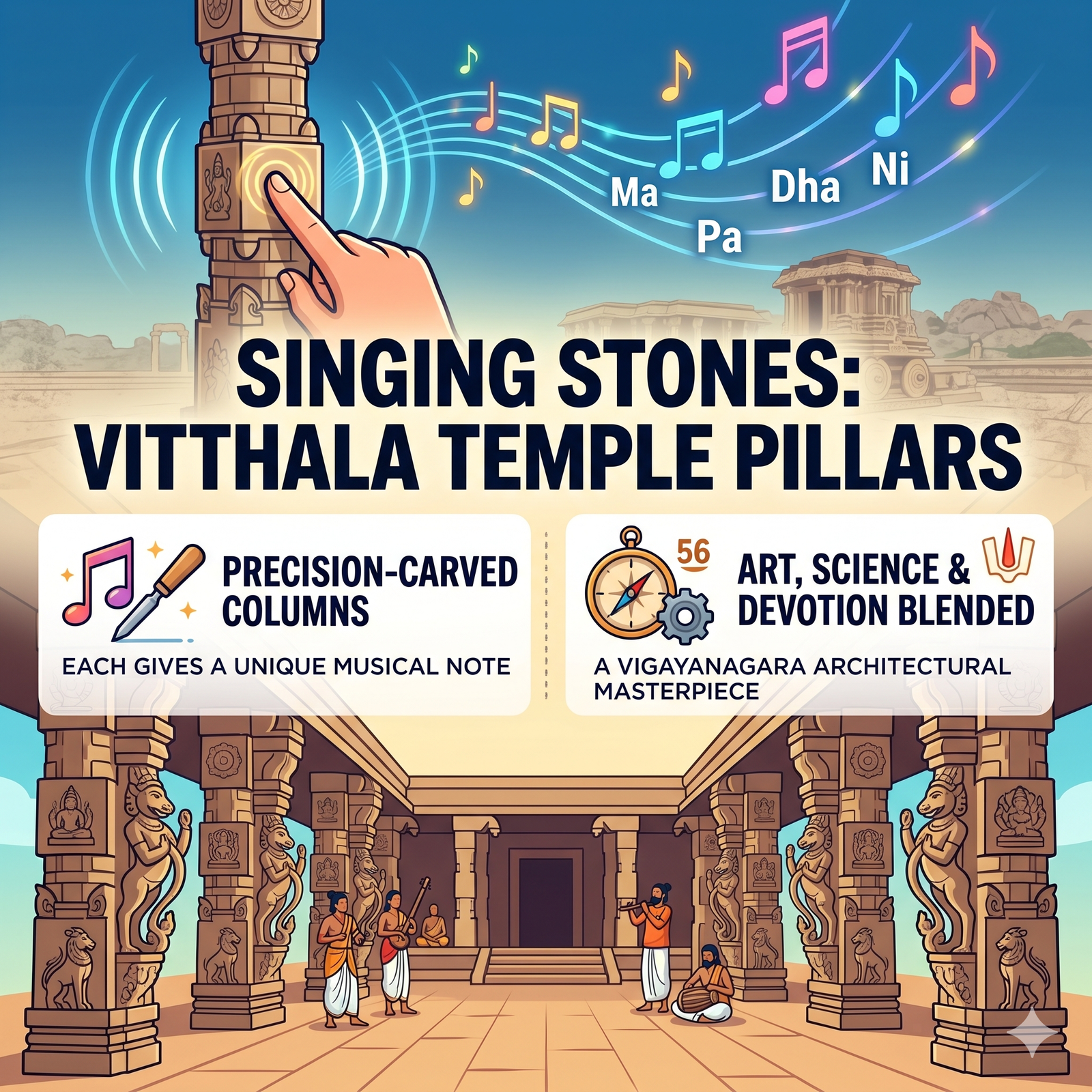
The musical pillars of Vitthala temple are one of the most enchanting features of Hampi’s vast temple complex. Scattered across the Ranga Mantapa and other halls, these 56 pillars were carved with such precision that each produces a different musical note when tapped. They represent the Vijayanagara Empire’s fascination with blending art, science and devotion. More than a curiosity for tourists, these pillars reveal how architecture in medieval India could be both functional and deeply expressive, turning stone into an instrument that still surprises visitors today.
DetailInformation
SubjectMusical pillars of Vitthala temple
LocationHampi, Karnataka, India
TempleVitthala Temple
DynastyVijayanagara Empire
Period15th–16th century CE
Feature56 carved stone pillars producing musical notes
Type of PillarsSaReGaMa pillars (musical columns)
MaterialStone (granite)
UNESCO StatusPart of Hampi World Heritage Site
Notable HallRanga Mantapa / main pillared halls
Vitthala temple

The Musical Pillars of Vitthala Temple and the Sound of Hampi

Walking through the Vitthala temple complex in Hampi, the scale of the place can feel overwhelming. The grand chariot, the sprawling courtyards, the carved gateways all compete for your attention. But then you step into one of the pillared halls and something smaller, quieter, pulls you in.

READ MORE:  The Demolition of Babri Masjid 1992

You notice a row of stone columns. Some are plain. Some are richly carved with mythical figures and floral patterns. And then someone taps one of them lightly with their fingers. A clear, ringing tone emerges. Another pillar gives a different note. Another hums like a bell. This is not a trick of the wind or an echo in the stone. These are the musical pillars of Vitthala temple.

How the Pillars Were Made to Sing

The Vitthala temple was built during the 15th and 16th centuries under the Vijayanagara Empire, a period when Hampi was one of the richest and most cosmopolitan cities in the world. The rulers of this empire were not only patrons of temples but also great builders who experimented with form, acoustics and artistic expression.

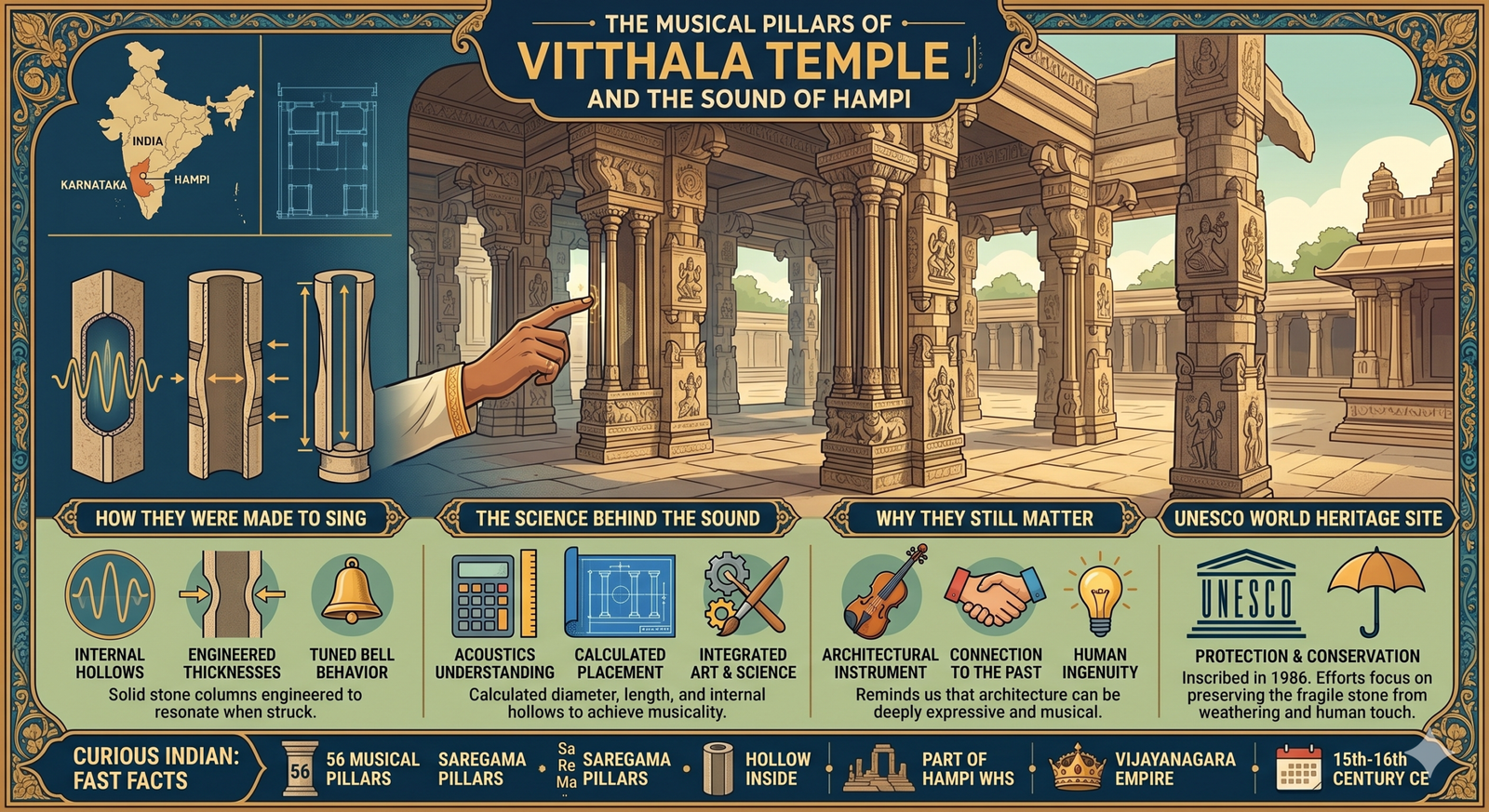
The musical pillars, often called the SaReGaMa pillars because they produce the seven notes of the Indian musical scale, are hollowed inside in such a way that they resonate when struck. The outer surface is carved stone, but the internal structure is engineered to vibrate at specific frequencies. Historians and archaeologists believe that different sections of the pillar were designed with varying thicknesses and hollows to generate distinct pitches.

It is important to understand that these are not pipes or modern instruments. They are solid stone columns that have been cleverly crafted to behave like tuned bells. When you tap them, you hear notes corresponding to the swaras of Carnatic music. Some pillars still produce clear tones, while others have lost their resonance due to centuries of weathering and human touch.

Sarnath Buddha Sculpture: Where Mathematics Meets Divine

The Science Behind the Sound

While the Vijayanagara artisans did not have electronic measuring tools, they possessed an extraordinary understanding of acoustics through experience and tradition. The placement of the pillars, their diameter, length and internal hollows were all calculated to achieve musicality. This is an example of how Indian temple architecture often integrated science with spirituality. The same precision that went into carving gods and goddesses also went into making stone sing.

Scholars studying Hampi’s monuments note that the musical pillars are part of a larger tradition of experimental architecture in South India. Temples were not only places of worship but also laboratories of sound, light and geometry. The resonance of these pillars would have complemented rituals, chants and the overall sensory atmosphere of the temple.

READ MORE:  Surgical Precision in Ancient Kashi: The Vision of Sushruta

Stories and Legends Around the Pillars

Local guides and pilgrims often share stories about the musical pillars. Some say the pillars were tested by musicians of the royal court who verified that each column indeed matched a particular note. Others speak of the sound being used during temple ceremonies to accompany devotional songs. While these stories may blend fact and folklore, they reflect the deep cultural memory that surrounds the site.

What is certain is that the Vijayanagara rulers took pride in showcasing such innovations. Hampi was a city of engineers, sculptors, poets and musicians. The Vitthala temple complex, with its iconic stone chariot and musical pillars, became a symbol of that creative energy.

Why These Pillars Still Matter Today

In a world where concert halls are built with acoustic panels and digital sound systems, the musical pillars of Vitthala temple remind us that architecture itself can be an instrument. They challenge us to think differently about stone not as inert matter but as something that can carry vibration, memory and beauty across centuries.

Unakoti Tripura: Jungle Sanctuary With a Million Stone Faces

For visitors today, tapping a pillar and hearing its tone is a small, intimate moment of connection with the past. It is a direct link to artisans who lived 500 years ago and who solved a problem that was both artistic and acoustic: how to make stone sing.

Hampi as a World Heritage Site

The entire group of monuments at Hampi, including the Vitthala temple, was declared a UNESCO World Heritage Site in 1986. This recognition helps protect these fragile structures from further damage while allowing millions of people to experience their wonder. Conservation efforts continue, especially because the stone has suffered from weathering, pollution and the heavy footsteps of countless visitors.

Quick Comparison Table

FeatureMusical Pillars of Vitthala TempleKonark Sun Temple WheelsMeenakshi Temple GopuramsBrihadeeswarar Temple Vimana
LocationHampi, KarnatakaOdishaMadurai, Tamil NaduThanjavur, Tamil Nadu
Main Artistic FeatureStone pillars producing musical notesGiant stone chariot wheelsTowering colorful gopuramsMassive granite vimana
MaterialGraniteKhondalite stoneGraniteGranite
Period15th–16th century CE13th century CE17th century CE11th century CE
Acoustic/Functional AspectTuned musical columnsDecorative wheels, symbolicSculptural storytellingStructural and symbolic
UNESCO StatusHampi WHSWHSNot listedWHS (part of group)

Curious Indian: Fast Facts

  • The Vitthala temple complex has about 56 pillars that are said to produce musical notes when tapped.
  • Each pillar generates a different pitch, corresponding roughly to the seven swaras of Indian classical music.
  • The pillars are hollow inside, allowing them to resonate like tuned stone tubes.
  • The Vitthala temple is famous not only for its music pillars but also for its iconic stone chariot.
  • Hampi was the capital of the Vijayanagara Empire, one of the largest and most prosperous kingdoms in medieval India.
  • The entire Hampi site covers over 4,100 hectares and contains hundreds of monuments.
  • UNESCO inscribed Hampi as a World Heritage Site in 1986 for its exceptional testimony to a rich civilization.
  • Many of the musical pillars are now protected and visitors are asked to tap them gently to preserve their condition.
READ MORE:  How Madam Bhikaiji Cama Unfurled India's Flag in Germany

Conclusion

The musical pillars of Vitthala temple are a small miracle hidden in plain sight. They do not shout for attention like the towering gopurams or the massive chariot. They wait quietly in the shade of history, ready to respond to the lightest touch. In that moment of sound, you realize that the Vijayanagara builders were not just craftsmen. They were musicians in stone, architects who knew that beauty could be heard as well as seen.

These pillars remind us that Indian temple architecture was never only about religion. It was about experience. It was about creating spaces where art, science, devotion and playfulness came together. A pillar that sings is a symbol of that human impulse to turn the ordinary into something magical.

Today, as we walk carefully around these fragile columns, we become temporary custodians of a sound tradition that has survived five centuries. The music is faint now, but it is still there, waiting for a curious finger to bring it back to life.

If you think you have remembered everything about this topic take this QUIZ


Results

Share your score!
Tweet your score!
Tweet your score!
Share to other
QUIZ START

#1. How many musical pillars are scattered across the Ranga Mantapa and other halls of the Vitthala temple?

Previous
Next

#2. Which empire was responsible for the construction of the Vitthala temple during the 15th and 16th centuries?

Previous
Next

#3. . What is the common nickname for these pillars because they produce the seven notes of the Indian musical scale?

Previous
Next

#4. According to the text, what is the primary material used to construct the musical pillars?

Previous
Next

#5. What internal structural feature allows the pillars to resonate when they are struck?

Previous
Next

#6. In which year was the group of monuments at Hampi declared a UNESCO World Heritage Site?

Previous
Next

#7. Besides the musical pillars, which other iconic structure is the Vitthala temple complex famous for?

Previous
Next

#8. Why have some of the pillars lost their resonance over time?

Previous
Finish

How many musical pillars are there in the Vitthala temple?

The Vitthala temple complex contains several halls with pillars, but the most famous musical pillars are located in the main pillared mantapas. Traditionally it is said there are about 56 pillars that can produce musical tones when tapped.

Do the musical pillars still produce sound today?

Some pillars still produce clear musical notes, while others have deteriorated due to age, weathering and frequent touching by visitors. Conservation authorities advise visitors to tap gently to preserve the pillars.


Were the pillars really used in temple music performances?

There is no definitive historical record that these pillars were regularly used as musical instruments during rituals. However, they were likely demonstrated to royal guests or used as an acoustic curiosity that showcased the empire’s artistic and scientific achievements.

Can visitors hear the music themselves?

Yes, visitors can try tapping the pillars with their fingers to hear the tones. It is a popular activity at Hampi and one of the most memorable experiences of the site.

Why is Hampi a UNESCO World Heritage Site?

Hampi was inscribed because it is an outstanding example of a prosperous medieval trading city, with a rich architecture including temples, forts, markets and water structures that illustrate the glory of the Vijayanagara Empire.

Tags: Acoustic stoneCategory SelectionHampiIndian ArchitectureKarnataka heritageMusical pillarsVijayanagara EmpireVitthala temple
ShareTweetPin
paripurnadatta

paripurnadatta

Related Posts

Khudiram Bose
Biography

The Final Letters of Khudiram Bose and Soul of Young Bengal

May 19, 2026
Bhikaiji Cama
Biography

How Madam Bhikaiji Cama Unfurled India’s Flag in Germany

May 19, 2026
Matangini Hazra
Biography

Matangini Hazra: The Widow Who Walked Into Gunfire

May 19, 2026
No Result
View All Result

Stay Updated

  • Trending
  • Latest
Life of Mahavira: From Prince Vardhamana to Great Conqueror

Life of Mahavira: From Prince Vardhamana to Great Conqueror

April 11, 2026
Life of Buddha: The Journey to Enlightenment

Life of Buddha: The Journey to Enlightenment

April 11, 2026
Christmas in India

Christmas in India: A Festive Blend of Faith, Flavors, and Tradition

April 11, 2026
From Shimla to Stardom: The Complete Biography of Anupam Kher

From Shimla to Stardom: The Complete Biography of Anupam Kher

April 11, 2026
Khudiram Bose

The Final Letters of Khudiram Bose and Soul of Young Bengal

May 19, 2026
Bhikaiji Cama

How Madam Bhikaiji Cama Unfurled India’s Flag in Germany

May 19, 2026
Matangini Hazra

Matangini Hazra: The Widow Who Walked Into Gunfire

May 19, 2026
Gommateshwara statue

Gommateshwara Statue and the Philosophy of Inner Peace

May 19, 2026

Widget Title

Facebook Twitter Youtube RSS
Curious Indian Logo

Explore the soul of Bharat with Curious Indian. A definitive guide to Indian history, arts, culture, biographies, and the events that defined our future.

Follow us on social media:

Recent News

  • The Final Letters of Khudiram Bose and Soul of Young Bengal
  • How Madam Bhikaiji Cama Unfurled India’s Flag in Germany
  • Matangini Hazra: The Widow Who Walked Into Gunfire

Category

  • Ancient Civilizations & The Vedic Age
  • Architecture
  • Artists & Cultural Icons
  • Arts & Culture
  • Battles of India
  • Biography
  • Business & Industrialists
  • Colonial India
  • Cultural Insights
  • Dance & Music
  • Entertainment Personalities
  • Festivals of India
  • Freedom Fighters
  • Freedom Movement
  • Historical Events & Turning Points
  • Indian History
  • Indian Politics
  • Major Festivals
  • Medieval India
  • North East India
  • Paintings & Visual Arts
  • Political Leaders
  • Post-Independence India
  • Regional Culture
  • Religious & Spiritual Figures
  • Science Personalities
  • Scientific Discoveries
  • Sculpture
  • Social Issues
  • SOCIETY & MYSTERIES
  • Strange & Unknown Stories
  • Textiles & Handicrafts
  • Uncategorized
  • Unsolved India
  • Unsung Heroes

© 2026 Curious Indian- Everything about India

Welcome Back!

Login to your account below

Forgotten Password?

Retrieve your password

Please enter your username or email address to reset your password.

Log In

Add New Playlist

No Result
View All Result
  • Arts & Culture
  • Festivals of India
  • Indian History
  • Indian Politics
  • Biography
    • Entertainment Personalities
    • Science Personalities

© 2026 Curious Indian- Everything about India

This website uses cookies. By continuing to use this website you are giving consent to cookies being used. Visit our Privacy and Cookie Policy.
Are you sure want to unlock this post?
Unlock left : 0
Are you sure want to cancel subscription?
×