Situated in the northeastern corner of Andhra Pradesh, Srikakulam district is a vibrant blend of ancient history, rich cultural traditions, and stunning natural landscapes.
In the greenest corner of Srikakulam, kidneys have been failing for thirty years and nobody can say why
The northern edge of Srikakulam district is the part a visitor would call beautiful.
Salihundam Stupam, Srikakulam district, Andhra Pradesh 31.jpg Related to article: Uddanam Means Garden · Source: Wikimedia Commons · రహ్మానుద్దీన్ · CC BY-SA 4.0
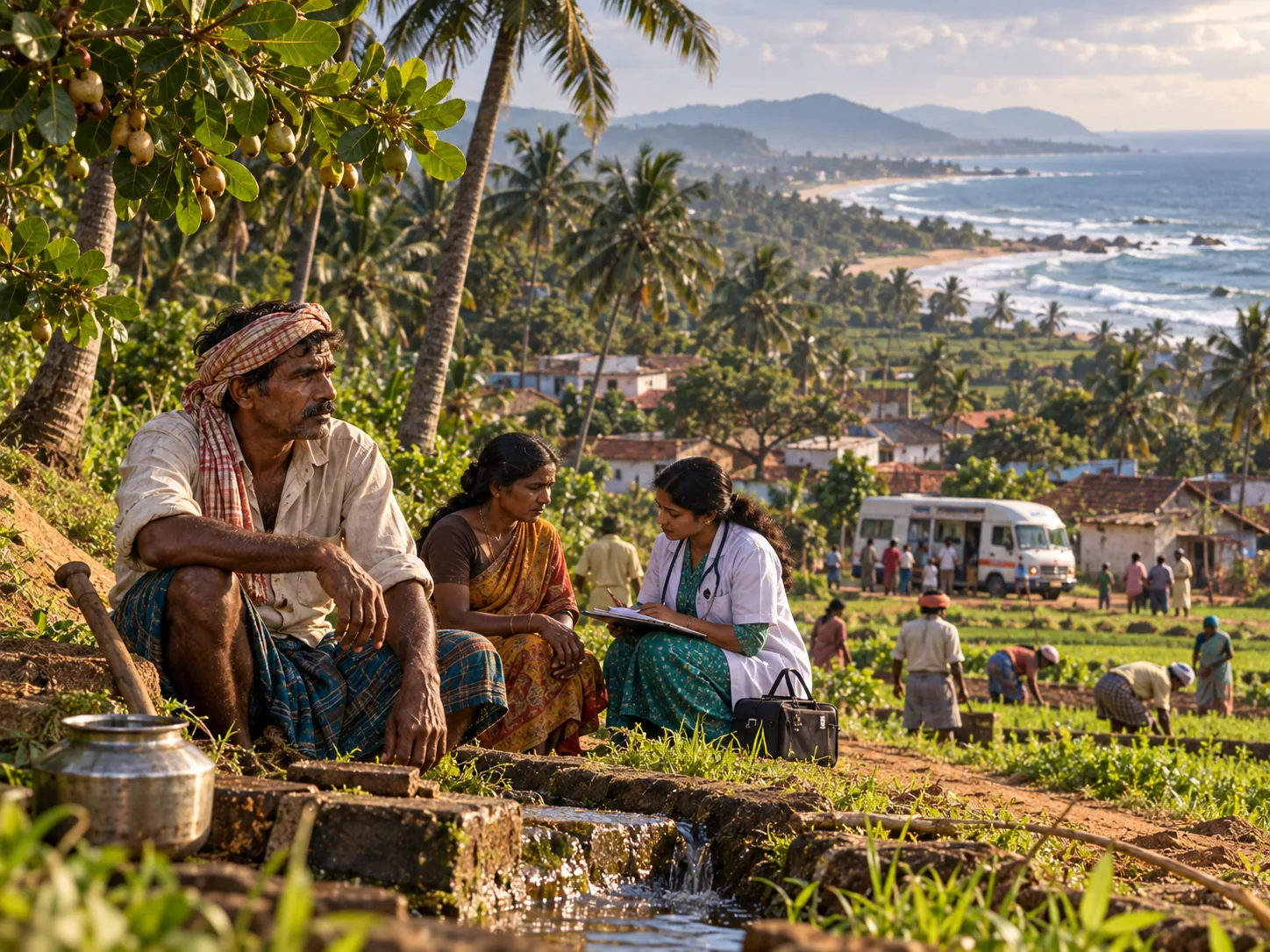
It is called Uddanam, which means garden, and it earns the name. Coconut and cashew plantations run almost to the sea, the water table sits close to the surface, the rain is reliable and the whole belt stays green through months when the rest of coastal Andhra has gone brown. About a hundred villages sit in it, across Ichchapuram, Kaviti, Kanchili, Mandasa, Palasa, Sompeta and Vajrapukotturu.
Since the 1990s it has also been the place in India where people’s kidneys fail for no reason anyone has been able to establish.
IIIT Srikakulam Campus 2.jpg Related to article: Uddanam Means Garden · Source: Wikimedia Commons · EnrichIndegi · CC BY-SA 4.0
What makes it strange
Chronic kidney disease is common and usually explicable.
In most patients it follows diabetes or years of high blood pressure, and a doctor can point to the cause. In Uddanam a large share of patients have neither. They are farmers and farm labourers, often young, often with no other illness, and their kidneys are failing anyway. The label the field uses for this is CKDu, chronic kidney disease of unknown aetiology.
The numbers are contested and all of them are bad. One published survey of villages in the district put chronic kidney disease prevalence at about thirty-two per cent. A state medical official said in November 2025 that roughly eighteen per cent of Uddanam’s population was affected. Government estimates have put deaths at around five thousand over a decade.
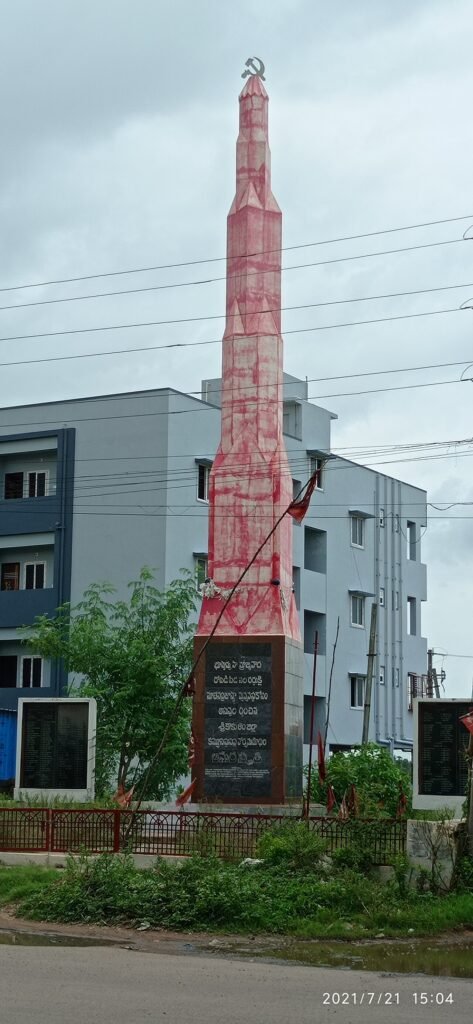
Srikakulam communist viplavodyamayodhula amarasmuthi.jpg Related to article: Uddanam Means Garden · Source: Wikimedia Commons · K.Venkataramana · CC BY-SA 4.0
The World Health Organization has described it as the least understood and least publicised nephropathy of unknown origin in the world.
Thirty years of investigation have produced a list of suspects and no conviction.
Salihundam archaeological site, artwork at the Museum, Andhra Pradesh – 1.jpg Related to article: Uddanam Means Garden · Source: Wikimedia Commons · G.N. Subrahmanyam · CC0
Groundwater is the oldest suspicion. A 2011 study reported high phenol and mercury levels. A larger survey of forty Uddanam villages, sampled through 2018 and 2019, found about a third of them with acidic groundwater, along with raised silica in the wet season and raised lead in the dry one. None of that is good water. None of it has been shown to be the cause.
The other candidates are heat and work. Field labour in that belt means long days in high humidity with repeated dehydration, which is hard on kidneys over years. Agrochemicals are on the list. So is genetic susceptibility. The likeliest answer is that several of these things are happening at once, which is also the hardest kind of answer to prove.
The most useful clue is that Uddanam is not unique.
The same pattern has been documented in the North Central Province of Sri Lanka, and among sugarcane cutters on the Pacific coast of Central America, where it is called Mesoamerican nephropathy. Different countries, different crops, no shared water supply.
What the three have in common is the shape of the people getting sick: manual agricultural workers, in hot places, who are poor. That is starting to look less like a local water problem and more like a disease of a particular kind of labour.
What has been done
Attention arrived late and mostly through politics.
Free dialysis and financial assistance for patients came after public pressure in 2016 and 2017. In 2023 the state opened a two-hundred-bed kidney research and super-speciality hospital at Palasa, built at a cost of about eighty-five crore rupees, and a seven-hundred-crore scheme to pipe treated water to 807 villages.
Outside expertise came too. A renal team from Harvard Medical School visited the affected mandals in 2016, and the pattern had already been put in front of the International Congress of Nephrology three years before that.
In November 2025 the Indian Council of Medical Research approved a three-year study, budgeted at about six crore rupees, which will test not only blood and urine but soil, air, water, rice, fish and vegetables across the affected mandals. It is the most serious attempt yet to name the cause.
Both things are true
None of this cancels the rest of the district.
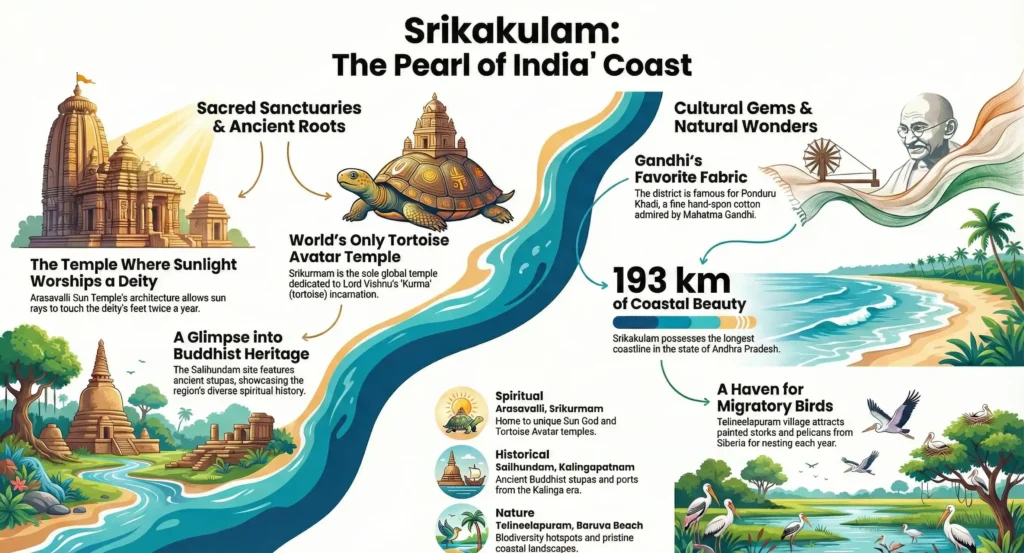
The sun temple at Arasavalli is genuinely rare, Srikurmam is genuinely the only Kurma temple of its kind, the khadi from Ponduru was genuinely the finest Gandhi could find, and the storks really do come from Siberia. A place is allowed to be more than one thing at once.
But a district guide that lists the storks and leaves out the dialysis chairs is not a guide to Srikakulam. It is a guide to the parts of Srikakulam that photograph well.
The Nagavali and Vamsadhara are the major rivers flowing through the district.
How do I reach Srikakulam?
The district headquarters is well-connected by National Highway 16 and the Srikakulam Road Railway Station (Amadalavalasa). The nearest airport is in Visakhapatnam.
What is the best time to visit Srikakulam?
The best time to visit is during the winter months, from November to February, when the weather is pleasant.
Are there Buddhist sites in Srikakulam?
Yes, Salihundam is a prominent ancient Buddhist site located on a hillock near the Vamsadhara River.
Sources & References
Indian Council of Medical Research — the three-year Uddanam study approved in November 2025 and its sampling protocol.
Renal Failure, “Occupational risk factors for chronic kidney disease in Andhra Pradesh: Uddanam Nephropathy” (2020) — prevalence and the occupational profile of patients.
Groundwater for Sustainable Development — the assessment of groundwater quality across forty Uddanam villages, sampled 2018 to 2019.
Government of Andhra Pradesh — the kidney hospital at Palasa and the piped water scheme for the affected mandals.