A physicist stuck in India by a war he had not planned for sat down and asked a trust for money
He came home in September 1939 for a holiday.
Homi Bhabha was twenty-nine, a Cambridge theoretician with twenty papers behind him and a reputation already made in cosmic ray physics. Then the war began and there was no way back, and he took a post at the Indian Institute of Science in Bangalore under C.V. Raman, which was meant to be temporary.
He spent five years there looking at what India had, which was a handful of good men in poorly equipped rooms and no institution capable of holding them.
The conversation and the letter
At some point he complained about exactly this to J.R.D. Tata, who told him to stop complaining and write to Sir Sorab Saklatvala, the chairman of the Sir Dorabji Tata Trust, and said he would back the proposal.
The letter is dated 12 March 1944. It asks for money to build a school of research in fundamental physics, and it makes an argument that nobody else in India was making at the time.
Not that physics is noble, or that a nation needs prestige. The argument is about timing. Nuclear energy will become usable for power in a couple of decades, he says, and when it does India should not have to look abroad for its experts, but should have them already to hand.
He wrote that more than a year before Hiroshima, at a point when the only working reactor on earth was under a squash court in Chicago.
120 Brave Hearts: The Battle of Rezang La 1962
7 Incredible Stories from the Battle of Zojila 1948
Being straight about how it got read
It is worth saying how a letter like that gets opened. Bhabha’s aunt Meherbai was married to Sir Dorabji Tata. He was a Parsi of the Bombay elite writing to his own family’s trust, with the chairman of the group already on side.
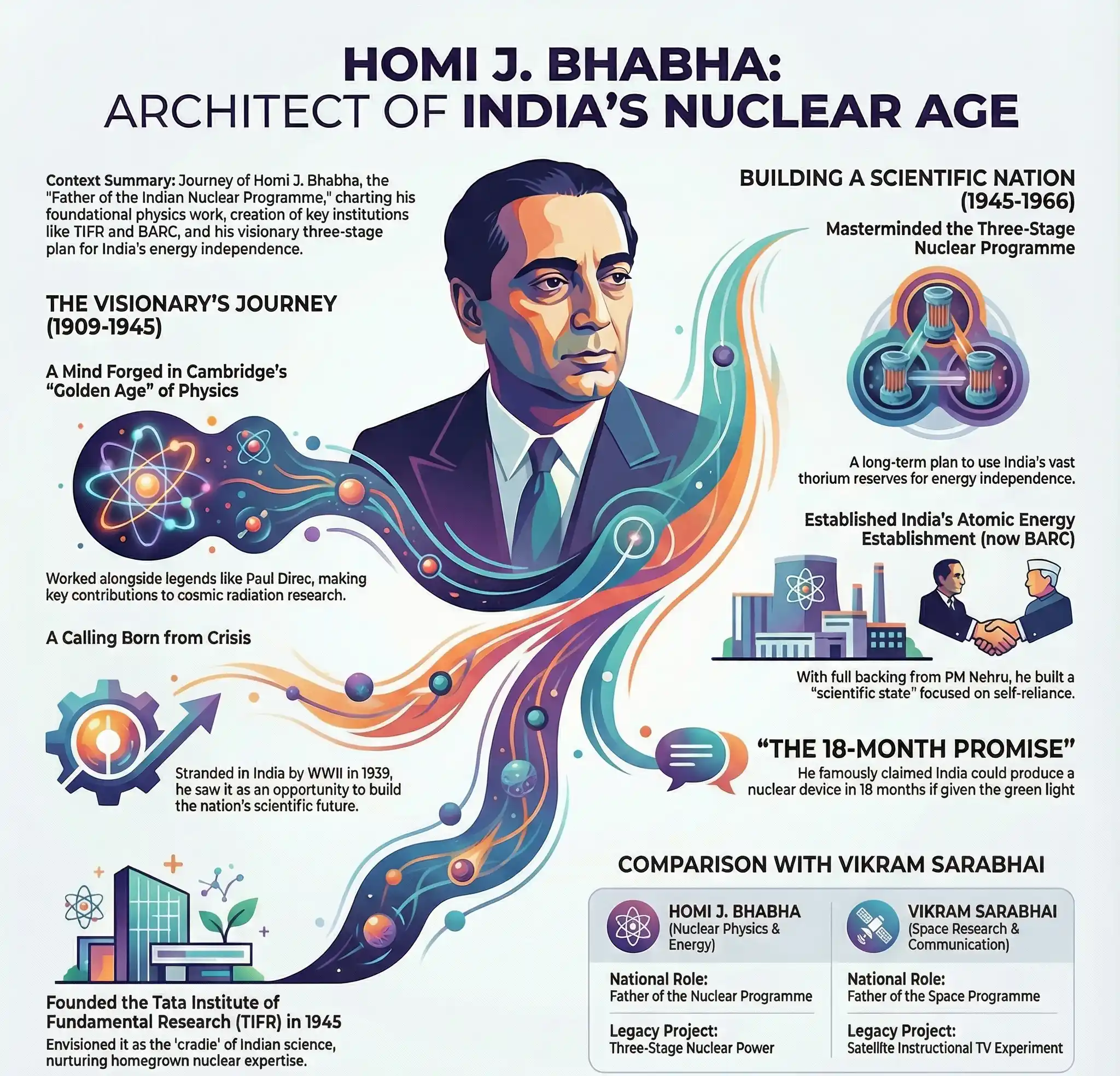
That is how it reached the top of the pile. What was in it is why it was answered. The Trust agreed, and the Tata Institute of Fundamental Research began on 1 June 1945, inside the cosmic ray unit at Bangalore, before moving to Bombay.
What grew out of it
The Atomic Energy Commission followed in 1948, eight months after independence, on a note Bhabha sent to Nehru. The establishment at Trombay came in 1954 and was renamed after him in 1967. Apsara went critical in 1956, the first research reactor in Asia.
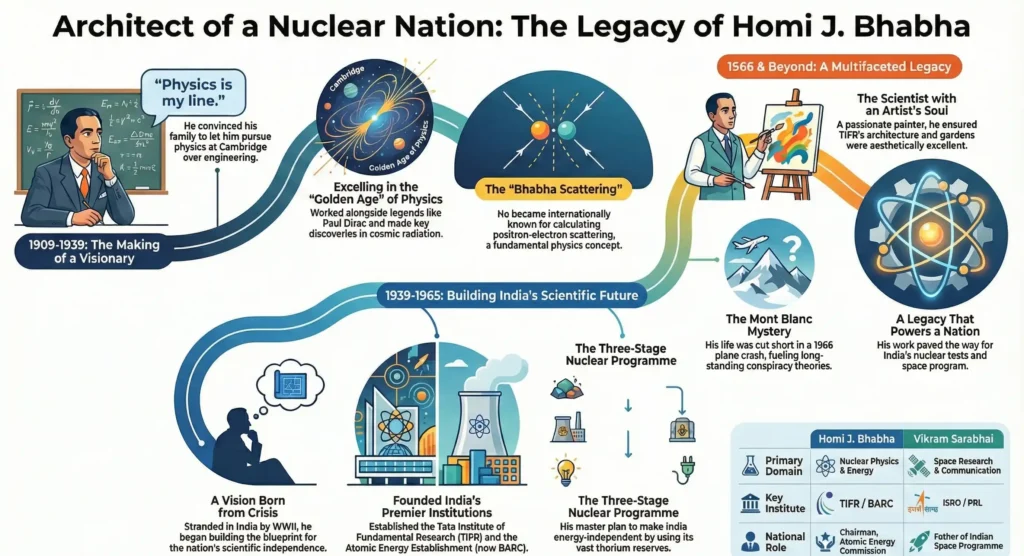
The design of the whole programme came from a piece of plain arithmetic about the ground under his feet. India has very little uranium and one of the world’s largest reserves of thorium, so he laid out a three-stage sequence that would end with thorium doing the work. India is still pursuing it, still not finished, sixty years on.
The space programme came out of the same soil. Vikram Sarabhai, who took over the Atomic Energy Commission after Bhabha died, had begun with the department’s backing.
Battle of Shalateng 1947: How Srinagar Was Saved
The man who wanted to paint
His father sent him to Cambridge to do engineering because the family had a place waiting for him in the Tata steel works. He wrote home asking to be allowed to do physics instead, and got his way on the condition that he passed the engineering tripos first.
He painted all his life and kept the eye. When he built TIFR at Colaba he interfered in the architecture, argued about the site, and then hung the corridors with Indian modern art bought when almost nobody was buying it, from Husain, Souza, Gaitonde and the others.
The country’s nuclear laboratory has one of its best collections of modern painting on the walls because the man who built it had wanted a different life.
24 January 1966
Air India Flight 101 went into the side of Mont Blanc on approach to Geneva. All hundred and seventeen people aboard were killed, Bhabha among them. He was fifty-six. Lal Bahadur Shastri had died at Tashkent thirteen days earlier.
The inquiry found a misunderstanding between the crew and Geneva control about the aircraft’s position relative to the mountain. An Air India aircraft had hit the same massif in 1950.
Claims that the crash was arranged, usually pointing at the CIA and India’s nuclear programme, have circulated for decades. They rest mainly on an unnamed source quoted in a book published in 2008, and no evidence has ever been produced for them. It is a story people want, on a mountain that has taken two Indian aircraft by ordinary means.
The test of it
The measure of an institution-builder is what happens after he is gone, and the answer here is that nothing stopped. TIFR kept running, Trombay kept running, Sarabhai took the chair, and the men Bhabha had recruited in his thirties ran Indian science for the next thirty years.
He asked a trust for money to start a physics department, and what was built on the reply is still the spine of Indian science.
5 Untold Secrets of Jaswant Singh Rawat 1962 War Legend
Secrets from the Madhava of Sangamagrama History
If you think you have remembered everything about this topic take this QUIZ
Results


#1. What was the ‘Bhabha Scattering’ process that Homi Bhabha identified during his time at Cambridge?
#2. Why did Bhabha decide to stay in India in 1939 despite having a successful career in Cambridge?
#3. What unique resource did Bhabha plan to use as the ultimate fuel source in his Three-Stage Nuclear Power Programme?
#4. Bhabha founded TIFR in 1945. What was his primary philosophy behind creating such an institute before India even had a nuclear program?
#5. Which tragic event ended Homi Bhabha’s life in 1966?
#6. Aside from his scientific achievements, Bhabha was known as a ‘Renaissance Man’. What does this refer to in his biography?
#7. How did Bhabha’s relationship with Prime Minister Jawaharlal Nehru impact Indian science?
#8. What did Bhabha famously claim India could achieve within 18 months if given the green light?
Why is Homi Bhabha called the Father of the Indian Nuclear Programme?
He is called the Father of the Indian Nuclear Programme because he envisioned, founded, and led the initial institutions (TIFR and BARC) and developed the strategic three-stage plan for India’s nuclear energy independence.
What was the cause of Homi Bhabha’s death?
Official records state he died in the crash of Air India Flight 101 on Mont Blanc due to a pilot communication error. However, several conspiracy theories suggest sabotage due to his role in India’s growing nuclear capabilities.
What is Bhabha Scattering?
Bhabha Scattering is a term in quantum electrodynamics referring to the electron-positron scattering process, which Homi Bhabha was the first to calculate and describe in 1935.
Was Homi Bhabha related to the Tatas?
Yes, his paternal aunt, Meherbai Tata, was married to Sir Dorabji Tata, the son of the Tata Group founder Jamsetji Tata.
What is the Bhabha Atomic Research Centre (BARC)?
Originally called the Atomic Energy Establishment, Trombay (AEET), it was renamed in Bhabha’s honor after his death. It is India’s premier multi-disciplinary nuclear research centre.
Sources & References
Letter from Homi Bhabha to Sir Sorab Saklatvala, 12 March 1944 (Homi Bhabha Papers, TIFR Archives) — the proposal itself and the argument about training Indian experts in advance.
Indira Chowdhury, Growing the Tree of Science: Homi Bhabha and the Tata Institute of Fundamental Research (Oxford University Press, 2016) — the founding of the institute and Bhabha’s part in shaping it.
Tata Institute of Fundamental Research, institutional history — the conversation with J.R.D. Tata, the founding date and the move from Bangalore to Bombay.
Biographical Memoirs of Fellows of the Royal Society, obituary of H.J. Bhabha — his Cambridge work, his return to India in 1939 and the course of his career.
Author


Exploring the Soul of Bharat through History, Science, Culture, and its Diversity
Our Mission
Curious Indian is a definitive knowledge portal dedicated to chronicling the events, personalities, and cultural shifts that defined the Indian subcontinent. From the ancient Vedic Period to the complexities of 21st-century politics, our goal is to provide deep-dive analysis that inspires.
Editorial Standards & E-E-A-T
Every article published under our brand undergoes a rigorous fact-checking process. We prioritize primary historical records, academic citations, and credible archives to ensure our readers receive accurate, high-authority information.
Historical Integrity Directly sourcing from ASI archives and academic journals.Topical Authority Comprehensive clustering of Indian Science, Biographies, and Wars.Managed by Paripurna Datta and TEAM | Dedicated to the Knowledge of India.