Kamal Haasan has spent fifty years putting his own money behind pictures nobody asked for
In 1997 Queen Elizabeth II stood on a set outside Chennai and watched a demonstration of a battle sequence. It is thought to be the only film shoot she ever attended.
The film was Marudhanayagam, about an eighteenth-century Tamil commander who served the British and then turned on them. Kamal Haasan was directing it, starring in it and paying for it. The budget was around eighty crore rupees, which would have made it the most expensive Indian film ever made.
Roughly thirty minutes were shot. The money ran out in 1999 and the film has never been finished. He was still talking about making it in 2025.
The most expensive Indian film of its time exists as half an hour of footage and a set that was taken down.
Working since he was six
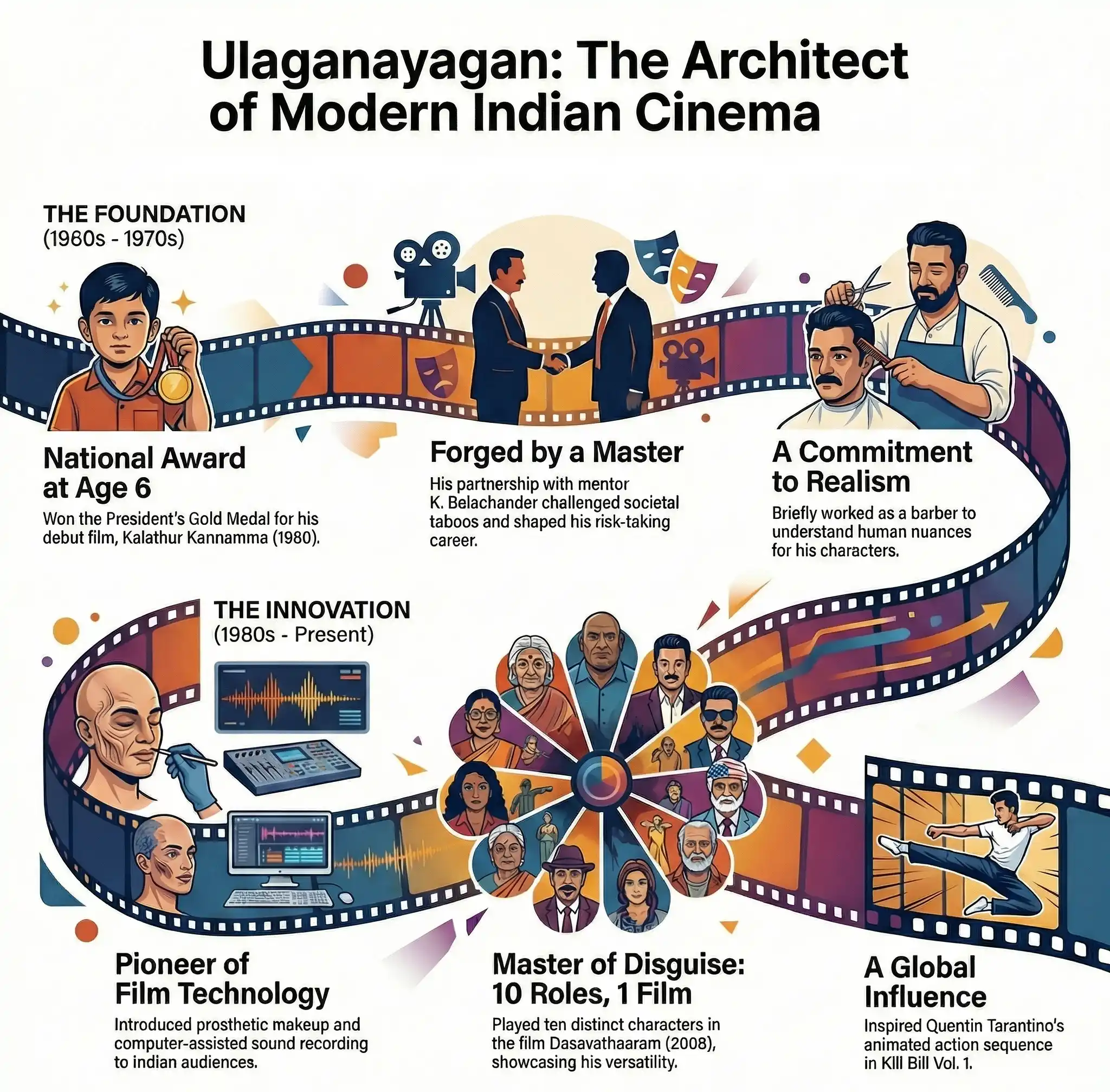
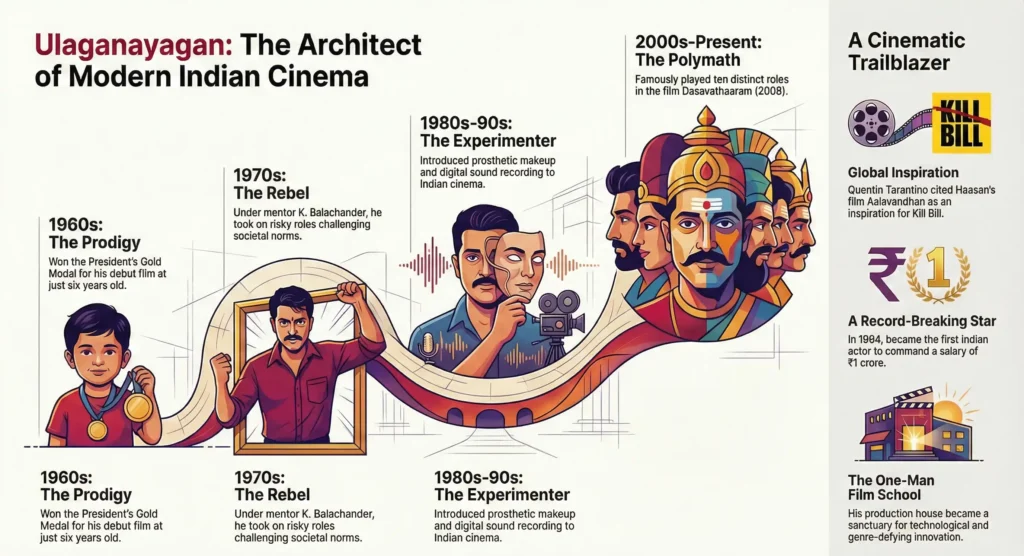
He was born in November 1954 in Ramanathapuram district, the son of a lawyer, and was on a film set at six. Kalathur Kannamma came out in 1960 and won him the President’s gold medal for a child artist.
Then the part nobody mentions. He spent the next decade and a half as a dance assistant and assistant director, learning the crafts around the camera rather than waiting for parts, which is why he has since worked as his own writer, director, choreographer and, on several films, his own make-up artist.
K. Balachander put him in Apoorva Raagangal in 1975 and the acting career proper began at twenty.
Salman Khan : Decades of Ruling Hearts and Box Offices
The face as material
Most stars protect a face. He has spent fifty years disassembling his. The old man in Indian. The woman in Avvai Shanmugi. The ten parts in Dashavathaaram, built out of prosthetics he helped design. The mentally disabled man in Moondram Pirai, which he plays without a single soft edge.
Nayakan in 1987, in which he ages from a boy on a Bombay dock to a Dharavi don, is on TIME’s list of the hundred best films ever made. Four National Awards, and more of his films sent up as India’s Oscar entry than any other actor’s.
He is the most valuable face in Tamil cinema and has spent his career covering it up.
The appetite has a cost that is easy to miss. Anbe Sivam in 2003, which many now call his best film, did no business at all on release and took years to find its audience.
His own money
Raaj Kamal Films International is his company, and the pattern of his career is that when nobody would fund something, he funded it. Hey Ram in 2000, on Partition and the killing of Gandhi. Aalavandhan. Virumaandi.
Marudhanayagam was the extreme case. The script was written with the novelist Sujatha and the French screenwriter Jean-Claude Carriere, Ilaiyaraaja was composing, and the cast ran to Naseeruddin Shah and Amrish Puri. It was designed to be seen outside India, and it collapsed on cost.
Unique Flavor Driving Bamboo Shoot Politics
2013
Viswaroopam cost about ninety-five crore rupees, much of it his, with his property behind the loans. He planned to release it on direct-to-home television first and the exhibitors stopped that.
Then, a day before it was due in cinemas, the Tamil Nadu government banned it for two weeks after Muslim organisations complained that scenes showed the community badly. Theatres were vandalised. He called the ban cultural terrorism, and said at a press conference in his own house that if it stood he might have to go and find a secular state to live in.
Whatever one makes of the objections or of the film, the sequence of events is the plain one: a producer put his own money in, the state removed his release date, and he negotiated his way to a shorter film.
He met the objectors, agreed to cuts, and the film came out. The distributors who had pulled it counted their losses in the hundreds of millions.
He had put his house behind a film, and his own state stopped it the day before it opened.
The Rajya Sabha
He started a party, Makkal Needhi Maiam, in 2018, and lost Coimbatore South narrowly in 2021. In 2024 he took his party into the DMK alliance, and in July 2025 he was sworn in as a member of the Rajya Sabha, taking the oath in Tamil at seventy.
It is the same instinct as the films. He is not interested in the safe version of anything, including his own standing.
Fifty years of work, and the thing that explains him best is the film that does not exist.
Sridevi Biography: From Sivakasi to Eternal Stardom
The 22000 Kilometer Journey of the Amur Falcons of Pangti
If you think you have remembered everything about this topic take this QUIZ
Results


#1. What significant achievement marked the very beginning of Kamal Haasan’s career at the age of six?
#2. To master the art of prosthetic makeup for films like ‘Indian’ and ‘Dasavathaaram,’ Kamal Haasan studied under which Academy Award winner?
#3. Which 1986 film by Kamal Haasan holds the distinction of being the first Indian movie to use a computer for song recording?
#4. What is the ‘mystery’ of ‘Marudhanayagam’ in the context of Kamal Haasan’s career?
#5. Why did Kamal Haasan request the Filmfare Association to stop considering him for nominations after the year 2000?
#6. According to the ‘Comparison’ table, what was the primary focus of the ‘Experimenter’ era (1980s-90s) of his career?
#7. Which Hollywood director admitted that a specific sequence in his film ‘Kill Bill Vol. 1’ was inspired by Kamal Haasan’s ‘Aalavandhan’?
#8. What does the moniker ‘Ulaganayagan’—given to Kamal Haasan—literally mean?
The Mizo Peace Accord: Ending Two Decades of Conflict
Why is Kamal Haasan called “Ulaganayagan”?
The title means “Universal Hero,” earned due to his immense versatility and his ability to transcend linguistic and cultural barriers across India and the globe.
How many languages does Kamal Haasan speak?
He is fluent in Tamil, Telugu, Malayalam, Hindi, Kannada, English, and has a working knowledge of Bengali and French.
Which film of Kamal Haasan was inspired by Hollywood’s Mrs. Doubtfire?
The 1996 hit Avvai Shanmukhi (remade in Hindi as Chachi 420) was inspired by the film, where he underwent grueling makeup sessions to play an elderly woman.
Read More: https://curiousindian.in/pran-february-1920-july-2013/
Sources & References
The Hindu — the launch of Marudhanayagam in 1997, its collapse in 1999 and the footage that was completed.
Gulf News (January 2013) — the ban on Viswaroopam, its cost, and his remarks at the press conference at his house.
TIME (All-Time 100 Movies) — the inclusion of Nayakan among the hundred greatest films.
Directorate of Film Festivals, Government of India — his National Film Awards, from the child artist prize of 1960 onwards.
Author


Exploring the Soul of Bharat through History, Science, Culture, and its Diversity
Our Mission
Curious Indian is a definitive knowledge portal dedicated to chronicling the events, personalities, and cultural shifts that defined the Indian subcontinent. From the ancient Vedic Period to the complexities of 21st-century politics, our goal is to provide deep-dive analysis that inspires.
Editorial Standards & E-E-A-T
Every article published under our brand undergoes a rigorous fact-checking process. We prioritize primary historical records, academic citations, and credible archives to ensure our readers receive accurate, high-authority information.
Historical Integrity Directly sourcing from ASI archives and academic journals.Topical Authority Comprehensive clustering of Indian Science, Biographies, and Wars.Managed by Paripurna Datta and TEAM | Dedicated to the Knowledge of India.