How a Village Transformed From Taking Lives to Saving the Most Daring Migration on Earth
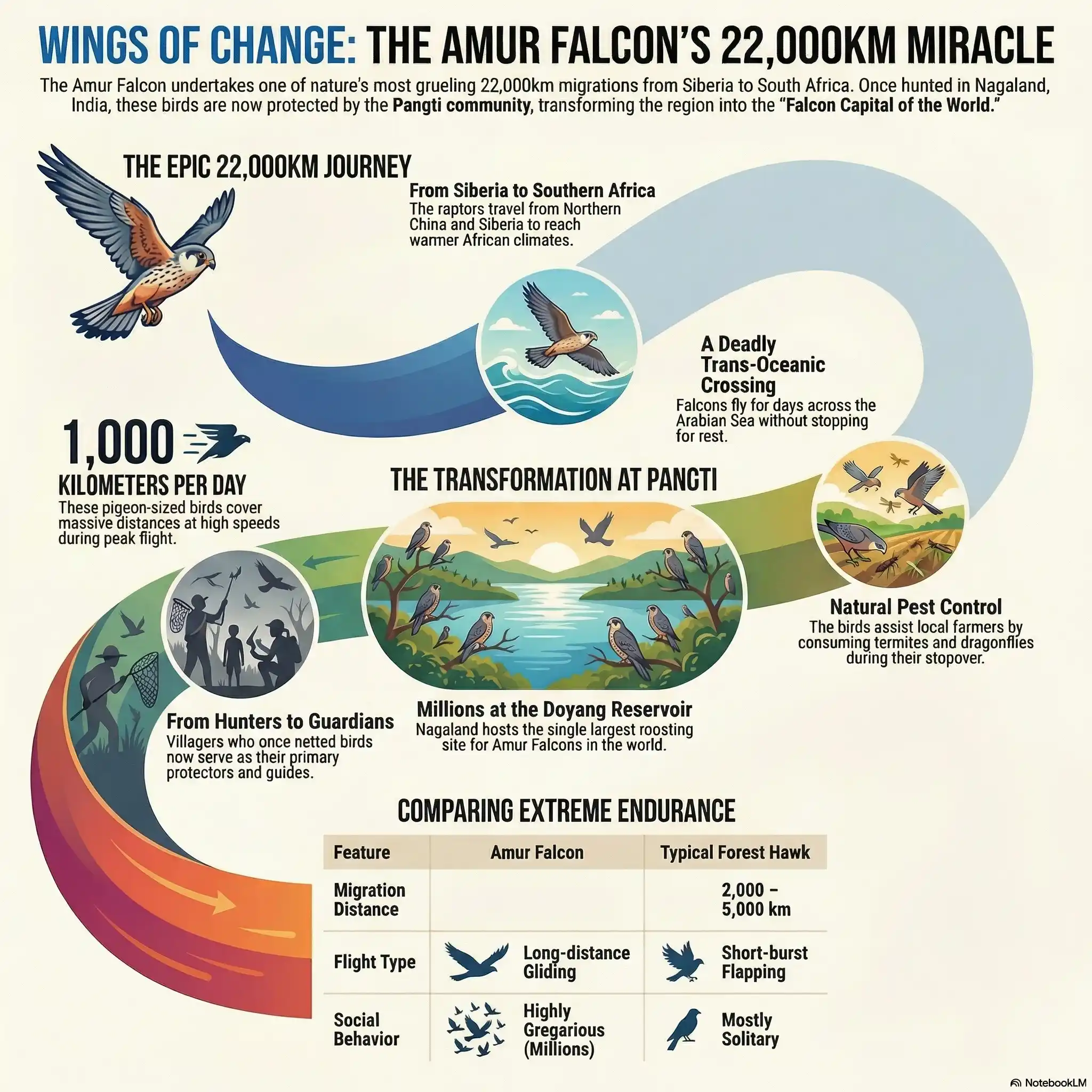
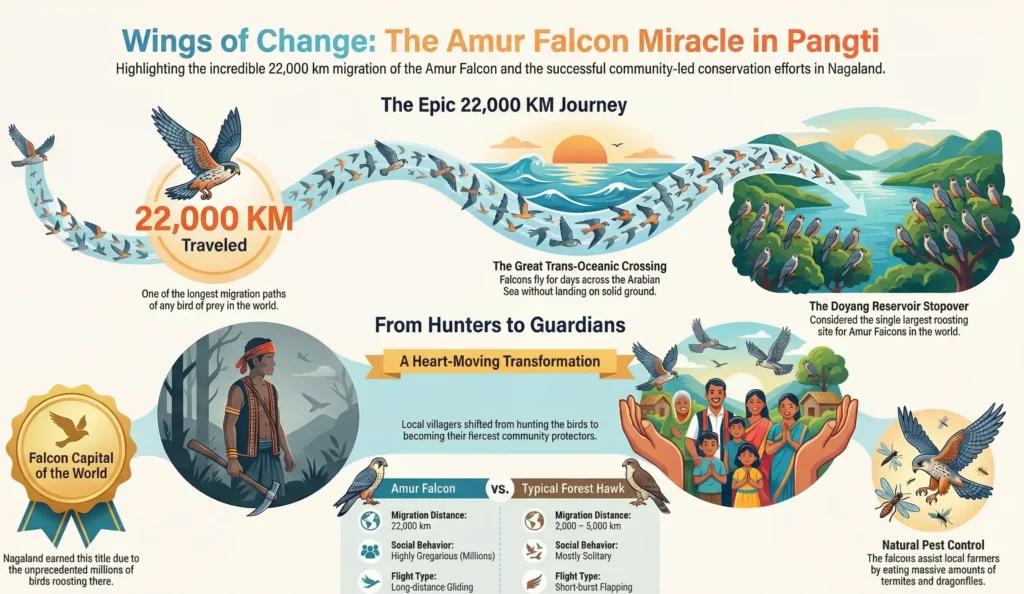
Every year, small birds no larger than a pigeon undertake a journey that defies logic. They fly 22,000 kilometers across continents and oceans, from the frozen plains of Siberia to the warmth of Southern Africa, with a crucial stop in the hills of Nagaland. For centuries, this migration happened in darkness, watched only by the creatures themselves. Then came a moment when the light shifted. A village that had once hunted these birds by the thousands made a choice that would transform them from predators into protectors. Their story is not just about conservation. It is about what happens when a community recognizes that what visits them is sacred.
Great Forest Uprising 1917: When Kuki Tribes Said No to British Empire
Wings Across Continents: The Arrival
The first indication that the Amur Falcons have arrived in Nagaland is always the same: a darkening of the sky. What begins as small specks on the horizon transforms into something that stops time. Thousands become tens of thousands, and the individual birds disappear into a collective phenomenon. The sky fills with wings, and the sound is like nothing else—a whisper of feathers cutting through air, the collective breath of a migration that has traveled across half the world.
These birds are small. If you held one in your hand, it would fit in your palm. But size is not the measure of the Amur Falcon. What matters is the fire that burns in them, the drive that pushes them to do what few creatures on Earth can do. They are raptors—hunters, swift and precise—but unlike their larger cousins, they have made a pact with distance and endurance. Every year, they prove that even the smallest creatures can accomplish the most impossible things.
The gathering happens at Doyang Reservoir in Wokha District, Nagaland. When the birds arrive in October, the reservoir becomes the largest roosting site for Amur Falcons in the entire world. Millions of them fill the trees along the water’s edge, creating a sight that has no parallel in nature. Tourists and birdwatchers from across the globe travel through difficult terrain, over bumpy roads and through thick forests, just to stand on the banks of the reservoir and witness what appears to be a living storm of wings.
Rani Gaidinliu: Zeliangrong Uprising’s Youngest, Boldest Voice
The Road From Siberia: A Journey Without Rest
The journey of the Amur Falcons begins not in Nagaland but in the cold, open plains of southeastern Siberia and Northern China. When winter arrives and the temperature plummets, these birds know it is time to leave. They do not make this decision lightly or casually. They have been preparing for this moment their entire lives. Every instinct in them drives toward survival, and survival means traveling south, thousands of kilometers, across mountains and valleys and open water.
The route they take is one of the longest migration paths of any bird of prey in the world. It is not a straight line. It is a carefully orchestrated path that has been refined over thousands of years, passed down through generations in a language that humans do not speak. The birds fly south across the vast lands of Asia, riding the winds, navigating by the stars and the Earth’s magnetic field. Scientists have tracked them using tiny satellite tags, small enough to be carried on their backs, and what they have discovered is extraordinary: these birds are master navigators. They do not wander. They do not get lost. They know exactly where they are going.
Pangti becomes their garden in the middle of a marathon. After the long flight from Siberia, the birds arrive exhausted and desperate for food. The Doyang Reservoir has become, in the past few decades, exactly what they need: a water body surrounded by a humid environment that attracts billions of insects. Termites, dragonflies, and countless other insects provide the feast that the birds need to rebuild their energy before the most dangerous part of their journey. It is a moment of abundance before scarcity, and the birds understand this instinctively. They settle into the trees and feed voraciously, storing fat and energy, preparing themselves.
When Hunters Became Guardians: The Transformation
Protecting The Rare Hoolock Gibbon India
Not long ago, the story of the Amur Falcons in Pangti was a very different story. When the birds first started arriving in massive numbers—after a new dam was built that created the reservoir—the local villagers saw them not as a miracle but as a resource. They saw an opportunity. Thousands of birds were caught in nets every day. The hunting was intense and unrelenting. It was economically valuable and, from the perspective of people struggling to survive, it was practical. The birds were there. They could be taken. They could be sold or eaten or used. Why would anyone object?
But this story of exploitation was also the story of a species in danger of disappearing. The hunting in Pangti was so intensive that it began to threaten the entire migration. Scientists and conservationists realized that if nothing changed, the Amur Falcons might stop coming to Nagaland altogether. They might choose a different route, one that avoided this danger. The species could vanish from the skies of India forever.
Then came the conversations—patient, respectful conversations between conservationists and the people of Pangti. The outsiders did not come with judgment or condemnation. They came with stories. They explained what these birds were, where they came from, where they were going. They shared the knowledge that the whole world was watching this migration, that scientists in other countries were tracking these birds through satellite tags, that this phenomenon was unique to Pangti. Most importantly, they helped the villagers understand that these birds were guests, and in Naga culture, guests are treated with the highest honor.
The transformation that followed was not gradual. It was fast and it was deep. The very people who had set the nets became the fiercest protectors of the birds. The village elders worked with the youth to form groups that guarded the roosting sites. They kept watch through the nights. They prevented poaching. They transformed their village from a place of danger into a sanctuary. What had been an industry of extraction became an industry of protection.
This transformation is now studied by conservation organizations all over the world as one of the most successful examples of community-led conservation. It demonstrates a principle that many conservationists had doubted: that when you help people understand the true value of what they have, when you show them that what they possess is something the world cherishes, they will choose to protect it. The shift in Pangti was not imposed from outside. It came from within the community itself.
The Ocean Crossing: The Most Dangerous Passage
After fattening up on insects in the sanctuary of Pangti, the Amur Falcons face the moment they have been preparing for. They must cross the Arabian Sea. This is not a casual journey over land where they can rest if they become tired. This is an open ocean crossing, thousands of kilometers of water with nowhere to land, nowhere to rest, nowhere to hide.
Most small birds do not attempt this. It is too risky. If a bird becomes exhausted over open water, there is no refuge. The instinct of most species is to stay near the coast, to always keep land within reach. But the Amur Falcons are different. They gather on the coast and wait for the perfect winds. When the conditions are right, they launch themselves out into the sky above the sea. They fly for days and nights without resting on solid ground.
What keeps them alive during this crossing is partly mystery and partly understanding. Scientists believe that the birds follow the migration of dragonflies across the sea, snacking on them while they fly, keeping their energy levels high enough to continue. They use the stars and the Earth’s magnetic field to navigate. They ride the winds when they can, gliding when they need to conserve energy. It is a feat of endurance and instinct that leaves even the most experienced experts shaking their heads in wonder.
Some birds do not make it. The sea is dangerous, and nature is unforgiving. Storms can blow them off course. Predators hunt in the open ocean. Exhaustion can claim the weak or the unlucky. But the journey continues, year after year, and the birds keep coming back. This is what makes them extraordinary: not that they never fail, but that they continue despite the possibility of failure.
The Falcon Capital: A Village’s Pride
Deendayal Upadhyaya Murder Mystery: Questions That Were Never Answered
Because of the incredible numbers that gather in Nagaland, the state has earned the title of the Falcon Capital of the World. Pangti is the beating heart of this title. During the peak of the migration in October and November, the village transforms. It is no longer just a settlement in the hills. It becomes a destination. Tourists and birdwatchers from across the globe arrive to witness the roosting. Local families have developed eco-tourism facilities. Children who were once part of families that hunted these birds now proudly tell visitors about the migration.
The local children can now identify the falcons by the way they hover in the air, by the pattern of their wings, by their distinctive silhouettes. They tell stories of the birds as if they are old friends, returning for a yearly visit. They have given the birds names. They have woven them into the fabric of their culture and identity. The presence of the falcons has brought a new sense of pride to the community. They are not just a village in the hills anymore. They are the guardians of a global treasure. The birds bring a message of peace. They remind the world that different species, different nations, different people are all connected through networks of migration and survival and interdependence.
A Reminder of Connection: The Eternal Lesson
When you stand on the banks of the Doyang Reservoir at dusk and watch the falcons settle into the trees for the night, something shifts in your understanding of what it means to be alive. The sky darkens with wings. The sound of thousands of birds settling into their roosts fills the air. You realize, in that moment, that the world is much larger than your daily concerns. There is a rhythm to life that has been going on for thousands of years, long before you were born, and it will continue long after you are gone.
The Amur Falcons return to the same trees year after year, generation after generation, driven by instincts older than human memory. They have survived ice ages. They have adapted to changing climates and changing landscapes. They continue despite the dangers. They are teachers, if we are willing to learn. They teach us about resilience—that survival is not just about being strong, but about being persistent, about refusing to give up even when the journey seems impossible. They teach us about connection—that what happens in Siberia affects what happens in Africa, that all of us share one world, and what we do in one place ripples across continents.
The people of Pangti have chosen to be part of this story. They have chosen to stand with these birds, to protect them, to welcome them year after year. In doing so, they have become more than hunters. They have become guardians. They have written themselves into a narrative that transcends their village, their region, their nation. The Amur Falcons of Pangti remind us all that transformation is possible, that a community can choose love over hunger, that a species on the brink can be saved when humans decide that some things are worth more than profit. The song of the Amur Falcon continues to be heard because a village chose to listen.
The Threat Of Deepor Beel Urban Encroachment
If you think you have remembered everything about this topic take this QUIZ
Results


#1. What is the scientific name of the Amur Falcon?
#2. Approximately how long is the incredible migration route of the Amur Falcon?
#3. Which village in Nagaland serves as the primary stopover and is known as the “Falcon Capital of the World”?
#4. The Amur Falcons begin their journey in Siberia and Northern China and travel all the way to which destination?
#5. What is the primary food source for the Amur Falcons during their migration?
#6. Which vast body of water do the Amur Falcons bravely fly across non-stop to reach Africa?
#7. How did the local community of Pangti transform their relationship with the Amur Falcons?
#8. According to the “Fast Facts,” how much distance can an Amur Falcon cover in a single day during its peak flight?
How long do the Amur Falcons stay in Nagaland?
The falcons usually arrive in early October and stay for about a month to six weeks before heading towards Africa in mid-November.
Why do they choose Pangti specifically?
The construction of the Doyang Dam created a large water body and a humid environment that attracts billions of insects, providing the perfect feast for the birds before their long ocean crossing.
Is it safe for tourists to visit Pangti to see the birds?
Yes, the local community has developed eco-tourism facilities and the area is very welcoming to visitors who want to witness the migration responsibly.
How many Amur Falcons visit Nagaland each year?
Estimates suggest that between 1 to 2 million falcons roost in the area during the peak of the migration season.
What can I do to help the conservation efforts?
Supporting local eco-tourism in Pangti and spreading awareness about the migration helps ensure the community continues to see the value in protecting these birds.
Sources & References
The Amur Falcon migration route from Siberia to Southern Africa with a major stopover at Pangti in Nagaland and the species’ characteristics and behavior — The Amur Falcon (Falco amurensis) undertakes one of the longest migration routes of any bird of prey, traveling approximately 22,000 kilometers from breeding grounds in southeastern Siberia and Northern China to wintering grounds in Southern Africa, with a critical stopover at Doyang Reservoir in Pangti village, Wokha District, Nagaland, where between 1-2 million birds roost during peak migration season in October and November.
The historical hunting of Amur Falcons in Pangti and the community-led conservation transformation that shifted the village from predation to protection — Prior to the early 2000s, local communities in Pangti hunted thousands of Amur Falcons daily following the construction of Doyang Dam, but through conservation education and community engagement, the villagers underwent a rapid transformation to become fierce protectors of the birds, establishing roosting site guards and anti-poaching measures, becoming one of the most successful examples of community-led conservation globally.
The ecological significance of Doyang Reservoir as the world’s largest roosting site for Amur Falcons and the reservoir’s role in providing food resources during migration — The Doyang Reservoir, created by the construction of Doyang Dam, has become the single largest roosting site for Amur Falcons in the world, providing critical food resources in the form of billions of insects, particularly termites and dragonflies, that allow the birds to rebuild energy reserves before their dangerous trans-oceanic crossing to Africa.
The Amur Falcon’s trans-oceanic crossing of the Arabian Sea and their navigation abilities using stars and Earth’s magnetic field — Amur Falcons undertake a dangerous trans-oceanic crossing of the Arabian Sea spanning thousands of kilometers without landing on solid ground, navigating using stars and the Earth’s magnetic field, with scientists theorizing that birds follow dragonfly migrations and feed on aerial insects during the journey to maintain energy levels required for survival.
Pangti and Nagaland’s designation as the Falcon Capital of the World and the economic and cultural impact of eco-tourism development around the Amur Falcon migration — Nagaland, particularly Pangti village, has earned the title of Falcon Capital of the World due to the concentration of Amur Falcon migrations, leading to the development of responsible eco-tourism infrastructure, increased global awareness, and a transformation of local community identity from hunters to conservation ambassadors and cultural stewards of a global natural phenomenon.