Pulomi, October 1932: a seventeen-year-old Zeliangrong girl, with a price on her head, set her followers to building a fort. The British came before it was finished. She would not be free again for fourteen years
In October 1932, in the village of Pulomi in the Naga hills, people were building a fort.
It was a palisade of timber, eighteen feet high by the accounts of those who watched it go up, copied from the stockade of the Assam Rifles post at Hangrum. It was meant to shelter her and her followers. At its centre was the one person the British most wanted to catch in all those hills.
She was seventeen years old. Her name was Gaidinliu.
At the centre of the fort was the one person the British most wanted to catch in all those hills. She was seventeen.
Jadonang
Gaidinliu was born in 1915 at Nungkao, in the Zeliangrong country of the hills of Manipur. The Zeliangrong are a group of Naga peoples, the Zeme, Liangmai and Rongmei, who live across the hills where Manipur, Nagaland and Assam now meet.
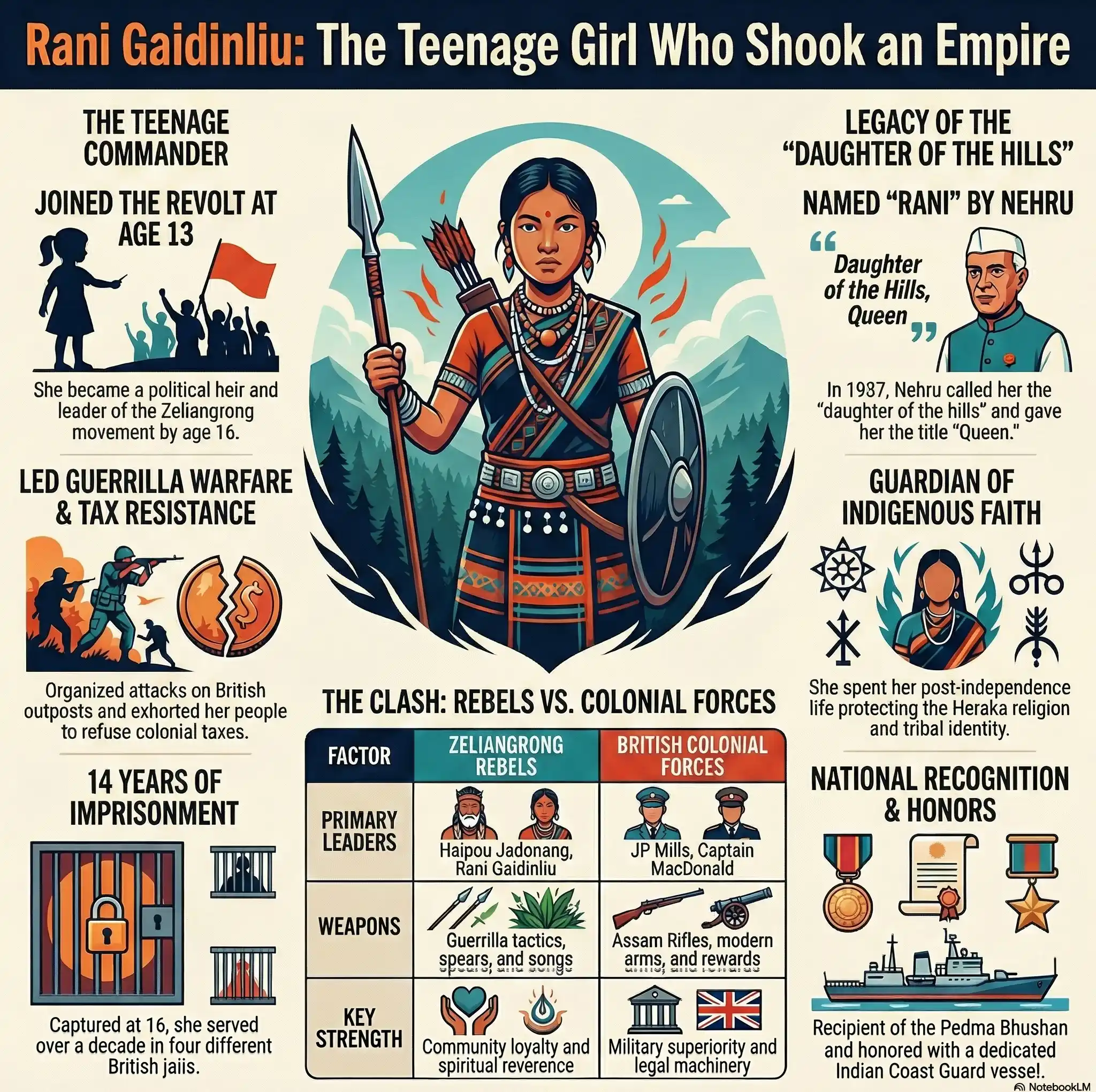
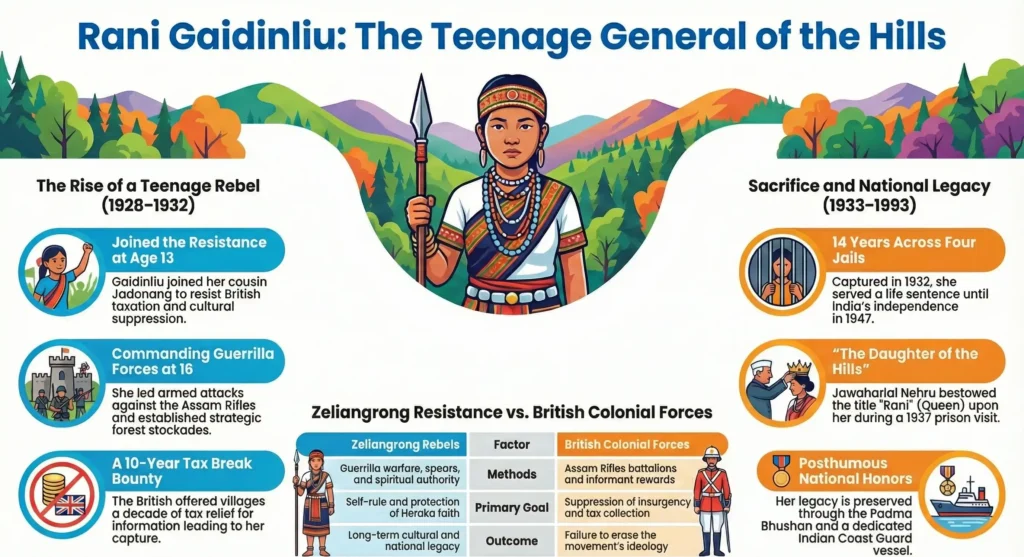
At thirteen she became a follower of her cousin, Haipou Jadonang. He was a young religious leader who called on the Zeliangrong to return to their own old faith, reform it, and stand together. In the British view, his movement also carried a dangerous idea: that the Nagas should one day rule themselves.
In 1931 the British arrested Jadonang. He was tried and, on 29 August 1931, hanged beside the Nambul river in Imphal.
Gaidinliu was sixteen. She took his place.
the Kamarupa Kingdom — the ancient root of Assam’s civilisational pride
Great Forest Uprising 1917: When Kuki Tribes Said No to British Empire
No taxes
She did more than keep the movement alive. She turned it openly against British rule. She told the Zeliangrong villages not to pay their taxes to the Raj. People brought her donations, and many joined her as volunteers.
The British hunted her from village to village. They offered a reward for information, and, to any village that helped catch her, freedom from taxes for ten years. For more than a year she moved through the hills with her followers, always a step ahead.
The British offered ten years free of taxes to any village that helped catch her. For more than a year, she stayed out of reach.
Pulomi
Then she came to Pulomi, and the fort began to rise.
Captain MacDonald of the Assam Rifles learned where she was. He did not march straight at the village. He sent a large force off in the opposite direction, as if chasing some other report, to make her think the danger was elsewhere. Then, on 17 October 1932, he struck Pulomi from where she did not expect him.
The fort was still unfinished. There was no fight. Gaidinliu and her followers were taken without resistance.
She was handcuffed and made to walk to Kohima, and then taken to Imphal. Her trial lasted ten months. She was convicted of murder and abetment of murder in connection with the movement’s clashes, and sentenced to life imprisonment. She always denied that she had ordered the attack on the Hangrum post, or the building of the fort itself.
Deendayal Upadhyaya Murder Mystery: Questions That Were Never Answered
Fourteen years
For the next fourteen years she was moved from one prison to another: Guwahati, Shillong, Aizawl, Tura. She went in a teenager. The whole of her twenties passed inside.
In 1937 Jawaharlal Nehru, touring Assam as President of the Congress, heard about her and went to see her in Shillong jail. Afterwards he wrote about her in the Hindustan Times. She had dreamed of freedom for her people, he wrote, and raised the banner of independence in her hills. “India does not even know of this brave child of her hills.”
He called her Rani, queen of her people, and promised to press for her release. He even raised her case with the British MP Lady Astor. It made no difference. She stayed in prison.
It was only after the Interim Government was formed that, in 1947, on Nehru’s own orders, the gates of Tura jail opened for her. She was thirty-two.
Rani
She lived for many years after that, working among her people. The name Nehru had given her stuck; to India she has been Rani Gaidinliu ever since.
But the picture that stays is the one from October 1932: a timber wall rising in a hill village, eighteen feet of it, built to protect a girl of seventeen who had told her people to stop paying the empire. The British came before it was finished, and the girl it was built for spent the next fourteen years in their prisons, growing up behind somebody else’s walls.
the Garo tribe’s ancient cultural legacy in Northeast India
the Khasi tribe’s matrilineal traditions and resistance to outside rule
If you think you have remembered everything about this topic take this QUIZ
Results


#1. Which tribal community did Rani Gaidinliu belong to?
#2. At what remarkably young age did Gaidinliu join the movement to expel the British from her homeland?
#3. Who was Gaidinliu’s cousin and mentor who established the Heraka movement before being executed by the British?
#4. What title, meaning “Queen,” was bestowed upon Gaidinliu by Jawaharlal Nehru?
#5. What unprecedented reward did the British colonial administration offer to any village that provided information leading to Gaidinliu’s arrest?
#6. After being captured in 1932, how many years did Rani Gaidinliu spend in various prisons before India’s independence set her free?
#7. What was the primary goal of the Heraka movement that Gaidinliu and Jadonang led?
#8. In 2016, how did the Indian Coast Guard honor the legacy of Rani Gaidinliu?
Who was Rani Gaidinliu?
Rani Gaidinliu (1915–1993) was a Naga spiritual and political leader from the Rongmei tribe of Manipur. She led the Zeliangrong Uprising against British colonial rule beginning at age 13, was sentenced to life imprisonment at 16, and served 14 years across four jails before being released after India’s independence in 1947. The title “Rani” (Queen) was given to her by Jawaharlal Nehru
What was the Zeliangrong Uprising about?
The Zeliangrong Uprising was a socio-religious and political revolt by the Zeliangrong Naga people — comprising the Zeme, Liangmai, and Rongmei tribes — against British colonial taxation, forced labour, religious interference, and suppression of indigenous culture. It was rooted in the Heraka movement founded by Haipou Jadonang, which sought to revive ancestral Naga traditions and establish self-rule.
Who was Haipou Jadonang and what happened to him?
Haipou Jadonang was a Rongmei Naga spiritual leader and the founder of the Heraka movement. He envisioned an independent Naga kingdom called “Makam Gwangdi” or Naga Raj. He was arrested by the British in February 1931 on fabricated murder charges and hanged on 29 August 1931 at just twenty-six years old. His movement was then carried forward by his cousin Rani Gaidinliu.
How was Rani Gaidinliu captured?
She was captured on 17 October 1932 through a deliberate British military deception. Captain MacDonald sent a large force in the wrong direction to mislead her, then surrounded her village of Pulomi. She was arrested without resistance, handcuffed, and marched on foot to Kohima before being tried in Imphal and sentenced to life imprisonment.
What awards and recognition did Rani Gaidinliu receive?
Rani Gaidinliu received the Tamra Patra in 1972, the Padma Bhushan in 1982, the Vivekananda Seva Award in 1983, and the Bhagwan Birsa Munda Puraskar posthumously. The Government of India issued a commemorative postage stamp in 1996. In 2016, the Indian Coast Guard named a Fast Patrol Vessel ICGS Rani Gaidinliu in her honour.
Sources & References
Indian Culture, Ministry of Culture, “Rani Gaidinliu” — the reward and tax exemption, her capture on 17 October 1932, her sentence, the prisons she was held in and Nehru’s visit in 1937.
The Better India, “How a 13-YO Freedom Fighter Scared the British Into Sentencing Her to Life Imprisonment” (8 March 2021) — the Pulomi palisade as described by Arkotong, and her march to Kohima.
Heritage Explorer, “Rani Gaidinliu – Daughter of the hills” — Captain MacDonald’s feint, the ten-month trial, Nehru’s Hindustan Times article of 18 December 1937 and her release from Tura jail.
Arkotong Longkumer, “Religious and Economic Reform: The Gaidinliu Movement and the Heraka in the North Cachar Hills,” South Asia 30(3) (2007) — the movement’s origins under Jadonang and its continuation under Gaidinliu.