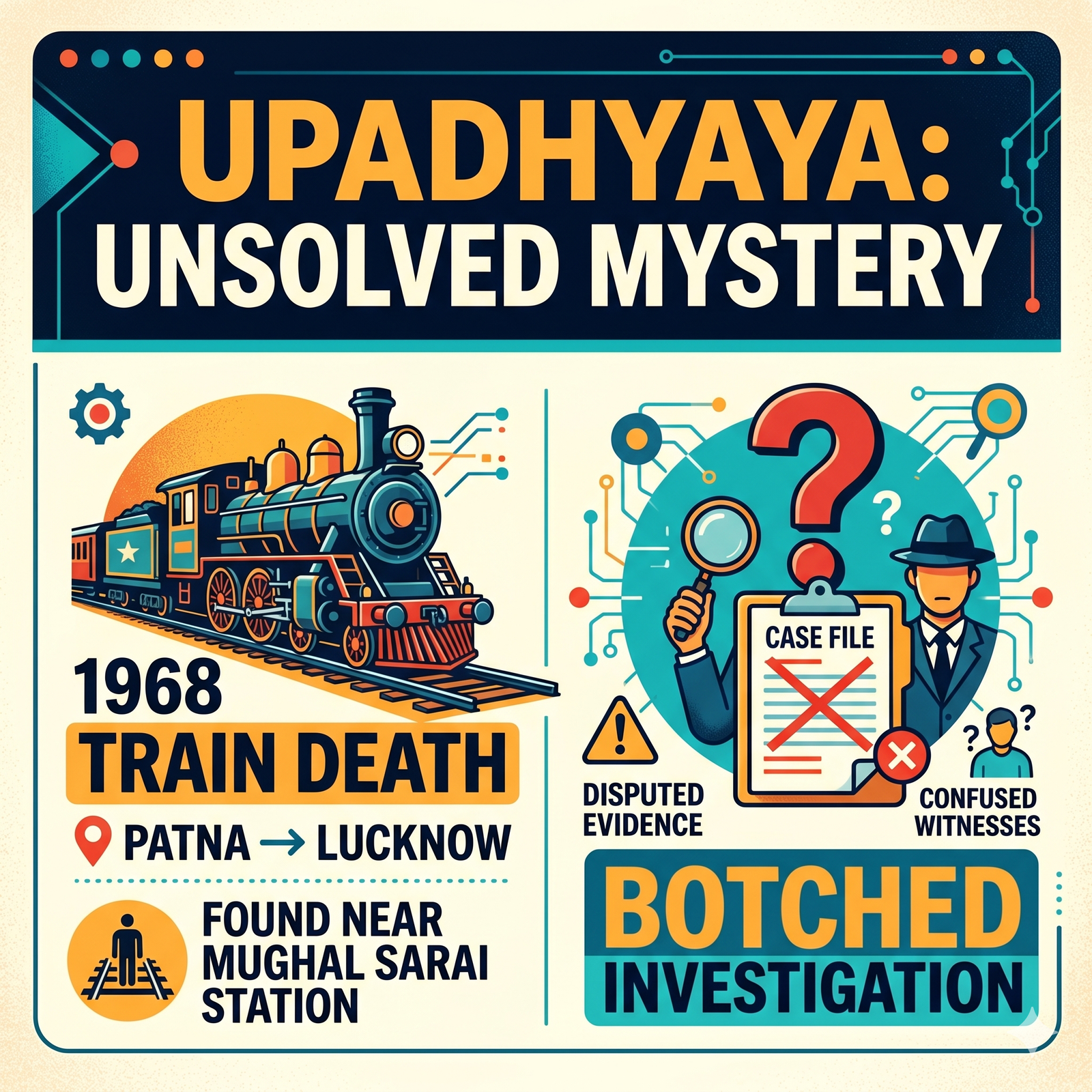
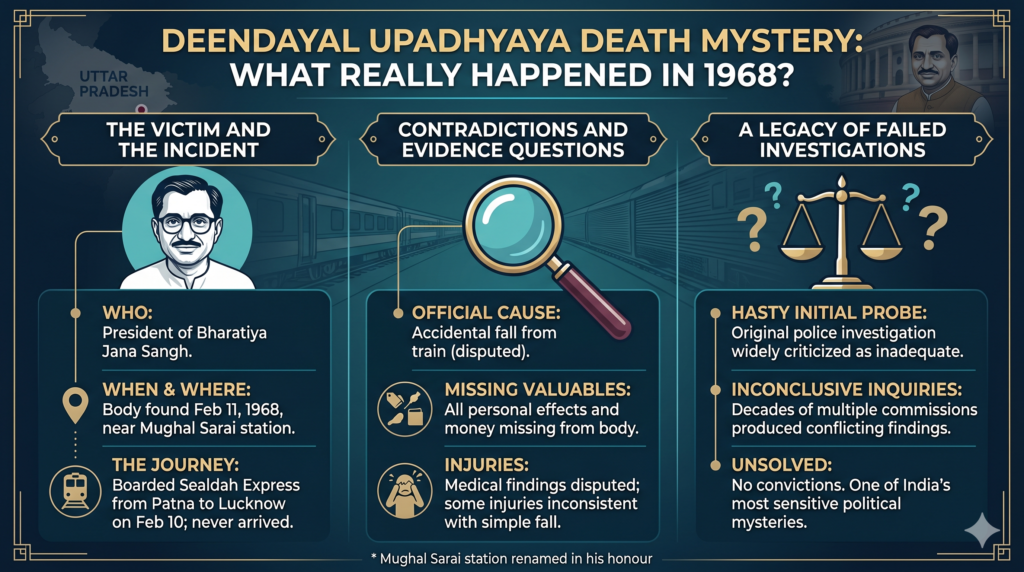
Deendayal Upadhyaya was one of the most significant political figures in post-independence India. He was the president of the Bharatiya Jana Sangh, the forerunner of the modern Bharatiya Janata Party, and the thinker behind the political philosophy called Integral Humanism that continues to shape Indian conservative political thought to this day. On the night of 10 to 11 February 1968 CE, he boarded the Sealdah Express at Patna Junction heading toward Lucknow. His body was found the next morning beside the railway tracks near Mughal Sarai station, now renamed Pt. Deen Dayal Upadhyaya Junction. He had injuries that were inconsistent with a simple fall from a moving train. His valuables were missing. His companions on the journey could not account for his movements during the night. The police investigation that followed was widely criticised as hasty, incomplete, and inadequate to the gravity of the case. Multiple inquiries over the following decades produced conflicting findings. No one was ever convicted of anything in connection with his death. The case remains officially unsolved. It is one of the most politically sensitive unresolved deaths in the history of the Indian republic.| Detail | Information |
| Victim | Pandit Deendayal Upadhyaya |
| Date of Death | 11 February 1968 CE |
| Location | Near Mughal Sarai railway station, Uttar Pradesh |
| Train | Sealdah Express, Patna to Lucknow |
| Political Role | President of the Bharatiya Jana Sangh |
| Philosophy | Integral Humanism, Ekatma Manav Darshan |
| Age at Death | 51 years old |
| Cause of Death | Official: fall from train. Disputed: possible murder |
| Investigations | Multiple police and judicial inquiries, all inconclusive |
| Conviction | None |
| Legacy | Mughal Sarai station renamed in his honour in 2018 CE |
The Death of Deendayal Upadhyaya: India’s Most Controversial Political Murder Mystery
Who Was Deendayal Upadhyaya?
To understand why the death of Deendayal Upadhyaya matters so much, you first need to understand who he was and what he represented in the India of the 1960s CE. He was not just a politician. He was a thinker, an organiser, and a man whose ideas about how India should be governed went far beyond the ordinary business of elections and party management.
Deendayal Upadhyaya was born on 25 September 1916 CE in the Mathura district of Uttar Pradesh. His childhood was marked by the same kind of loss that seems to have shaped so many of the figures who gave the most to India’s public life. His father died when he was very young. His mother died shortly after. He was raised by relatives and grew up in circumstances that were modest and difficult.
Despite these early hardships, he was a brilliant student. He studied at Sanatan Dharma College in Kanpur and later at Agra and Allahabad. He was a gold medal student, the kind of academic performer who had every conventional door of opportunity open to him. He chose instead to join the Rashtriya Swayamsevak Sangh, the RSS, in 1937 CE and dedicate his life to the project of building Hindu cultural and political organisation in India.
Within the RSS and later within the Bharatiya Jana Sangh, which was founded in 1951 CE, Upadhyaya made himself indispensable not through charisma or electoral success but through the quiet and consistent quality of his organisational and intellectual work. He edited the party newspaper Panchjanya and Organiser, built the Jana Sangh’s administrative structures across northern India, and over years of sustained thinking developed the political philosophy that he called Integral Humanism and Ekatma Manav Darshan.
Integral Humanism was Upadhyaya’s answer to what he saw as the failures of both Western capitalism and Soviet communism as models for India’s development. He argued that India needed a political and economic framework rooted in its own civilisational values, one that placed the individual within the community rather than in opposition to it and that respected the dharmic order of Indian life rather than importing alien ideological frameworks. These ideas, developed in a series of lectures in Bombay in 1965 CE, became the philosophical foundation on which the Jana Sangh and its successor the BJP built their political identity.
By January 1968 CE, Upadhyaya had just been elected as the national president of the Bharatiya Jana Sangh at the party’s Calicut session. He was at the peak of his political influence and at a moment when the Jana Sangh was beginning to find a wider national voice. He had a great deal of work ahead of him. He would not live to do it.
Dr. Salim Ali: The Man Who Taught India to Look at the Skies
The Last Journey: Patna to Lucknow
On 10 February 1968 CE, Deendayal Upadhyaya was in Patna, the capital of Bihar. He had been attending party-related meetings and activities in the city. In the evening, he boarded the Sealdah Express at Patna Junction. His destination was Lucknow. The journey should have taken several hours and he was expected to arrive in the morning.
He was not travelling alone. There were colleagues and party workers on the same train, some of whom knew he was on board. There were also, according to various accounts that emerged later, other individuals whose presence on the train that night became the subject of considerable speculation.
The train passed through several stations through the night. It approached Mughal Sarai, which was and remains one of the most important railway junctions in northern India, in the early hours of 11 February 1968 CE.
Somewhere between Patna and Mughal Sarai, Deendayal Upadhyaya disappeared from the train.
The Body at Mughal Sarai
On the morning of 11 February 1968 CE, railway workers near Mughal Sarai station found a body beside the tracks. The body was identified as that of Deendayal Upadhyaya. He was fifty-one years old.
The initial police response treated the death as a possible accident, a fall from the moving train. This was the simplest available explanation and it was the one that the authorities moved toward first. But the details of what was found with the body and the nature of the injuries quickly made the accident theory very difficult to sustain without serious questions.
Several things were immediately noted by those who examined the scene and the body. His valuables, including money and personal effects, were missing. This is not what you would expect from an accidental fall. A person who falls from a moving train does not lose their valuables in the process unless those valuables were taken by someone.
Mylswamy Annadurai: The Village Boy Who Conquered the Moon and Mars
The injuries on the body were also the subject of significant controversy. Medical examination of the body produced findings that different investigators interpreted in different ways. Some of the injuries were described as consistent with a fall from a moving train. Others were described as inconsistent with such a fall and more suggestive of a beating or an attack that preceded any contact with the track. The precise nature of the injuries and what they meant was something that different medical and investigative opinions would contest for years afterward.
There was also the question of how a man of Upadhyaya’s experience and caution came to fall from a train at night. He was not a careless or reckless person. He was a senior political leader who travelled regularly and was accustomed to the business of moving between cities for party work. The image of him simply losing his balance and falling from an open door of a moving train in the middle of the night did not sit easily with what those who knew him said about his character and his habits.
The Investigation That Failed
The investigation into Deendayal Upadhyaya’s death was, by almost any honest assessment, a failure. It was not a failure of resources or of time. It was a failure of will and of thoroughness that left the most important questions unanswered.
The Uttar Pradesh police, which had primary jurisdiction over the case given where the body was found, moved through the initial investigation quickly. Witnesses were questioned but not all the people who had been on the train or who had knowledge of Upadhyaya’s movements that night were tracked down and interviewed with the persistence that a death of this political significance deserved. Evidence from the scene was collected but questions were raised later about whether all relevant evidence had been properly preserved and examined.
The speed with which the initial official conclusion moved toward accident was itself a source of suspicion. In a country where political deaths had a way of being explained away as quickly as possible by whoever happened to be in power, the haste with which authorities settled on a non-criminal explanation for the death of the president of a major opposition party struck many as deeply suspicious.
The Congress party was in power at the centre and in Uttar Pradesh at the time. The Jana Sangh was in opposition. Whether political considerations shaped the conduct of the police investigation is something that has been argued about ever since. What is harder to argue about is that the investigation did not produce answers adequate to the questions that the circumstances of the death raised.
The Multiple Inquiries and Their Contradictions
Because the initial investigation was so widely regarded as inadequate, the death of Deendayal Upadhyaya became the subject of multiple subsequent inquiries over the following years and decades. Each of these inquiries added information to the public record. None of them produced a definitive conclusion that settled the matter.
A judicial commission was set up to examine the circumstances of the death. Its findings were contested by those who believed a murder had taken place. Political pressure from the Jana Sangh and its supporters kept the question alive in public discourse. Questions were asked in Parliament. Documents were demanded. Officials were called to account.
Over time, a picture emerged from the various inquiries of a death that was far more complex than a simple accident. The missing valuables pointed toward robbery at minimum. The nature of the injuries pointed toward the possibility of violence before the body reached the track. The failure to properly account for all the people who were on or near the relevant section of the train that night left open the question of who had the opportunity to commit a crime if a crime had been committed.
The Battle of Saraighat That Stopped a Mughal Empire
Several specific theories about what had happened to Upadhyaya circulated among investigators and political observers. One theory held that he had been murdered by individuals with criminal connections who saw an opportunity to rob a prominent person travelling by train at night. Another theory pointed toward political motivation, suggesting that his growing influence and the particular moment of his Jana Sangh presidency made him a target for those who wanted to prevent the Hindu nationalist political movement from consolidating around a strong national leader. A third theory suggested that the death was the result of factional politics within or connected to the political world he moved in.
None of these theories was ever proven. None was ever definitively disproven either. The case remained open and contested in a way that is deeply unsatisfying to anyone who believes that the death of a prominent public figure deserves a clear and honest accounting.
The Railway Connection and Mughal Sarai Station
The location of Upadhyaya’s death, beside the tracks near Mughal Sarai, has its own significance in the story. Mughal Sarai Junction, now officially renamed Pt. Deen Dayal Upadhyaya Junction by the Uttar Pradesh government in 2018 CE, is one of the most important railway hubs in India. It sits at the confluence of multiple major rail routes and handles an enormous volume of passenger and freight traffic. In 1968 CE, as now, it was a busy, complex, and not easily monitored environment.
The renaming of the station in Upadhyaya’s honour fifty years after his death was a gesture of profound symbolic importance by the BJP government, which regarded him as a founding father of their political tradition. The fact that the station where his body was found now bears his name is a kind of memorial that is both fitting and quietly unsettling. Every train that stops at Pt. Deen Dayal Upadhyaya Junction stops at the place where the questions about his death have never been answered.
The geography of the death also had practical implications for the investigation. The area near Mughal Sarai station in 1968 CE was not a place with sophisticated surveillance or easy witness tracking. The track-side where the body was found was accessible to many people. The train itself had been moving through the night with hundreds of passengers, any of whom could theoretically have had access to Upadhyaya’s compartment or to him personally in the hours before his death.
Deendayal Upadhyaya and Integral Humanism: What Was Lost
Part of what makes the death of Deendayal Upadhyaya such a significant moment in Indian political history is what was lost with him, not just the man but the particular quality of political and intellectual leadership he represented.
Upadhyaya was fifty-one when he died. He was in good health and at the height of his intellectual powers. The philosophy he had been developing, Integral Humanism and Ekatma Manav Darshan, was still being refined and elaborated. The Jana Sangh under his leadership was beginning to find a wider national audience. There is no way to know what he would have built had he lived for another twenty or thirty years. But the scale of the influence he had already accumulated by the age of fifty-one gives some indication of what was cut short.
The political movement that he helped build went on without him, eventually transforming into the Bharatiya Janata Party that would go on to form national governments in India. The BJP under Prime Minister Narendra Modi has explicitly cited Deendayal Upadhyaya as a founding philosophical inspiration and Antyodaya, the idea of lifting the last person in society, which was one of his central concepts, has been used as a touchstone for social welfare programmes. The station renaming, the large portrait in Parliament, and the numerous government programmes and institutions named after him all reflect the degree to which the political tradition he helped found has chosen to keep his memory and his ideas at the centre of its identity.
But the unanswered question of how he died sits alongside all of this commemoration like a shadow that nobody can quite explain away. A political tradition that venerates a founding figure deserves to know what happened to him. The people of India, for whom he had dedicated his life, deserved the truth about his death. Neither has ever fully received it.
The Railway Crime Dimension
One aspect of the Deendayal Upadhyaya case that has received less attention in the political analysis of his death is the broader context of crime on Indian railways in the 1960s CE. Railway crimes, including robbery and murder of passengers on overnight trains, were a genuine and documented problem on Indian railways during this period. The cover of a moving train at night, with limited oversight and easy access between compartments, made robbery of passengers a crime that was committed with some regularity.
It is entirely possible that what happened to Upadhyaya on the night of 10 to 11 February 1968 CE began as a robbery that turned violent. The missing valuables are consistent with this theory. A man who was robbed, beaten, and thrown from a moving train would present exactly the kind of scene that was found near Mughal Sarai the following morning.
If this is what happened, it does not necessarily rule out a political dimension. A robbery could have been staged to disguise a politically motivated attack. Or a genuine robbery could have coincidentally targeted one of India’s most important political leaders with consequences that went far beyond what a random criminal encounter would normally produce.
The problem is that without a proper investigation that identified who was near Upadhyaya on the train that night and properly examined their movements and motivations, it is impossible to distinguish between these possibilities. The investigation that was actually conducted did not produce the evidence needed to make that distinction. And the evidence that was not collected in the immediate aftermath of the discovery of the body can never be recovered.
Why the Mystery Has Never Been Resolved
More than fifty years after Deendayal Upadhyaya’s body was found near Mughal Sarai, the question of what happened to him on that train remains officially unresolved. The reasons for this persistent unresolved status are worth examining honestly.
The first reason is the quality of the original investigation. A death investigation that begins by favouring a particular conclusion, namely that the death was accidental, and organises its evidence-gathering around confirming that conclusion rather than testing it objectively, will not produce reliable answers even if the people conducting it are reasonably competent and not actively dishonest. The initial Mughal Sarai investigation appears to have had this character.
The second reason is the political context. In 1968 CE, the party whose leader had died was in opposition to the government whose police were investigating the death. The incentive structure for a thorough, uncomfortable investigation that might produce findings embarrassing to the government in power was simply not present. Subsequent inquiries, conducted under changing political circumstances with incomplete access to the original evidence, faced their own limitations.
The third reason is the passage of time. The longer a death investigation remains unresolved, the harder it becomes to resolve. Witnesses die or become unavailable. Memories fade and become unreliable. Physical evidence, if it was not properly preserved in the first place, is gone. The people who might have been prosecutable for involvement in the death become progressively more difficult to reach through any legal process even if the political will to prosecute them existed.
The fourth reason is the political sensitivity that surrounds the case from every direction. For the political tradition that honours Upadhyaya as a founding father, reopening the investigation means confronting the possibility that the full truth of his death is darker and more complicated than the existing narrative acknowledges. For those who would prefer to see the death attributed to political conspiracy, there is an incentive to maintain the mystery rather than allow an investigation that might produce a more mundane conclusion.
The result of all these factors is a case that has served different political purposes at different times without ever being resolved in the one way that matters most: honestly and completely.
Quick Comparison Table: Deendayal Upadhyaya Death vs. Other Contested Political Deaths in India
| Feature | Deendayal Upadhyaya 1968 | Lal Bahadur Shastri 1966 | Syama Prasad Mookerjee 1953 |
| Role | Jana Sangh President | Prime Minister of India | Jana Sangh founder |
| Location of Death | Railway track, Mughal Sarai | Tashkent, Soviet Union | Detention, Kashmir |
| Official Cause | Accidental fall from train | Disputed heart attack | Disputed heart attack |
| Investigation Quality | Widely criticised as inadequate | Never formally investigated | Never independently investigated |
| Missing Evidence | Valuables missing, injury questions | Autopsy disputed | Medical records disputed |
| Political Context | Congress in power, Jana Sangh in opposition | Congress government | Congress government |
| Conviction | None | None | None |
| Current Status | Officially unsolved | Officially unsolved | Officially unsolved |
Curious Indian: Fast Facts
Mughal Sarai Junction, the railway station near where Deendayal Upadhyaya’s body was found in 1968 CE, was renamed Pt. Deen Dayal Upadhyaya Junction by the Uttar Pradesh government in 2018 CE, fifty years after his death. It is one of the busiest railway junctions in India.
Deendayal Upadhyaya had been elected president of the Bharatiya Jana Sangh just weeks before his death, at the party’s Calicut session in January 1968 CE. He was at the very peak of his political influence when he was killed.
The philosophy of Integral Humanism that Upadhyaya developed in his 1965 Bombay lectures was formally adopted as the official ideology of the Bharatiya Jana Sangh in 1965 CE and continues to be cited as the philosophical foundation of the Bharatiya Janata Party to this day.
Antyodaya, the idea of placing the welfare of the last and most marginalised person in society at the centre of governance, was one of Upadhyaya’s most important contributions to Indian political thought. The term has been used by multiple Indian governments to describe social welfare programmes.
The valuables that were missing from Upadhyaya’s body when it was found near Mughal Sarai were never recovered and no one was ever charged in connection with their disappearance.
A large portrait of Deendayal Upadhyaya hangs in the Central Hall of the Indian Parliament, one of a very small number of political figures to be honoured in this way. The questions about how he died have never been answered with the same clarity that his political legacy has been celebrated.
The BJP government under Prime Minister Narendra Modi declared 25 September, Upadhyaya’s birth anniversary, as Antyodaya Divas, a national day dedicated to the welfare of the marginalised. His centenary year in 2016 to 2017 CE was observed with extensive programmes across India.
Conclusion
The death of Deendayal Upadhyaya on the night of 10 to 11 February 1968 CE is one of those events in Indian history where the gap between what is known and what needs to be known is almost unbearably wide. A man of enormous intelligence, deep integrity, and genuine political vision boarded a train one evening and was found dead beside a railway track the next morning. His valuables were gone. His injuries raised questions that were never satisfactorily answered. The investigation that followed was inadequate to the gravity of the case. The inquiries that came after produced contradictions rather than conclusions. And the political tradition that he helped found has honoured his memory with statues and renamed stations and parliamentary portraits while the truth about how he died remains officially unknown. India knows how Deendayal Upadhyaya lived. It deserves to know how he died.
If you think you have remembered everything about this topic take this QUIZ
Results


#1. . On which train was Deendayal Upadhyaya traveling on the night he disappeared?
#2. What was the name of the political philosophy developed by Deendayal Upadhyaya that remains the foundation of the BJP?
#3. What was the official, though widely disputed, cause of death initially provided by the authorities?
#4. Which city was Upadhyaya’s intended destination on his final journey from Patna?
#5. What specific detail found at the scene made the “accidental fall” theory difficult for many to believe?
#6. In which year was the Mughal Sarai railway station officially renamed to Pt. Deen Dayal Upadhyaya Junction?
#7. Which concept of Upadhyaya’s emphasizes lifting the last and most marginalized person in society?
#8. What was Upadhyaya’s political role at the time of his death in February 1968? A) Prime Minister of India
How did Deendayal Upadhyaya die?
His body was found beside the railway tracks near Mughal Sarai station in Uttar Pradesh on the morning of 11 February 1968 CE. He had been travelling on the Sealdah Express from Patna to Lucknow. The official explanation was an accidental fall from the moving train but this explanation was immediately contested by the nature of his injuries, the disappearance of his valuables, and the inadequacy of the investigation that followed.
Was Deendayal Upadhyaya murdered?
This question has never been definitively answered. Multiple inquiries over the decades since his death have produced contradictory findings. His missing valuables and disputed injuries point toward the possibility of robbery and violence. Political motivations have also been suggested. No one has ever been charged or convicted in connection with his death and the case remains officially unsolved.
Why was the investigation into his death considered inadequate?
The initial police investigation was criticised for moving too quickly toward an accidental death conclusion without properly testing other possibilities. Key witnesses were not fully pursued, evidence from the scene was not comprehensively examined and preserved, and the political context of a Congress-led government investigating the death of an opposition party leader created a conflict of interest that further undermined public confidence in the investigation.
How is Deendayal Upadhyaya remembered today?
Deendayal Upadhyaya is honoured as a founding philosophical father of the Bharatiya Janata Party. His portrait hangs in the Central Hall of the Indian Parliament. Mughal Sarai Junction, near where his body was found, was renamed Pt. Deen Dayal Upadhyaya Junction in 2018 CE. His birth anniversary, 25 September, is observed as Antyodaya Divas. Numerous government programmes, institutions, and public spaces across India bear his name.