Northeast India sits closer to Myanmar and Thailand than to most of India. The Act East Policy is meant to turn that into an open door. On the map, the door is almost built. On the ground, the last stretch is still missing
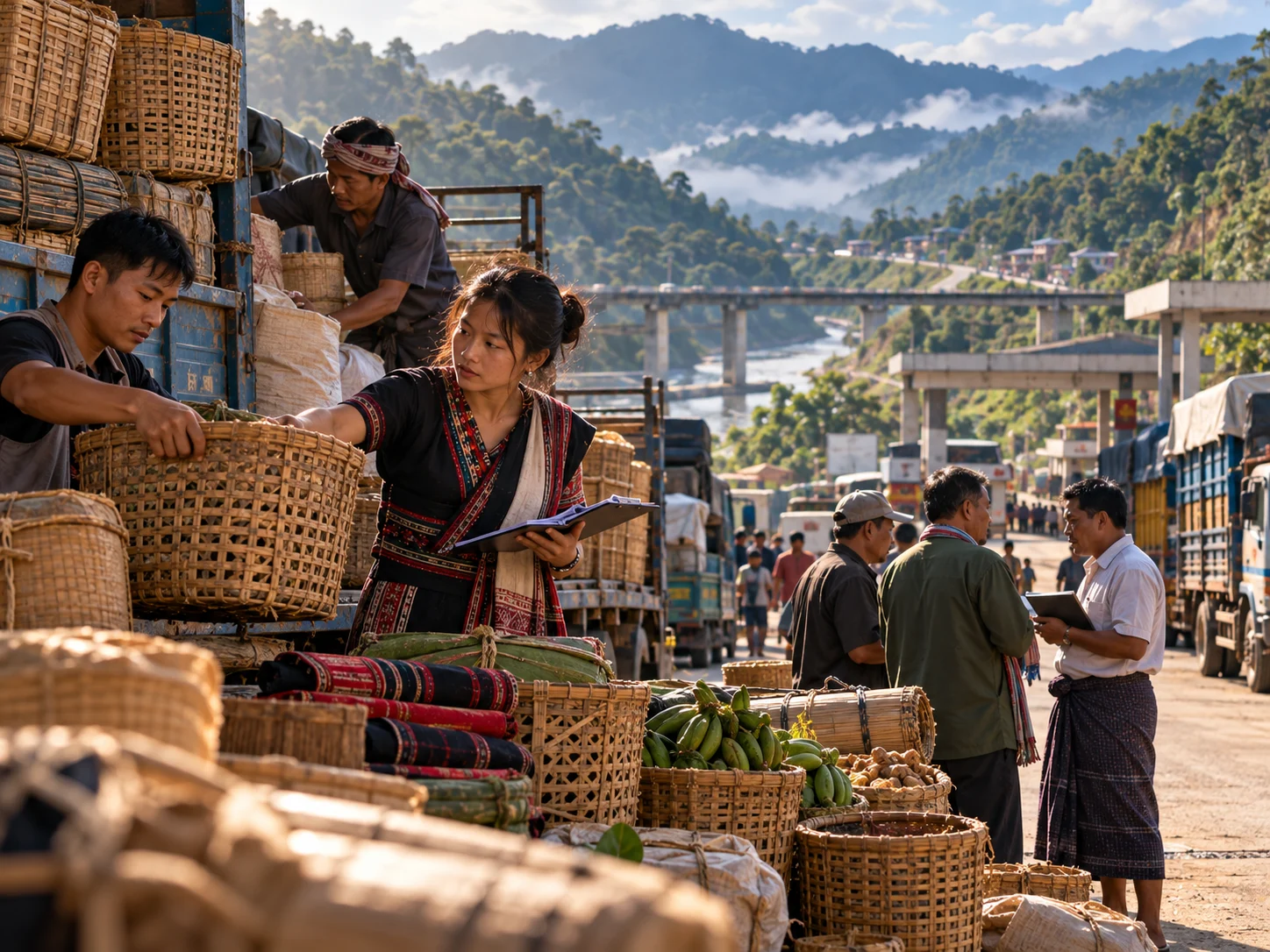
Zorinpui is a small place on the southern edge of Mizoram, right on the border with Myanmar. Not many people outside the state have heard of it.
On a map of India’s Act East Policy, though, it matters a great deal. It is where a road is supposed to come in from Myanmar, carrying goods that have travelled from Kolkata by sea and up a Burmese river. It is where the Northeast is supposed to get a new way to the sea.
From Zorinpui, Indian highways are meant to carry the traffic onward. The road on the other side, 109 kilometres of it, is the part still waiting to be finished.
The road on the other side, 109 kilometres of it, is the part still waiting to be finished.
The narrow neck
To understand why this matters, look at a map of India and find the Northeast.
Before 1947, the region traded easily with the plains of Bengal and shipped goods out through the port of Chittagong. Partition changed that. When East Pakistan, later Bangladesh, was created, the eight north-eastern states were left joined to the rest of India by a strip of land only about twenty-two kilometres wide at its narrowest, near Siliguri. People call it the Chicken’s Neck.
Almost everything going into or out of the Northeast by land has to squeeze through it. The region shares far more border with Myanmar, Bangladesh, Bhutan and China than it does with the rest of India. Its neighbours were once its natural markets. After 1947, most of those doors closed.
Revocation of Article 370 (2019): Integration of Jammu & Kashmir
From Lockdown to Vaccination: How India Fought Coronavirus Pandemic
Looking east, then acting
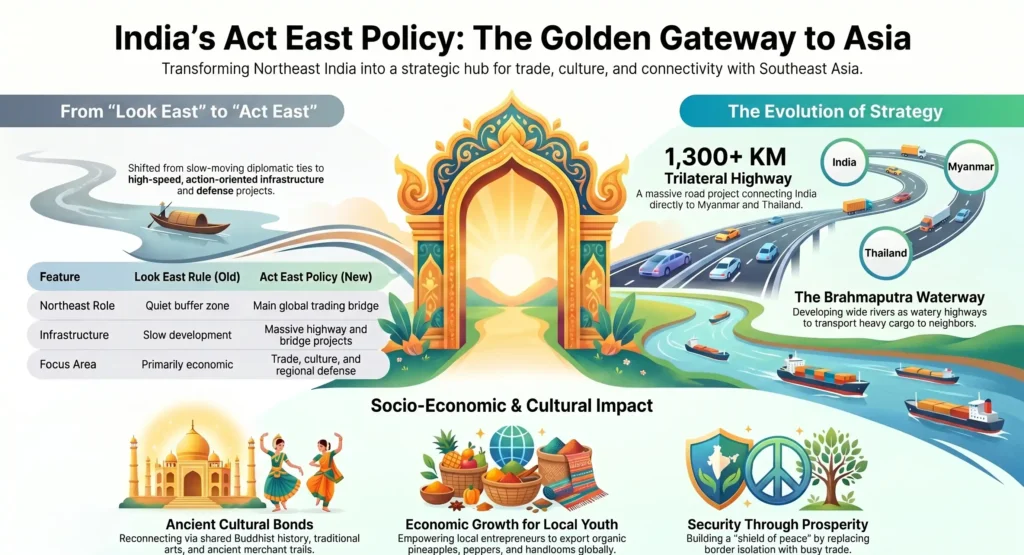
In 1991, with India opening up its economy, the government of P.V. Narasimha Rao launched a Look East Policy, to build ties with the fast-growing countries of Southeast Asia. In 2014 the Modi government renamed it the Act East Policy, promising to move from looking to doing.
The idea was simple. If India wanted to trade with Myanmar, Thailand and the rest of ASEAN, the Northeast was its only land gateway. Instead of being a remote corner at the end of a narrow neck, it could become a front door.
There was even an old road to remind everyone it was possible. During the Second World War, Allied engineers built the Stilwell Road, running about 1,736 kilometres from Ledo in Assam through Burma to Kunming in China. After the war, most of it was abandoned to the jungle.
The river route
The most ambitious project is called Kaladan, after the Burmese river at its heart.
The plan works in three stages. Ships sail from Kolkata across the Bay of Bengal to the port of Sittwe in Myanmar. From Sittwe, boats travel 158 kilometres up the Kaladan river to Paletwa. From Paletwa, a new road runs 109 kilometres north to Zorinpui, and into Mizoram. It would give the Northeast a way to the sea that does not pass through the Chicken’s Neck at all.
It was first meant to be ready by 2014. The port at Sittwe and the river section were finished and opened. But the road from Paletwa runs through Myanmar’s Rakhine and Chin regions, which have been torn by fighting, and after the military coup in Myanmar in February 2021 things only grew harder. Deadline after deadline has passed.
It would give the Northeast a way to the sea that does not pass through the Chicken’s Neck at all.
Dilip Kumar (1922–2021): The Tragedy King Who Taught India How to Act
The highway
The other great project is a highway. The India-Myanmar-Thailand Trilateral Highway is planned to run about 1,360 kilometres from Moreh in Manipur, through Myanmar, to Mae Sot in Thailand, and one day, perhaps, on to Laos, Cambodia and Vietnam.
It too has been slowed by conflict. It is said to be about seventy per cent finished, but it has missed deadline after deadline.
The door
None of this means the Act East Policy has failed. Inside the Northeast, much has been built in recent years, roads and bridges among them, bringing the region closer to the rest of the country. Japan has become a partner in many of these projects.
But the policy’s biggest promise, of goods and people flowing freely from the Northeast into Southeast Asia, depends on something India cannot build alone: peace on the other side of the border.
So, for now, the story of Act East can be told in one small place. At Zorinpui, India’s side of the route reaches the border, and waits. The last 109 kilometres, through a country at war with itself, will decide whether the Northeast becomes India’s front door, or stays at the end of a very narrow neck.
Dev Anand (1923–2011): The Evergreen Legend of Indian Cinema
If you think you have remembered everything about this topic take this QUIZ
Results


#1. What is the primary vision of the Act East Policy mentioned in the text?
#2. When was the original “Look East” idea started, and when was it upgraded to “Act East”?
#3. What is the name of the massive road project designed to connect India, Myanmar, and Thailand?
#4. Which river is being developed as a “watery highway” to transport heavy cargo to neighboring countries?
#5. How does the Act East Policy help the local youth of Northeast India?
#6. What ancient cultural connection is mentioned as a bond between India and Southeast Asia?
#7. According to security experts, why is a prosperous border considered the safest border?
#8. Approximately how long is the highway connecting India, Myanmar, and Thailand?
What is the main goal of this eastern policy?
The main goal is to build strong roads, powerful businesses and deep cultural friendships between India and the countries of Southeast Asia using the Northeast as the connecting bridge.
How does this help the local people of the Northeast?
It brings massive investments into their states creating new jobs in transport tourism and farming. It allows local youth to find great opportunities without having to leave their hometowns.
Which foreign countries are mainly involved in this connection?
The primary focus is on nations that belong to the ASEAN group which includes countries like Myanmar Thailand Vietnam Singapore and Indonesia.
Is the project only about building roads and making money?
No, it places a massive focus on human culture. The policy actively promotes the shared history of Buddhism, traditional arts and academic exchanges between the countries.
Why was the policy changed from “Look East” to “Act East”?
The change was made to emphasize “action-oriented” results. While the old policy focused on building diplomatic ties, “Act East” focuses on building the physical infrastructure (roads, rail, ports) necessary to make those ties functional.
Sources & References
The Diplomat, “BIMSTEC, Northeast India, and an Overlooked Pillar of the Act East Policy” (July 2026) — the status of the Trilateral Highway and the Paletwa–Zorinpui road.
Deccan Herald, Shemin Joy, “Key ‘Act East’ project on creating shipping corridor misses deadline” — the waterway and road components of the Kaladan project.
PolSci Institute, “Act East Policy: Enhancing India’s Role in East Asia” (25 May 2026) — the Kaladan route as an alternative to the Chicken’s Neck and the India-Japan Act East Forum.
Tolivi H. Sumi, “Connectivity projects of North-East India under Act East Policy”, Dimapur Government College Journal X(1) (2024) — the Kaladan route from Kolkata to Mizoram.