Manipur: at the end of a feast comes a bowl of kheer the colour of a bruise. The rice that makes it went into the pot looking almost black. It is called chak-hao, which simply means delicious rice
At a Manipuri feast, after the rice and the fish and the vegetables, comes the last dish of the day.
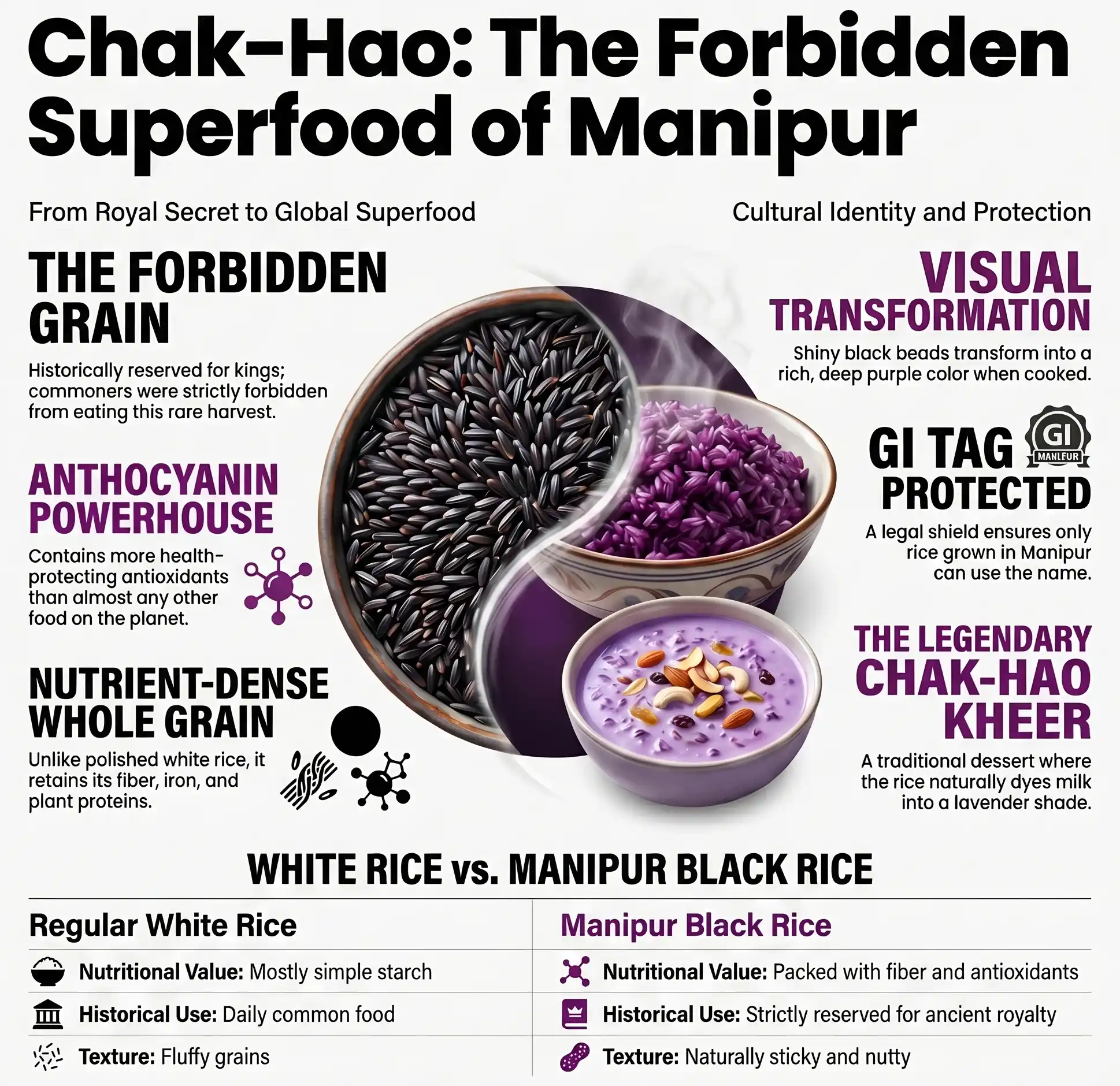
It is a kheer, a milk pudding, and it is purple. Not pink, not brown. A deep, glowing purple, somewhere between burgundy and violet, with a nutty smell rising off it.
The rice that went into it did not look like that at all. In the sack it is so dark it seems black.
In the sack the rice is so dark it seems black. In the pot it turns purple.
The rice is called chak-hao. In Meitei, the language of the Manipur valley, chak means rice and ahaoba means delicious. So the name of this rice is, quite simply, delicious rice.
It is an old scented variety, grown mainly in Manipur and in parts of Nagaland. The grains are large. When cooked, the rice is soft and sticky, and carries a strong, pleasant aroma.
Manipuri farmers sort their scented rices by colour. Chakhao Amubi is the black one, Chakhao Poireiton the purple, Chakhao Angangba the red and Chakhao Angouba the white. Amubi and Poireiton are the two best known, and the ones most often grown.
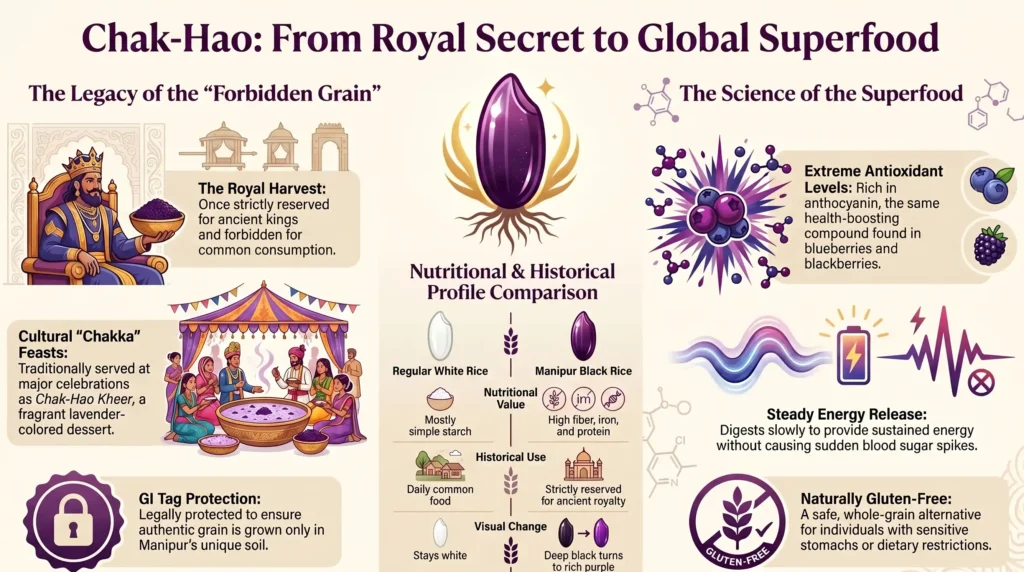
The colour comes from anthocyanins, natural pigments that also give blueberries and blackberries their deep shades. The outer layer of black rice carries one of the highest levels of anthocyanin found in any food.
That is also why the colour shifts in the pot. Dry, the pigment looks almost black. Cooked in milk or water, it spreads and lightens into purple.
Chak-hao is not polished white rice. Its grain keeps its bran, so it has more fibre, and a mild, nutty taste. In Manipur it has long been treated as something closer to medicine than to everyday food, and traditional practitioners have used it in their remedies.
The colour comes from the same pigment that makes blueberries blue.
Chak-hao is grown in the wet fields of the Manipur valley and in the hills, including in the country around Loktak, the great lake at the heart of the state. It is a single-season crop, and the new rice comes to the markets in the cold months, from about December onwards.
Elsewhere in the world, black rice goes by other names. In several countries it is sold as forbidden rice, after a story that it was once reserved for emperors. In Manipur it needed no such story. It was simply the rice you brought out when something mattered.
Chak-hao is not the rice Manipuris eat every day. It is for occasions: community feasts, religious ceremonies, weddings and celebrations.
Cooking it takes patience. The grains are tough and are usually soaked for several hours, often overnight, before they go into the pot. Then they are simmered slowly, in milk for kheer, with a little cardamom, and often finished with nuts.
Outside the kheer, cooks use it as porridge, or in place of ordinary rice in a pulao, where it holds its shape instead of turning to mush.
In December 2017, the Consortium of Producers of Chak-hao, based in Imphal, applied for a Geographical Indication tag for the rice, helped by the state agriculture department and the regional agricultural marketing corporation.
On 20 April 2020, it was granted. A GI tag means the name belongs to the place: rice grown elsewhere cannot be sold as chak-hao. For a small farming community, that is a way of keeping the value of something they have grown for generations.
There is a reason it mattered. Researchers note that many of Manipur’s traditional rice landraces have already been lost, pushed out by modern high-yielding varieties. Interest in chak-hao farming has risen again only in recent years, as demand has grown far beyond the state.
The bowl
That is the story sitting in the bowl at the end of a Manipuri feast.
An old, slow, difficult rice that gives poor yields compared with modern varieties, kept alive because it smells wonderful, because it is good for you, and because a feast would not feel like a feast without it. Black in the sack. Purple in the pot. Delicious, as its name says.
If you think you have remembered everything about this topic take this QUIZ
Results
QUIZ START
#1. What is the local name for the unique black rice grown in Manipur?
Previous
Next
#2. Why was this grain historically known as the “forbidden rice”?
Previous
Next
#3. What happens to the color of the rice when it is cooked?
Previous
Next
#4. Which powerful natural antioxidant gives the rice its deep dark color?
Previous
Next
#5. What is the most famous traditional dessert made from this rice in Manipur?
Previous
Next
#6. Which official status protects the black rice of Manipur from fake varieties?
Previous
Next
#7. How does the nutritional profile of black rice differ from regular white rice?
Previous
Next
#8. According to the “Fast Facts,” what was a traditional medicinal use for the water used to boil this rice?
Previous
Finish
Why is it called the forbidden rice?
In ancient times the harvest was so small and the nutritional value was considered so high that common people were strictly forbidden from eating it so it could be saved entirely for the royal family.
The dark color comes from a massive concentration of anthocyanin which is a very powerful natural antioxidant found in the outer bran layer of the grain.
Is it difficult to cook this type of rice?
Yes it takes significantly longer to cook than regular white rice because of its thick outer bran layer. It is often recommended to soak the grains in water for a few hours before boiling.
What is the most popular way to eat it in Manipur?
The most traditional and popular preparation is Chak-Hao Kheer which is a rich sticky and sweet pudding made by slow cooking the rice with milk and cardamom.
Can anyone grow this specific rice?
While black rice can grow elsewhere the specific authentic Chak-Hao variety holds a Geographical Indication tag meaning the highest quality and true form uniquely belongs to the soil and climate of Manipur.
Sources & References
Wikipedia, “Chak-Hao black rice” — the meaning of the name, the four colour types, the GI application of December 2017 and its grant on 20 April 2020; to be checked against the GI Registry certificate before publishing.
The Organic Magazine, “Black rice is called forbidden rice worldwide; in India, Manipur calls it Chak-hao” (2020) — the consortium behind the GI application, the use of chak-hao in community feasts and traditional medicine, and its nutritional comparison with other rices.
Devi et al., “Chakhao: scented traditional rice of Manipur”, Journal of Advanced Scientific Research 12(1) (2021) — the qualities of chakhao, its use in religious feasts, and the loss of landraces to high-yielding varieties.
Manipur Organic Mission Agency, Government of Manipur, “Black aromatic rice (Chak-hao)” — the anthocyanin pigment, the two cultivated varieties and the season of availability.