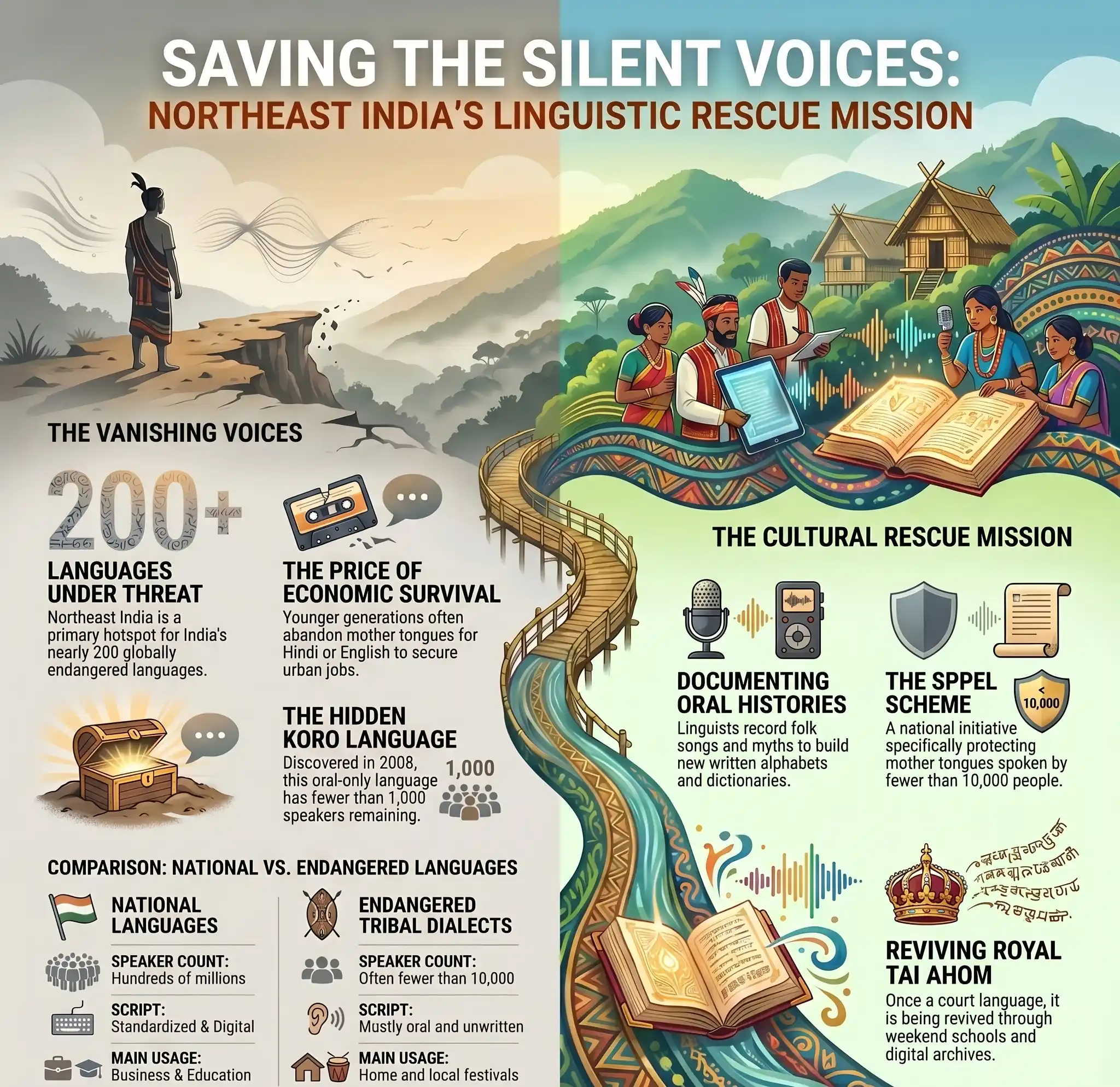
Northeast India is home to one of the most incredible collections of human languages on the entire planet. However this brilliant linguistic diversity is under massive threat. Dozens of ancient tribal dialects are quietly slipping away as younger generations move to modern cities and adopt dominant languages for better jobs. Languages like the historically royal Tai Ahom or the recently discovered hidden Koro language are balancing right on the edge of extinction. Today a dedicated team of linguists local tribal elders and government organizations like the Central Institute of Indian Languages are working desperately to record dictionaries map grammars and revive these ancient mother tongues before they are lost to history forever.| Feature | Details |
| Focus Region | Northeast India |
| Total Languages | Over two hundred distinct native languages |
| Key Endangered Languages | Koro Tai Ahom Miji |
| Primary Threat | Urban migration and cultural assimilation |
| Leading Organization | Central Institute of Indian Languages |
Imagine waking up one day to realize that you are one of the very last people on earth who knows how to say hello in your native tongue. When a language dies we do not just lose a collection of vocabulary words. We lose a completely unique way of looking at the universe. We lose ancient songs intimate knowledge of local forest medicine and the beautiful oral histories of entire civilizations.
Northeast India is currently standing at a massive cultural crossroads. The lush green valleys and steep hills of this region hide over two hundred different indigenous languages making it an absolute hotspot for global linguistic study. Yet as modern roads and the internet connect these deep villages to the outside world the ancient dialects are quickly fading into silence. Documenting and protecting these voices has become one of the most urgent cultural rescue missions of our modern time.
The Unconventional Journey of Irrfan Khan
A Linguistic Treasure Map
To understand the sheer scale of the situation you must look at how the communities in the eastern borderlands have lived for thousands of years. Separated by thick jungles massive roaring rivers and steep mountain ranges neighboring villages often developed entirely different languages. They did not just create different accents they created completely different language families including Tibeto-Burman and Austroasiatic groups.
According to global reports from the United Nations Educational Scientific and Cultural Organization India has nearly two hundred endangered languages and a massive portion of them are concentrated strictly in the northeast. When the elders of these small communities pass away they take massive libraries of unwritten knowledge with them.
Beyond Boundaries: The Complete Biography of Farhan Akhtar
The Discovery of the Hidden Koro
Sometimes scientists find incredible treasures completely by accident. In two thousand and eight a linguistic expedition organized by the National Geographic Society traveled to a remote district in Arunachal Pradesh. They went there to document two known local dialects called Aka and Miji. While sitting on the bamboo porches of the village houses they suddenly heard a completely different sound.
They discovered an entirely unknown language called Koro. It was spoken by barely a thousand people living directly among the Aka tribe. Despite living in the exact same village sharing the same food and wearing the same clothes the Koro speakers used a language that sounded as different from Aka as English does from Japanese.
A Completely Unique Vocabulary
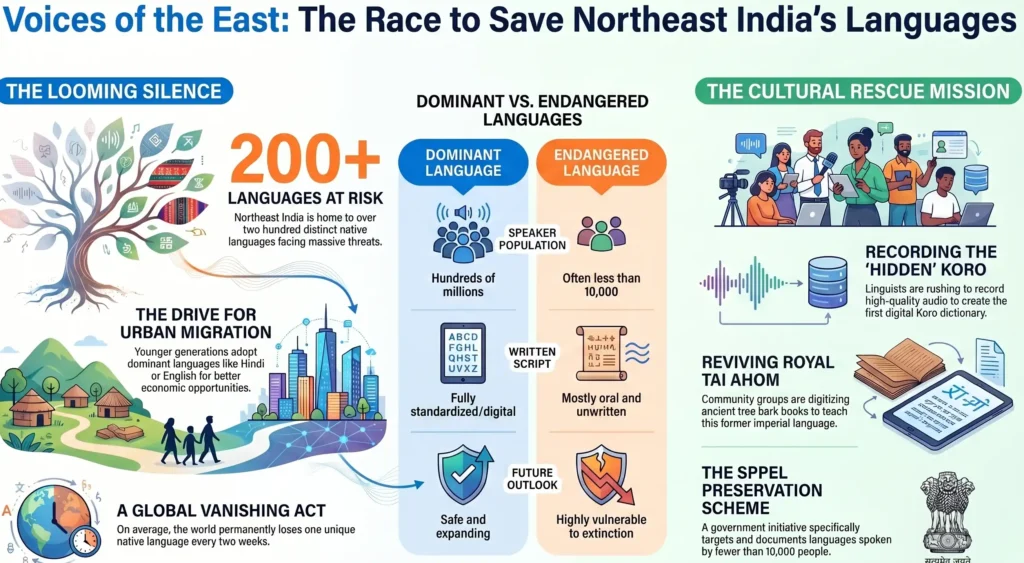
The discovery shocked the academic world. The Koro language has absolutely no written script. It is kept alive entirely by memory and daily conversation. For example while the surrounding Aka speakers call a mountain “phù” the Koro speakers call it “nggõ”. Because the younger generation of the tribe is rapidly shifting to speaking Hindi for better educational opportunities the newly discovered Koro language was immediately classified as highly endangered. Organizations like the Living Tongues Institute for Endangered Languages are now rushing to record high quality audio of the village elders to create the very first digital Koro dictionary.
The Fading Echoes of Royal Ahom
Not all endangered languages belong to tiny isolated hill tribes. Some were once the powerful voices of massive empires. The Tai Ahom language was the official royal court language of the mighty Ahom kingdom which ruled Assam for over six hundred years. Originating from the Tai Kadai language family it had its own beautiful written script and a massive collection of historical manuscripts written on tree bark.
From Jadoo to Javed: The Complete Biography of a Literary Giant
However during the later years of the kingdom the rulers gradually adopted the local Assamese language to connect better with their subjects. Over centuries the original Tai Ahom language completely stopped being used in daily conversation. Today it survives only in sacred religious chants performed by traditional priests. But there is a bright spark of hope. Dedicated community groups and young scholars are currently fighting a brilliant cultural battle to revive this royal language by teaching it in local weekend schools and digitizing the ancient tree bark books.
The Modern Threat to Mother Tongues
Why are these beautiful languages disappearing so quickly? The answer is tied deeply to modern economics and survival. When a young person from a remote village wants to attend a major university or get a well paying job in a modern city they must learn dominant national languages like Hindi or English.
As they move away from their villages to work in big cities they naturally stop using their mother tongue. When these young people eventually have their own children they often do not teach them the ancient tribal dialect because it has no practical use in the modern business world. It is a completely understandable choice for economic survival but it results in a massive and heartbreaking loss of cultural identity.
Heroes of Language Preservation
Thankfully the national government and passionate linguists refuse to let these languages disappear without a massive fight. The Central Institute of Indian Languages based in Mysuru runs a highly focused initiative called the Scheme for Protection and Preservation of Endangered Languages. This brilliant program specifically targets mother tongues spoken by fewer than ten thousand people.
They send trained linguists deep into the northeastern forests to live with the tribal communities for months at a time. They carefully record folk songs traditional stories and local myths. They use these recordings to build brand new written alphabets grammar books and simple picture dictionaries for local children. The Ministry of Development of North Eastern Region actively supports these massive preservation efforts realizing that the true wealth of the country lies in its brilliant human diversity.
Every time a linguist hits the record button on their camera they are capturing a beautiful fading piece of the human soul ensuring that the unique voices of the eastern hills will continue to echo in digital archives forever.
A.R. Rahman : The Musical Genius Who Conquered the Globe
Quick Comparison Table
| Feature | Dominant National Language | Endangered Tribal Language |
| Speaker Population | Hundreds of millions | Often less than ten thousand |
| Written Script | Fully standardized and digital | Mostly oral and completely unwritten |
| Main Usage | Government business and education | Remote village homes and local festivals |
| Future Outlook | Completely safe and expanding | Highly vulnerable to rapid extinction |
Curious Indian Fast Facts
- On average the world permanently loses one unique native language every two weeks.
- The Koro language has absolutely no written alphabet and relies entirely on village elders passing down oral stories.
- Tai Ahom was the powerful court language of an empire that successfully resisted massive Mughal invasions for centuries.
- The SPPEL scheme officially documents languages that have a speaking population of fewer than ten thousand individuals.
- Many isolated dialects in the northeast have highly specific words for local forest plants that modern science has not even discovered yet.
Conclusion
The fight to document and save the fading dialects of Northeast India is a race against time. It is not just an academic exercise for scholars in dusty libraries. It is a deeply emotional battle to save the very soul and identity of the indigenous communities. A language is the ultimate mirror of a culture reflecting exactly how a group of people loves thinks and understands the natural world around them.
When we support the incredible work of the linguists and the brave tribal elders we are doing a profound service to global humanity. We are ensuring that the beautiful royal chants of Tai Ahom and the hidden mountain words of Koro are safely protected from the harsh winds of rapid globalization. The beautiful misty valleys of the northeast have always been a sanctuary for diversity and by protecting these ancient mother tongues we promise future generations that the brilliant colorful voices of India will never go completely silent.
Ashok Kumar (1911–2001): The Accidental Star Who Defined Bollywood
If you think you have remembered everything about this topic take this QUIZ
Results


#1. Approximately how many distinct native languages are found in the Northeast Indian region?
#2. Which “hidden” language was discovered by a National Geographic expedition as recently as 2008?
#3. What was the historical status of the Tai Ahom language in the state of Assam?
#4. According to UNESCO, how many endangered languages does India have in total?
#5. What is the primary cause for the rapid disappearance of ancient tribal dialects today?
#6. The SPPEL scheme focuses on protecting mother tongues spoken by fewer than how many people?
#7. Which organization is leading the national effort to record dictionaries and map grammars of these languages?
#8. According to the “Fast Facts,” how often does the world permanently lose a unique native language?
What makes a language officially endangered?
A language is considered endangered when its speakers stop using it in daily life parents stop teaching it to their children and it faces a very high risk of becoming completely extinct.
How was the Koro language discovered?
It was discovered entirely by accident in two thousand and eight by a team of linguists who traveled to Arunachal Pradesh to study a different language but suddenly heard a completely unknown dialect being spoken on the village porches.
Why do young people stop speaking their native tribal languages?
Young people often shift entirely to dominant languages like Hindi or English because those languages are absolutely necessary for higher education getting modern jobs and surviving in big urban cities.
What is the SPPEL program?
The Scheme for Protection and Preservation of Endangered Languages is a massive government program run by the Central Institute of Indian Languages to formally document and digitize native languages spoken by fewer than ten thousand people.
Can a completely extinct language be brought back to life?
Yes it is incredibly difficult but possible. With proper historical documentation dedicated community effort and structural teaching an extinct language like Tai Ahom can slowly be revived into active use.