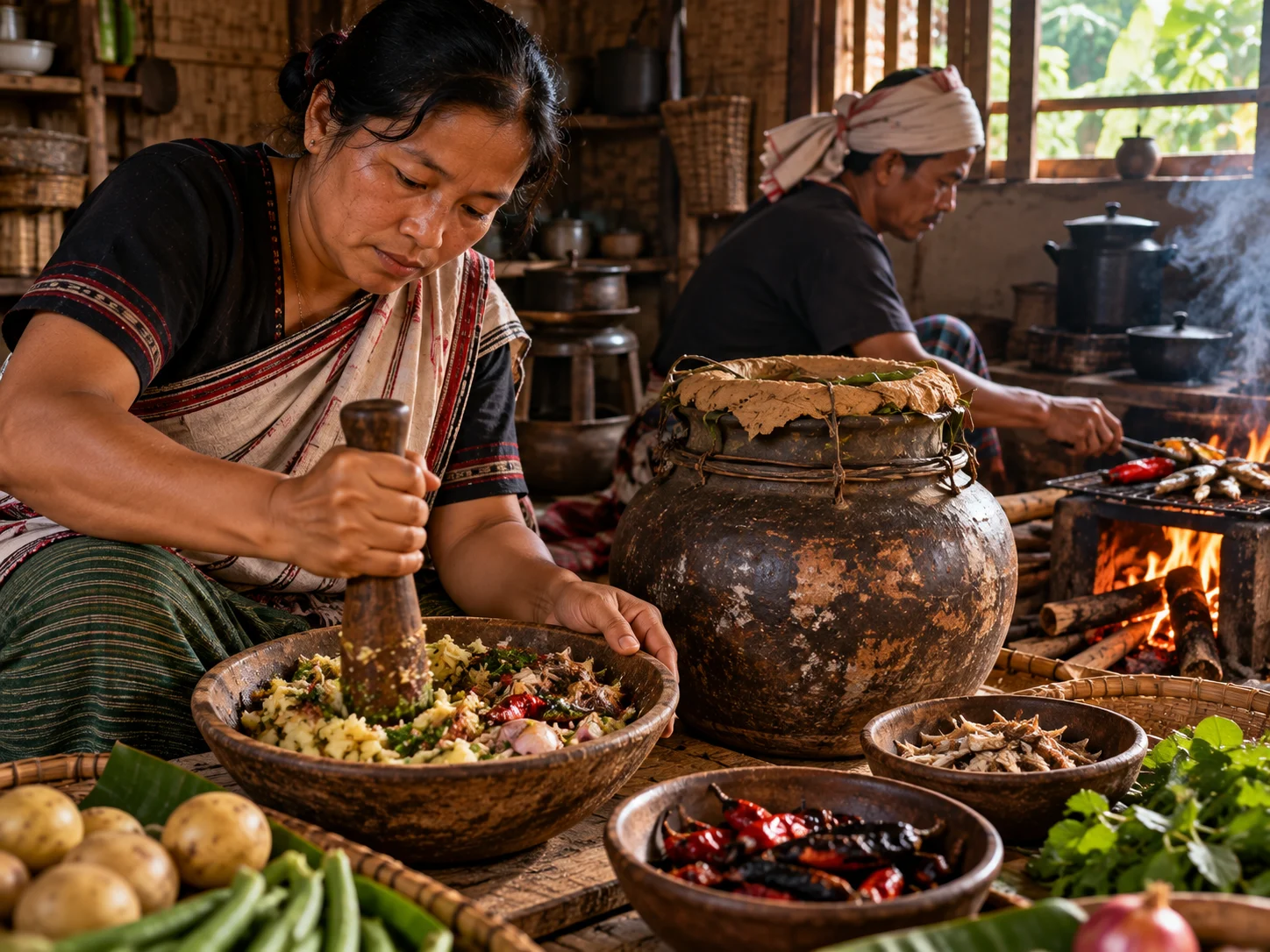
Manipur: the eromba on a Meitei family’s plate takes a few minutes to mash. The fish that gives it its soul has spent half a year sealed in a clay pot, waiting
In a Meitei kitchen in Manipur, there is a dish that turns up at meal after meal, all year round. It is not grand. It takes a few minutes to make. It is eromba.
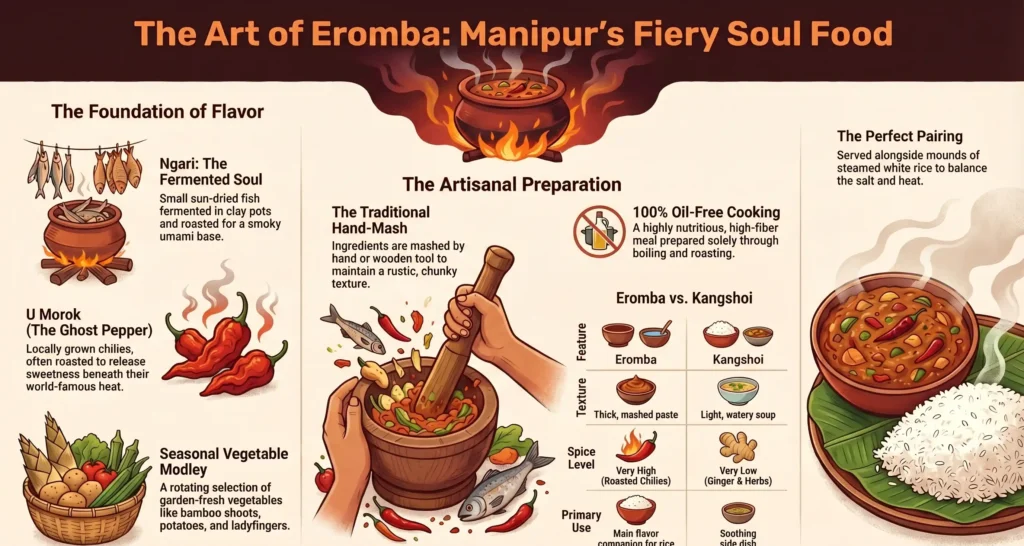
Somebody boils or steams whatever vegetables are at hand: potatoes, beans, pumpkin, a bamboo shoot or two. Then they are mashed together with fiery chillies, often the fearsome umorok, the king chilli, and with one ingredient that nothing else can replace. A little water, and a little more mashing, and it is done.
The name tells you exactly what happens. Eromba, people say, comes from the Manipuri words for mixing and stirring something watery.
The one ingredient that nothing can replace is ngari. And the ngari in today’s eromba started its journey many months ago.
The eromba takes a few minutes to make. The ngari in it started its journey months ago.
The small fish
Ngari begins as a very small fish, a pool barb that the Meiteis call phabou nga, rarely longer than a finger. The fish are caught, cleaned and dried in the sun.
Then they are pounded. The dried fish are spread on gunny bags, covered with more gunny bags, and beaten with long-handled wooden tampers until the heads and bones are crushed and soft. This helps them ferment faster and better.
Nga means fish. Ri comes from the word for fermenting. Ngari is simply fermented fish. But there is nothing simple about the next part.
Operation Vijay: How India Won the High-Altitude Kargil War of 1999
The Life and Teachings of Guru Nanak Dev Ji: A Journey of Truth
The pot
Ngari is made in a special earthen pot called the ngari chaphu. It is thick-walled, and often bound on the outside with strong iron wire to hold it together. Before any fish goes in, the inside walls are coated with mustard oil, again and again, until the clay is sealed and will not drink in the fish.
Then the fish are packed in. Not gently. Skilled workers press them down hard, first with their feet and then with a heavy wooden pestle, until there is no air left in the pot at all. No salt is added. A single pot can hold anywhere from about fifteen to seventy-five kilograms of fish.
Finally the mouth of the pot is sealed with fish paste, leaves and mud. And then everyone waits.
The pot sits, at ordinary room temperature, for about six months. Inside, in the dark and without air, the fish slowly change into something else: dense, pungent, deep in flavour, and good to keep.
No salt. No air. Just fish, oil, clay and about six months of patience.
There are families in Manipur who have been making ngari this way for generations.
The market
When the pots are opened, much of the ngari makes its way to the markets. The most famous is Ima Keithel in the heart of Imphal, the mothers’ market, run entirely by women.
It is a remarkable place. Each shed has its own rules about what can be sold where. Every morning, women bring produce in from the farms and villages. Stalls inside the main buildings are almost impossible for newcomers to get, because many have been in the same families for decades, handed down through the generations. Here, among the rice, the phanek sarongs and the puja offerings, women sell ngari and fermented bamboo shoot to other women, who carry them home.
Mumbai Terror Attacks (2008): The Siege That Shook the World
The mortar
And so, a few months after a small silver fish was caught and dried, a spoonful of it goes into a kitchen in Imphal or a village by Loktak.
It is roasted a little, then mashed into the potatoes and beans and chillies. The smell fills the house. For people who did not grow up with it, the smell can be a shock. For the family sitting down to eat, it smells of every ordinary day of their lives.
Researchers who studied Meitei food traditions put it plainly: for the Meiteis, the daily meal is never complete without ngari. Much of the time, that ngari arrives as eromba.
That is the quiet wonder of it. A dish that takes a few minutes to mash, and is eaten on an ordinary Tuesday without anyone thinking twice, depends on months of waiting in a sealed clay pot. Fast food, in the end, is only possible because somebody, somewhere, was very, very slow.
The 2004 Indian Ocean Tsunami: From Devastation to Resilience
Demonetization in India (2016): The Night That Changed the Economy
If you think you have remembered everything about this topic take this QUIZ
Results


#1. What is the name of the special fermented fish that acts as the “soul” of Manipuri cooking?
#2. How are the fermented fish and chilies traditionally prepared before being added to the mash?
#3. What is unique about the dietary profile of a traditional Manipuri Eromba?
#4. Which famous chili, once certified as the hottest in the world, is used to provide the dish’s intense heat?
#5. Why do local cooks prefer mashing the ingredients by hand rather than using an electric blender?
#6. According to the text, what are the special clay pots used for fermenting fish called?
#7. How does the Eromba dish change throughout the year?
#8. Based on the “Quick Comparison Table,” how does Eromba differ from Kangshoi?
What is the main flavor profile of this traditional mash?
It is intensely savory, spicy, and earthy. The combination of roasted fermented fish and roasted chilies gives it a strong, pungent umami flavor that pairs perfectly with plain rice.
Can this dish be made without fermented fish?
While the authentic version relies heavily on Ngari for its signature taste, vegetarians sometimes make a similar mash using roasted fermented soybeans, locally known as Hawaijar, to replicate the savory depth.
Is the meal considered healthy?
Yes, it is highly nutritious. Because the ingredients are only boiled and roasted, there is absolutely no cooking oil used. It is packed with fiber from the vegetables and vitamins from the fresh herbs.
What kind of vegetables work best for the boiling process?
Almost any vegetable that becomes soft when boiled works perfectly. Local favorites include potatoes, bamboo shoots, ladyfingers, taro roots, and banana stems.
Why is the food always mashed by hand instead of a machine?
Mashing by hand or with a wooden tool retains a rustic, chunky texture. An electric blender would turn the ingredients into a fine puree, which ruins the traditional mouthfeel of the meal.
Sources & References
“The traditional fermented foods of Meiteis of Manipur, India: A case study”, Journal of Pharmacognosy and Phytochemistry 7(4) (2018) — the making of ngari, the ngari chaphu, and ngari’s place in the daily Meitei meal.
Indian Journal of Fisheries research on traditionally fermented Ngari, together with peer-reviewed studies of Manipuri fermented fish — Puntius fish, drying and packing in earthen pots, airtight fermentation and a maturation period of roughly four to six months.
The Locavore, Ammo Angom, “The Shifting Heart of Manipur’s Iconic Ima Market” (26 October 2022) — the organisation of Ima Keithel and the stalls handed down through generations.
India Today NE, “Eromba: A culinary gem of Manipur” (13 February 2024) — the meaning of the name eromba and its ingredients.