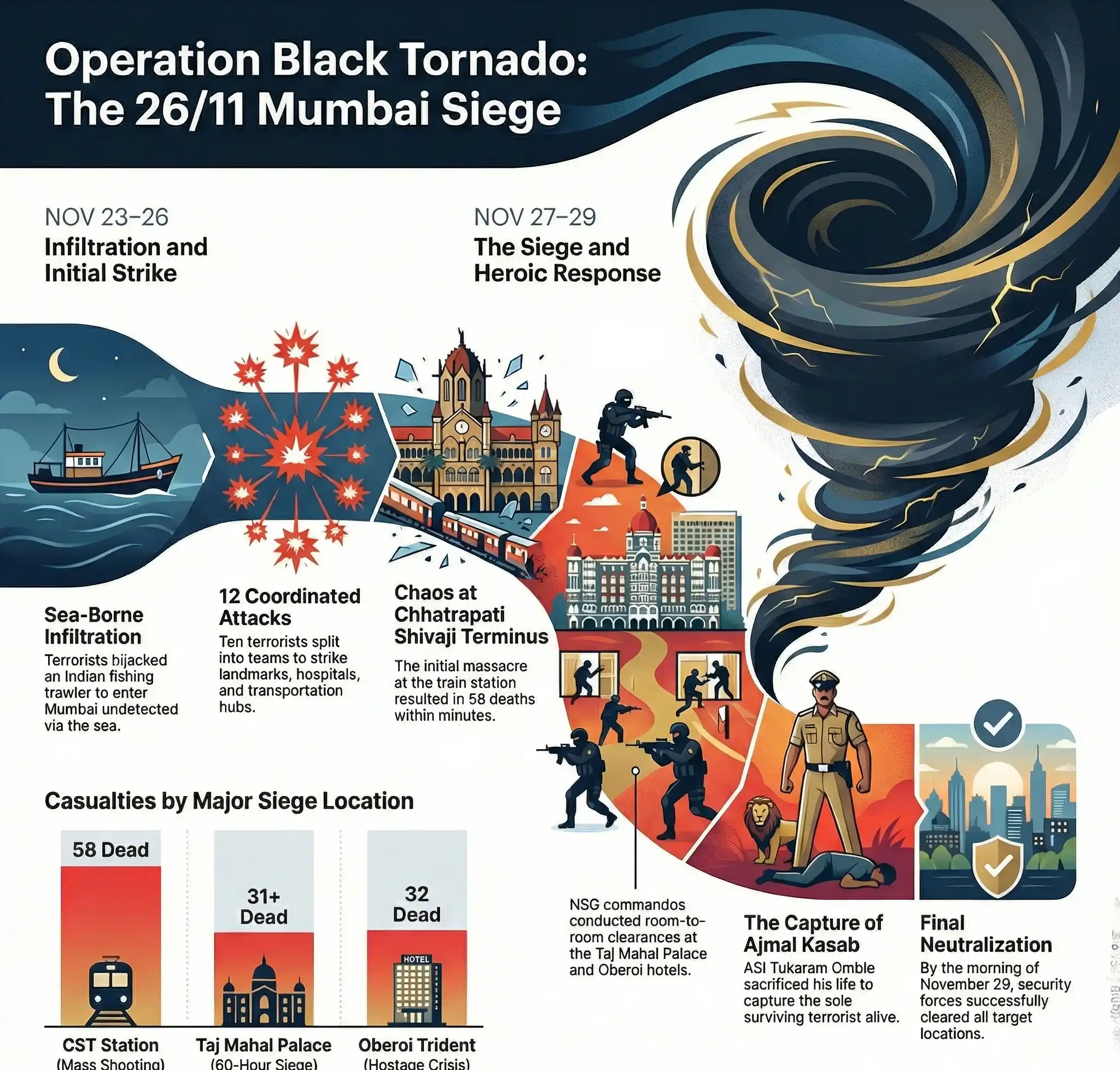
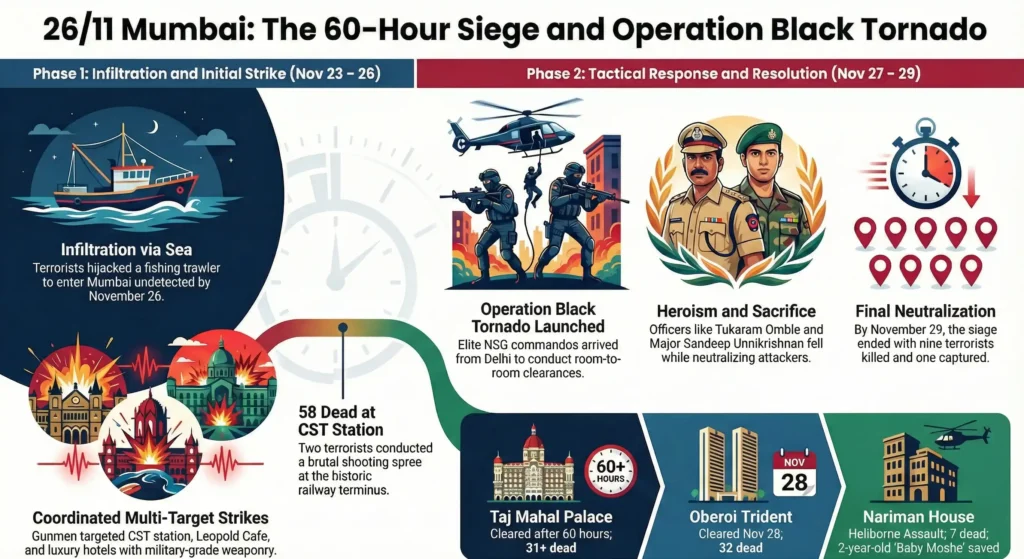
The 2008 Mumbai terror attacks, known as 26/11, unfolded from November 26 to 29, involving 10 Lashkar-e-Taiba (LeT) militants from Pakistan who executed 12 coordinated shootings and bombings across Mumbai, killing 175 people including 9 attackers and injuring over 300.
How Mumbai answered three days of terror with courage, not hatred
For three days in November 2008, ten young men with automatic rifles and grenades moved through the city of Mumbai, killing everyone they could. Before it was over, they had murdered a hundred and sixty-six people, and wounded hundreds more.
It was one of the most shocking terrorist attacks the world had ever seen, and it was broadcast live, hour after hour, into homes around the globe.
But the truest story of those three days is not really about the ten killers, and it is a mistake, the very mistake they wanted the world to make, to make it about them. The truest story is about everyone else. It is about a constable who caught bullets in his own body so that a killer could be taken alive. It is about hotel waiters who died shielding the guests they could easily have abandoned. It is about a city of many faiths that the attackers came to divide, and could not.
This is the story of 26/11, and of what the killers could not take.
Three days in November
On the night of 26 November 2008, ten attackers came ashore from the sea, having sailed from Pakistan in a hijacked fishing boat. They split into small teams and fanned out across the city.
Over the next sixty hours, they struck a series of targets chosen to hit the city’s heart and to hold the world’s cameras: the grand Taj Mahal Palace hotel and the Oberoi Trident, a popular cafe, a hospital, and, most infamously, the crowded Chhatrapati Shivaji railway terminus, where they simply opened fire on ordinary commuters heading home, and a small Jewish community centre called Nariman House, which they seized and where they murdered the rabbi and his wife.
The men were not lone madmen. They were young operatives trained and sent by Lashkar-e-Taiba, a terrorist organisation based in Pakistan, and throughout the assault their every move was guided in real time by handlers speaking to them by phone from across the border, watching the television coverage and telling them where to go and whom to kill.
For sixty hours, guided by voices on the phone from another country, ten men held one of the world’s great cities in a grip of fire and fear, while it was all shown live to a watching planet.
And here is where the real story of those days is found, because while the killers spread terror, a great many other people did the exact opposite. They ran toward the guns.
Police officers died in the very first hours trying to stop the attackers. Elite commandos of the National Security Guard were flown in from Delhi and fought through the smoke-filled hotels room by room, one of them, a young major named Sandeep Unnikrishnan, dying as he shielded a wounded comrade.
But perhaps the single most extraordinary act belonged to a middle-aged police constable named Tukaram Omble. Cornering one of the gunmen, and knowing the man was still firing, Omble seized the hot barrel of the rifle with his bare hands and simply would not let go. He took the bullets into his own body and held on, so that his colleagues could take the attacker alive rather than shoot him dead.
A constable seized the barrel of the killer’s firing gun with his bare hands and refused to let go, taking the bullets into his own body so that the man could be captured alive rather than killed.
Omble died. The attacker he gave his life to capture was Ajmal Kasab, the only one of the ten taken alive, and his capture would prove to the entire world exactly where the attack had been planned and launched. And in the Taj hotel, the waiters and cooks and telephone operators, ordinary staff who could have fled to save themselves, chose instead to stay behind, hiding and guiding and shielding their guests through the long night, and many of them died doing it, for people they had known only as customers.
The city they came to divide
The men who planned the attack wanted far more than a body count. They wanted to terrify India and humiliate it. And, above all, they wanted to set its communities against one another, to use the rage and grief that follow such horror to turn Hindus and Muslims into enemies in the streets.
In that deepest aim, they failed completely.
The dead of those three days were Hindu and Muslim, Christian and Jew, Indian and foreign, rich guests and poor commuters. The men who killed them did not care what god anyone prayed to. Terrorism is the enemy of every ordinary person alive.
The victims crossed every line the attackers had hoped to inflame, and so did the people who saved them. At Nariman House, the rabbi and his wife were killed, but their two-year-old son was carried out alive in the arms of his nanny, an Indian woman who ran through the gunfire with the child clutched to her chest. A Jewish baby, saved by an Indian nanny, from terrorists who had come, in part, to make India’s faiths hate one another. And the city grieved for all its dead, of every religion, together, as one.
When it was over, India’s response said something quiet but important about the kind of country it wished to be.
The captured gunman, Ajmal Kasab, was not lynched by a furious crowd, nor made to vanish into a cell. He was given a lawyer and a full, public trial in open court, and only after he had been convicted was he executed, years later. It would have been easy, and popular, to do otherwise. That India chose instead the slow dignity of the law, even for a man who had machine-gunned its citizens, was its own kind of answer to people who believed in nothing but the gun. And though the pressure to strike back across the border was immense, India did not rush into a war.
What the killers could not take
So what, in the end, did those three days mean?
The ten men took a hundred and sixty-six lives, and that loss is permanent and beyond any comfort. Each of those people was an entire world, and their families carry the empty place where they were to this day. Nothing written here can lessen that, and nothing should try.
But it is worth being very clear about what the killers wanted, and what they actually got. They wanted a city broken and cowering. They got a city that buried its dead of every faith side by side, and went back to work. They wanted communities at one another’s throats. They got a constable who died to bring a killer to justice rather than to kill him, hotel workers who died for strangers, and a country that answered mass murder with a courtroom.
They wanted a city broken and turned against itself. They got a city that buried its dead of every faith together and refused to hate. That refusal is the thing they could not take.
Terrorism, in the end, is a message, and the message is always the same: be afraid, and turn on one another. The only real way to defeat it is to refuse, together, to do either. Mumbai, in the worst three days of its life, refused. It was frightened, of course, as anyone would be. But it did not let the fear make it cruel, or divided, or small. That refusal, quiet and stubborn and shared across every faith and street of a wounded city, is the thing the killers could never reach, and the thing most worth remembering. The ten men are a footnote of infamy. The constable with his bare hands on the gun, the waiter shielding a stranger, the nanny running through fire with a child in her arms, and a city that would not be turned against itself, are the story.
If you think you have remembered everything about this topic take this QUIZ
Results
QUIZ START
#1. How did the ten terrorists infiltrate Mumbai on the evening of November 26, 2008?
Previous
Next
#2. Which specific location was the site of the longest battle, lasting 60 hours before being cleared by the NSG?
Previous
Next
#3. What was the code name of the elite military operation launched by the National Security Guard (NSG) to neutralize the terrorists?
Previous
Next
#4. Which hero made the ultimate sacrifice by taking multiple bullets to his chest to ensure Ajmal Kasab was captured alive?
Previous
Next
#5. What significant intelligence breakthrough proved Pakistani involvement in the attacks?
Previous
Next
#6. According to the ‘Quick Comparison’ table, how many people were rescued from the Oberoi Trident after it was cleared on November 28?
Previous
Next
#7. Which landmark was a Jewish outreach center targeted by the terrorists, resulting in the rescue of 2-year-old ‘Baby Moshe’?
Previous
Next
#8. As a result of the security failures exposed by 26/11, which national agency was formed to investigate terror-related crimes across India?
Previous
Finish
When did the Mumbai terror attacks happen?
The attacks began on the night of November 26, 2008, and lasted until the morning of November 29, 2008.
Who was behind the 26/11 attacks?
The attacks were carried out by Lashkar-e-Taiba (LeT), a Pakistan-based terrorist organization.
How many terrorists were involved in 26/11?
There were 10 terrorists who entered Mumbai via sea.
Who was the only terrorist captured alive?
Ajmal Kasab was the only terrorist captured alive; he was later tried and executed by hanging in 2012.
What was Operation Black Tornado?
It was the code name for the operation launched by the National Security Guard (NSG) to flush out terrorists and rescue hostages from the besieged sites.
Encyclopaedia Britannica (“2008 Mumbai attacks”) — the three days of attacks, the targets, and the death toll.
Supreme Court of India (the Ajmal Kasab judgment) — the capture, trial, and conviction of the sole surviving attacker.
National Security Guard, Government of India (Operation Black Tornado) — the commando operation that ended the siege.
Gallantry Awards portal, Government of India (the 26/11 Ashok Chakra recipients) — the officers and constable decorated for their sacrifice, including Tukaram Omble and Sandeep Unnikrishnan.
Exploring the Soul of Bharat through History, Science, Culture, and its Diversity
Our Mission
Curious Indian is a definitive knowledge portal dedicated to chronicling the events, personalities, and cultural shifts that defined the Indian subcontinent. From the ancient Vedic Period to the complexities of 21st-century politics, our goal is to provide deep-dive analysis that inspires.
Editorial Standards & E-E-A-T
Every article published under our brand undergoes a rigorous fact-checking process. We prioritize primary historical records, academic citations, and credible archives to ensure our readers receive accurate, high-authority information.
Historical IntegrityDirectly sourcing from ASI archives and academic journals.
Topical AuthorityComprehensive clustering of Indian Science, Biographies, and Wars.
Managed by Paripurna Datta and TEAM | Dedicated to the Knowledge of India.