Uncovering the Nagarwala scandal mystery of 1971. How did Rustom Nagarwala walk out of SBI with ₹60 Lakhs just by mimicking Indira Gandhi’s voice? Was it a con, or a cover-up for a secret slush fund?
New Delhi, 24 May 1971: a bank cashier took a phone call he believed came from the Prime Minister, drove sixty lakh rupees to a stranger in an olive-green hat, and went to collect his receipt
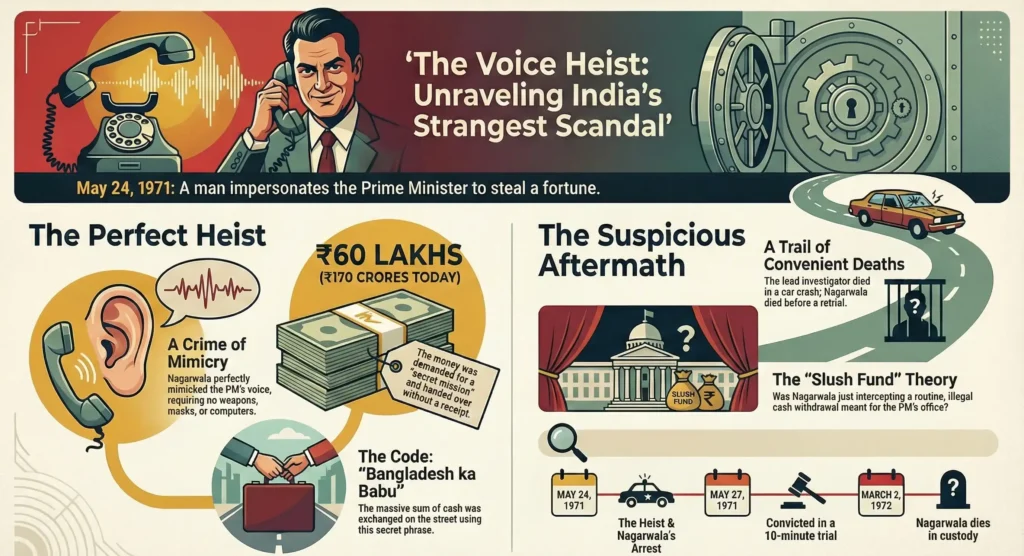
On the morning of 24 May 1971 the telephone rang on the desk of Ved Prakash Malhotra, chief cashier of the State Bank of India’s branch on Parliament Street in New Delhi.
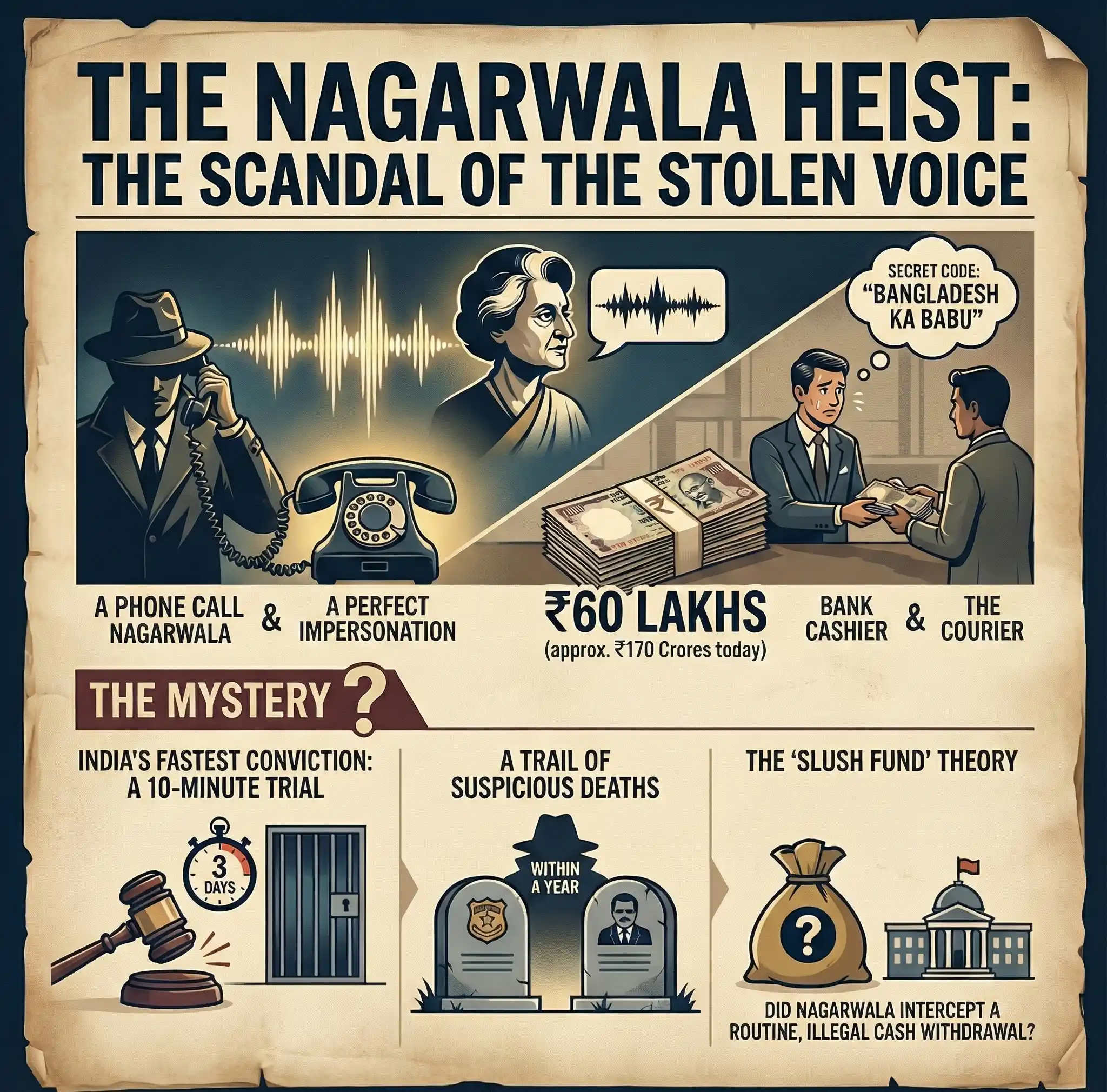
The caller said he was P.N. Haksar, secretary to the Prime Minister. Then a second voice came on the line. It said it was Indira Gandhi.
Malhotra could hardly believe it. The voice was brisk and got straight to the point. As her secretary had just told him, sixty lakh rupees was needed urgently in Bangladesh for important secret work. He was to get it ready quickly. A courier would come for it.
The voice on the line said it was the Prime Minister. He believed it.
1971 Nagarwala Case
Bangladesh ka babu
It was not a strange thing to believe in May 1971. East Pakistan was in revolt, refugees were pouring into India by the million, and a war was coming. Money for secret work in Bangladesh was exactly the kind of thing a government might need, quietly, in a hurry.
Malhotra asked how he would know the courier. The voice gave him a code. The man would say, “I am Bangladesh ka babu.” Malhotra was to answer, “I am Bar-at-Law.” After that he should do as the man said. And once the money was handed over, he was to come straight to the Prime Minister’s house, where he would be given a receipt.
Then the line went dead.
Sixty lakh rupees in 1971 was an enormous sum. Malhotra had the cash taken out and packed, loaded it into a car, and drove fast to make the one o’clock deadline.
He stopped across the road, about a hundred paces from the bank, near the old red-and-white Free Church, as the voice had told him to. He got out.
A tall, heavily built, fair-skinned man in an olive-green hat walked up to him. “I am Bangladesh babu,” he said.
“I am Bar-at-Law,” said Malhotra. The man said, “Let us go.”
They got into the car, an Ambassador. It would not start.
Malhotra tried again. Nothing. He turned to the stranger and asked him if he knew how to drive. The man said he did. So Malhotra asked him to take the steering, got out, and pushed.
The chief cashier of the State Bank pushed the car himself, with sixty lakh rupees inside and the stranger at the wheel.
The engine caught. They swapped places, Malhotra took the wheel again, and they drove off. Somewhere along the way the man got out with the money.
The house
Malhotra did what he had been told. He went to collect his receipt from the Prime Minister’s office.
There he was told that neither the Prime Minister nor Haksar had given any such instruction. Nobody had sent anyone. There was no secret work, and there was no receipt.
He went to the police. The man in the olive-green hat was Rustom Sohrab Nagarwala, a retired army captain. Within hours the Delhi Police had arrested him and recovered most of the money.
That should have been the end of it. It was the beginning. Nagarwala confessed, and was tried and sentenced with remarkable speed. The officer who had led the investigation, D.K. Kashyap, was killed later that year in a road accident. Nagarwala himself died in custody not long after. The opposition asked, loudly and for years, how a phone call could move sixty lakh rupees out of a public bank, and whose money it really was. Those questions were never properly answered, and the case has never quite closed.
Of everyone in the story, Ved Prakash Malhotra is the one it is easiest to laugh at and hardest to blame. He heard the voice he had been taught all his working life to obey, in the one year when a secret request from that voice was perfectly believable. He did exactly what he was asked, down to pushing his own car.
Then he went to the Prime Minister’s office to ask for a piece of paper saying he had done the right thing. That was the only part of the day he had got right, and it was the part that told him everything else had been wrong.
If you think you have rememberd everything about this topic take this QUIZ
Results
QUIZ START
#1. What was the primary method Rustom Sohrab Nagarwala used to convince the Chief Cashier of the State Bank of India to hand over ₹60 Lakhs?
Previous
Next
#2. According to the ‘Slush Fund’ hypothesis, why might Chief Cashier Ved Prakash Malhotra have complied with the request for cash so easily?
Previous
Next
#3. What was particularly strange about the judicial process following Rustom Nagarwala’s arrest?
Previous
Next
#4. What were the respective secret codes used by Ved Prakash Malhotra and Rustom Nagarwala during their meeting?
Previous
Next
#5. What was the fate of D.K. Kashyap, the investigating officer who successfully arrested Nagarwala?
Previous
Next
#6. Before Rustom Nagarwala’s death, what action did he attempt to take regarding his conviction?
Previous
Finish
Who was Rustom Sohrab Nagarwala?
He was a former Captain in the Indian Army.He reportedly had connections to intelligence circles, which fueled theories that he knew about secret bank transfers.
That is the official police version. However, many skeptics doubt that a man could fool a senior bank manager simply by mimicking a female voice over a 1970s telephone line without prior knowledge of bank protocols.
What happened to the money?
Most of the money (₹59.9 Lakhs) was recovered from the Parsi Dharamshala where Nagarwala was staying. He had supposedly left ₹500 with a taxi driver, which helped police track him.
Why is the death of D.K. Kashyap suspicious?
D.K. Kashyap was the Assistant Superintendent of Police who arrested Nagarwala. His death in a car accident just months after the case closed led to rumors that he was silenced because he found out the “real” source of the money.
Was the money for the Bangladesh War?
The caller claimed the money was for a secret mission in East Pakistan (Bangladesh). Given that the 1971 war was looming, this was a plausible cover story that convinced the patriotic cashier to break the rules.
Sources & References
Rasheed Kidwai and Prakash Patra, The Scam That Shook a Nation: The Nagarwala Scandal (HarperCollins India, 2024) — the phone call, the code words, the handover near the Free Church and the stalled car, from Malhotra’s statements.
Deccan Chronicle, “The 1971 Rs 60L SBI heist: Did the bank keep Indira’s unaccounted for money?” (20 August 2024) — the call, the promised receipt, the visit to the PMO and Nagarwala’s arrest.
Wikipedia, “Nagarwala case” — the trial, the death of D.K. Kashyap and Nagarwala’s death in custody; to be replaced with a contemporary press source before publishing.
Exploring the Soul of Bharat through History, Science, Culture, and its Diversity
Our Mission
Curious Indian is a definitive knowledge portal dedicated to chronicling the events, personalities, and cultural shifts that defined the Indian subcontinent. From the ancient Vedic Period to the complexities of 21st-century politics, our goal is to provide deep-dive analysis that inspires.
Editorial Standards & E-E-A-T
Every article published under our brand undergoes a rigorous fact-checking process. We prioritize primary historical records, academic citations, and credible archives to ensure our readers receive accurate, high-authority information.
Historical IntegrityDirectly sourcing from ASI archives and academic journals.
Topical AuthorityComprehensive clustering of Indian Science, Biographies, and Wars.
Managed by Paripurna Datta and TEAM | Dedicated to the Knowledge of India.