How a Goddess’s Grief Transformed the Feminine Body into the Divine
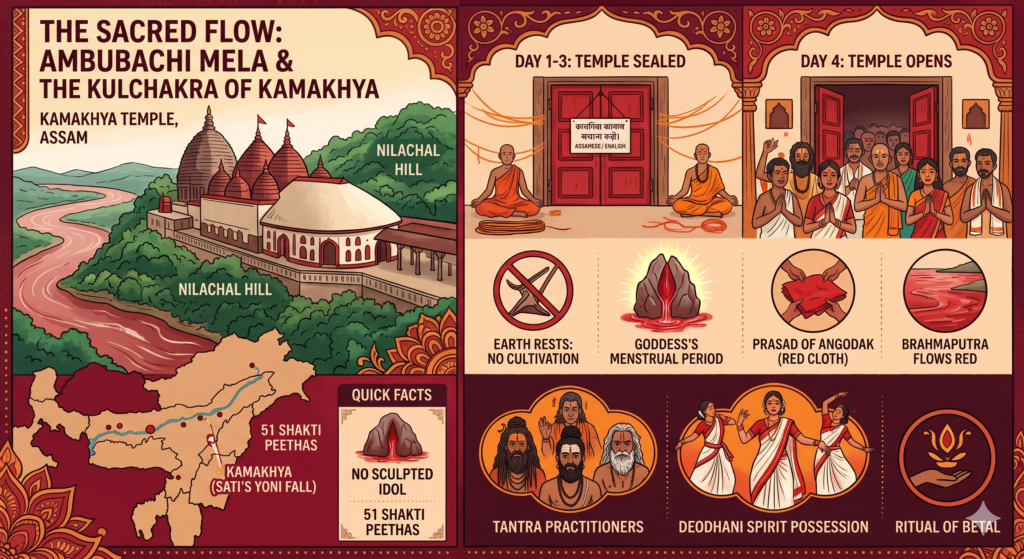
There is no idol in the innermost sanctum of the Kamakhya temple. There is a cleft in the rock, draped in cloth and perpetually wet from an underground spring, and it is this cleft that is worshipped as the yoni of the goddess Sati, fallen to the earth at this precise location when Vishnu’s Sudarshana Chakra dismembered her grief-stricken body as Shiva carried it across the cosmos. The Ambubachi Mela, observed when Goddess Kamakhya is understood to be in her annual menstrual period, is built on a theological foundation so ancient and so radical in its embrace of the feminine biological cycle as sacred that it challenges almost every assumption about what Hindu worship can centre on and what it can celebrate.
The Grief That Created Sacred Geography
The mythology that underlies the Kamakhya temple and the Ambubachi Mela begins not in Assam but in the devastation of a marriage broken by a father’s contempt.
Sati was the daughter of Daksha, one of the progenitor figures of the Vedic cosmos, and the wife of Shiva. Daksha despised his son-in-law with a ferocity that went beyond personal animosity into cosmic presumption, a refusal to acknowledge Shiva’s supreme status in the divine hierarchy. When Daksha organized the great Daksha Yajna, the grand sacrificial assembly to which all the gods of the cosmos were invited, he conspicuously excluded Shiva and Sati from the invitation.
Sati, unable to accept that her father’s home would be a place from which she and her husband were excluded, insisted on attending the yajna despite Shiva’s warnings. She went, and Daksha received her with open contempt, heaping abuse on Shiva before the assembled gods. Sati, whose identity and devotion were entirely inseparable from her husband, could not survive the humiliation of hearing Shiva dishonored. She immolated herself in the sacrificial fire.
What followed was a grief so total that it threatened the stability of the cosmos. Shiva retrieved Sati’s body from the ashes of Daksha’s yajna and carried it across the universe, inconsolable, his mourning disrupting the cosmic functions that his own divine role was responsible for maintaining. The universe began to come apart at the seams of Shiva’s sorrow.
Vishnu intervened. Using his Sudarshana Chakra, the divine discus that is one of his most potent weapons, Vishnu dismembered Sati’s body as Shiva carried it, separating it into pieces that fell across the Indian subcontinent at specific geographic locations. As each piece fell, the grief that had been concentrated in the whole body was distributed across the landscape, and at each point of falling a sacred site came into being, a Shakti Peetha, a throne of the goddess, where the divine feminine power that had animated Sati’s body remained present in the earth itself.
The number of Shakti Peethas varies across different Puranic and Tantric textual traditions, with counts ranging from 18 to 108 depending on the source, but the most widely accepted enumeration recognizes 51 principal peethas corresponding to 51 parts of Sati’s body that fell to earth. The Kamakhya temple at Nilachal Hill in Guwahati marks the site where Sati’s yoni, her womb and generative organ, fell to the earth. This is the origin of the most sacred site in the Shakta Tantric tradition. Not a temple built to house an image of the goddess, but a site where the generative power of the divine feminine is understood to be literally present in the earth.
How the Karaga Bearers Balance the Floral Pyramid in Karnataka
The Temple Without an Image
The innermost sanctum of the Kamakhya temple, the garbhagriha, contains no sculpted image of the goddess. What it contains is a natural depression in the bedrock of Nilachal Hill, understood as the yoni of Sati, draped in red cloth and perpetually moistened by an underground spring whose waters are among the most sacred in the Assamese Hindu tradition.
This absence of anthropomorphic representation is not a deficiency in the temple’s sacred apparatus. It is a theological statement of the most deliberate kind. The Tantric tradition that the Kamakhya temple embodies understands the divine feminine not as a personage to be depicted in stone or bronze but as a force, the Shakti, the fundamental creative energy that underlies all of manifest existence. The rock cleft at Kamakhya is not a symbol of the goddess’s generative power. It is understood to be that power itself, present in the earth at this specific location because of the specific cosmic event of Sati’s fall.
The waters of the underground spring that keep the rock cleft perpetually moist are collected and distributed as prasad to devotees who visit the temple, and their sacred status within the Kamakhya tradition reflects the understanding that what the spring water has been in contact with, the divine feminine presence in the earth, has transformed it into a vehicle of grace and blessing. The sacred site itself, the rock cleft on Nilachal Hill recognized as a Shakti Peetha, is understood in the tradition to have been a place of worship long before any stone temple stood above it.
What Menstruation Means in a Tantric Universe
The theological core of the Ambubachi Mela is the radical proposition that the menstrual cycle of the goddess is not a subject to be avoided in the context of worship but is itself among the most sacred events in the cosmic calendar.
In the Tantric understanding of the cosmos that the Kamakhya tradition embodies, Shakti is not merely an attribute of the divine. She is the fundamental creative energy of the universe, the power without which even Shiva, the supreme consciousness, would be inert. The universe exists because Shakti animates it. Matter takes form because Shakti moves through it. Life regenerates because Shakti’s creative force operates within the biological cycles of all living beings.
The menstrual cycle, within this framework, is not a bodily function to be managed or concealed. It is the most direct expression in the biological world of the creative and regenerative power that is the goddess’s essential nature. The earth itself, understood in the Tantric tradition as a manifestation of Shakti’s body, undergoes an annual cycle of creative rest and renewal that the Ambubachi Mela maps onto the biological cycle of the goddess. During Ambubachi, the earth is understood to be in a state of menstrual rest, which is why the tradition holds that no cultivation of the soil is to take place during the three days of the festival, no ploughing, no planting, no digging, in direct parallel to the agricultural rest observed in many ancient cultures when the earth was understood to be in a state requiring stillness rather than labor.
This theological framework transforms the Ambubachi Mela from a festival that might seem, from outside the tradition, to be organized around a topic that religious observance typically avoids, into one of the most coherent and internally consistent expressions of Tantric cosmological understanding available in a living festival form. The menstruation of the goddess is sacred because the creative and regenerative power it expresses is the same power that sustains all of existence.
The Practitioners Who Gather at Nilachal
The Ambubachi Mela draws two broad categories of devotee to Nilachal Hill. The first is the vast mainstream Hindu pilgrimage population, families, individuals, and community groups from across Assam, the Northeast, Bengal, Odisha, and increasingly from all parts of India and from the Indian diaspora abroad, who come to receive the goddess’s prasad, seek her blessing, and participate in the festival as an act of conventional devotion within the Shakta tradition.
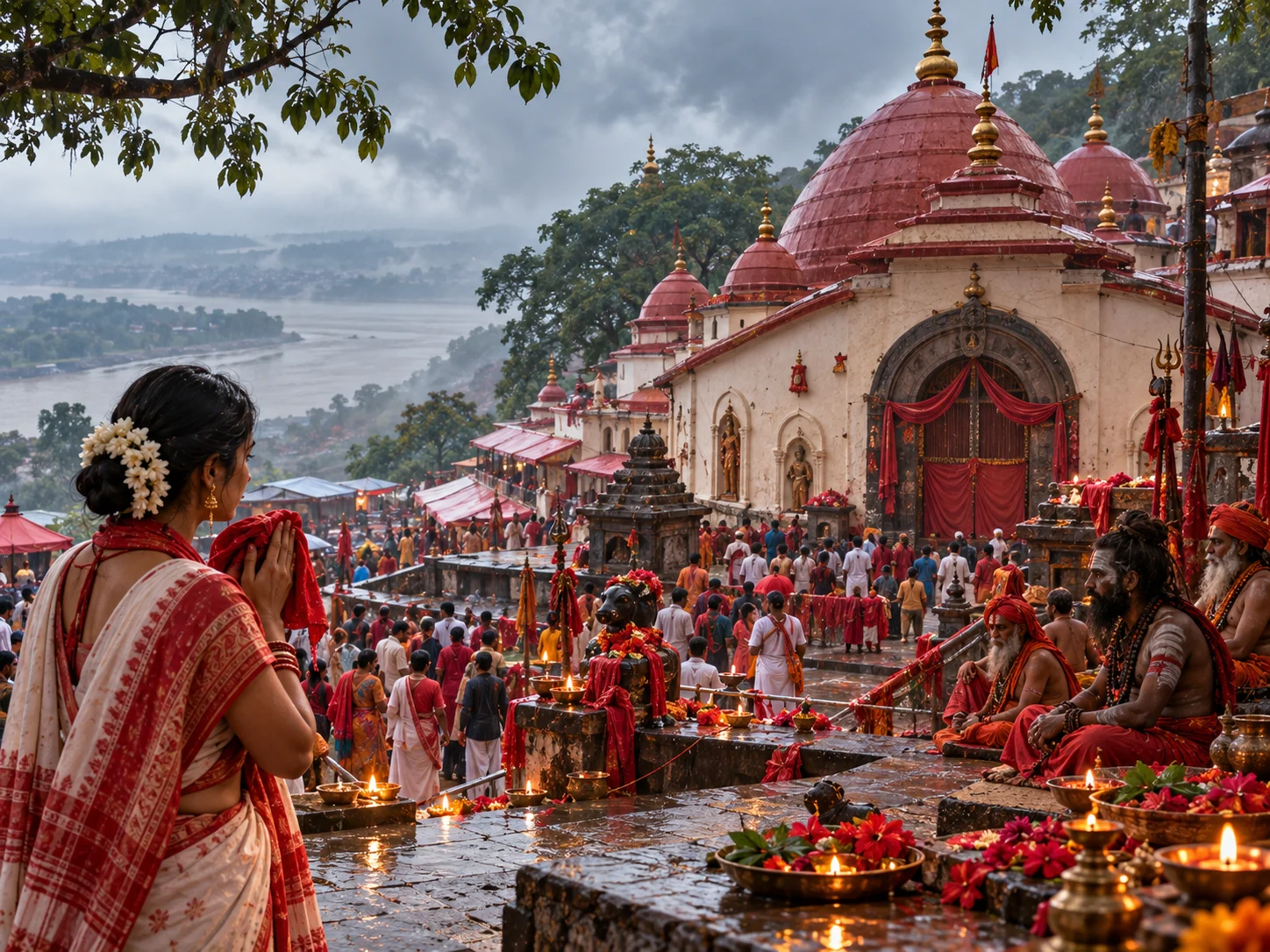
The second category is considerably more esoteric. The Ambubachi Mela is one of the most significant gatherings of Tantric practitioners in the Hindu world, drawing sadhus, ascetics, and initiated practitioners of various Tantric schools from across India to Nilachal Hill during the four days of the festival. The Kamakhya temple is the supreme peetha of the Kalikula, the family of goddess worship centred on Kali and her manifestations, and within Tantric practice the site is understood as possessing the highest concentration of Shakti energy available at any physical location on earth.
The Tantric practitioners who gather at Ambubachi represent a range of traditions and practice lineages, from the Kaula school that practices Vama Marga Tantra, which uses ritual elements as vehicles for transcending conventional dualities, to the more orthodox Dakshinachara or right-handed schools that use the same symbolic framework. Their presence at the Ambubachi Mela is not incidental to the festival’s character. It is central to it, connecting the mainstream devotional observance to the deeper Tantric theological tradition that gives the Kamakhya cult its particular spiritual authority.
How the Sibling Bond of Yama and Yamuna Created Bhai Dooj
The Deodhani and Direct Communion
Among the most dramatic ritual expressions of the Kamakhya tradition that become visible during the Ambubachi Mela period are the performances of the Deodhani, the possessed dancers who serve as vehicles through which the goddess communicates directly with the assembled devotees.
The Deodhani tradition is specific to the Kamakhya temple and the broader Assamese Shakta tradition. The Deodhani, typically women though occasionally men, enter a state of ritual possession understood as the goddess herself taking residence in their bodies, and in this state they perform frenzied dances, make pronouncements, and respond to the questions and petitions of devotees in a mode that the tradition understands as direct communication from the goddess rather than through the mediation of a priest. The Deodhani tradition represents one of the oldest forms of spirit possession ritual in Northeast India, with structural parallels to similar possession traditions documented across the tribal and pre-Aryan communities of the Brahmaputra Valley.
The Three Days the Temple Closes
The ritual sequence of the Ambubachi Mela follows a precise structure that enacts the mythological and theological content of the festival in physical and temporal form.
On the first day of Ambubachi, the temple doors are closed and the goddess is understood to begin her period of menstrual rest. The closure of the temple is not a suspension of the sacred. It is an intensification of it. The goddess is present within the sealed space in a state of particular intimacy, and the closure of the outer doors is understood as a boundary of respect, a recognition that what is happening within the sacred space of the temple during these three days is of a nature that requires both protection and reverence.
During the three days of closure, the red cloth that drapes the rock cleft in the garbhagriha absorbs the waters of the underground spring, taking on the reddish quality that the tradition understands as the physical expression of the goddess’s menstrual grace. This cloth, cut into small pieces, becomes the most precious prasad distributed at Kamakhya, the Angodak, whose receipt is understood as a direct blessing from the goddess in her most intimate and powerful state.
The pilgrims who gather at Nilachal Hill during the three days of closure do not simply wait. The hillside becomes a vast temporary community of devotees and practitioners, with continuous performance of devotional music, Tantric ritual, and the specific practices of the various ascetic orders gathered there. On the fourth day, the temple doors open before dawn. Hundreds of thousands of pilgrims move toward the temple doors at the moment of opening, each seeking to receive the goddess’s prasad in the first hours of her emergence from her period of sacred rest. The river Brahmaputra, which flows below Nilachal Hill, is said by the tradition to have run red during the three days of closure, a claim that has generated both devotional testimony and discussion about the mineral content of the spring waters and the river’s sediment during the monsoon period when Ambubachi typically falls.
The Sacred Root of the Feminine
The Ambubachi Mela asks its participants, and asks anyone who encounters it from outside, to do something genuinely difficult. It asks them to hold simultaneously the idea that the divine is supremely sacred and the idea that the biological cycle of the feminine body is the most direct expression of that divinity available in the living world. For the Tantric tradition centred on Kamakhya, these are not two ideas requiring reconciliation. They are a single idea expressed at two levels of the same reality.
The grief of Shiva carrying Sati’s body across the cosmos is not simply a beautiful mythological narrative about divine love. It is the story of how sacred sites come into being, how the personal becomes cosmological, how a specific point on the earth becomes charged with divine presence through the convergence of loss, intervention, and the literal embodiment of Shakti in the landscape.
The sealed temple on those three days in Ashadha is not empty. It is the most full it will be all year. The goddess is present in the most intimate and powerful mode available to her, and the community gathered on the hillside outside, the mainstream pilgrim and the Tantric practitioner, the first-time visitor from a distant state and the hereditary devotee whose family has been coming to Nilachal for generations, are all waiting in the same anticipation for the doors to open and for what the tradition understands as the most grace-filled moment in the annual sacred calendar to be available to anyone who comes to receive it.
What the Kamakhya tradition has preserved across centuries of political disruption, temple destruction, and the various pressures of modernity is a theological framework in which the feminine body is not the object of shame or management but the primary location of the sacred. That is not a radical idea in the disruptive contemporary sense. It is a radical idea in the original sense. It goes to the root. And the root, at Kamakhya, is a cleft in the rock on a hill above the Brahmaputra, perpetually wet, perpetually present, perpetually available to whoever climbs the hill and comes to receive what it offers.
Why the Sun God Surya Stands at the Heart of Chhath Puja
If you think you have remembered everything about this topic take this QUIZ
Results


#1. On which hill in Guwahati, Assam, is the Kamakhya temple located?
#2. During which Hindu month is the annual Ambubachi Mela observed?
#3. Which body part of Sati is mythologically believed to have fallen at the Kamakhya temple site?
#4. According to records by the Kamrup Anusandhan Samiti, which Muslim general destroyed the earlier Kamakhya temple structure in the sixteenth century?
#5. What agricultural restriction is strictly observed during the three days of the Ambubachi festival?
#6. What is the specific name of the red cloth prasad distributed to devotees after the temple reopens?
#7. Which specific Tantric school that practices left-handed or Vama Marga Tantra is drawn to the Kamakhya temple?
#8. Which performance features possessed dancers serving as vehicles for direct communication with the goddess during the festival?
What is the Ambubachi Mela and why is it significant?
The Ambubachi Mela is a four-day festival observed annually at the Kamakhya temple on Nilachal Hill in Guwahati, Assam, during the Hindu month of Ashadha. It marks the period when Goddess Kamakhya, the supreme Shakti, is understood to be in her annual menstrual cycle. The festival is significant as one of the most theologically distinctive events in the Hindu calendar, celebrating the feminine biological cycle as sacred within the Tantric cosmological framework, drawing hundreds of thousands of mainstream devotees and Tantric practitioners simultaneously to one of the 51 Shakti Peethas.
Why does the Kamakhya temple have no idol in its sanctum?
The Kamakhya temple’s innermost sanctum contains a natural cleft in the bedrock of Nilachal Hill, understood as the yoni of the goddess Sati, rather than a sculpted image. This reflects the Tantric theological understanding that Shakti, the divine feminine power, is not a personage to be depicted but a force to be recognized in its natural physical manifestations. The rock cleft is understood to be the actual presence of the goddess’s creative power embedded in the earth at the specific location where Sati’s yoni fell when Vishnu dismembered her body.
What is the mythological origin of the Kamakhya temple?
The Kamakhya temple’s origin lies in the story of Sati, who immolated herself at her father Daksha’s yajna after Daksha publicly humiliated her husband Shiva. Shiva retrieved her body and carried it across the cosmos in inconsolable grief, disrupting cosmic order. Vishnu intervened by using his Sudarshana Chakra to dismember Sati’s body, whose parts fell across the Indian subcontinent creating the 51 Shakti Peethas. The Kamakhya site marks where Sati’s yoni fell to earth, making it the supreme peetha of the Shakta Tantric tradition.
What happens during the three days the temple is closed at Ambubachi?
During the three days of closure, the goddess is understood to be in her period of menstrual rest. The red cloth draped over the rock cleft in the sanctum absorbs the waters of the underground spring, taking on a reddish quality understood as the physical expression of the goddess’s menstrual grace. This cloth, the Angodak prasad, is cut into small pieces and distributed to devotees when the temple reopens on the fourth day. Agricultural activity including ploughing and planting is prohibited during the three days, and the hillside becomes a vast temporary community of pilgrims and Tantric practitioners engaged in continuous devotional and ritual practice.
Who are the Deodhani and what role do they play at Kamakhya?
The Deodhani are practitioners of the Kamakhya temple’s tradition of ritual possession, typically women who enter a state in which the goddess is understood to take residence in their bodies. In this possessed state they perform frenzied dances, make pronouncements, and respond to devotees’ petitions as direct communications from the goddess rather than through priestly mediation. The Deodhani tradition represents one of the oldest documented forms of spirit possession ritual in Northeast India and is particularly active during the Ambubachi Mela period when the goddess’s presence on Nilachal Hill is understood to be at its most concentrated and powerful.
Sources & References
The mythology of Sati and the Shakti Peethas — The Ambubachi Mela originates in the story of Sati’s immolation at Daksha’s yajna and Shiva’s inconsolable grief that threatened cosmic order, resolved when Vishnu dismembered Sati’s body with his Sudarshana Chakra, its parts falling across the subcontinent to create 51 Shakti Peethas with the Kamakhya site marking where Sati’s yoni fell to earth.
The Kamakhya temple’s natural yoni and Tantric theology — The Kamakhya temple’s innermost sanctum contains a natural rock cleft perpetually moistened by an underground spring rather than a sculpted image, reflecting the Tantric theological understanding of Shakti as a fundamental creative force present in the earth rather than as a personage to be depicted.
The Tantric cosmology of menstrual sacredness — The Ambubachi Mela’s observance of the goddess’s menstrual cycle as the most sacred event in the cosmic calendar reflects the Tantric understanding that Shakti’s menstrual power is the direct expression of the creative and regenerative force that sustains all of existence.
The Deodhani possession tradition and spirit communication — The Deodhani ritual at Kamakhya in which women enter possession states understood as the goddess speaking through their bodies represents one of the oldest documented forms of spirit possession ritual in Northeast India, connected to pre-Aryan tribal traditions of the Brahmaputra Valley.
The Gauhati University historical documentation of Ambubachi pilgrimage — Research by the Gauhati University Department of History identifies the Ambubachi Mela as the single largest annual gathering in Assam by concentrated pilgrimage attendance, with hundreds of thousands of devotees visiting Nilachal Hill during the four-day festival period for the Angodak prasad and goddess’s blessing.