The Jatinga valley in Assam's Dima Hasao district is the site of one of the most extraordinary and least fully explained ornithological phenomena in the world, a seasonal mass disorientation of birds that occurs on foggy, moonless nights between September and November, during which more than forty species of birds descend toward artificial lights in a state of apparent confusion that has historically led to their death at the hands of local villagers. First documented by Western science in the 1950s and subsequently studied by leading Indian ornithologists including Salim Ali, the phenomenon has generated numerous scientific theories without producing a consensus explanation that accounts for all of its observed characteristics.| Detail | Information |
|---|---|
| Location | Jatinga, Dima Hasao district, Assam, India |
| Altitude | Approximately 1,000 metres above sea level |
| Phenomenon | Mass nocturnal bird disorientation and descent |
| Season | Late monsoon, September to November |
| Time of Occurrence | Between 7 PM and 10 PM on foggy, moonless nights |
| Bird Species Affected | Over 40 migratory and local species documented |
| First Documented By | Edward Gee, British naturalist, 1950s |
| Scientifically Studied By | Dr. Sudhin Sengupta, Salim Ali, Anwaruddin Choudhury |
| Valley Orientation | North to South running narrow valley strip |
| Status | Unexplained, multiple competing theories |
| Conservation Concern | Local tradition of killing disoriented birds |
| Current Awareness Effort | Assam government, wildlife organizations |
The Night the Birds Came Down
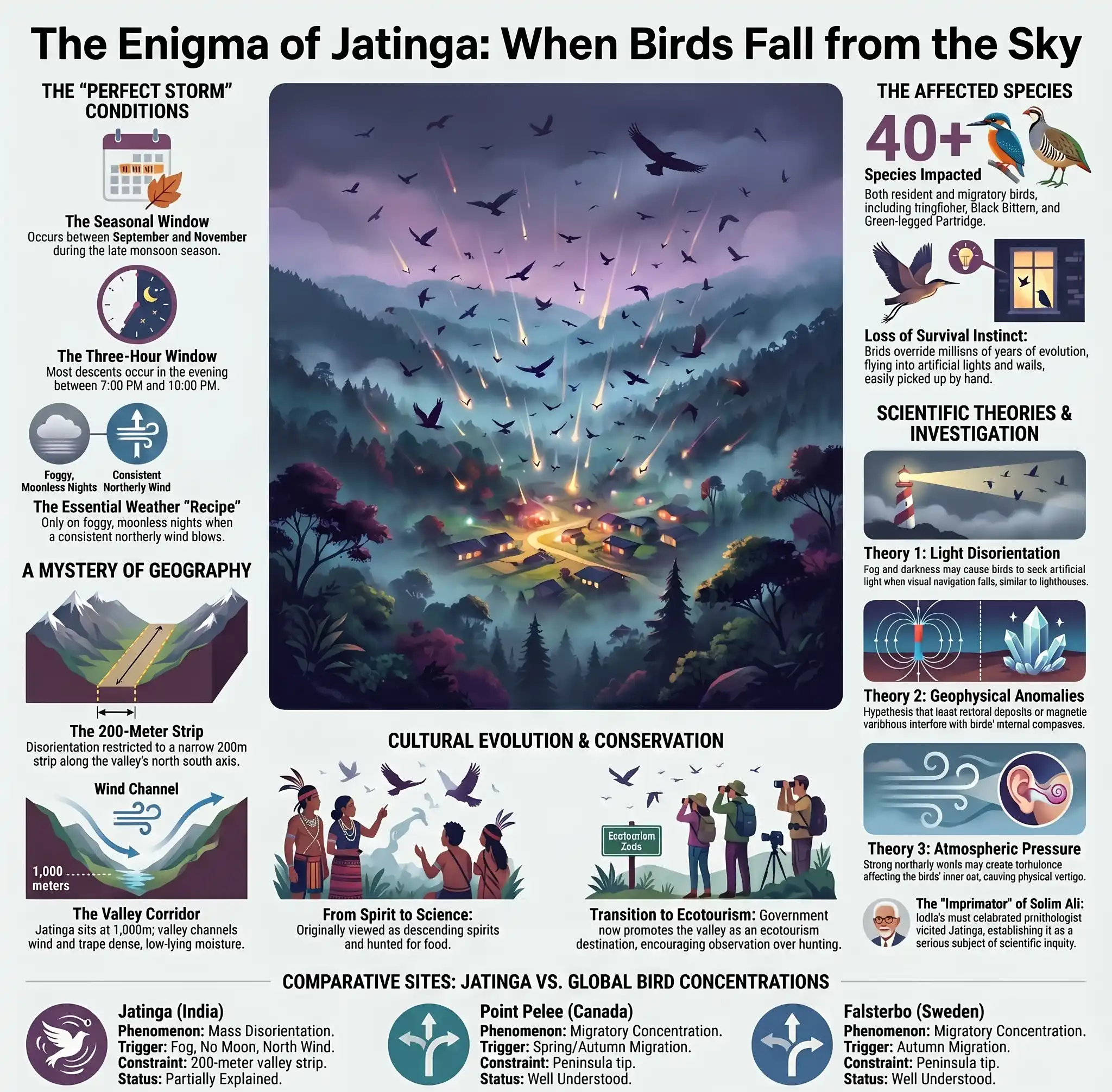
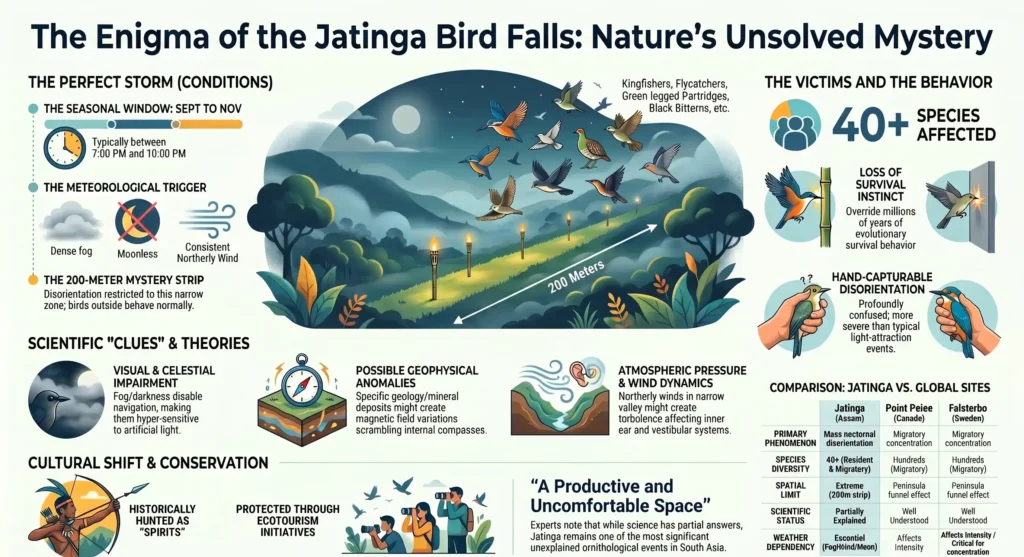
There are moments of encounter with the natural world that defy the frameworks we use to make sense of things. For the villagers of Jatinga in the Dima Hasao district of Assam, such a moment arrives every year with the reliability of the season itself. The late monsoon comes in, the fog thickens in the narrow valley, the moon disappears behind cloud or beneath the horizon, and then, between seven and ten in the evening, the birds begin to fall.
Not all birds. Not randomly. Specific species, on specific nights, in specific weather conditions, in a specific strip of land no wider than two hundred metres along the north-south axis of the valley, descending toward any source of light with a fixedness of purpose that appears to override every instinct that has kept their kind alive across millions of years of evolution. They fly into torches. They land on bamboo poles. They crash into walls. They can be picked up by hand. They are, in the most precise available word, disoriented, but disoriented in a way that has direction, that has consistency, that happens to the same species in the same location in the same seasonal window year after year with a regularity that looks, to human observers, like something organized.
The local Zeme Naga community, who have lived in this valley for generations, had their own understanding of the phenomenon long before any naturalist arrived to document it. They understood the birds as spirits descending, as manifestations of something supernatural that the valley summoned during those specific nights. They hunted the disoriented birds, which were easily caught in their confused state, and the hunt became embedded in local cultural practice as something between a tradition and a ritual.
The naturalists who eventually arrived brought different frameworks. They did not resolve the mystery. They deepened it.
The Valley and Its Particular Geography
Jatinga is not simply any valley in Assam. It is a specific place with a specific geography that every scientific account of the phenomenon has had to reckon with, because the geography appears to be directly implicated in what happens there.
The valley runs north to south through the Dima Hasao hills at an altitude of approximately one thousand metres above sea level. It is narrow, no more than a few kilometres wide at its broadest, and it is oriented in a way that channels the wind during the late monsoon season into a consistent northerly flow through the valley corridor. The fog that forms during the September to November period is a consequence of the elevation, the humidity of the post-monsoon atmosphere, and the specific topography of the valley, which traps moisture in ways that produce the dense, low-lying fog banks that appear on the nights when the phenomenon occurs.
The strip of land within the valley where birds descend is even narrower than the valley itself, approximately two hundred metres wide and running along the valley’s north-south axis. Birds that come down in this strip behave in the characteristic disoriented fashion. Birds outside this strip, even within the broader valley, do not show the same behavior. This spatial specificity is one of the most puzzling aspects of the phenomenon and one of the most important constraints on any theoretical explanation.
The combination of altitude, valley orientation, seasonal fog, and the specific behavior of the strip has led researchers to focus on the physical properties of the valley environment as the primary explanatory factor, but the precise mechanism by which those physical properties produce the specific behavioral response observed in the birds has not been satisfactorily established.
Edward Gee and the First Scientific Documentation
The Jatinga phenomenon entered the written record of Western natural science primarily through the work of Edward Gee, a British tea planter and naturalist who worked in Assam and who documented the bird falls in the 1950s. Gee was a careful observer whose work on Assam’s wildlife, including his documentation of the Indian rhinoceros, was recognized by the international conservation community as significant and reliable.
His account of Jatinga described the phenomenon with the specificity that a trained naturalist brings to an unusual observation, noting the seasonal timing, the weather conditions, the species involved, the spatial restriction to a particular strip of valley, and the behavior of the birds themselves. He also noted the local practice of hunting the disoriented birds, which he observed with the combination of scientific interest and conservationist concern that characterized his approach to Indian wildlife generally.
Gee brought the phenomenon to the attention of Salim Ali, the Indian ornithologist who was the most significant figure in the development of systematic bird science in India in the twentieth century and whose work on Indian avifauna is foundational to the field. Ali visited Jatinga and conducted his own observations, adding the authority of the most respected ornithological voice in India to the documentation of the phenomenon. His interest helped to establish Jatinga as a serious subject of scientific inquiry rather than simply a local curiosity.
The combination of Gee’s initial documentation and Ali’s subsequent engagement brought Jatinga to the attention of the broader scientific and conservation community and began the process of sustained inquiry that has continued, without fully resolving the central question, to the present day.
Mythological Origins of the Kumbh Mela and Descent of the Ganga
Salim Ali, Sengupta, and the Science That Followed
The most sustained scientific study of the Jatinga phenomenon was conducted by Dr. Sudhin Sengupta, an ornithologist who spent years observing and documenting the bird falls and who produced the most comprehensive scientific account of the phenomenon available. Sengupta’s work, conducted over multiple seasons, established a series of empirical facts about the phenomenon that any theoretical explanation must account for.
He documented the specific species involved, which included both resident birds and migratory species passing through the region during the late monsoon season. The list extends to over forty species, including birds as different as the Black Bittern, the Green-legged Partridge, the Kingfisher, and various species of flycatcher and warbler. The diversity of species affected is itself significant, because it suggests that whatever is causing the disorientation is not species-specific but is affecting the sensory or navigational systems that different bird species share.
He documented the weather conditions with precision, confirming that the phenomenon occurs specifically on foggy, moonless nights with northerly winds and does not occur on clear nights, on nights with moonlight, or on nights when the wind comes from a different direction. This meteorological specificity is one of the strongest constraints on theoretical explanation and points toward an interaction between the birds’ sensory systems and the specific atmospheric and meteorological conditions that the valley produces on these particular nights.
He documented the spatial restriction of the phenomenon to the specific strip of valley and confirmed that the behavior is consistently directed toward artificial light sources, suggesting that the birds are not simply falling randomly but are navigating toward something that their disoriented sensory system is interpreting as a meaningful signal.
The ornithological work of Anwaruddin Choudhury, another significant Assam-based researcher, extended and refined Sengupta’s documentation, adding additional species to the record and providing more detailed analysis of the behavioral patterns observed during the falls.
The Theories That Have Been Proposed
The scientific literature on Jatinga has generated a range of theoretical explanations, none of which has achieved consensus and each of which accounts for some but not all of the observed characteristics of the phenomenon.
The most widely cited explanation involves a combination of factors relating to the birds’ disorientation during foggy conditions. Birds navigate using a combination of visual cues, magnetic field sensitivity, and in many species the position of celestial bodies including the sun, moon, and stars. On foggy, moonless nights, the visual and celestial navigation systems are impaired, and the birds may become disoriented in a way that makes them vulnerable to confusion by artificial light sources, toward which many bird species have a documented tendency to fly during conditions of visual impairment.
This explanation is supported by the documented phenomenon of bird mortality at lighthouses and illuminated structures during foggy nights in other parts of the world, a phenomenon well established in ornithological literature and recognized as a conservation concern for migratory birds globally. The Jatinga phenomenon may be an extreme version of this more general sensitivity to artificial light during navigation-impairing weather conditions.
However, this explanation does not fully account for several of the Jatinga phenomenon’s specific characteristics. It does not explain why the disorientation is restricted to such a narrow strip of valley when the fog covers a much larger area. It does not adequately explain why northerly winds are a necessary condition, suggesting that there is an additional atmospheric or physical factor involved beyond simple visual impairment. And it does not explain the specific behavioral characteristics of the disoriented birds, which appear more profoundly affected than birds typically observed in lighthouse-mortality events.
A second line of explanation focuses on the possibility of unusual electromagnetic or geophysical conditions in the specific strip of valley where the phenomenon occurs. Some researchers have suggested that the valley’s geology, including the possibility of unusual magnetic field variations or the presence of specific mineral deposits, might interfere with the magnetic navigation systems that birds use alongside visual cues. This would explain the spatial restriction of the phenomenon to a specific strip and would account for the severity of the disorientation observed.
Geophysical surveys of the valley have not produced conclusive evidence for unusual magnetic field variations in the strip where the phenomenon occurs, but the measurements taken have not been comprehensive enough to rule out the possibility entirely. This remains one of the most promising lines of inquiry for future research.
A third explanation has focused on the role of atmospheric pressure and wind dynamics in the valley during the phenomenon nights. The northerly wind channeling through the narrow valley at altitude may create specific pressure and turbulence conditions that affect the birds’ inner ear and vestibular systems, producing a physical disorientation that compounds the visual impairment caused by fog and darkness. This explanation would account for the wind direction as a necessary condition and would explain why the phenomenon is more severe in the valley corridor where wind channeling is most pronounced.
The most honest assessment of the current state of scientific knowledge about Jatinga is that the phenomenon is likely the result of multiple interacting factors, including meteorological conditions, visual impairment, possible geophysical anomalies, and the birds’ physiological responses to these combined conditions, but that the precise interaction of these factors and the specific mechanism that produces the extreme behavioral response observed has not been definitively established.
The UNESCO documentation on biodiversity and natural phenomena recognizes Jatinga as one of the most significant unexplained ornithological events in South Asia, noting the need for continued interdisciplinary research combining ornithology, meteorology, and geophysics to produce a more complete understanding of the phenomenon.
How the Bhotiya Weavers of Uttarakhand Kept a Himalayan Textile Tradition Alive
The Local Tradition and the Conservation Question
The birds that descend in Jatinga’s specific strip of valley on those foggy nights have historically been hunted by the local Zeme Naga community. The hunting was not random or unlimited but embedded in the seasonal cultural practice of the community, which understood the bird falls as a periodic abundance provided by the valley’s spiritual character and used the birds as a significant food source during the late monsoon season.
From the perspective of wildlife conservation, the practice raised serious concerns. Several of the species affected by the Jatinga phenomenon are not abundant, and the seasonal concentration of disoriented, easily caught birds in a small area created conditions under which hunting pressure could have significant population-level effects. The conservation community, alerted to the phenomenon through Gee’s and Ali’s documentation, began to advocate for the protection of the birds during the fall season.
The response of the local community to conservation advocacy has evolved over decades. The Assam government and wildlife organizations have worked with the Jatinga community to develop approaches to the phenomenon that address conservation concerns while respecting the cultural practice and economic realities of the local population. Tourism-oriented approaches, in which visitors come to Jatinga during the fall season to observe the phenomenon rather than to hunt the birds, have been developed as an alternative economic framework.
The tension between conservation and local cultural practice at Jatinga reflects a wider pattern in Indian wildlife conservation, in which the interests and practices of communities who have lived alongside wildlife for generations must be engaged with respectfully rather than simply overridden by external conservation mandates. The specific resolution of this tension at Jatinga remains ongoing, with conservation awareness having reduced hunting pressure considerably without eliminating it entirely.
The Indian government has promoted Jatinga as an ecotourism destination, and the valley receives visitors during the September to November season who come specifically to observe the phenomenon under conditions that do not involve the hunting of the birds. The ecotourism model has provided the local community with economic incentives aligned with conservation rather than opposed to it, though the transition has not been without its complications.
The Broader Pattern of Mass Bird Events
Jatinga is not the only place in the world where mass bird disorientation events occur, and placing it within the broader scientific context of similar phenomena elsewhere helps to identify both what it shares with other events and what makes it distinctive.
Mass bird mortality events associated with artificial light during foggy nights have been documented at lighthouses and illuminated structures across North America, Europe, and Asia. The Jatinga phenomenon is distinguished from these events by its consistent spatial restriction to a specific valley strip, its multi-species character, the severity of the disorientation observed, and the combination of weather conditions required for its occurrence. These distinguishing characteristics suggest that the Jatinga phenomenon involves additional factors beyond the general light-disorientation effect documented at other sites.
Mass bird disorientation events associated with geophysical anomalies have been documented in a small number of other locations globally, and the possibility that Jatinga belongs to this category of events, or involves a combination of geophysical and meteorological factors unique to its specific location, remains an open research question.
The Jatinga phenomenon’s persistence across documented decades without adequate scientific explanation places it in the company of a small number of natural phenomena that have resisted the explanatory frameworks available to contemporary science, not because science has ignored them but because the interaction of factors producing them is sufficiently complex that the available investigative tools have not yet produced a complete account.
Why Paliwal Brahmins Left Kuldhara in a Single Night and Never Returned
What the Valley Keeps to Itself
Standing in the Jatinga valley on a foggy October night, watching birds descend toward a torch flame in the manner that observers have described consistently for seventy years of scientific documentation, one encounters something that resists the reassurance of incomplete explanation. The partial accounts are real. The meteorological factors are real. The visual impairment caused by fog is real. The documented light-attraction behavior of disoriented birds is real.
But the totality of what happens in that strip of valley on those specific nights, the scale of it, the consistency of it, the spatial restriction of it, the multi-species character of it, the behavioral specificity of it, adds up to something that the sum of the partial explanations does not yet fully contain. There is a remainder, and the remainder is what makes Jatinga genuinely mysterious rather than simply inadequately documented.
India has places that carry their mysteries lightly, places where the unexplained has been woven so thoroughly into the fabric of local life that it no longer registers as remarkable. Jatinga is not quite that kind of place. The mystery there is still active, still being studied, still generating questions that the available answers have not managed to close. The birds still come down on the foggy October nights, as they have for as long as anyone in the valley can remember, and the valley keeps, for now, whatever it knows about why.
Quick Comparison Table
| Aspect | Jatinga Valley, Assam | Point Pelee, Canada | Falsterbo, Sweden |
|---|---|---|---|
| Phenomenon Type | Mass nocturnal bird disorientation and descent | Mass migratory bird concentration | Mass migratory bird concentration |
| Season | September to November, late monsoon | Spring and autumn migration | August to November autumn migration |
| Species Affected | Over 40 species, resident and migratory | Hundreds of species, primarily migratory | Hundreds of species, primarily migratory |
| Weather Dependency | Foggy, moonless nights, northerly wind essential | Weather affects concentration intensity | Wind direction critical for concentration |
| Scientific Status | Partially explained, active research question | Well understood migratory phenomenon | Well understood migratory phenomenon |
| Conservation Status | Active concern, hunting historically practiced | Protected national park, no hunting | Protected nature reserve |
| Tourism Development | Ecotourism model developing | Major established ecotourism destination | Established birdwatching destination |
| Geographic Restriction | Specific 200 metre strip within valley | Peninsula tip funneling effect | Peninsula tip funneling effect |
Curious Indian: Fast Facts
- The strip of land within Jatinga valley where the bird phenomenon occurs is only approximately two hundred metres wide, an extraordinary spatial restriction that no current scientific theory has fully explained.
- Over forty species of birds have been documented participating in the phenomenon, including both resident species and migratory birds passing through Assam during the late monsoon season, suggesting that whatever causes the disorientation affects sensory systems common to very different kinds of birds.
- The phenomenon occurs only on foggy, moonless nights with northerly winds, and the strict meteorological conditions required for its occurrence are one of the most important clues to its underlying mechanism that scientists have identified.
- Edward Gee, the British tea planter and naturalist who first documented the phenomenon for Western science in the 1950s, was the same naturalist whose work on the Indian rhinoceros made significant contributions to the conservation of that species in Assam.
- Salim Ali, India’s most celebrated ornithologist and the author of the definitive handbook of Indian birds, visited Jatinga and took a personal interest in the phenomenon, giving it the imprimatur of the most respected name in Indian ornithological science.
- The birds that descend during the Jatinga phenomenon can be picked up by hand in their disoriented state, a characteristic that has made them vulnerable to hunting by local communities but that has also allowed researchers to examine specimens closely.
- Local Zeme Naga tradition understood the bird falls as a spiritual phenomenon, the descent of bird spirits called to the valley by forces that the natural world periodically releases, an interpretation that embedded the falls in a cultural and religious framework long before science arrived to propose alternative explanations.
- The Indian government has promoted Jatinga as an ecotourism destination during the September to November season, developing an economic alternative to bird hunting that aligns the interests of the local community with conservation rather than against it.
- The behavioral disorientation observed in Jatinga birds is described by researchers as more severe than the light-attraction behavior documented at illuminated structures elsewhere in the world, suggesting that additional factors beyond simple light confusion are operating in the valley.
- No comprehensive geophysical survey of the specific valley strip where the phenomenon occurs has yet been completed, leaving open the possibility that unusual magnetic field variations or other geophysical factors are contributing to the birds’ navigation system failure.
Conclusion
The Jatinga valley bird phenomenon sits in that productive and uncomfortable space between explanation and mystery that the best unsolved natural questions occupy. It is not completely without explanation. The meteorological conditions, the visual impairment, the documented tendency of birds to orient toward artificial light during navigation failure, all of these provide genuine partial accounts of what happens in the valley on those foggy October nights. They are not nothing.
But they are not everything. The spatial restriction to a two-hundred-metre strip, the multi-species severity of the disorientation, the consistent requirement of northerly wind as a necessary condition, the behavioral characteristics that exceed what light-attraction events elsewhere have documented, these remain the parts of the phenomenon that the available explanations have not yet adequately enclosed.
Science works on the remainder. Researchers continue to visit the valley, to instrument the strip, to measure meteorological variables and propose geophysical hypotheses and refine the ornithological record. The explanation when it comes in its complete form will almost certainly involve the interaction of multiple factors rather than a single elegant cause, which is how most genuinely complex natural phenomena turn out to work when the full picture finally becomes clear.
Until then, the valley keeps its September and October appointments with the birds, and the birds keep coming down out of the foggy sky toward whatever it is in that strip of Assam hillside that calls to them in a language no living scientist has yet fully translated.
The local community knows this language is real. The scientists know the question is real. Between that consensus and the complete answer lies the specific kind of mystery that makes the natural world endlessly worth paying attention to, the mystery of a thing that happens with perfect consistency and remains, despite that consistency, not yet fully understood.
The birds will come again next October. They always do.
How Titu Singh’s Past Life Memories Led to a Murder Conviction in Agra
If you think you have remembered everything about this topic take this QUIZ
Results


#1. The mass bird disorientation phenomenon in the Jatinga valley occurs strictly between which months?
#2. What is the approximate altitude above sea level of the Jatinga valley in the Dima Hasao district of Assam?
#3. What is the precise width of the narrow strip of land within the valley where the birds undergo mass disorientation?
#4. Which British tea planter and naturalist first documented the Jatinga bird phenomenon for Western science in the 1950s?
#5. Which celebrated Indian ornithologist visited Jatinga and helped establish the phenomenon as a serious subject of scientific inquiry?
#6. According to the text, between which hours of the evening does the bird descent typically take place?
#7. Which specific wind direction is documented as a necessary meteorological condition for the Jatinga phenomenon to occur?
#8. Which local indigenous community historically hunted the disoriented birds as a seasonal cultural practice?
What exactly happens during the Jatinga valley bird phenomenon?
Between September and November each year, on foggy nights with no moonlight and northerly winds, birds of over forty species descend toward artificial light sources in a specific two-hundred-metre strip of the Jatinga valley in Assam’s Dima Hasao district. The birds appear deeply disoriented, flying into flames and light sources and crashing into structures, and can be picked up by hand. The phenomenon occurs consistently between seven and ten in the evening and has been documented reliably for decades.
Why do scientists believe the birds become disoriented at Jatinga?
The most widely accepted partial explanation involves the combination of foggy conditions and moonless nights impairing the birds’ visual and celestial navigation systems, making them vulnerable to attraction toward artificial light sources in a way documented at illuminated structures globally. Additional factors possibly including unusual atmospheric pressure conditions created by northerly winds channeling through the narrow valley may compound this disorientation. However, no explanation fully accounts for all observed characteristics, particularly the strict spatial restriction to the two-hundred-metre strip.
Which bird species are affected by the Jatinga phenomenon?
Over forty species have been documented, including the Black Bittern, Green-legged Partridge, various Kingfisher species, flycatchers, warblers, and other resident and migratory species present in the Assam region during the late monsoon season. The multi-species character of the phenomenon is significant because it suggests that whatever causes the disorientation affects sensory or navigational systems common across very different kinds of birds rather than targeting species-specific biology.
What is the conservation situation regarding the Jatinga bird phenomenon?
The historical practice of local Zeme Naga communities hunting the disoriented birds during the falls raised significant conservation concerns among wildlife organizations following the phenomenon’s documentation by Western naturalists in the 1950s. The Assam government and conservation organizations have worked with the local community to reduce hunting pressure and develop ecotourism as an alternative economic framework. The transition has been partially successful, with tourism during the September to November season now providing economic incentives for conservation, though hunting has not been eliminated entirely.
Has any scientific consensus been reached about the cause of the Jatinga phenomenon?
No scientific consensus has been reached that fully accounts for all observed characteristics. The most complete current understanding treats the phenomenon as likely the result of multiple interacting factors including meteorological conditions, visual impairment during foggy moonless nights, possible geophysical anomalies in the specific valley strip, and the physiological responses of birds to these combined conditions. The strict spatial restriction to the two-hundred-metre strip and the severity of disorientation observed remain the aspects of the phenomenon least adequately explained by current theories, and active research continues.