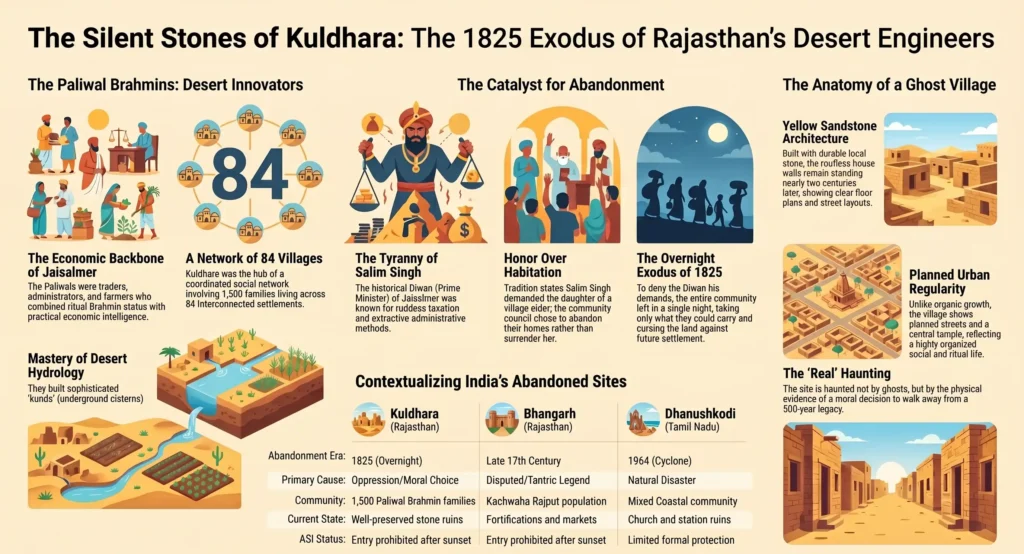
Kuldhara was a prosperous Paliwal Brahmin village in the Jaisalmer district of Rajasthan that was abandoned overnight in 1825, along with eighty-three surrounding settlements, by a community that left behind five centuries of accumulated habitation and cursed the land against future settlement. The traditional account attributes the abandonment to the oppressive conduct of Salim Singh, the Diwan of Jaisalmer, whose demands on the Paliwal community and specifically whose reported designs on the daughter of a village elder made continued habitation incompatible with the community's honor. The village has stood empty since that night, protected now by the Archaeological Survey of India and visited by thousands of tourists annually, and remains one of the most complete physical records of a Rajput-era desert settlement that India possesses.| Detail | Information |
|---|---|
| Location | Kuldhara, Jaisalmer district, Rajasthan, India |
| Founded | Approximately 13th century |
| Community | Paliwal Brahmin community |
| Abandoned | 1825, overnight |
| Estimated Population at Abandonment | Approximately 1,500 families across Kuldhara and surrounding villages |
| Reason Given in Tradition | Oppression by Salim Singh, Diwan of Jaisalmer |
| Curse Reported | Departing community cursed the land against future habitation |
| Administrative Status | Protected monument, Archaeological Survey of India |
| ASI Restriction | Entry prohibited after sunset |
| Current State | Ghost village, partially preserved ruins |
| Tourism Status | Established heritage tourism site, Jaisalmer circuit |
| Nearest City | Jaisalmer, approximately 18 kilometres |
The Night That Ended Five Centuries
Communities do not abandon their homes easily. The decision to leave a place where your family has lived for generations, where your ancestors are buried, where the water sources have been mapped and the agricultural patterns understood and the social relationships built across lifetimes, is not made without a weight of necessity that ordinary accounts tend to underestimate. When an entire community makes that decision simultaneously, in a single night, leaving behind everything that cannot be carried, the force of whatever drove that decision must be understood as something very close to unbearable.
The Paliwal Brahmins of Kuldhara had been in the Jaisalmer district for approximately five centuries before the night of 1825. They had built a village of stone houses, organised around the social and religious conventions of a prosperous Brahmin community in the Thar Desert, that had developed its own particular solutions to the fundamental challenge of desert habitation, the reliable management of water in one of the most arid environments in the world.
Their water management technology was so sophisticated that modern engineers who have examined the ruins have expressed admiration for the ingenuity of the systems they built. The Paliwals understood the desert hydrology of the Thar with the precision of people who had studied it for generations, and they managed its limited water resources with a skill that allowed their community to prosper in conditions that most agricultural communities would have found impossible.
Vishwakarma Puja and the Ancient Theology Behind Worship of Tools
In 1825, they left all of it. The stone houses. The water systems. The agricultural fields. The temples. The accumulated physical infrastructure of five centuries of intelligent desert habitation. They left it in a single night and they cursed the land as they went.
Who the Paliwals Were
The Paliwal Brahmin community was one of the most prosperous and socially organised communities in the Jaisalmer region of the eighteenth and early nineteenth centuries. Their name derives from the region of Pali in Rajasthan, from which the tradition holds they originally migrated, though the precise history of their settlement in the Jaisalmer area is not fully documented.
They were Brahmins by caste, which gave them the ritual authority and social standing associated with the priestly class in the Hindu social hierarchy. But the Paliwals were not primarily a priestly community in the conventional sense. They were traders, administrators, and farmers who had combined their Brahmin social position with a practical economic intelligence that made them the economic backbone of the Jaisalmer district’s rural economy.
Their agricultural innovations in the Thar Desert are what most distinguish the Paliwal community in the historical record. In a landscape that receives among the lowest annual rainfall of any inhabited region in India, the Paliwals developed techniques of water harvesting, storage, and distribution that allowed sustained agriculture across settlements that would otherwise have been incapable of supporting significant populations. The kunds, underground water cisterns that the Paliwals constructed to capture and store the limited rainfall, are considered engineering achievements of a high order, and some of them remain intact in the ruins of Kuldhara today.
The community occupied not just Kuldhara but a network of eighty-four villages across the Jaisalmer district, all connected by the common identity and the shared agricultural and water management practices of the Paliwal tradition. The simultaneous abandonment of all eighty-four villages, coordinated in a single night, required a level of community organisation and communication that the conventional narrative of a simple haunted village does not adequately appreciate.
Salim Singh and the Account of Oppression
The traditional account of why the Paliwals left Kuldhara points to a specific person and a specific set of events. Salim Singh, who served as the Diwan, the prime minister, of the Jaisalmer state in the early nineteenth century, is described in Paliwal oral tradition as a man of considerable power and considerably less restraint, whose administration of the Jaisalmer state was marked by a pattern of extraction from the communities under his authority that went beyond the conventional demands of taxation.
The Paliwal community, as one of the most prosperous groups in the Jaisalmer district, was a natural target for this extraction. Salim Singh is described in the traditional account as having imposed increasingly heavy taxes on the Paliwals, demands that went beyond what any legitimate administration could justify and that represented an appropriation of the community’s accumulated prosperity for the personal enrichment of the Diwan.
The specific incident that is credited in the traditional account with precipitating the overnight exodus involves not a tax demand but a personal one. Salim Singh is said to have expressed his intention to take the daughter of a village elder of Kuldhara, either as a wife or as a concubine, depending on the version of the account. For the Paliwal community, whose social identity was organized around the honor of the Brahmin community and the protection of its women from precisely this kind of predatory attention from the powerful, this demand represented a violation of a fundamental principle that no economic calculation could override.
A council of the community’s elders from across the eighty-four villages is described as meeting and reaching the unanimous conclusion that compliance was impossible. The honor of the community’s women was not negotiable, and the power of Salim Singh was sufficient that resistance by conventional means was not a realistic option. The only available response was departure, simultaneous and complete, denying Salim Singh both the object of his desire and the community whose prosperity had been sustaining his extraction.
The decision was made. The departure was organized. On a single night, the Paliwals of Kuldhara and the eighty-three surrounding villages took what they could carry and left, cursing the land behind them against any future habitation.
Goddess Kamakhya and Mythology Behind the Ambubachi Mela
The Historical Salim Singh
Salim Singh, the figure at the center of the traditional account, is not simply a character in a folk narrative. He is a historical person about whom a considerable amount is known from sources other than Paliwal oral tradition, and that additional context is important for assessing the credibility of the traditional account.
Salim Singh Mehta served as the Diwan of Jaisalmer in the late eighteenth and early nineteenth centuries and was by most historical accounts a man of considerable administrative ability and equally considerable ruthlessness. He is documented in multiple sources as having imposed heavy financial demands on the communities under his administration, using the power of his position to extract wealth in ways that the rulers of Jaisalmer state sometimes found excessive even by the standards of the era.
The historical Salim Singh is also the subject of an extraordinary architectural legacy. The haveli that bears his name, Salim Singh ki Haveli, is one of the most distinctive buildings in Jaisalmer, a structure of remarkable elaboration and ambition that speaks to both the wealth Salim Singh accumulated during his tenure and the particular character of a man who chose to express that wealth through a building of exceptional architectural extravagance.
The haveli’s existence confirms the historical Salim Singh’s position as a man of enormous accumulated wealth and social power in the Jaisalmer of his era, which is entirely consistent with the traditional account’s description of him as someone whose power made conventional resistance by the Paliwal community futile.
Historical accounts of Salim Singh’s conduct as Diwan include references to his harsh treatment of communities under his authority, providing a general historical context that supports rather than contradicts the specific tradition about his treatment of the Paliwals. The complete documentation of the specific events described in the Paliwal oral tradition is not available in colonial administrative records, but the broad outline of a powerful and extractive Diwan whose conduct drove communities to extreme responses is consistent with what the historical record shows about Salim Singh’s character and methods.
What Was Left Behind
Walking through the ruins of Kuldhara today, what strikes the visitor who pays careful attention is not the romantically dilapidated quality that popular accounts tend to emphasize but the evidence of a life of considerable sophistication and organization.
The houses of Kuldhara were built in stone, the yellow sandstone of the Jaisalmer region that weathers slowly and retains its structure across centuries when not actively demolished. The houses are roofless, the wooden beams and roof materials having long since deteriorated or been removed, but the walls stand to significant heights in many cases, and the floor plans of individual houses and their relationships to each other are clearly readable.
The organisation of the village reflects the social and domestic conventions of a prosperous Brahmin community. The temple at the village center occupies the position of social and ritual focal point that such structures typically occupy in villages of this type. The streets between the houses are laid out with a regularity that suggests planned development rather than organic growth. The water management structures, including the kunds that the Paliwals constructed, are present in the ruins and some retain enough structural integrity to demonstrate the engineering sophistication of the original construction.
The houses show evidence of the kind of domestic life that requires a degree of economic comfort above bare subsistence. The niches in the walls where household objects were stored, the hearths where cooking was done, the courtyards that provided private outdoor space within the dense urban fabric of the settlement, all of these speak to a community that had developed a quality of domestic life appropriate to its prosperity and its social standing.
What is absent is almost as eloquent as what remains. There are no personal objects, no items of household use, none of the domestic material that accumulates in a lived house across generations of occupation. The community took what could be carried and left what could not, and the line between those two categories is visible in what the ruins contain. The stone architecture could not be carried. Everything else was taken.
The Curse and Its Three-Century History
The curse that the departing Paliwals left on the land of Kuldhara is the element of the story that has contributed most directly to its reputation as a haunted place and to the comparison with Bhangarh that most popular accounts draw. The precise formulation of the curse is not documented in a single authoritative version, but its substance across different versions is consistent. The land was cursed against habitation, against prosperity for anyone who attempted to settle there, and against the reversal of the abandonment.
The practical consequence of this curse, if it is understood as a supernatural force rather than simply a community’s declared intention, appears to be confirmed by the village’s three-century history of failed resettlement attempts. Several attempts have reportedly been made to resettle Kuldhara since 1825, and all have reportedly failed, with the settlers leaving after experiencing difficulties that the local tradition attributes to the effects of the curse.
The Archaeological Survey of India’s decision to prohibit entry after sunset, the same restriction that applies at Bhangarh, has given the curse of Kuldhara an institutional framing similar to that which surrounds Bhangarh’s supernatural reputation. The ASI’s stated reason, safety concerns related to unlit ruins, is legitimate. Its effect on the popular imagination has been to reinforce the sense that something about Kuldhara at night is actively dangerous rather than simply physically hazardous.
The more interesting question about the curse is not whether it has supernatural force but what it was intended to accomplish at the moment it was made. A community leaving a place they had occupied for five centuries, under circumstances that combined humiliation, loss, and the necessity of sacrificing an accumulated life to preserve something more fundamental, would naturally want their departure to mean something. The curse was the formal declaration that the departure was not simply a defeat but an act of will, that the land being left was being left deliberately and permanently, and that any attempt to profit from or reverse that departure would be resisted by whatever forces the community could invoke.
In this reading, the curse is not primarily supernatural in its character but social and moral, a declaration of the community’s ongoing claim on the meaning of what happened at Kuldhara even after the community itself had dispersed beyond the reach of the power that had driven it away.
Mythological Origins of the Kumbh Mela and Descent of the Ganga
Where the Paliwals Went
One of the most frustrating gaps in the historical record of the Kuldhara abandonment is the absence of clear documentation of where the Paliwal community went after leaving their eighty-four villages. A community of approximately one thousand five hundred families, representing a substantial portion of the prosperous trading and agricultural population of the Jaisalmer district, cannot simply have disappeared into the desert without leaving any trace.
What the available evidence suggests is that the community dispersed across multiple destinations, with different family groups and village clusters moving to different areas of Rajasthan and possibly beyond. The dispersal would have been deliberate and coordinated, consistent with the organisation that the overnight abandonment itself required, but the specific destinations and the subsequent history of the dispersed community have not been documented in a way that allows the story to be followed beyond the night of departure.
Some researchers have suggested that elements of the Paliwal community settled in areas of Rajasthan outside the Jaisalmer district, maintaining their identity as a distinct community while integrating into the social landscape of their new locations. Others have proposed that the community’s dispersal was so complete that it effectively dissolved the communal identity that had defined the Paliwals as a distinct group, with individual families assimilating into the broader social fabric of wherever they settled.
The descendants of the Paliwal community, if they can be identified, have not come forward in a way that has allowed their subsequent history to be documented. The community that built the sophisticated water management systems of the Thar Desert and maintained five centuries of prosperous desert habitation effectively vanished from the historical record on the night they cursed Kuldhara and walked into the desert.
Kuldhara in the Tourism Economy
The contemporary Kuldhara is a site of significant and growing tourism, part of the broader Jaisalmer heritage circuit that draws visitors to the golden fort city and its surrounding desert landscape. The village receives hundreds of thousands of visitors annually, many of them attracted primarily by the supernatural reputation rather than by the historical and architectural significance of what the ruins actually represent.
The tourism development at Kuldhara has been a mixed outcome for the site. On the positive side, the tourist economy has provided resources for basic preservation and management of the ruins and has maintained the site’s visibility in the public consciousness in a way that purely academic heritage interest might not have sustained. The Archaeological Survey of India’s protection of the site has been reinforced by the tourism demand that makes the site economically significant to the Jaisalmer economy.
On the negative side, the supernatural framing of the site’s significance has overshadowed the historical and architectural dimensions that deserve more careful attention. The Paliwal water management systems that survive in the ruins are extraordinary examples of desert engineering. The domestic architecture of the village provides an unusually complete record of a Rajput-era desert settlement. The historical event of the overnight abandonment, understood as a community’s deliberate sacrifice of its accumulated material life to preserve its fundamental values, is one of the most dramatic and humanly interesting stories in Rajasthan’s rich social history.
None of these dimensions receive the attention that ghost stories and sunset prohibitions command in the popular account of Kuldhara, and the site’s long-term significance as a heritage resource is better served by the historical and architectural understanding than by the supernatural one.
The Indira Gandhi National Centre for the Arts has documented the cultural landscape of the Jaisalmer district, including the Paliwal settlement pattern across the eighty-four villages, as part of its broader work on the architectural and cultural heritage of the Thar Desert region.
The Real Haunting
Kuldhara is genuinely haunted, but not necessarily in the sense that the ghost story tradition suggests. It is haunted by the specific, documented, humanly comprehensible decision of a community that valued its honor more than its home, that chose dispossession over compliance, and that expressed that choice in the most complete and irreversible way available to it, by leaving everything behind and cursing the leaving.
The ruins that the Archaeological Survey of India protects and the tourists photograph are not simply the remnants of an abandoned village. They are the physical evidence of a moral decision, made by approximately one thousand five hundred families in a single night, that the conditions under which continued habitation was possible were conditions incompatible with the fundamental values of the community. The stone walls that still stand, the water cisterns that still hold their structure, the temple that still occupies the center of the settlement, all of these are the material remains of a community that chose to leave them rather than accept the alternative.
That is a story worth taking seriously in its own terms, without the overlay of supernatural narrative that has made Kuldhara famous for reasons that undervalue what actually happened there. The most haunting thing about Kuldhara is not that ghosts walk its streets after sunset. It is that a community of human beings walked its streets for five centuries and then chose, in a single night, to walk away and never come back.
That choice, and the necessity that produced it, is the real ghost of Kuldhara. It has been sitting in the ruins since 1825, visible to anyone who looks at the empty houses with the attention they deserve.
Why Peer Ali Khan Chose the Gallows Over Betraying His City
Quick Comparison Table
| Aspect | Kuldhara, Rajasthan | Bhangarh, Rajasthan | Dhanushkodi, Tamil Nadu |
|---|---|---|---|
| Era of Abandonment | 1825, documented overnight exodus | Late 17th century, disputed circumstances | 1964, catastrophic cyclone |
| Cause of Abandonment | Documented oppression, community decision | Partially documented, disputed | Natural disaster, government evacuation |
| Community Involved | Paliwal Brahmin, 1,500 families, 84 villages | Kachwaha Rajput urban population | Mixed Tamil coastal community |
| Curse Tradition | Explicit departure curse against future habitation | Tantric curse, ascetic shadow curse | No formal curse tradition |
| Current Physical State | Roofless stone ruins, partially preserved | Temples, market ruins, fortifications | Church and station ruins, some habitation |
| ASI Status | Protected monument, sunset restriction | Protected monument, sunset restriction | Limited formal protection |
| Tourism Character | Ghost village, desert heritage, Jaisalmer circuit | Haunted fort, Rajput heritage, Alwar circuit | Pilgrimage adjacency, cyclone heritage |
| Historical Documentation | Community identity documented, destination unclear | Dynasty documented, abandonment cause unclear | Cyclone documented, evacuation documented |
Curious Indian: Fast Facts
- The overnight abandonment of Kuldhara in 1825 involved not just one village but eighty-four villages across the Jaisalmer district, all vacated simultaneously by the Paliwal Brahmin community in a coordinated exodus that required a level of community organisation rarely documented in Indian social history.
- The Paliwal Brahmins’ water management technology in the Thar Desert, including the underground kunds they built to harvest and store the limited rainfall, was sophisticated enough to allow sustained agriculture in one of India’s most arid environments, and some of these structures remain intact in the Kuldhara ruins today.
- Salim Singh, the Diwan of Jaisalmer whose conduct the tradition blames for the exodus, is a historically documented figure whose harsh administrative methods are recorded in multiple sources, providing an external historical context that supports rather than contradicts the Paliwal oral tradition.
- Salim Singh ki Haveli, the elaborate residence that the same Diwan constructed in Jaisalmer, is one of the most architecturally distinctive buildings in the city and stands as physical evidence of the extraordinary wealth accumulated by the man the Paliwal tradition identifies as the cause of their exodus.
- No historical record has established with certainty where the approximately fifteen hundred families of the Paliwal community went after leaving Kuldhara and the surrounding villages in 1825, making the subsequent history of the community one of the unresolved questions of Rajasthan’s social history.
- The houses of Kuldhara were built in the yellow sandstone of the Jaisalmer region, which weathers slowly enough that the wall structures remain standing to significant heights nearly two centuries after abandonment, providing an unusually complete physical record of a Rajput-era desert settlement.
- Several attempts to resettle Kuldhara after the 1825 abandonment are reported to have failed, with settlers leaving after experiencing difficulties that local tradition attributes to the curse, though the specific historical documentation of these resettlement attempts is limited.
- The Archaeological Survey of India’s prohibition on entry to Kuldhara after sunset, officially justified on safety grounds, has reinforced the site’s supernatural reputation in the popular imagination in much the same way that the identical restriction at Bhangarh has amplified that site’s haunted status.
- The domestic organisation of the Kuldhara ruins, including the regularity of the street layout, the positioning of the temple at the village center, and the evidence of household niches and courtyards in the surviving walls, provides more information about prosperous Rajput-era desert domestic life than most sites of comparable age that remain intact because they were never abandoned.
- Modern desert engineers and architects who have examined the Paliwal water harvesting systems at Kuldhara have noted that the technology represents a sophisticated understanding of Thar Desert hydrology that contemporary sustainable development approaches in arid regions could learn from.
Conclusion
Kuldhara is most accurately understood not as a haunted village but as a monument to a community decision that deserves to be remembered in its full human weight. The Paliwal Brahmins did not leave because of a supernatural curse. They left because a powerful man in a powerful position was prepared to violate the most fundamental values of their community, and because they concluded that leaving, completely and permanently, was the only adequate response available to them.
The curse they left behind was not the cause of Kuldhara’s emptiness. It was the form in which the community expressed the irreversibility of its decision, the declaration that what had been done to them was not simply a misfortune but an injustice serious enough to warrant the permanent sacrifice of five centuries of accumulated habitation.
That sacrifice is what the ruins represent. Every roofless house in Kuldhara is a house that someone built and maintained and heated and cooked in and raised children in and eventually walked away from in a single night because the alternative was worse than the walking. Every water cistern is a piece of engineering that someone worked to understand and construct and maintain, left behind not because it was worthless but because it could not be carried and because carrying the community’s honor mattered more than carrying the evidence of the community’s ingenuity.
The ghost of Kuldhara is the Paliwal community itself, not in the supernatural sense of spirits wandering roofless rooms at night, but in the very precise sense that the shape of their life together is still visible in the ruins they left behind. The streets they laid out, the houses they built, the temple they organized their social life around, the water systems they designed to survive in the desert, all of these are still there.
How Mirabai Left the Palace and Found Her God
What is not there is them. And the reason they are not there is the most human and the most honorable reason that any community has ever had for leaving a place it loved.
If you think you have remembered everything about this topic take this QUIZ
Results


#1. In which year was the prosperous Paliwal Brahmin village of Kuldhara abandoned overnight?
#2. How many surrounding settlements were abandoned simultaneously along with Kuldhara by the departing community?
#3. What traditional term refers to the underground water cisterns constructed by the Paliwals to harvest and store rainfall in the Thar Desert?
#4. Which historically documented Diwan (prime minister) of Jaisalmer is blamed in oral tradition for driving out the Paliwal community through heavy taxation and oppressive conduct?
#5. Approximately how many centuries of accumulated habitation did the Paliwal Brahmin community leave behind when they vacated Kuldhara?
#6. What specific building material was used to construct the houses of Kuldhara, allowing the wall structures to stand nearly two centuries after abandonment?
#7. Which official regulatory body currently protects Kuldhara and enforces a strict entry prohibition after sunset?
#8. Approximately how many families across Kuldhara and its surrounding villages are estimated to have taken part in the overnight exodus?
Why did the Paliwal Brahmins abandon Kuldhara in 1825?
The traditional account holds that the Paliwal community abandoned Kuldhara and eighty-three surrounding villages in a single night in 1825 because of the oppressive conduct of Salim Singh, the Diwan of Jaisalmer, whose demands on the community included a reported intention to take the daughter of a village elder. For a Brahmin community whose social identity was organized around the protection of its women’s honor, this demand was incompatible with continued habitation under Salim Singh’s authority, and the community elected to depart completely rather than comply.
Who were the Paliwal Brahmins and what made them distinctive?
The Paliwal Brahmins were a prosperous trading and agricultural community that had inhabited the Jaisalmer district for approximately five centuries before the 1825 abandonment. They were distinguished by their sophisticated water management technology, specifically the underground kunds they built to harvest and store the limited rainfall of the Thar Desert, which allowed sustained agriculture in one of India’s most arid environments. Their simultaneous organisation of an overnight exodus across eighty-four villages also demonstrates a level of community cohesion and communicative capacity unusual in the social landscape of early nineteenth-century Rajasthan.
What happened to the Paliwal community after they left Kuldhara?
No historical record has established with certainty where the Paliwal community went after leaving Kuldhara and the surrounding villages. The community of approximately fifteen hundred families dispersed across multiple destinations, and their subsequent history has not been documented in a way that allows the story to be followed beyond the night of departure. Some researchers suggest elements of the community settled in other parts of Rajasthan, while others propose that the dispersal was so complete that the community’s distinct identity dissolved through assimilation into local populations wherever individual families settled.
What is the archaeological significance of the Kuldhara ruins?
The ruins of Kuldhara are archaeologically significant as one of the most complete physical records of a Rajput-era desert settlement in India. The stone houses, built in Jaisalmer’s yellow sandstone, retain their walls to significant heights, and the floor plans of individual houses and their social organisation are clearly readable. The Paliwal water harvesting systems, including intact kunds, demonstrate sophisticated desert engineering. The domestic organisation of the village, including the temple’s position, the regularity of the street layout, and evidence of household arrangements in surviving walls, provides detailed information about prosperous Rajput-era desert domestic life.
Is the curse of Kuldhara historically documented or primarily a folk tradition?
The curse is primarily preserved in Paliwal oral tradition rather than in written historical documentation. The broader traditional account, including the oppression by Salim Singh and the overnight exodus, has historical support in the documented character of Salim Singh’s administration and in the physical evidence of the village’s abrupt abandonment. The curse itself, as a formal supernatural imprecation on the land, is a traditional element that functions in the narrative both as a moral statement about the injustice of what drove the community away and as the explanation for the reported failure of subsequent resettlement attempts. Its historical reality in the sense of a deliberate communal declaration of departure is plausible. Its supernatural force is a matter of belief and tradition rather than historical documentation.