Allahabad, July 1928: a young man from Udaipur who had lost his father to the plague finished his MSc, and his teacher, Meghnad Saha, sat him down and dictated his job application for him
In July 1928, a young man from Udaipur named Daulat Singh Kothari came to see his professor at Allahabad University. His MSc results in physics were just out. He had stood first.
The professor was Meghnad Saha, eight years past the equation that had made him famous, and head of the physics department. The two talked about what Kothari meant to do next. Whatever Saha asked him, the answer pleased him greatly. He offered Kothari a post in the department on the spot, as a demonstrator.
Then Saha did something unusual. He sat down and dictated the application himself. Kothari took it down, and submitted it the next day.
Saha sat down and dictated the application himself. Kothari submitted it the next day.
Udaipur
Kothari was twenty-two. He was the eldest of five children. His father, Fateh Lal Kothari, had been a schoolteacher and then a headmaster in the government schools of Bhilwara and Udaipur. In 1918, when Daulat Singh was twelve, his father died in the plague epidemic, at thirty-eight. His only sister died young too. His mother, Lahar Bai, brought up the boys on her own, through years of real hardship.
A family friend, Siremal Bapna, then chief minister of Indore State, took the boy into his own home so that he could go on studying with Bapna’s children. Kothari finished school in Indore in 1922, came back to Udaipur for his intermediate studies, and in 1924 stood first on the Rajputana Board, with distinctions in physics, chemistry and mathematics.
By one account, at that point he thought of becoming a watchmaker. Instead the Maharana of Mewar gave him a scholarship of fifty rupees a month, a generous sum in those days, to go on to university. It took him to Allahabad, where Meghnad Saha was head of physics.
7 Incredible Facts in the Satyendra Nath Bose Biography
8 Fascinating Facts in the Homi Jehangir Bhabha Biography
The teacher
The meeting of that student and that teacher lasted the rest of their lives. Saha saw what Kothari could do early, and Kothari began research before he had even finished his master’s degree.
The dictated application was only the beginning. Two years later, when Kothari wanted to go to Cambridge to work at the Cavendish Laboratory, it was Saha who recommended him to Ernest Rutherford. Kothari went, with a scholarship from the United Provinces government. He also took an interest-free loan of 3,500 rupees from the state of Mewar, so that his mother and brothers would not suffer while he was away. He sailed for England in September 1930.
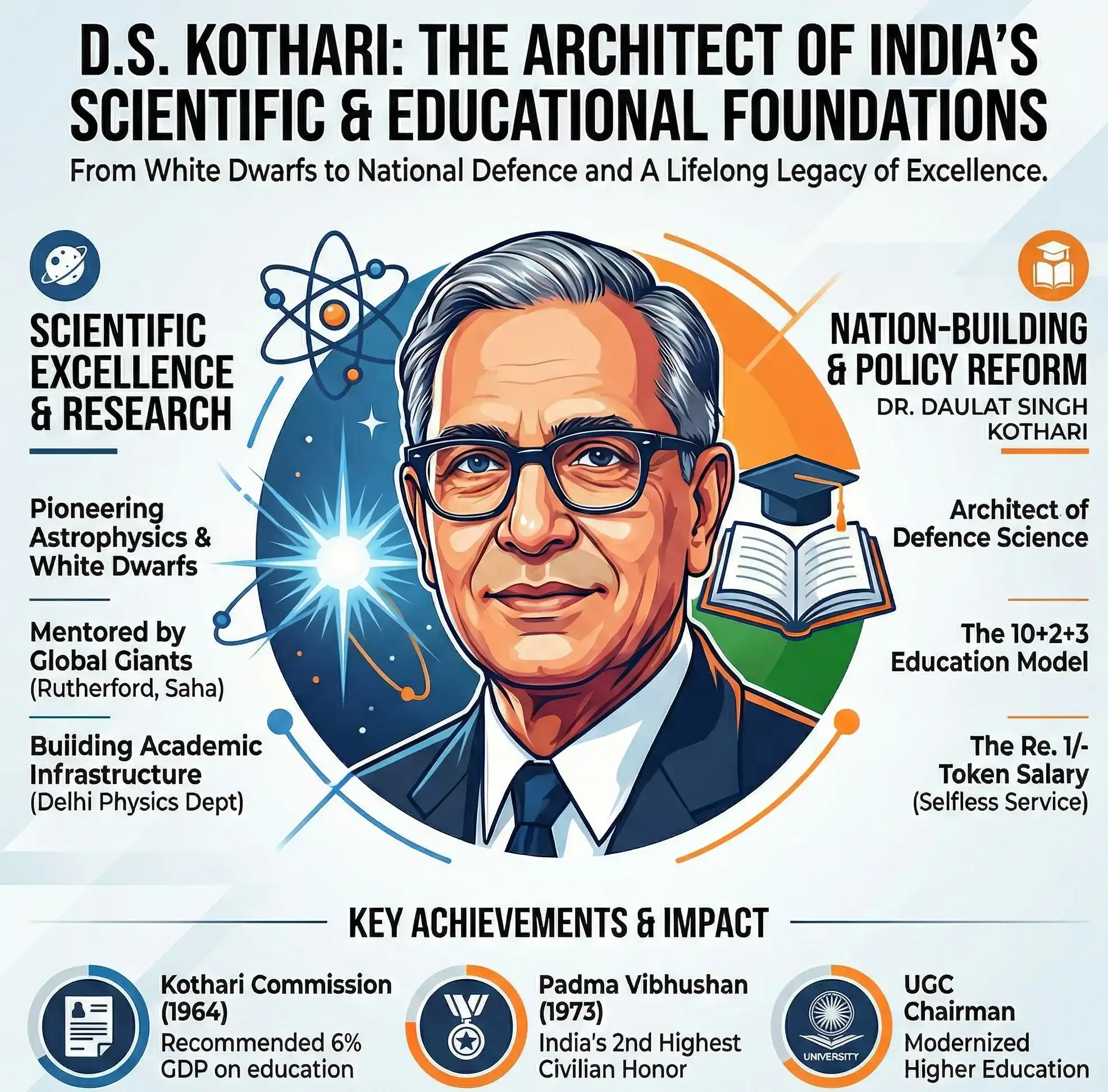
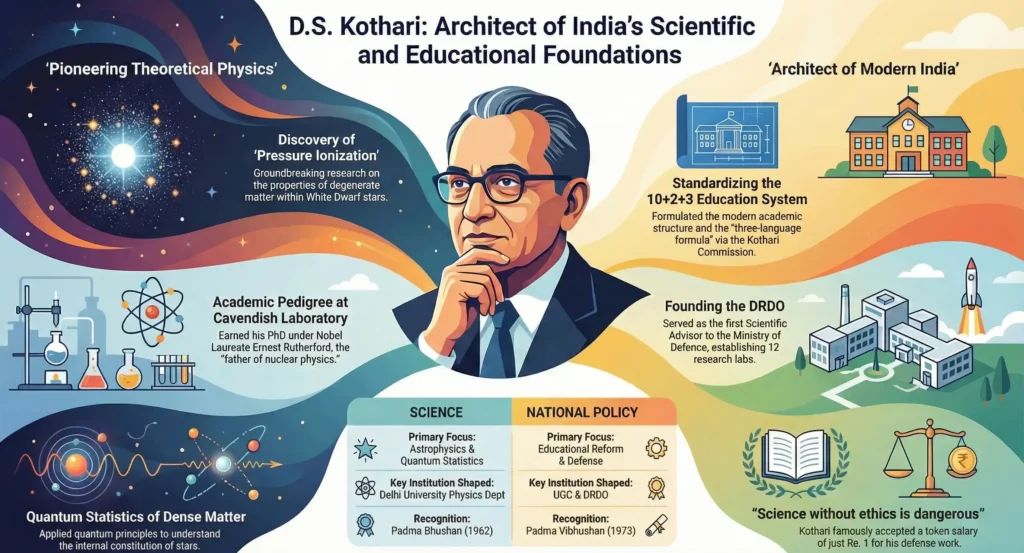
At Cambridge he worked with Rutherford and R.H. Fowler, and began the work that made his name, a theory of pressure ionisation, the way atoms are crushed and stripped of electrons deep inside dense stars like white dwarfs. He took his PhD in 1933 and soon came back to his old job in Allahabad.
When he wanted to go to Cambridge, it was Saha who wrote to Rutherford.
Delhi
In 1934 Saha pushed him again, this time to leave. Delhi University wanted a Reader in Physics, and at Saha’s insistence Kothari took the job.
When he arrived, the physics department had two teachers: Kothari and one demonstrator. There were no postgraduate courses in science at all. He built the department from there, and stayed with it for twenty-seven years. He set a rule that every member of the faculty, theorist or experimenter, had to take part in the laboratory work.
He went on to be scientific adviser to the Ministry of Defence, chairman of the University Grants Commission, and chairman of the Education Commission of 1964 to 1966. The Education Commission’s report, submitted in June 1966, opened with a sentence that has been quoted in almost every Indian education policy since: “The destiny of India is now being shaped in her classrooms.”
8 Remarkable Secrets in the Jagadish Chandra Bose Biography
The classroom
It is easy to read that sentence as a grand statement about a nation. It was also, perhaps, something Kothari knew about himself.
A plague had taken his father when he was twelve. A family friend had taken him in. A Maharana’s scholarship had sent him to Allahabad. And there, in a physics department, a teacher who had himself been a poor boy from a village had looked at his results, asked him a question, and then picked up a pen and dictated a young man’s future for him.
In 1978 the Indian National Science Academy gave Kothari its Meghnad Saha Medal. He used his lecture to argue that knowing more about the atom was not enough, and that science without self-knowledge could in the end only invite disaster.
10 Remarkable Facts About Meghnad Saha Life and Achievements
Read More: https://curiousindian.in/shivkar-bapuji-talpade-1864-1916/
If you think you have remembered everything about this topic take this QUIZ
Results


#1. Where was Dr. Daulat Singh Kothari born in 1906?
#2. Under which legendary Nobel Laureate did Kothari study at the Cavendish Laboratory at the University of Cambridge?
#3. What specific area of astrophysics was the primary focus of Dr. Kothari’s groundbreaking research?
#4. What crucial administrative role was Kothari appointed to in 1948 by the Government of India?
#5. Which standardized schooling system was proposed by the Kothari Commission (1964–1966)?
#6. What remarkable personal gesture did Kothari make while serving as the Defence Scientific Advisor?
#7. For how many years did Dr. Kothari serve at the University of Delhi, heavily influencing generations of physics students?
#8. Which two major Indian civilian awards was Dr. Kothari honored with in 1962 and 1973, respectively?
What is D.S. Kothari famous for in the field of physics?
He is famous for his groundbreaking work in astrophysics, specifically regarding the quantum statistics of dense matter and pressure ionization in White Dwarf stars.
What is the Kothari Commission?
It was the Indian Education Commission (1964–1966) chaired by D.S. Kothari, which recommended the standardized 10+2+3 educational structure and the three-language formula for India.
Who was D.S. Kothari’s most famous mentor in India?
The legendary Indian physicist Meghnad Saha, who guided him at Allahabad University and pushed him to pursue his PhD at Cambridge.
What was Kothari’s role in India’s defence?
He was the first Scientific Advisor to the Ministry of Defence and laid the foundational groundwork for the Defence Research and Development Organisation (DRDO).
Which prestigious laboratory did Kothari attend for his PhD?
He attended the Cavendish Laboratory at the University of Cambridge, studying under Nobel Laureate Lord Ernest Rutherford.
Sources & References
Dr D S Kothari Institute, Udaipur, “About Dr DS Kothari” — Saha’s offer and the dictated application in July 1928, the watchmaker plan, the Delhi department in 1934 and his laboratory rule.
Vigyan Prasar, Government of India, “Kothari Daulat Singh” — his schooling in Indore, the Rajputana Board result, the Maharana’s scholarship, the Mewar loan and his voyage to England.
Resonance, Indian Academy of Sciences, “Daulat Singh Kothari (1906–1993)”, Article-in-a-Box (2020) — his work at Cambridge and his 1978 Meghnad Saha Medal lecture.
Ministry of Education, Report of the Education Commission 1964–66, Education and National Development (1966) — the opening sentence of the report.
Author


Exploring the Soul of Bharat through History, Science, Culture, and its Diversity
Our Mission
Curious Indian is a definitive knowledge portal dedicated to chronicling the events, personalities, and cultural shifts that defined the Indian subcontinent. From the ancient Vedic Period to the complexities of 21st-century politics, our goal is to provide deep-dive analysis that inspires.
Editorial Standards & E-E-A-T
Every article published under our brand undergoes a rigorous fact-checking process. We prioritize primary historical records, academic citations, and credible archives to ensure our readers receive accurate, high-authority information.
Historical Integrity Directly sourcing from ASI archives and academic journals.Topical Authority Comprehensive clustering of Indian Science, Biographies, and Wars.Managed by Paripurna Datta and TEAM | Dedicated to the Knowledge of India.