Pokhran-II refers to India’s series of five underground nuclear tests conducted at the Indian Army’s Pokhran Test Range in Rajasthan on 11 and 13 May 1998, demonstrating a thermonuclear design and multiple fission devices and declaring India a nuclear-weapon state in practice outside the NPT framework.
How India ended its nuclear ambiguity, and what it cost
Twenty-four years earlier, in the very same desert, India had set off a nuclear device and then spent a generation being coy about it. It had called that blast “peaceful,” and for twenty-four years afterwards it refused to say plainly whether it had the bomb or not, living in a careful grey zone of hints and silence.
In May 1998, India stopped whispering.
Over two days, it detonated five nuclear devices beneath the sands of Pokhran. And then the Prime Minister stood before the country and the world and said, without apology and without evasion, the thing India had refused to say out loud for a generation: that it had nuclear weapons, and it meant to keep them.
This is the story of Pokhran-II, the tests that ended India’s long ambiguity, and of what a nation gains, and what it risks, when it finally stops apologising for its own power.
The secret in plain sight
The most astonishing part of the whole affair was how they hid it.
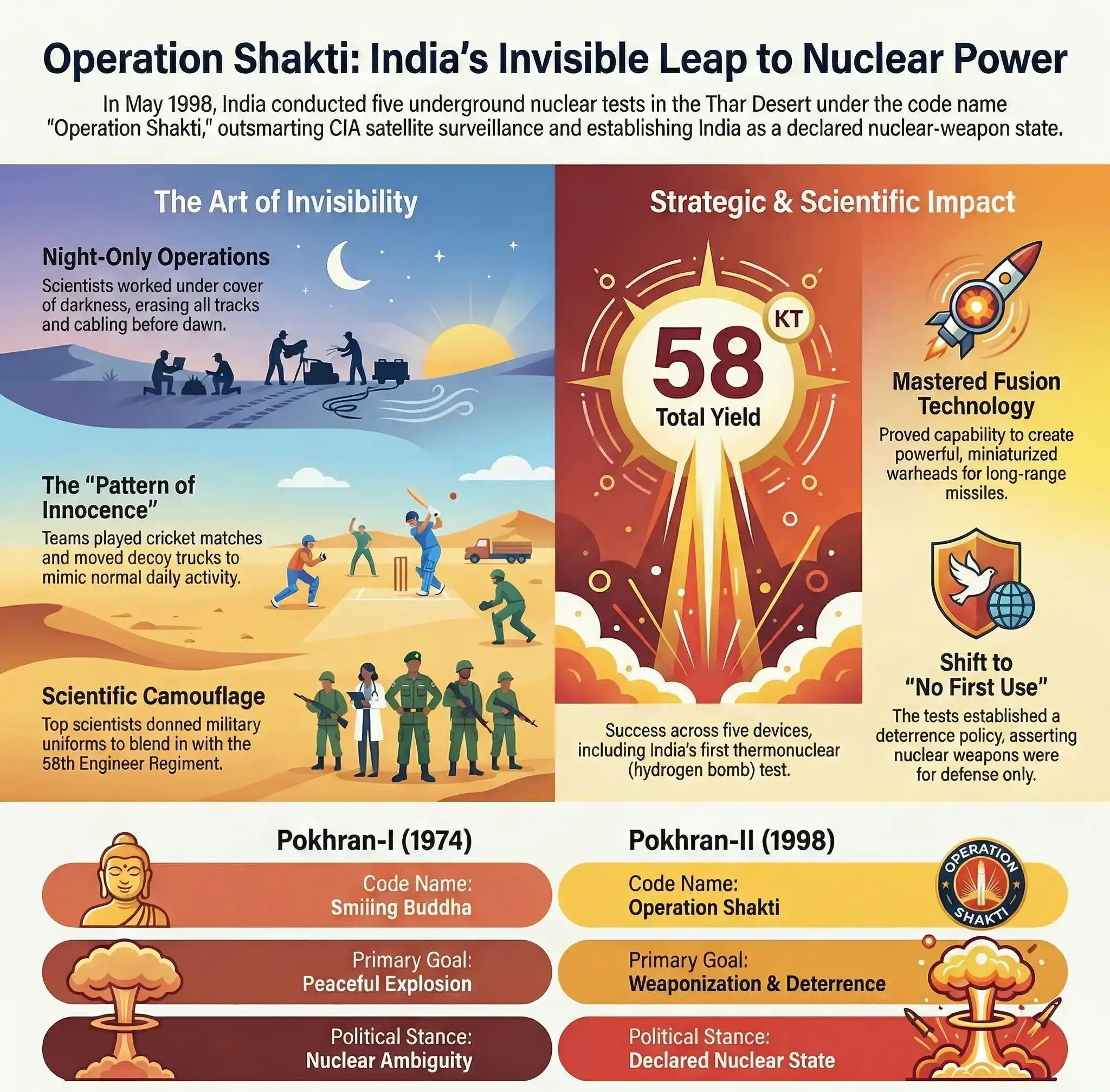
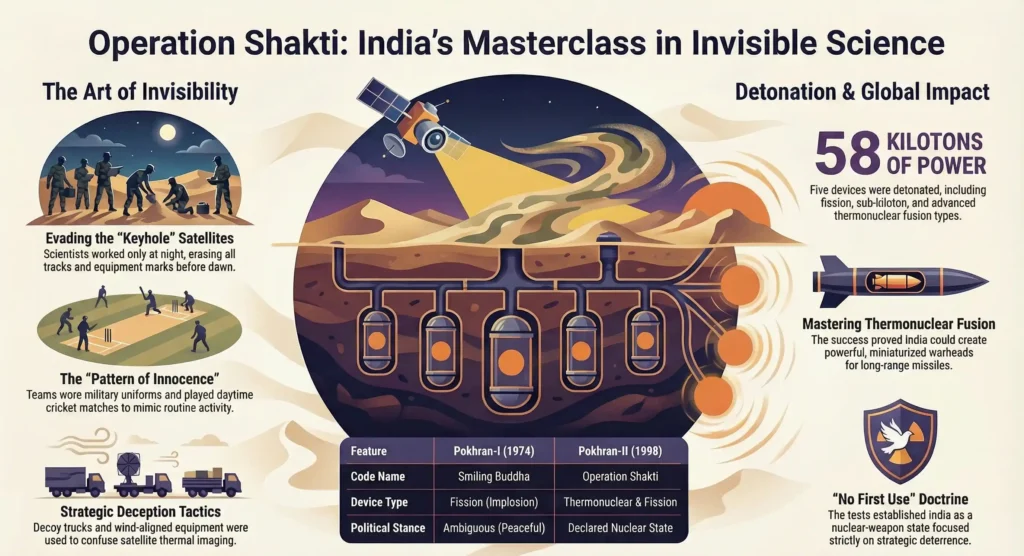
The world’s most powerful spy agencies, above all the American CIA, kept a close and constant watch on the Pokhran range from space. Their satellites passed overhead again and again, photographing every truck and trench. Once before, in the mid-1990s, they had caught India preparing to test and had pressured it into backing down. This time, India’s scientists and soldiers were determined not to be caught.
So they became the desert. They worked almost entirely at night, and by dawn they erased every trace, filling in and smoothing over the disturbed sand so the morning photographs would show a landscape that never seemed to change. They disguised the digging as ordinary army work. The lead scientists, among them A.P.J. Abdul Kalam, moved about the range in military uniforms under false names. They even kept up the small, dull routines of a sleepy garrison, so that from orbit there was nothing to see but a pattern of perfect innocence.
They moved their equipment only in the dark, and put the desert back before dawn, so that the spy satellites overhead would photograph a wilderness that never seemed to change. The mightiest intelligence machine on earth saw nothing coming.
The obvious question is why. Why, after a quarter-century of careful silence, choose this moment to say it plainly?
The reasons India gave were, whatever one thinks of nuclear weapons, real ones. To its north lay China, a nuclear power with which India had fought a war and still shared an unsettled border. To its west lay Pakistan, widely believed to have quietly built a bomb of its own. And the established nuclear powers were meanwhile trying, through global treaties, to freeze the nuclear club forever, with themselves comfortably inside it and India permanently outside, an arrangement India denounced as “nuclear apartheid.”
The great powers wanted to lock the nuclear club shut forever, with themselves inside and India out. India refused to accept one rule for the strong and another for everyone else.
India concluded that living in permanent ambiguity, neither openly armed nor safely disarmed, left it with the worst of both worlds: the suspicion of a nuclear power and the vulnerability of a non-nuclear one. It chose, instead, to declare itself, and to argue that a nation of a billion people had exactly the same right to defend itself as any other.
Shakti
On 11 and 13 May 1998, the desert shook. Five devices were fired, among them what India said was its first true thermonuclear weapon, a hydrogen bomb, the kind that draws its terrible power from the same reaction that lights the sun. The operation was code-named Shakti, a word that simply means power.
The nation erupted in pride. Two of its most admired scientists, Abdul Kalam and R. Chidambaram, became national heroes overnight. For a country long used to feeling like a poor and overlooked also-ran in the world, it was a moment of fierce and uncomplicated joy: India had done, entirely on its own, what only a small handful of nations had ever managed to do. When the tests succeeded, Kalam sent a quiet message back to Delhi that reached all the way back to that first blast in 1974. The Buddha, he said, has smiled again.
The world did not smile. The United States, Japan and others quickly imposed heavy sanctions, and condemnation rained down from every direction. India weathered it, and within a few years the sanctions faded and the world made its peace with a nuclear India. But the deepest consequence was not the sanctions. It was, exactly as it had been in 1974, a mirror.
Within two weeks, Pakistan answered. In its own desert, at Chagai, it set off nuclear tests of its own and declared itself, too, a nuclear power.
Within two weeks, Pakistan answered with tests of its own. The same fear that had driven India now drove its neighbour, and South Asia had two openly nuclear rivals where before it had none.
There is no villain to point to in that exchange, only a grim symmetry. India had reached for the bomb because China had one; Pakistan reached for it because India now openly had one. The same fear, the same reasoning, the same terrible logic, passed from hand to hand down the line. And when it was done, one of the most crowded and most bitterly divided corners of the earth had become a place where two old enemies faced each other, openly, with the power to end each other.
Barely a year later, the question at the very heart of the matter was put to a real and frightening test.
In 1999, India and Pakistan fought a war high in the icy mountains of Kargil, the first war ever fought between two openly nuclear-armed states. The whole world held its breath, terrified that a battle in the mountains might climb, rung by rung, toward the unthinkable. It did not. The fighting stayed limited, and it stopped.
And here the two ways of seeing the bomb split apart, looking at the very same war and drawing opposite conclusions.
To those who trust the bomb, Kargil proved it worked: because both sides now held nuclear weapons, both took care to keep even a real war small. To those who fear it, Kargil proved the opposite: that nuclear neighbours will fight anyway, and must simply be lucky, every single time, that no one climbs the last rung.
Both readings are serious, and both are held by serious people. It is worth saying, in fairness, that India also declared a policy of “no first use,” a promise that it would never be the one to reach for these weapons first. But a promise is only a promise, and the deeper truth of Kargil is that the world had just watched two nuclear powers go to war and survive it, and had learned nothing that could tell it whether that was reassurance or warning.
So what did India truly gain in those two days in the desert?
It gained, undeniably, a kind of standing. It stopped apologising for its power and claimed it in the open, and much of the old habit of being lectured and pushed around by greater nations fell away. There is a real dignity in that, for a country as for a person: the dignity of standing squarely in the world as what you actually are, rather than hiding behind a polite fiction.
But standing tall this way carries a weight that never sets down, and honesty means naming it plainly. India is safer now, in the sense that no one will lightly threaten a nation that can answer with a bomb. And India is in more permanent danger now, in the sense that it lives, and will always live, only a few bad decisions away from catastrophe, bound for good to a nuclear-armed rival in a quarrel neither of them has ever managed to end. Both of those are true, and both will stay true.
India walked into that desert a country that felt pushed around, and walked out a country no one could push around, and one that could never again fully relax. That is the bargain of the bomb.
Perhaps the deepest thing Pokhran-II teaches is that power, once you claim it openly, does not free you from fear. It only changes the kind of fear you carry. India went into that desert feeling small and slighted, and came out feeling strong and unafraid of others, and yet permanently unable, ever again, to fully rest. Having made that bargain, India, like every nuclear nation before it, must now live with it, carefully, forever. And the truest measure of the strength it found beneath the sands of Pokhran will not, in the end, be the size of its arsenal. It will be whether India and its neighbour prove wise enough that the weapons are never, ever used.
If you think you have remembered everything about this topic take this QUIZ
Results
QUIZ START
#1. What was the official code name for the series of five nuclear tests conducted in May 1998?
Previous
Next
#2. How did Indian scientists and the 58th Engineer Regiment hide their activity from CIA ‘Keyhole’ spy satellites?
Previous
Next
#3. Which major scientific milestone was achieved during the May 11 tests that proved India’s advanced nuclear capability?
Previous
Next
#4. What was the purpose of the three ‘sub-kiloton’ experimental devices tested during Pokhran-II?
Previous
Next
#5. According to the ‘Quick Comparison’ table, what was the primary political shift after Pokhran-II compared to Pokhran-I?
Previous
Next
#6. Which scientist, who later became the President of India, led the DRDO during these tests and donned a military uniform as a disguise?
Previous
Next
#7. How did the United States initially react to the successful completion of the tests?
Previous
Next
#8. What was the legendary code word used by Dr. Kalam to inform New Delhi that the tests were successful?
Previous
Finish
Why did India conduct the Pokhran-II tests?
India conducted the tests to establish a credible nuclear deterrent against regional threats (primarily China and Pakistan) and to demonstrate its technological capability to build thermonuclear weapons.
How many bombs were detonated in Pokhran-II?
A total of five devices were detonated. Three on May 11, 1998, and two on May 13, 1998.
Did the CIA know about the Pokhran-II tests?
No. The Indian Army and scientists successfully deceived US spy satellites by working at night and using camouflage, resulting in a massive intelligence failure for the CIA.
Who was the Prime Minister during the Pokhran-II tests?
Atal Bihari Vajpayee was the Prime Minister of India who authorized the tests.
What is the difference between an atomic bomb and a thermonuclear bomb?
An atomic bomb (fission) splits atoms to release energy. A thermonuclear bomb (hydrogen bomb) uses a fission bomb to trigger a fusion reaction (joining atoms), releasing vastly more energy. India tested both types in 1998.
Sources & References
Encyclopaedia Britannica (“Pokhran” and India’s nuclear programme) — the 1998 tests, Operation Shakti, and the declaration of nuclear status.
Arms Control Association (India, Pakistan and the 1998 nuclear tests) — the tests, the treaty context, and the international response.
Encyclopaedia Britannica (“A.P.J. Abdul Kalam”) — the scientist who helped lead the tests.
Encyclopaedia Britannica (“Kargil War”) — the 1999 conflict between the two newly declared nuclear powers.
Exploring the Soul of Bharat through History, Science, Culture, and its Diversity
Our Mission
Curious Indian is a definitive knowledge portal dedicated to chronicling the events, personalities, and cultural shifts that defined the Indian subcontinent. From the ancient Vedic Period to the complexities of 21st-century politics, our goal is to provide deep-dive analysis that inspires.
Editorial Standards & E-E-A-T
Every article published under our brand undergoes a rigorous fact-checking process. We prioritize primary historical records, academic citations, and credible archives to ensure our readers receive accurate, high-authority information.
Historical IntegrityDirectly sourcing from ASI archives and academic journals.
Topical AuthorityComprehensive clustering of Indian Science, Biographies, and Wars.
Managed by Paripurna Datta and TEAM | Dedicated to the Knowledge of India.