He rang a bell through three walls with invisible waves, and then refused to take a patent
Calcutta Town Hall, November 1895. The Lieutenant-Governor of Bengal, Alexander Mackenzie, is sitting in the front of the room.
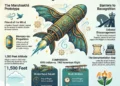
Jagadish Chandra Bose presses a key on the lecture table. Something invisible leaves the apparatus, passes through the Governor, then through a wall, a passage and two more walls, and reaches a receiver seventy-five feet away in another room. A bell rings. A weight falls. A small heap of gunpowder goes off with a flash.
He called it adrisya alok, invisible light.
Nobody in that hall had seen anything cross the rooms. A bell rang in a place nobody was standing.
What happened next, and what did not
What happened next is that he published. Papers to the Asiatic Society, to the Royal Society through Lord Rayleigh, and articles in the trade press in London, describing the apparatus completely: the transmitter, the horn, the receiver, the detector.
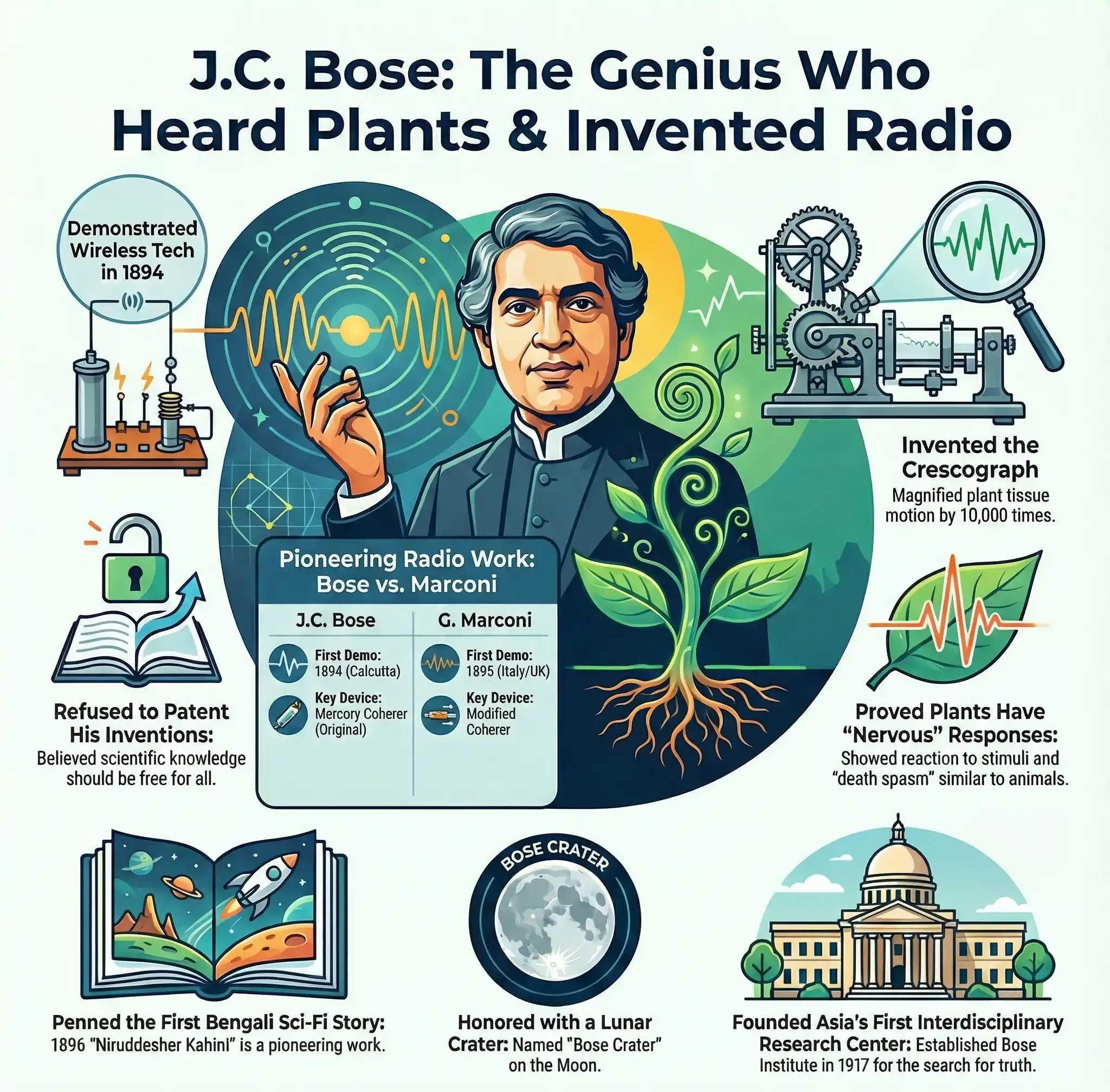
What did not happen is a patent. Offers came from manufacturers who could see what this was worth, and he turned them down, and wrote to Rabindranath Tagore about it in some disgust, as a thing he could not stand about the commercial world.
He said in interviews in London that he had no interest in commercial telegraphy and that anyone who wanted to use his work was welcome to it. He meant it literally.
He described the machine in full, in public, and told the men who wanted to sell it that they could have it for nothing.
7 Incredible Stories from the Battle of Zojila 1948
5 Untold Secrets of Jaswant Singh Rawat 1962 War Legend
Being accurate about the claim
The version of this story that circulates in India says Bose invented radio and was robbed. That is too simple and it does him no favours.
Oliver Lodge had demonstrated wireless signalling in England the year before. Bose and Lodge were both studying the physics of the waves rather than trying to build a telegraph, which is precisely why neither of them raced to the patent office and why Marconi, who was trying to build a telegraph, got there.
What is solidly Bose’s is the short end of the spectrum. He was working at millimetre wavelengths, made the horn antennas, polarisers and waveguides to handle them, and his galena point-contact detector was a semiconductor device decades before the field existed. In 1997 the IEEE credited him as one of the founders of radio science, and modern millimetre-wave work, including the frequencies in current mobile networks, sits in the territory he opened.
The one patent
There is exactly one patent, and he had to be pushed into it.
Sister Nivedita and Sara Chapman Bull, an American friend, argued him into filing for his detector in 1901. Mrs Bull lent him the eighty dollars the application cost. It was granted in 1904 and he let it go afterwards, and never filed another.
Marconi’s transatlantic signal came in December 1901 and the Nobel Prize in 1909. Bose got a lecture room and, eventually, a knighthood.
Battle of Shalateng 1947: How Srinagar Was Saved
Then he stopped
Around 1900, at the height of his reputation in physics, he changed subject entirely and spent the next thirty-seven years on plants.
It was not a whim. His instruments had shown him that metals under repeated stimulation showed something that looked like fatigue, and recovered after rest, and he wanted to know where exactly the boundary between living and non-living response was, if there was one.
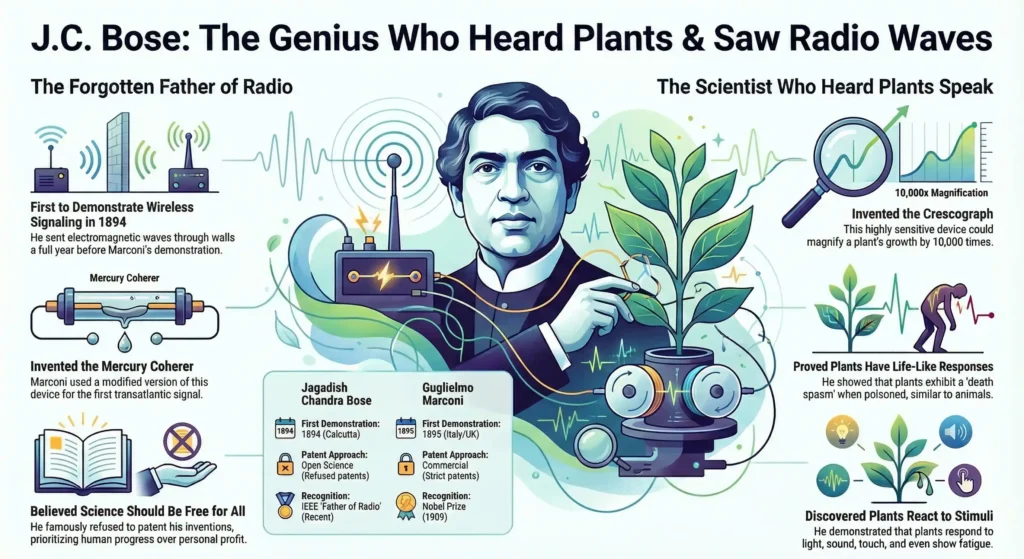
He built the crescograph, which magnified a plant’s growth ten thousand times so that you could sit and watch it happen. He recorded electrical responses in plants to touch, heat, light and poison, and demonstrated at the Royal Institution a plant being dosed with poison, its trace convulsing and then going flat.
What that cost him
Plant physiologists did not accept it. He was told he had overreached, that he was reading feeling into mechanism, and for decades his later work sat outside the mainstream in the West while he was revered at home.
Plant electrophysiology is now an ordinary field. Action potentials in the sensitive plant and the Venus flytrap are textbook material, and electrical signalling between parts of a plant is established. The instruments were right. The vocabulary he used for them was ahead of what anyone was willing to hear.
The institute
He founded the Bose Institute in Calcutta in 1917 and said at the opening that it was not a laboratory but a temple, and that what was found in it would be given away rather than sold.
He built the thing, told everyone how it worked, and then spent his life asking whether a plant gets tired. A patent would have made him rich and would not have made him interested.
120 Brave Hearts: The Battle of Rezang La 1962
Inspiring Chapters of the CV Raman Life Story
If you think you have remembered everything about this topic take this QUIZ
Results


#1. What was the primary reason Jagadish Chandra Bose refused to accept his salary at Presidency College for three years?
#2. Which specific instrument did J.C. Bose invent to measure and observe the growth and responses of plants?
#3. Regarding the invention of the radio, what distinguished Bose’s approach from Guglielmo Marconi’s?
#4. In his botanical research, what did Bose demonstrate by exposing a plant to poison during a presentation at the Royal Society?
#5. What is the title of the story written by J.C. Bose that is considered the first major work of Bengali science fiction?
#6. Which of the following describes a ‘first’ achieved by J.C. Bose in the context of his international recognition?
#7. How did Bose’s early education in a vernacular school influence his scientific perspective?
#8. Bose discovered that even inorganic metals show signs of ‘fatigue’ and ‘recovery’. What did this lead him to believe?
What did J.C. Bose invent?
He is most famous for inventing the Crescograph (which measures plant growth) and several microwave components like the spiral-spring coherer and the horn antenna.
Did J.C. Bose win a Nobel Prize?
No, he did not win a Nobel Prize. Many believe this was due to the colonial politics of the time and his refusal to patent his work, which allowed others like Marconi to take the commercial spotlight.
How did he prove plants have life?
Using his crescograph, he showed that plants respond to external stimuli like electricity, chemicals, and light in a way that is mathematically similar to animal nervous systems.
Why is he called the Father of Bengali Science Fiction?
He wrote “Niruddesher Kahini” in 1896, which is credited as the first significant science fiction story in the Bengali language.
What is the Bose Institute?
Founded by J.C. Bose in 1917 in Kolkata, it is one of India’s oldest and most prestigious interdisciplinary research institutes.
Sources & References
D.T. Emerson, “The work of Jagadis Chandra Bose: 100 years of mm-wave research”, IEEE Transactions on Microwave Theory and Techniques (1997) — his millimetre-wave apparatus, the galena detector and the modern assessment of his priority.
United States Patent 755,840, Detector for Electrical Disturbances (1904) — the single patent he was persuaded to file.
Patrick Geddes, The Life and Work of Sir Jagadis C. Bose (1920) — the 1895 demonstration, his refusal of commercial offers and the turn to plant research.
J.C. Bose, letter to Rabindranath Tagore (1901) — his own account of why he would not patent.
Author


Exploring the Soul of Bharat through History, Science, Culture, and its Diversity
Our Mission
Curious Indian is a definitive knowledge portal dedicated to chronicling the events, personalities, and cultural shifts that defined the Indian subcontinent. From the ancient Vedic Period to the complexities of 21st-century politics, our goal is to provide deep-dive analysis that inspires.
Editorial Standards & E-E-A-T
Every article published under our brand undergoes a rigorous fact-checking process. We prioritize primary historical records, academic citations, and credible archives to ensure our readers receive accurate, high-authority information.
Historical Integrity Directly sourcing from ASI archives and academic journals.Topical Authority Comprehensive clustering of Indian Science, Biographies, and Wars.Managed by Paripurna Datta and TEAM | Dedicated to the Knowledge of India.