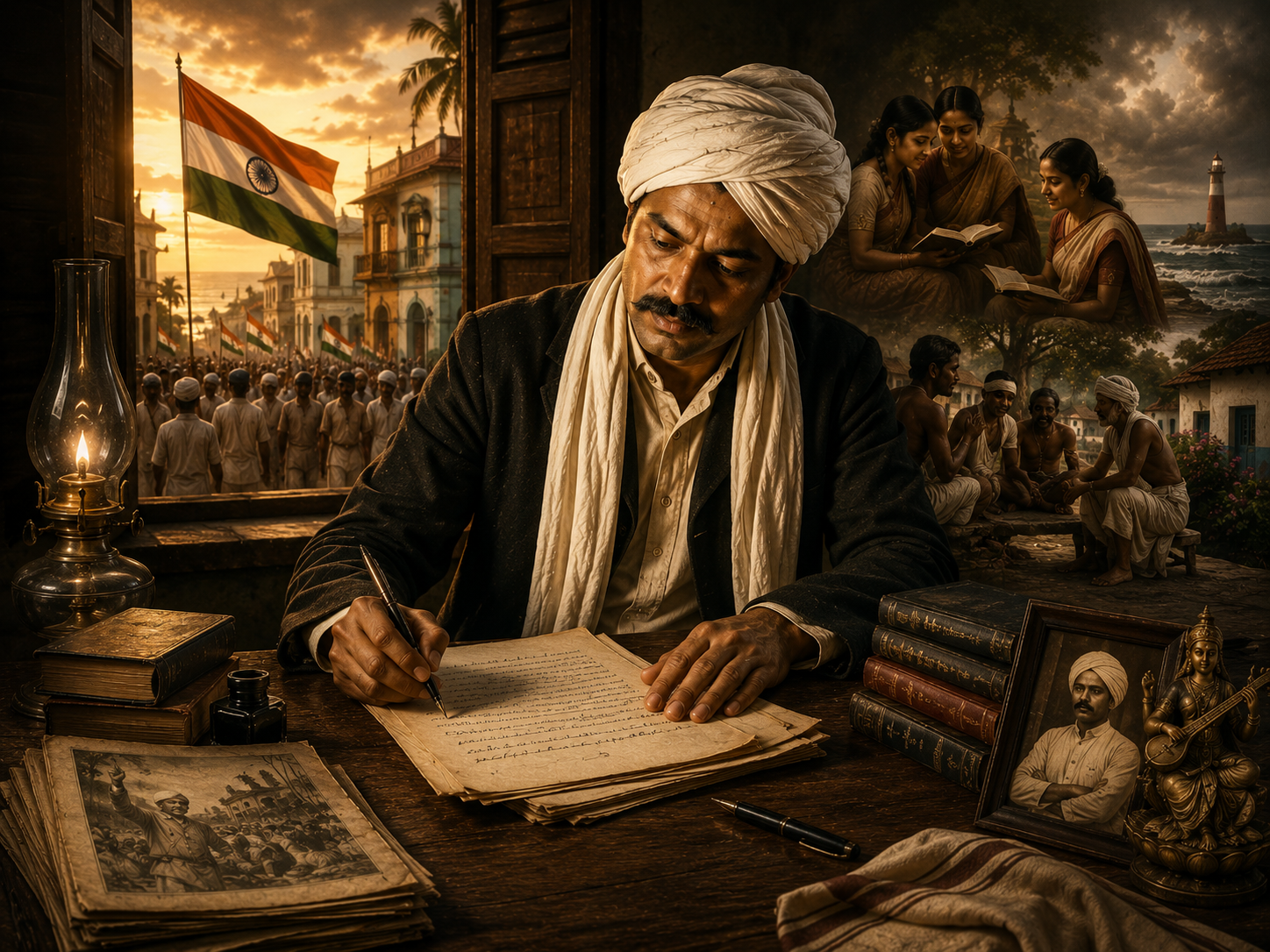
How the Great Tamil Poet Sang for a Freedom Far Bigger than Independence and Died before Either Arrived
Most of the men and women who fought for India’s freedom wanted one clear thing above all: to be rid of the British. Subramania Bharati wanted that too, and fiercely. But he wanted something bigger, and far harder.
He wanted freedom for everyone. Not only freedom from the foreign rulers, but freedom from all the other chains that Indians had wrapped around one another: the chains of caste, and the chains that kept women shut away from the world. For Bharati, a song of freedom was also a song of equality. And that dream was so far ahead of its time that he lived and died poor and half-forgotten, and was fully understood only long after he was gone. This is the story of the great Tamil poet who dreamed too soon.
The Boy called Bharati
He was born in 1882 in a small town in Tamil Nadu. He lost his mother when he was five and his father when he was sixteen. But from very early on, he possessed one extraordinary gift: words.
Poetry simply poured out of him. By the age of eleven, his verses so amazed the local king’s court that he was given a special title he would carry for the rest of his life. They called him Bharati, a name of the goddess of learning herself. He was, in other words, marked out as a poet before he was even fully a man.
Vedic Period 1500-500 BCE: The Foundation of Indian Civilization
A Pen like a Fire
Bharati poured that great gift into the cause of his country’s freedom. He became a journalist, editing blazing Tamil newspapers, and along the way he did something that changed the Tamil language forever.
He took Tamil down from the dusty high shelf of the scholars and handed it to the ordinary people in the street.
Bharati wrote in a simple, drumbeat rhythm that a farmer or a fisherman could actually sing. And sing they did.
His patriotic songs spread across the south of India like flying sparks, teaching a beaten-down, colonised people to lift up their heads and to believe that freedom was theirs by right. To the British authorities, a poet who could make millions of ordinary people feel that way was a very dangerous man indeed.
Reign of Emperor Ashoka: The Transformation of a Tyrant
The Two Castes
But here is what set Bharati apart from so many of those around him. He looked long and hard at his own society, and he did not like everything that he saw. What was the use, he asked, of throwing off a foreign master, if Indians simply went on being cruel masters over one another? So he turned his fire inward as well.
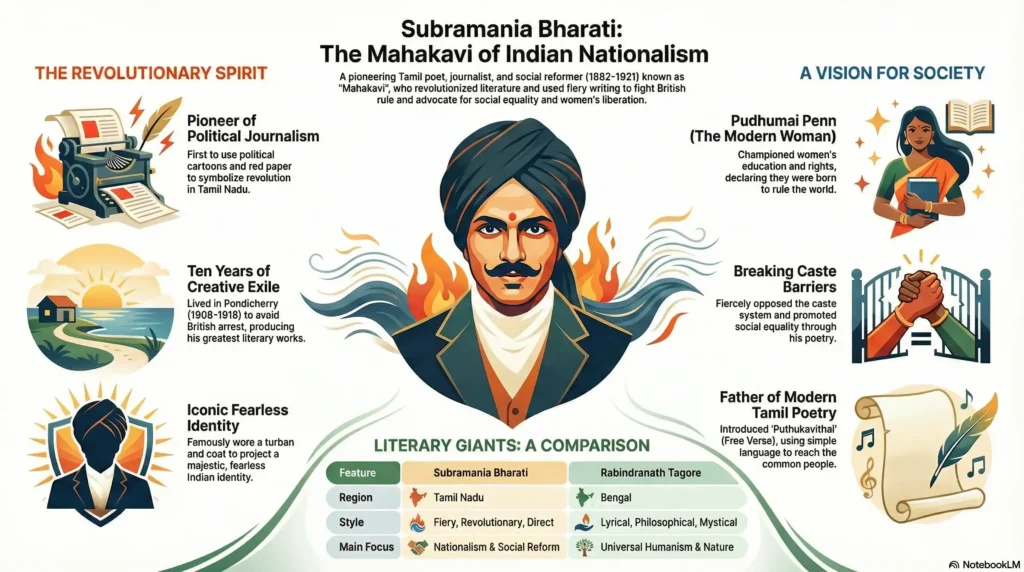
He hated the caste system, and he said so without flinching. In a line that can still startle people today, he declared that there were really only two castes in the whole world, men and women, and no others at all. Though he himself had been born into a high, “Brahmin” caste, he tore off the sacred thread that marked out his high birth, and he honoured those whom society cruelly called “untouchable” as his full equals.
Bharati declared that there were really only two castes in all the world: men and women. And he tore off the sacred thread of his own high birth.
He fought every bit as hard for the freedom of women. In an age when many girls were married off as children and kept hidden behind closed doors, Bharati sang instead of a bold “new woman”, proud, educated, and free, walking with her head held high beside any man.
It is worth being clear that this was never a war on faith. Bharati was himself a deeply devout man, who sang tender songs to the goddess and translated holy scripture into Tamil. His fight was against the cruelty and the injustice that had crept into society over the centuries, and never against belief itself.
Sangam Period: The Golden Age of Tamil Literature
The Years in Exile
All of this made Bharati a hunted man. His writings openly called on Indians to overthrow their rulers, and the British moved to silence him for good.
In 1908, to escape arrest, he fled to the small, French-ruled town of Pondicherry, and there he lived in exile for close to ten years. They were hard, hungry years, forever shadowed by poverty. And yet it was in that very exile that some of his greatest poetry of all came pouring out of him. In one long and famous work, he retold an old story from the Mahabharata, the public humiliation of the queen Draupadi, and turned it into a mirror for his own humiliated, colonised motherland. Poverty could starve his body, but it could not lay a finger on his pen.
The Elephant and the Quiet Funeral
Bharati’s story ends with a cruelty that is hard to forget.
He came home from exile still poor, still struggling every day to feed his family. In the city of Madras there was a temple elephant that he loved and often went to feed by hand. One day in 1921, the great animal, perhaps suddenly startled, turned on him and injured him badly. Already worn thin by years of hardship and hunger, Bharati never truly recovered, and a few months later he died. He was only thirty-eight years old.
And here is the saddest part of all. The man who had sung an entire people awake died almost unknown, in poverty, and only a small handful of mourners came to see him laid to rest.
Dadasaheb Phalke: The Father of Indian Cinema
The Freedom He did not Live to See
India did not stay forgetful of him for long. In the years after his death, and above all after freedom finally arrived in 1947, Tamil Nadu came to treasure Bharati as its very greatest modern poet, its beloved Mahakavi. His works were made the property of the whole people, free for anyone at all to sing. His songs are still sung today, and his face is known to every Tamil child.
But there is a deeper thing worth remembering about him. Bharati did not live to see even the first of his dreams come true, for he died a full twenty-six years before the British finally left. And the second, larger freedom that he sang for, an India with no caste and no cages for its women, a land where the only two castes were men and women, all of them equal, that freedom is one his country is, arguably, still reaching towards a whole century later. He was a poet who simply saw further than his own age could follow. He sang of a dawn he knew he would never live to watch break, and he trusted the rest of us to keep on singing until at last it did.
Sunayani Devi: A Woman’s Voice in the Bengal School
If you think you have remembered everything about this topic take this QUIZ
Results


#1. At what age did Chinnaswami Subramania Iyer earn the title “Bharati” (Blessed by Saraswati) after winning a debate?
#2. Whom did Subramania Bharati consider his Guru, inspiring him to fight for the freedom of women and the nation?
#3. Bharati is credited with introducing political cartoons to Tamil journalism through which weekly magazine?
#4. To escape an arrest warrant by the British in 1908, Bharati lived in exile for 10 years in which French colony?
#5. In his epic poem Panchali Sabatham, whom did Bharati visualize as Mother India to inspire the nation?
#6. What Tamil term did Bharati coin to advocate for women’s rights, education, and liberation?
#7. Which tragic incident contributed to the deterioration of Bharati’s health and his eventual death in 1921?
#8. Bharati famously wore a turban and a coat to project a majestic, fearless Indian identity, inspired by his admiration for which community?
What is the popular title of Subramania Bharati?
He is called Mahakavi (Great Poet) or Bharathiyar.
Which poem depicts Draupadi as Mother India?
Panchali Sabatham (The Vow of Draupadi).
Where did Bharati live in exile?
He lived in Pondicherry for 10 years (1908–1918).
Who was Bharati’s spiritual guru?
Sister Nivedita (disciple of Swami Vivekananda).
What was the name of the magazine edited by Bharati?
He edited India (a weekly) and worked for Swadesamitran (a daily).
Sources and References
- Wikipedia (“Subramania Bharati”) — his dates (1882–1921), the title “Bharati” and “Mahakavi,” his role as a pioneer of modern Tamil poetry, and his advocacy for the emancipation of women, against child marriage, and against the caste system.
- Anantam IAS and Storytrails — his journalism (Swadesamitran, India, Bala Bharatam, Vijaya), his exile in Pondicherry from 1908 to 1918, his major works including Panchali Sabatham (using Draupadi as an allegory for colonial oppression), and Sister Nivedita’s influence on him.
- Brainly and Bioglance (on his reform and death) — his declaration that there were only two castes, men and women, his removal of his own sacred thread, and his death at 38 in 1921 after being injured by a temple elephant.
- Organiser and Tamil Heritage sources — the accurate picture of his reform as directed against untouchability and the discrimination of women rather than against faith, his devotion to the goddess Kali and his Tamil translation of the Bhagavad Gita, and the 1949 nationalisation of his works by the Tamil Nadu government.
- Original Curious Indian article (“Subramania Bharati”) — his prodigy childhood and the title earned at eleven, his simplification of Tamil for the common people, his fiery editorials and cartoons, and his combined legacy of nationalism, feminism and anti-caste reform.