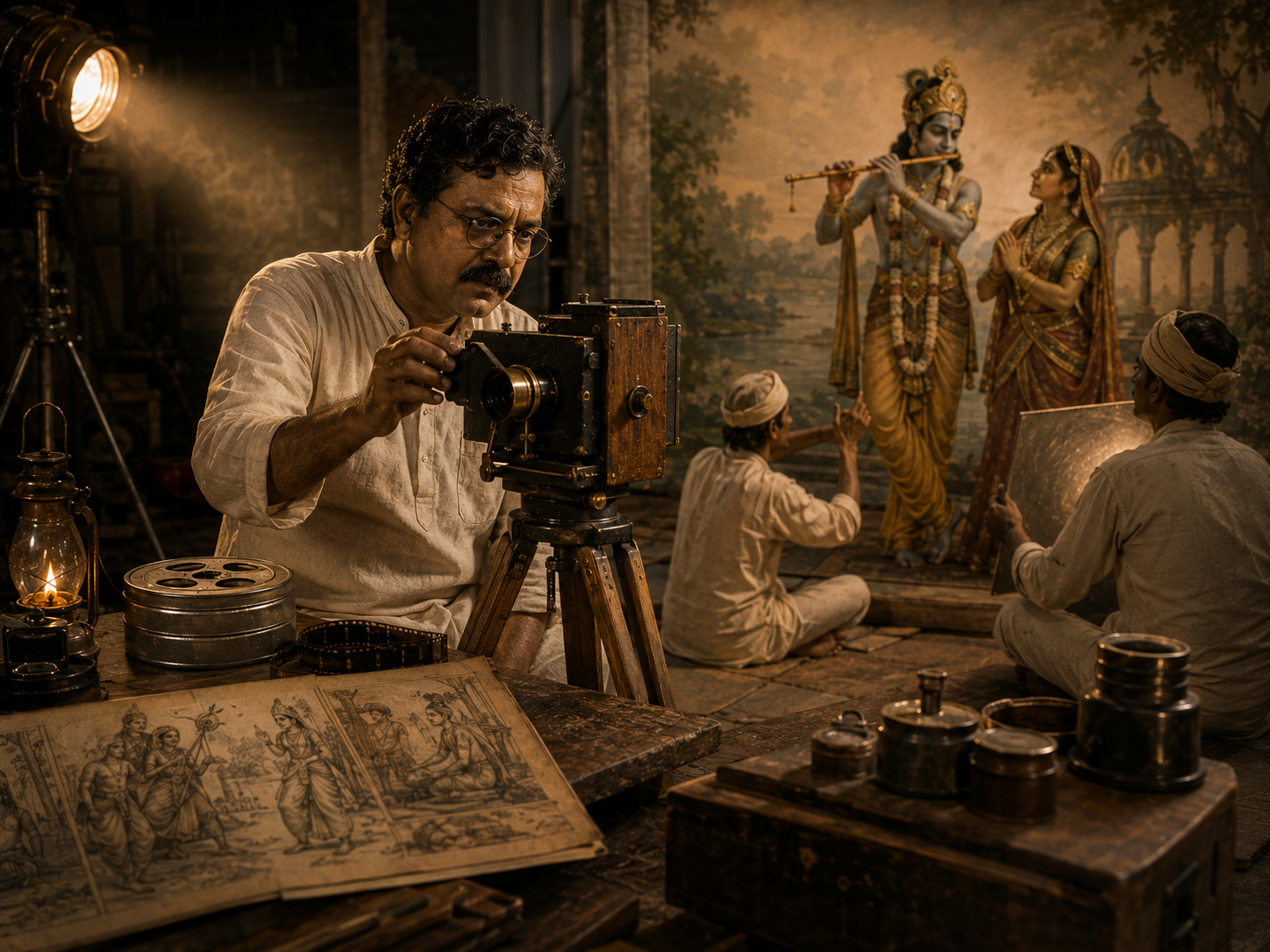
How One Man’s Vision in a Dark Bombay Cinema Gave Birth to India’s Film industry
One evening around 1911, in a dark cinema hall in Bombay, a man of about forty sat watching a silent film about the life of Jesus. Everyone around him was watching the story unfold on the screen. But this one man was watching something else entirely, something that was not there at all.
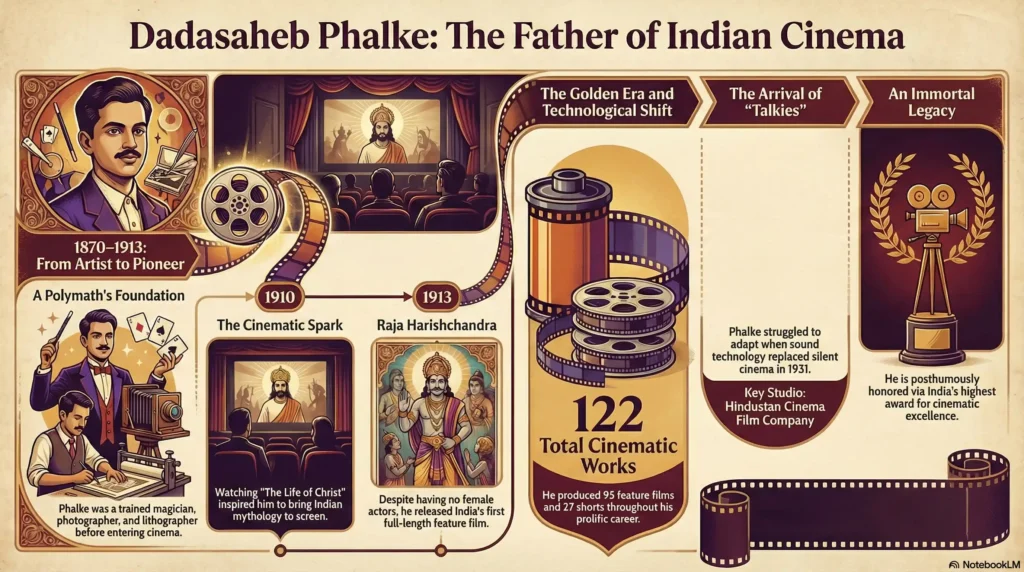
As the flickering images of Christ moved through the dark, he found himself seeing, in his mind’s eye, completely different figures: the Indian gods he had grown up loving, Krishna and Rama, walking and moving in that same magical light. And a single question seized hold of him and would not let go. Could the sons of India ever see their own gods, and their own stories, come alive on a screen? His name was Dhundiraj Govind Phalke, and to answer that one question, he would give up nearly everything, come close to losing his own eyesight, and single-handedly bring a whole new art form to life for his country.
An Impossible Idea
It was, by any sensible measure, a mad idea, and almost everyone told him so.
In 1911, not a single person in India knew how to make a film. There were no studios, no cameras, no teachers, and certainly no money for such a strange dream. Phalke had none of these things. What he had instead was a burning certainty and a truly stubborn will. So he set out to teach himself, starting from absolutely nothing. He watched films over and over again, hour after hour, day after day, studying every flicker of light, straining to understand exactly how the magic was done.
He watched so obsessively, and in such dim light, that his eyes finally gave out on him, and for a time he actually went blind.
The man who dreamed of giving India new things to see very nearly lost his own eyesight in the doing of it.
His family became convinced he had lost his mind. But his sight slowly returned, and still he did not stop. He sailed all the way to London to buy a camera and learn whatever he could, and then he came home and mortgaged almost everything he owned to pay for his impossible dream.
Reign of Chandragupta II Vikramaditya: The Golden Age of India
A Family and a Film
He did not manage it alone. His wife, Saraswati, whom the entire film crew came to call by a warm and affectionate name, was the quiet engine of the whole enterprise. She reloaded the camera, she developed the delicate film in the darkness, and she cooked the meals for the full cast and crew. From the very beginning, this was a family affair.
Then there was the tricky problem of the actors. Phalke had chosen to film the story of Raja Harishchandra, a much-loved old tale about a king so utterly honest that he gives up his throne, his wife, and even his own son, rather than tell a single lie. But he hit a wall. In those days, acting was thought to be a shameful profession, and no respectable woman would step in front of a camera. Phalke searched high and low for a woman to play the queen, and simply could not find one.
In the end, India’s very first leading lady, the queen Taramati, was played by a young man who worked as a cook in a local restaurant.
Sangam Period: The Golden Age of Tamil Literature
The Gods Come to the Screen
In May 1913, after months of painstaking, self-taught labour, Raja Harishchandra was finally shown to the public. It was India’s first full-length feature film, and it was an instant sensation.
Phalke had done very nearly all of it with his own hands, the writing, the directing, the set design, the editing. He had even invented simple camera tricks to make gods appear and disappear and to conjure miracles right before the audience’s astonished eyes. And the audiences were utterly spellbound. When the gods of their own beloved stories appeared before them on the screen, some people were so deeply moved that they rose up from their seats and bowed down to the floor in worship.
Phalke’s dream in the dark had come true. Indians were watching their own gods, in their own light, at last.
More than a Movie
There was something deeper folded inside what Phalke had achieved, and it was a quiet, dazzling act of pride.
This was the height of British rule, an age when Indians were constantly made to feel that everything grand and modern in the world came from the West. Phalke took the newest and most magical Western invention of all, the moving picture, and he filled it, completely and joyfully, with India. Indian gods, Indian epics, Indian faces, Indian stories. He proved, for all to see, that Indians could master this astonishing new art and bend it to the telling of their own tales, in their own way. It was a small declaration of independence, made entirely of light and shadow.
Reign of Raja Raja Chola I: The Golden Age of the Cholas
The Forgotten Father
And here the story turns sad, in a way that has since become painfully familiar.
Phalke went on to make nearly a hundred films over the years that followed. But the very industry he had fathered soon grew up, and moved on, and left its own father far behind. Big new studios, bigger money, and then the arrival of sound in films all made his silent, handmade mythological pictures seem old-fashioned and quaint. The great pioneer was gently pushed aside. He struggled badly with money, tried his hand at other businesses, and at last retired from it all. Dhundiraj Govind Phalke, the man who had given India the movies, died in 1944 in poverty and near-total obscurity.
Sunayani Devi: A Woman’s Voice in the Bengal School
Every Film Since
But you cannot keep a dream that enormous buried for very long.
Today, the film industry that Phalke conjured out of thin air is the largest in the entire world, making more films every year than any other country on earth. It is a vast dream-factory that entertains and moves and comforts well over a billion people. India’s highest honour in all of cinema now carries his name, the Dadasaheb Phalke Award, so that his memory is spoken aloud with reverence every single year.
So think back, one last time, to that single man in that dark theatre in 1911, watching a foreign god upon the screen and daring to picture his own. Every Indian film that has ever been made since then, every song, every hero, every tear shed in a darkened hall, grew out of that one stubborn vision in the dark. He simply wanted his people to be able to see their own stories in the light. And more than a hundred years later, they still have not stopped watching.
Gupta Empire: The Golden Age of Ancient India
If you think you have remembered everything about this topic take this QUIZ
Results


#1. What was the birth name of Dadasaheb Phalke?
#2. Which 1910 silent film inspired Dadasaheb Phalke to make his own films?
#3. What was the title of India’s first full-length feature film released by Phalke in 1913?
#4. Who supported Phalke’s dream by selling her jewelry and is often considered Indian cinema’s first technician?
#5. Why did Phalke cast a male actor (Anna Salunke) to play the role of a queen in his debut film?
#6. Which 1913 film is notable for breaking the gender barrier by casting a female actor, Durgabai Kamat?
#7. What was the title of Dadasaheb Phalke’s only sound film (talkie), released in 1937?
#8. Phalke’s cinematic style was heavily influenced by his earlier work at the lithography press of which famous painter?
Which was the first film directed by Dadasaheb Phalke?
Raja Harishchandra, released in 1913.
Why is he called the Father of Indian Cinema?
He produced India’s first full-length indigenous feature film and established the filmmaking infrastructure (studio, distribution) in India.
Did Dadasaheb Phalke make any sound films?
Yes, he made one sound film titled Gangavataran (1937), but it was not successful.
Who played the female role in his first film?
A male actor named Anna Salunke played the role of Queen Taramati because no women were willing to act.
What is the highest award in Indian cinema?
The Dadasaheb Phalke Award, instituted by the Government of India in 1969.
Sources and References
- Encyclopaedia Britannica (“Dadasaheb Phalke”) — his 1911 viewing of the silent film The Life of Christ as the turning point, his printing background working on Raja Ravi Varma’s images of the gods, and Raja Harishchandra (1913) as India’s first full-length feature film.
- Wikipedia (“Raja Harishchandra”) and Cinemaazi — Phalke’s 1912 trip to London to learn filmmaking, the casting of the male actor Anna Salunke as Queen Taramati because women would not act, the film’s release in May 1913, and Phalke’s career of some 95 features and 27 shorts.
- Encyclopedia.com and Millennium Post — Phalke’s temporary blindness from studying films, his wife Saraswati reloading the camera, processing film and cooking for the crew, and audiences prostrating before the gods on screen.
- DPIFF and National Film Awards — the aim of building an indigenous industry to reflect Indian myths and values, his short film The Growth of a Pea Plant (1911), and the Dadasaheb Phalke Award instituted by the Government of India in 1969.
- Original Curious Indian article (“Dadasaheb Phalke”) — the epiphany at the Christmas-season screening, the making of Raja Harishchandra, the family’s role in the films, and Phalke’s decline and death in obscurity despite founding a mammoth industry.