Saturday, May 23, 2026
28 °c
Dunkerque
Curious Indian
  • Arts & Culture
  • Festivals of India
  • Indian History
  • Indian Politics
  • Biography
    • Entertainment Personalities
    • Science Personalities
  • Unsolved India
No Result
View All Result
  • Arts & Culture
  • Festivals of India
  • Indian History
  • Indian Politics
  • Biography
    • Entertainment Personalities
    • Science Personalities
  • Unsolved India
No Result
View All Result
Curious Indian
No Result
View All Result
Home Biography

Bagha Jatin: German Plot That Shook Colonial India 1915

paripurnadatta by paripurnadatta
in Biography, Colonial India, Freedom Fighters, Indian History
Reading Time: 21 mins read
0 0
A A
Bagha Jatin
Share on FacebookShare on Twitter

Table of Contents

Toggle
  • The Man Who Fought a Tiger and Became One
  • The Yugantar Network and Its Architecture
  • When Germany Entered the Equation
  • The Annie Larsen and the Maverick
    •  
  • The Net Closes Around Bengal
  • The Battle of the Buribalang River
  • The Mystery That Remains
  • Quick Comparison Table
  • Curious Indian: Fast Facts
  • Conclusion
  • If you think you have remembered everything about this topic take this QUIZ
    • Who was Bagha Jatin and how did he get that name?
    • What was the Indo-German Conspiracy of 1915?
    • What was the Battle of Buribalang river?
    • What role did Germany play in the conspiracy?
    • Why is the Indo-German Conspiracy less well known than other episodes of India’s freedom movement?

Bagha Jatin, born Jatindra Nath Mukherjee, was the most significant armed revolutionary in Bengal in the years preceding the First World War. As the de facto leader of the Yugantar movement, he built a clandestine network of revolutionary cells across Bengal and coordinated with Indian revolutionaries in Europe, the United States, and Southeast Asia to plan an armed uprising against British rule in India. The Indo-German Conspiracy of 1914 to 1915, also called the Hindu-German Conspiracy, was the most ambitious expression of this network, a plan to import German weapons into India through the Bay of Bengal, distribute them to revolutionary cells across the country, and launch a coordinated armed insurrection at the moment when Britain was most stretched by the demands of the First World War. The plan came closer to execution than most historians initially recognized, involved networks spanning four continents, and collapsed through a combination of intelligence failures, German military setbacks, and the interception of the arms shipment at the American end of its supply chain. Bagha Jatin died in a riverbank battle in Odisha on September 10, 1915, never knowing the full extent of what had gone wrong. The mystery of exactly how and why the conspiracy unraveled has occupied historians of colonial India ever since.

DetailInformation
Full NameJatindra Nath Mukherjee (known as Bagha Jatin, meaning Tiger Jatin)
BornDecember 7, 1879, Koya village, Nadia district, Bengal
DiedSeptember 10, 1915, Balasore, Odisha
Revolutionary OrganizationYugantar, armed revolutionary wing of the Bengal nationalist movement
German ConnectionIndo-German Conspiracy, also known as the Hindu-German Conspiracy of 1915
Key German ContactHarry Puck, German agent, and the German consulate network in the United States and Southeast Asia
OperationAnnie Larsen arms shipment plan, coordinated through the Ghadar Party in the United States
Final BattleBattle of Balasore, September 9, 1915, on the banks of the Buribalang river
Colonial Government ResponseWorldwide suppression coordinated between British, American, and German authorities following US entry into the war
Bagha Jatin

The Man Who Fought a Tiger and Became One

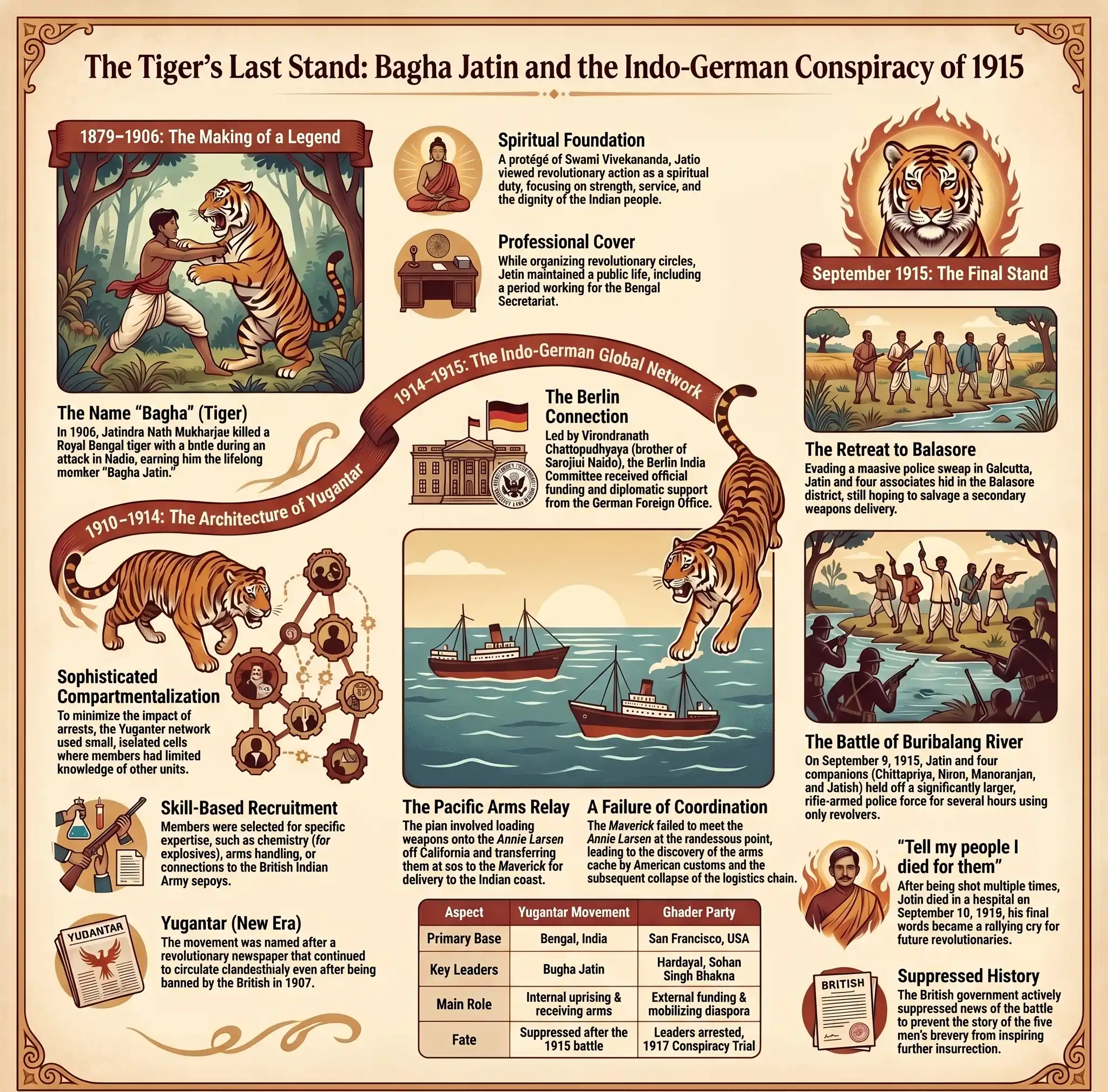
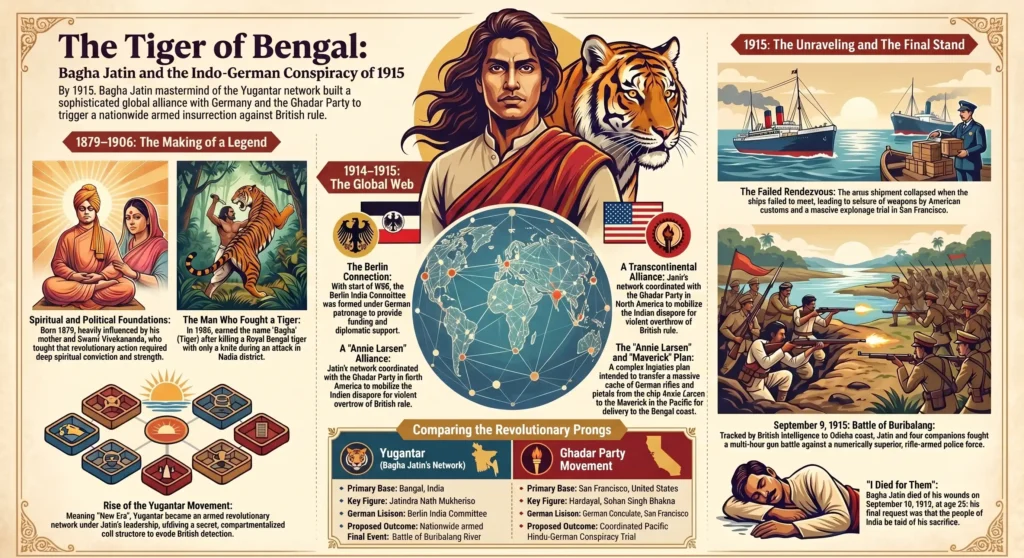
The name Bagha Jatin requires explanation before anything else. In Bengali, bagha means tiger, and the name was given to Jatindra Nath Mukherjee after an incident in 1906 that became legendary within his lifetime. Walking near a forest in the Nadia district of Bengal, he encountered a full-grown Royal Bengal tiger that attacked him. He fought the animal with a knife, sustaining serious injuries but killing the tiger. The story spread immediately, and from that point forward he was known as Bagha Jatin throughout Bengal. The name carried a particular resonance in the revolutionary circles he moved through. A man who could fight a tiger was a man whose courage was not theoretical.

His revolutionary career had begun considerably earlier than the tiger incident. Born in 1879 in the Nadia district of Bengal into a family of modest means, Jatindra Nath lost his father young and was raised by his mother, whose influence on his character is referenced consistently in accounts of his life. He came to Calcutta as a young man, worked in various capacities including a period with the Bengal Secretariat, and came into contact with the revolutionary nationalist circles forming around figures like Bal Gangadhar Tilak and the militant wing of the Indian National Congress in the early 1900s.

His connection to Swami Vivekananda, which he made during Vivekananda’s final years in Calcutta, shaped his understanding of revolutionary action as something that required not just political conviction but spiritual depth. Vivekananda’s teachings on strength, service, and the dignity of the Indian people informed Bagha Jatin’s approach to revolutionary organization in ways that distinguished him from purely tactical thinkers within the movement. He was building not just an insurgent network but a community of committed individuals who understood their struggle in terms that went beyond immediate political objectives.

The Yugantar Network and Its Architecture

By the early 1910s, Bagha Jatin had become the organizing center of the Yugantar movement, the armed revolutionary network that had emerged from the Bengal nationalist ferment of the early twentieth century. The name Yugantar means new era in Sanskrit, and the movement published a revolutionary newspaper of the same name that was banned by the colonial government in 1907 but continued to circulate clandestinely.

What Bagha Jatin built within the Yugantar network was structurally sophisticated for its time. Revolutionary cells were organized in small units with limited knowledge of each other’s membership, a compartmentalization that was designed to limit the damage that any single arrest could do to the broader network. Members were recruited not just for political commitment but for specific skills, some for their ability to move between communities without attracting attention, some for their knowledge of chemistry and arms, some for their connections to the sepoys of the British Indian Army, which was a crucial part of the planned insurrection strategy.

READ MORE:  Rakesh Roshan Biography: The Mastermind Behind the 'K' Phenomenon

The network extended beyond Bengal through connections with revolutionary organizations across India and with the diaspora communities of Indian nationalists in Britain, Europe, the United States, and Southeast Asia. The most significant of these external connections was with the Ghadar Party, a revolutionary organization founded primarily by Punjabi immigrants in the United States and Canada who were committed to the violent overthrow of British rule in India. The Ghadar Party, whose name means mutiny or revolution in Punjabi, had its headquarters in San Francisco and a network of members across North America, Southeast Asia, and East Africa.

According to research documented by the Netaji Research Bureau in Kolkata, which maintains one of the most significant archives of Bengal revolutionary movement records, the coordination between Bagha Jatin’s Yugantar network in Bengal and the Ghadar Party in the United States was more extensive and more operationally developed than colonial-era British intelligence initially recognized, and more than some subsequent nationalist historians have fully acknowledged.

When Germany Entered the Equation

The outbreak of the First World War in August 1914 transformed the strategic calculations of Indian revolutionaries in ways that seemed to open a window of extraordinary opportunity. Britain was now at war with Germany, its military resources stretched across multiple fronts, and Germany had obvious strategic interest in destabilizing British colonial holdings that provided the manpower and material resources sustaining the British war effort.

The Indian revolutionary network in Berlin, centered around Virendranath Chattopadhyaya, known as Chatto, who was the brother of the poet Sarojini Naidu, had been attempting to establish contact with the German government since before the war. The war created the political conditions in which the German Foreign Office and the German General Staff were willing to take these approaches seriously and invest actual resources in them.

What emerged was the Indo-German Conspiracy, sometimes called the Hindu-German Conspiracy in contemporary British intelligence documents, a plan that in its full conception involved coordinating an armed uprising across India with German military support. The plan required German weapons to reach India through clandestine channels, German diplomatic and financial support for the revolutionary networks, and coordination with the Ghadar Party to bring Indian revolutionaries from North America back to India to participate in the uprising.

The German Foreign Office established the India Committee in Berlin in 1914, bringing together Indian revolutionary leaders in Europe under official German patronage. They were given offices, funding, and access to German diplomatic networks. The Committee produced propaganda, coordinated with Irish nationalists who were simultaneously pursuing their own relationship with Germany against British rule, and worked to establish the practical logistics of arms delivery to India.

Bagha Jatin in India was aware of these developments through his network’s communication channels, though the operational security demands of the situation meant that detailed information moved slowly and incompletely. What he understood was that Germany was willing to provide weapons and that a window for action connected to the pressures of the war was opening. He began preparing his network for the uprising that German arms would make possible.

The Annie Larsen and the Maverick

The operational heart of the Indo-German Conspiracy’s arms delivery plan was a scheme to move a large shipment of German weapons from the United States to India through a relay of ships in the Pacific. The plan, coordinated between the Indian revolutionary network in the United States, the Ghadar Party, and German agents operating through the German consulate in San Francisco, involved loading weapons onto a ship called the Annie Larsen off the coast of California and transferring them at sea to another vessel, the Maverick, which would carry them across the Pacific to a prearranged point off the coast of India where they could be received by Bagha Jatin’s network.

The scale of the proposed shipment was significant. According to records held by the United States National Archives, which investigated the conspiracy as part of the later Hindu-German Conspiracy Trial in San Francisco in 1917, the arms cache being assembled included rifles, pistols, and ammunition in quantities intended to equip a substantial armed force. The plan required precise coordination across thousands of miles of ocean between multiple parties operating under intelligence surveillance in multiple countries.

The coordination was never achieved. The Annie Larsen made its way to the rendezvous point but the Maverick failed to arrive at the right time and place. The Annie Larsen returned to port multiple times in a manner that attracted attention from American customs authorities who were already monitoring German activity in American ports following the outbreak of the war. Eventually the ship was searched, the weapons were discovered, and the American end of the operation collapsed, leading to arrests that ultimately produced the Hindu-German Conspiracy Trial, one of the largest espionage trials in American history at that point.

In India, Bagha Jatin did not immediately know the full extent of what had gone wrong. He knew the weapons had not arrived. He knew German support through the Southeast Asian channel, which had been a secondary route through which weapons and money were expected to reach India via Burma and the eastern coast, had also failed to materialize as promised. He was left with a network prepared for an uprising that could not begin without the weapons, and a colonial intelligence apparatus that was closing in around him.

READ MORE:  Muslim League Founded (1906): A New Voice in Colonial India


1 of 3
– +
Bagha Jatin
Bagha Jatin
Bagha Jatin

The Net Closes Around Bengal

British intelligence in India had been tracking the Yugantar network for years and had significantly increased its surveillance intensity following the outbreak of the war and the growing evidence of German involvement with Indian revolutionary organizations. The Intelligence Department of the Government of India, working in coordination with British intelligence operations in the United States, Southeast Asia, and Europe, was assembling a picture of the conspiracy that was increasingly detailed and accurate.

Arrests began in Bengal in 1915, as British authorities moved against Yugantar network members whose identities had been established through informers, intercepted communications, and the intelligence flowing from the unraveling of the American end of the operation. Bagha Jatin evaded the initial sweep, moving out of Calcutta with a small group of close associates that included Chittapriya Ray Chaudhuri, Niren Dasgupta, Manoranjan Sengupta, and Jatish Pyne.

The group made its way toward the Odisha coast, specifically toward the Balasore district, which was the area where Bagha Jatin had planned to receive the German arms shipment from the Bay of Bengal. He was still, even at this point, operating on the possibility that some form of the weapons delivery might yet be salvaged through the German network in Southeast Asia. The evidence suggests he did not yet understand that the entire operation had collapsed beyond recovery.

According to records documented at the West Bengal State Archives, the colonial government’s internal communications during this period describe the effort to locate and capture Bagha Jatin as a matter of considerable urgency, reflecting their assessment of him as the most dangerous active revolutionary in Bengal. Multiple police units and intelligence operatives were deployed across the region to track the small group moving toward the Odisha coast.

The Battle of the Buribalang River

On September 9, 1915, British police forces caught up with Bagha Jatin and his four companions on the banks of the Buribalang river near Chashakhand village in the Balasore district of what is now Odisha. What followed was a battle that lasted several hours against a significantly larger and better-armed force of colonial police.

Bagha Jatin and his companions fought with the weapons they had, which were personal revolvers and limited ammunition, against a police force that had rifles and numerical superiority. The engagement was not a symbolic gesture. They inflicted casualties on the police force before their ammunition was exhausted. Bagha Jatin was severely wounded during the fighting, shot multiple times. His companion Chittapriya Ray Chaudhuri was killed outright during the battle. The others were captured wounded.

Bagha Jatin was taken to the Balasore district hospital where he died of his wounds on September 10, 1915. He was thirty-five years old. His reported final words, directed at the police officer attending him, were said to be a request that the people of India be told he had died for them. The colonial government suppressed news of the battle and his death as completely as it could manage, recognizing that the account of five men holding off a police force for several hours would be exactly the kind of story that the revolutionary movement would draw sustenance from.

It was, of course, precisely that kind of story, and it circulated through revolutionary networks in Bengal and beyond despite the suppression effort.

The Mystery That Remains

The historical question that continues to interest researchers of the Indo-German Conspiracy is not simply why it failed but how close it actually came to succeeding and what the consequences of success might have been.

The conspiracy was more extensive, more operationally developed, and more seriously resourced than its subsequent treatment in mainstream Indian nationalist historiography has reflected. The German investment in it was real, the coordination between the Bengal network, the Ghadar Party, the Berlin India Committee, and German agents across Southeast Asia was genuine, and the plan for a coordinated uprising across India was not a fantasy. It was a serious operational plan that was defeated by a combination of intelligence penetration at the American end, German military setbacks that diverted resources and attention, and the logistical challenges of coordinating a secret operation across four continents without secure communication channels.

Research published through the Indian Council of Historical Research has identified documentation from German Foreign Office archives, released after the Second World War, that reveals the full extent of the German financial and logistical investment in the conspiracy, providing detail about the German side of the operation that was not available to earlier historians working only from British colonial records. This material has significantly revised understanding of how seriously Germany took the plan and how close to execution it came before the American interception ended its most critical logistics chain.

The question of whether a successful arms delivery would have produced the uprising Bagha Jatin planned, and what that uprising might have achieved against the full military resources of the British Empire even in its wartime-stretched condition, is one that historians necessarily approach with caution. What is not in question is that Bagha Jatin’s network was real, his plan was serious, and his death on the Buribalang riverbank was the end of the most ambitious armed revolutionary operation that colonial India had yet seen.

READ MORE:  How Vagbhata Ayurveda Harmonized Ancient Healing

Quick Comparison Table

AspectBagha Jatin and the Indo-German ConspiracyGhadar Party Movement 1915
Primary BaseBengal, IndiaSan Francisco, United States
Key FigureJatindra Nath Mukherjee, Bagha JatinHardayal, Sohan Singh Bhakna
German ConnectionBerlin India Committee, German Foreign OfficeGerman consulate San Francisco
Arms PlanBay of Bengal delivery via Southeast Asia channelAnnie Larsen and Maverick Pacific relay
Operational OutcomeArms never delivered, network suppressedArms intercepted, leaders arrested
Final EventBattle of Buribalang river, September 1915Hindu-German Conspiracy Trial, San Francisco, 1917
Historical RecognitionSignificantly underrepresented in mainstream narrativeBetter documented through American trial records

Curious Indian: Fast Facts

  • Bagha Jatin earned his name by killing a Royal Bengal tiger with a knife in 1906 after the animal attacked him near a forest in Nadia district, Bengal, sustaining serious injuries but surviving the encounter.
  • The Hindu-German Conspiracy Trial held in San Francisco in 1917 was one of the largest and most complex espionage trials in American legal history at that point, involving defendants from multiple countries and documentary evidence gathered across four continents.
  • Bagha Jatin had a personal connection to Swami Vivekananda during the latter’s final years in Calcutta, and Vivekananda’s teachings on strength and service shaped his approach to revolutionary organization throughout his career.
  • The German Foreign Office established the India Committee in Berlin in 1914, providing Indian revolutionary leaders in Europe with official patronage, offices, and funding to coordinate anti-British activities during the First World War.
  • Virendranath Chattopadhyaya, known as Chatto, who coordinated the Indian revolutionary network in Berlin, was the brother of the celebrated Indian poet Sarojini Naidu, a connection that illustrates the breadth of the families drawn into revolutionary politics in this period.
  • The colonial government actively suppressed news of the Battle of Buribalang river following Bagha Jatin’s death, recognizing that the account of five men fighting a much larger police force for several hours would strengthen rather than discourage revolutionary sentiment in Bengal.
  • German Foreign Office archives released after the Second World War have provided historians with documentation of the full financial and logistical investment Germany made in the Indo-German Conspiracy, significantly revising earlier assessments of how seriously the plan was developed and resourced.

Conclusion

The Indo-German Conspiracy of 1915 sits in an uncomfortable place in the history of India’s freedom movement. It was armed, it was externally supported, and it was aimed at achieving independence through insurrection rather than through the political processes that the dominant nationalist narrative of the independence movement prefers to celebrate. These characteristics have made it easier to treat as a fascinating footnote than to engage with as the serious, carefully planned, and nearly executed operation it actually was.

Bagha Jatin himself is a figure who deserves more than footnote status. He built a revolutionary network of genuine operational sophistication in the most difficult possible conditions, under constant intelligence surveillance, without secure communications, and without the financial resources that his German partners had access to and were consistently late in delivering. He coordinated across continents at a time when coordination across continents required personal messengers, coded letters, and an extraordinary degree of trust between people who had often never met. He held his network together through the force of personal character and the quality of the relationships he had built within it.

And at the end, when the plan had collapsed and the police were closing in, he fought. Not symbolically. He and four companions held a position against a numerically superior armed force for several hours on a riverbank in Odisha. That is not the action of a man who had given up. It is the action of a man who had decided that the manner of what came next mattered as much as the outcome.

He died asking that his people be told he had died for them. The least that history owes him is to make sure enough people know that he did.

If you think you have remembered everything about this topic take this QUIZ

Who was Bagha Jatin and how did he get that name?

Bagha Jatin was the revolutionary name of Jatindra Nath Mukherjee, the de facto leader of the Yugantar armed revolutionary movement in Bengal in the early twentieth century. He earned the name, which means Tiger Jatin in Bengali, after fighting and killing a Royal Bengal tiger with a knife in 1906 following an attack near a forest in Nadia district. The name became widely known within revolutionary circles as a marker of his extraordinary personal courage.

What was the Indo-German Conspiracy of 1915?

The Indo-German Conspiracy, also called the Hindu-German Conspiracy, was a plan coordinated between Indian revolutionary networks in Bengal, the Ghadar Party in the United States, the Berlin India Committee supported by the German Foreign Office, and German agents across Southeast Asia to deliver a large shipment of German weapons to India and launch a coordinated armed uprising against British rule. The plan was timed to exploit Britain’s military commitments during the First World War. It collapsed primarily because the arms shipment organized through the Annie Larsen and Maverick ships in the Pacific was intercepted by American authorities.

What was the Battle of Buribalang river?

The Battle of Buribalang river took place on September 9, 1915, near Chashakhand village in the Balasore district of present-day Odisha, when British colonial police forces caught up with Bagha Jatin and his four companions. The group fought for several hours with revolvers against a larger, rifle-armed police force, inflicting casualties before their ammunition was exhausted. One of Bagha Jatin’s companions was killed outright. Bagha Jatin was severely wounded and died in Balasore district hospital the following day, September 10, 1915.

What role did Germany play in the conspiracy?

Germany’s involvement was substantial and officially sanctioned through the German Foreign Office and the German General Staff. Germany established the India Committee in Berlin in 1914, providing Indian revolutionary leaders in Europe with offices, funding, and access to German diplomatic networks. German agents coordinated the arms shipment operation through the German consulate in San Francisco and through networks in Southeast Asia. German Foreign Office archives released after the Second World War have confirmed the scale of this investment, revising earlier assessments that tended to treat German involvement as marginal or opportunistic.

Why is the Indo-German Conspiracy less well known than other episodes of India’s freedom movement?

The conspiracy’s relative obscurity reflects several factors. Its reliance on external German support made it politically awkward for nationalist historians constructing a narrative of India’s independence movement as an internally driven moral and political struggle. Its armed insurrectionary character placed it outside the dominant Gandhian framework that shaped popular historical memory of the independence movement. The colonial government’s active suppression of news about Bagha Jatin’s final battle further reduced its immediate public impact. And the scale of its ambition, which made it genuinely threatening to British authority, also made the colonial administration particularly thorough in suppressing the documentary record of its near success.

Tags: 1857 Bengal freedom movementBagha JatinBengal nationalismcolonial IndiaHindu-German ConspiracyIndian revolutionariesYugantar movement
ShareTweetPin
paripurnadatta

paripurnadatta

Related Posts

S.H. Raza Bindu
Artists & Cultural Icons

S.H. Raza and the Bindu: How a Dot Held the Universe

May 23, 2026
Abanindranath Tagore
Artists & Cultural Icons

How Abanindranath Tagore Built a Distinctly Indian Art Movement

May 23, 2026
Surya Sen
Biography

Surya Sen: Chittagong Armoury Raid That Shook British India

May 23, 2026
No Result
View All Result

Stay Updated

  • Trending
  • Latest
Life of Mahavira: From Prince Vardhamana to Great Conqueror

Life of Mahavira: From Prince Vardhamana to Great Conqueror

April 11, 2026
Life of Buddha: The Journey to Enlightenment

Life of Buddha: The Journey to Enlightenment

April 11, 2026
Christmas in India

Christmas in India: A Festive Blend of Faith, Flavors, and Tradition

April 11, 2026
From Shimla to Stardom: The Complete Biography of Anupam Kher

From Shimla to Stardom: The Complete Biography of Anupam Kher

April 11, 2026
Warli paintings

Warli Paintings and the Ancient Visual Language of Maharashtra’s Tribes

May 23, 2026
Shekhawati murals

Shekhawati Murals and the Stories Painted on Desert Walls

May 23, 2026
S.H. Raza Bindu

S.H. Raza and the Bindu: How a Dot Held the Universe

May 23, 2026
Abanindranath Tagore

How Abanindranath Tagore Built a Distinctly Indian Art Movement

May 23, 2026

Widget Title

Facebook Twitter Youtube RSS
Curious Indian Logo

Explore the soul of Bharat with Curious Indian. A definitive guide to Indian history, arts, culture, biographies, and the events that defined our future.

Follow us on social media:

Recent News

  • Warli Paintings and the Ancient Visual Language of Maharashtra’s Tribes
  • Shekhawati Murals and the Stories Painted on Desert Walls
  • S.H. Raza and the Bindu: How a Dot Held the Universe

Category

  • Ancient Civilizations & The Vedic Age
  • Architecture
  • Artists & Cultural Icons
  • Arts & Culture
  • Battles of India
  • Biography
  • Business & Industrialists
  • Colonial India
  • Cultural Insights
  • Dance & Music
  • Entertainment Personalities
  • Festivals of India
  • Freedom Fighters
  • Freedom Movement
  • Historical Events & Turning Points
  • Indian History
  • Indian Politics
  • Lesser-Known Facts
  • Major Festivals
  • Medieval India
  • North East India
  • Paintings & Visual Arts
  • Political Leaders
  • Post-Independence India
  • Regional Culture
  • Religious & Spiritual Figures
  • Science Personalities
  • Scientific Discoveries
  • Sculpture
  • Social Issues
  • SOCIETY & MYSTERIES
  • Strange & Unknown Stories
  • Textiles & Handicrafts
  • Uncategorized
  • Unsolved India
  • Unsung Heroes

© 2026 Curious Indian- Everything about India

Welcome Back!

Login to your account below

Forgotten Password?

Retrieve your password

Please enter your username or email address to reset your password.

Log In

Add New Playlist

No Result
View All Result
  • Arts & Culture
  • Festivals of India
  • Indian History
  • Indian Politics
  • Biography
    • Entertainment Personalities
    • Science Personalities

© 2026 Curious Indian- Everything about India

This website uses cookies. By continuing to use this website you are giving consent to cookies being used. Visit our Privacy and Cookie Policy.
Are you sure want to unlock this post?
Unlock left : 0
Are you sure want to cancel subscription?
×