The Shekhawati desert: a blank stone surface, waiting. Then, for two hundred years, it spoke in colour. Then it went silent again
In the beginning, the Shekhawati desert—caught between Delhi, Bikaner, and Jaipur—offered only blank stone. No tradition of painting. The walls were silent.
Then the Marwari merchants arrived. Traders in wool, spices, opium, and rice. They had travelled. They had seen Mughal courtyards, European goods, painted walls in distant cities. They knew walls could speak. And they decided to make Shekhawati listen.
The walls had no tradition. Then merchants arrived, and the desert began to speak in colour.
At first, there was no security on these routes. Robbers preyed on the caravans. Then, in the early 19th century, the British established the Shekhawati Brigade to suppress the brigandry, to bring order, to make the roads safe. And something remarkable happened. With peace came prosperity. The merchants could trade without fear. Their wealth grew.
And then they built.
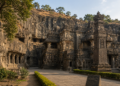
They built havelis—great merchant mansions—with courtyards and chambers and walls that rose up to the sky. And as a final touch, they painted them. They commissioned artists and said: paint us. Paint what we believe. Paint where we have been. Paint who we are.
And the artists began.
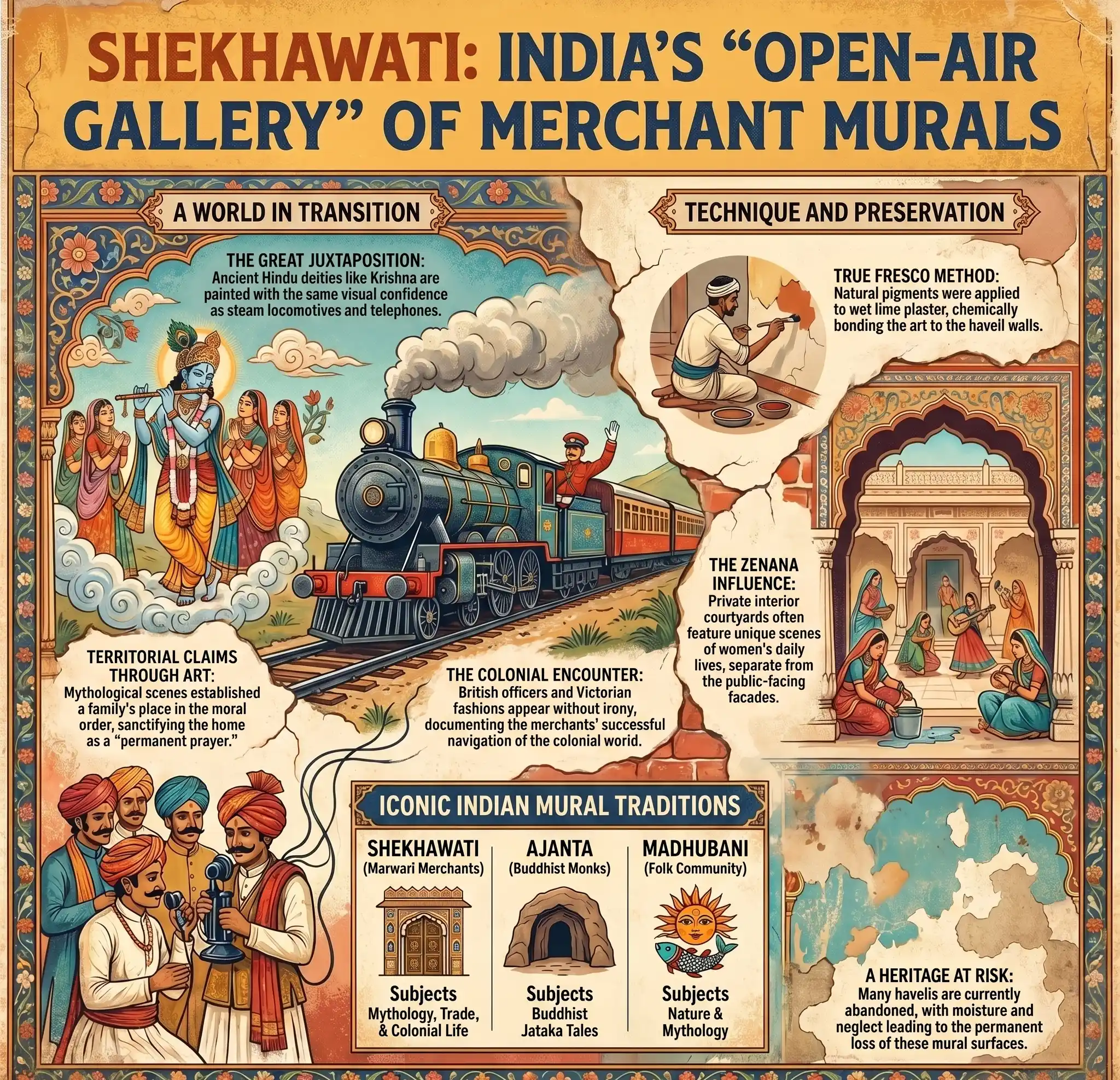
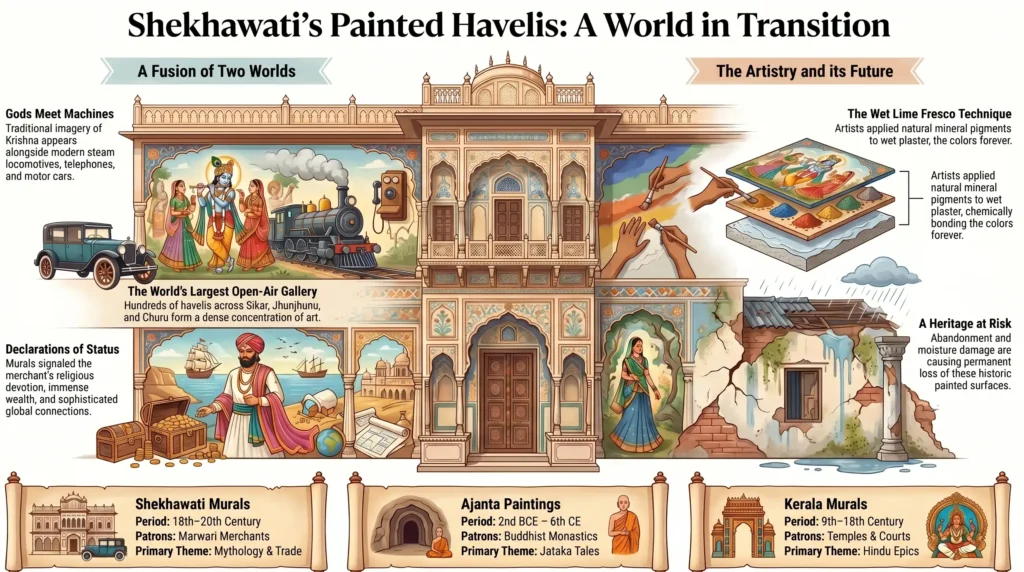
The paintings that emerged were unlike anything before or after in Indian art. They were not pure Mughal. They were not pure Rajput. They were something new: a deliberate mixing. Marwari merchants who had travelled the world brought back fragments of everything they had seen and asked their painters to weave it into a single language.
So the walls of Shekhawati became a record. Not a history book—something more direct. A visual testimony to what was happening to India in the 18th and 19th centuries.
Walk through the towns and you can read the murals like a book of that moment. Religious themes cover many walls—Krishna, gods and goddesses. But alongside these, the merchants painted their own world. Their battles, ancestors, hunts, feasts, journeys. Toward the end of the 19th century, something else appeared: Europeans, trains, carriages, technology arriving in India. The painters painted it even if they did not fully understand it. The world was changing, and the merchants wanted the walls to witness it.
Geometric patterns and stylised plants covered every inch. Floral designs ran along borders. Every surface was filled. There was no silence in the colours. The merchants were saying: we are here. We have built. We are not being forgotten.
These paintings were not made to last forever. Pigments applied to dry plaster. The desert sun faded them. Rain stained them. Wind dulled their surfaces. But for two hundred years, they endured. They spoke.
The walls outlived the painters. The murals are still teaching: desire and permanence are not the same thing.
The silence that followed
Then, in the middle of the 20th century, something else changed.
The merchants began to leave. The trade routes shifted. Calcutta and Bombay and Delhi became the centres of wealth. The families that had built the havelis moved to these cities. They took their money with them. The havelis were abandoned or neglected or handed down through complex inheritance systems that made decisions about preservation nearly impossible.
The painters stopped coming. The walls began to fade. Some were whitewashed. Some simply crumbled. Buildings collapsed. The art that had been created to celebrate and commemorate the merchants’ prosperity became a record of their absence.
By the late 20th century, the murals were nearly forgotten. The paintings that had been commissioned with pride—declarations of presence and permanence—had become almost invisible. The desert was reclaiming what the merchants had given it.
The recovery
Slowly, conservationists and scholars began to pay attention. NGOs stepped in. Historians documented the paintings, recording what remained. Hotels restored havelis as galleries. The government placed heritage protections. In 2012, a postal stamp was issued honouring the paintings.
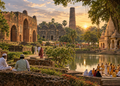
Today, Shekhawati is called “India’s largest open-air art gallery.” Walk the dusty streets and the merchants’ dreams are still visible. Not perfect. Not pristine. But there. Still speaking. Still saying: we existed. We saw. We were worthy of being remembered.
What the murals teach
The story of Shekhawati murals is not unique in Indian history. It is a story that has played out in many places: artistic flourishing in a moment of prosperity, followed by decline when the prosperity moves elsewhere. But what makes Shekhawati remarkable is that you can still see it. You can stand in front of a fading Krishna painted in 1870 and feel the presence of the merchant who commissioned it. You can see where water has damaged a fresco and imagine the monsoon that caused it. You can read in the accumulation of detail what a particular person, in a particular moment, decided was important enough to paint on a wall forever.
This is what the murals are doing now, in their faded state: they are teaching us something about desire and permanence. The merchants painted their stories on stone because they wanted those stories to last. And they did last. Not perfectly. Not without loss. But longer than the merchants themselves stayed in Shekhawati. Longer than the prosperity that had commissioned them. Longer than anyone would have predicted.
The walls outlived the painters. And that is what the murals are still saying, in their silence.
If you think you have remembered everything about this topic take this QUIZ
Results
QUIZ START
#1. Which prominent community of wealthy merchant families commissioned the massive painted havelis in the Shekhawati region of Rajasthan?
Previous
Next
#2. What unusual visual combination defines the unique juxtaposition seen across the Shekhawati haveli walls?
Previous
Next
#3. Due to the incredible density of painted havelis across its historic towns, what title have heritage scholars given to the Shekhawati region?
Previous
Next
#4. Which specific Hindu deity’s imagery and devotional stories dominate the religious themes painted on the Shekhawati walls?
Previous
Next
#5. What traditional method was utilized by local painting communities where natural pigments were applied directly to wet lime plaster?
Previous
Next
#6. Which hybrid style developed during the colonial period influenced later Shekhawati murals as artists absorbed perspective and mechanical rendering?
Previous
Next
#7. What name is given to the interior courtyards accessible only to the women of the household, which featured quieter and more autonomous domestic murals?
Previous
Next
#8. According to the Quick Comparison Table, how does the chronological period of the Shekhawati Murals compare to the Ajanta Paintings?
Previous
Finish
Where exactly is the Shekhawati region and which towns have the best murals?
Shekhawati covers parts of the Sikar, Jhunjhunu and Churu districts of Rajasthan. The towns with the highest concentration of significant painted havelis include Mandawa, Nawalgarh, Fatehpur, Jhunjhunu and Bissau. Nawalgarh and Mandawa are generally the most accessible and have the largest number of well-preserved or partially restored sites.
The murals were commissioned primarily by Marwari merchant families who had accumulated significant wealth through trade networks spanning India and beyond. They built large ancestral havelis in their home towns as displays of status and devotion, covering them with paintings that served both religious and social purposes.
What painting technique was used in the Shekhawati murals?
The primary technique was fresco, in which natural pigments were applied to wet lime plaster so that the colors bonded chemically with the surface as it dried. Some later works used fresco secco, applying pigments to dry plaster with a binding medium. Natural pigments derived from minerals and organic sources produced the distinctive warm palette of the tradition.
Why do the Shekhawati murals depict European figures and modern technology?
The Marwari merchants who commissioned these paintings had direct experience of colonial India and the technological changes it brought. Railway engines, motor cars and European figures appear because the merchants who had seen these things wanted them recorded in their domestic visual world alongside traditional religious imagery, reflecting a confident and pragmatic engagement with modernity.
What is being done to preserve the Shekhawati murals?
Conservation efforts are ongoing but uneven. The Archaeological Survey of India and organizations working within the INTACH conservation framework have undertaken restoration work at specific sites. Some havelis have been converted to heritage hotels, providing commercial funding for maintenance. Many havelis remain in private ownership without resources for upkeep, and significant painted surfaces continue to deteriorate each monsoon season.
Sources & References
Wikipedia, “Shekhawati Painting” (n.d.) — Region of Shekhawati in Rajasthan remarkable for wealth of mural paintings adorning walls of many buildings including havelis; traces of wall paintings found on structures erected by Muslim nawabs, Rajputs, Banias dating back 17th century; local style influenced by 16th/17th century Mughal work in Agra and Fatehpur Sikri via painted monuments in Amer; earliest dated Shekhawati work includes ‘Jaipur fresco’ work employing thick layers of pigment applied to wet plaster surface, incised with geometric and floral designs.
Atlas Obscura, “Exploring the Painted Mansions of the Rajasthani Desert” (2025) — Shekhawati slow-paced region requiring several hours drive through Thar desert from Delhi or Jaipur; elaborately painted residences dating back centuries, unique houses largely unknown to outside world; merchants’ mansions painted with intricate frescoes in vibrant colors; like 3D comic books adorned inside and out with whimsical scenes of mythology, ancestral battles, coming of Europeans with trains, cars, hovercrafts.
IIC (International Institute for Conservation), “The Shekhawati Project” (n.d.) — Shekhawati region northern Rajasthan famous for frescoes and painted haveli from 19th and early 20th centuries; exceptional palaces covered with frescoes and murals on interior and exterior walls creating extraordinary open-air art gallery; palatial mansions decorated with glorious painted walls and façades witness to great wealth of merchants (marwaris) who owned them; tangible symbol of then flourishing trade of wool, spices, opium and rice; mid-20th century marks decline, merchant families emigrated to bigger cities Delhi, Mumbai, Kolkata.
Wanderlust Magazine, “Exploring Shekhawati, India’s largest open-air art gallery” (2025) — Elaborately decorated havelis known for elaborate frescoes, carved doorways and disparate influences; owners typically well-travelled merchants drew on world around them and legends and stories leading to chaotic blend of Mughal, Rajput and European ideas; long before Mumbai and Gurgaon, quiet semi-desert region northern Rajasthan laid foundations for powerful mercantile community; in recent years NGOs, hotel owners and Rajasthan government stepped in with heritage zoning, restoration grants and legal protection against demolition.
Exotic India Art, “Rajasthan Exploring Painted Shekhawati” (n.d.) — Military mission led to founding of Shekhawati Brigade to suppress robbery and bring security to local merchants; peace and prosperity returned creating ideal conditions for display of conspicuous wealth; merchants commissioned fine buildings and walls were painted, so military mission led to artistic one.
Shekhawati Paintings, Learn Arts of India (n.d.) — Paintings characterised by pictures drawn and colored piecemeal on dry plaster surface of walls; subjects ranged from religious and mythological themes to everyday environments and erotica; first Shekhawati paintings traced back as far as 17th century; as merchants began settling in urban spaces middle 20th century, havelis and chhatris began neglected; buildings collapsed, whitewashed or broken down; Shekhawati paintings began decline.
Paripurna Datta is the founder and editor of Curious Indian, an independent editorial publication focused on Indian history, culture, science, society, and the stories behind them. He oversees research, editorial standards, and the publication's long-term direction.
Paripurna Datta is the founder and editor of Curious Indian, an independent editorial publication focused on Indian history, culture, science, society, and the stories behind them. He oversees research, editorial standards, and the publication's long-term direction.