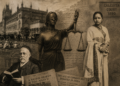
Calcutta, 1887: a young artist trained in European naturalism met a British educator who told him something revolutionary. You have a tradition. You don’t need to copy theirs
Born in 1871 into the Tagore family, nephew of Rabindranath, Abanindranath studied at Sanskrit College in the 1880s. He learned to paint in the European naturalistic style—the skill of rendering objects and bodies as they appeared to the eye. By his early twenties, he had mastered the tradition the British schools had brought to India. He was becoming exactly what the colonial system had designed him to become.
Then, around 1887, something happened that would change not just his career but the course of Indian art.
A relative of his, a woman named Gyanadanandini Devi, arranged a meeting between the young artist and E.B. Havell, an Englishman who had become Principal of the Government School of Art in Calcutta. Havell was a strange figure in the imperial apparatus—an Englishman who believed something that the imperial system officially denied: that Indian art had value. That the colonial schools, by teaching only European techniques, were not elevating Indian artists. They were destroying a tradition.
He had not just painted beautiful paintings. He had created a philosophical framework that allowed an entire generation to reject the colonial aesthetic.
Britannica, “Abanindranath Tagore” (2026) — Born August 7, 1871 Jorasanko Calcutta, died December 5, 1951; celebrated Indian artist pioneered Bengal School of Art; painted Bharat Mata 1905; depicted India as four-armed goddess clad in orange sari during Swadeshi Movement; work became emblematic of Indian anti-colonial resistance.
Wikipedia, “Abanindranath Tagore” (n.d.) — Principal artist and creator of Indian Society of Oriental Art 1907; first major exponent of Swadeshi values in Indian art; founded influential Bengal School of Art; sought to modernize Mughal and Rajput styles to counter Western models; believed Western art was “materialistic,” India needed to return to traditions for spiritual values.
Wikipedia, “Bharat Mata (painting)” (n.d.) — Abanindranath nephew of Rabindranath Tagore; studied Sanskrit College 1880s, painted in European naturalistic style early (e.g., The Armoury); around 1886/1887 relative Gyanadanandini Devi arranged meeting with E.B. Havell, curator of Government School of Art; meeting resulted in exchanges with Havell gaining native art collaborator, Tagore gaining teacher about “science” of Indian art history.
Artflute, “Who Is Abanindranath Tagore? History, Artistic Style and Legacy” (2026) — Around 1897 shift in style after encounter with E.B. Havell; Havell held radical ideas that Indian art had value, colonial institutions destroying Indian aesthetic traditions; solution was recover and reinterpret Indian forms; Havell saw Tagore’s restlessness; Krishna Lila series represents shift away from European academic training.
DAGWorld, “Abanindranath Tagore” (n.d.) — Meeting with E.B. Havell pointed Tagore toward study of Mughal and Rajput painting; became active proponent of nationalist revivalist art; established Bengal School; influential teacher trained Nandalal Bose and Asit Haldar; inspired entire generation reimagining definition of Indian modern art; retained European-trained realist base with selective assimilation of Ajanta frescos, Kalighat pats, Mughal, Japanese, Persian elements.
Indian Culture Portal, “The Swadeshi Movement and the Bengal School of Art” (n.d.) — Bengal School of Art art movement late 19th century Kolkata, soon spread; modern and nationalist approach; Abanindranath Tagore and E.B. Havell main proponents of Indianizing art education; rejected colonial art schools, set up nationalist school in Calcutta; Tagore wanted to paint Indian subjects in Indian style, took inspiration from Mughal and Pahari miniature paintings; founded journal Indian Society of Oriental Art.
Indian Society of Oriental Art, Wikipedia (n.d.) — Founded Calcutta 1907 by brothers Gaganendranath and Abanindranath Tagore; organized art exhibitions, taught students, published high-quality reproductions and illustrated journals; followed annual exhibitions at Government School of Art showing latest works of artists in new movement initiated by Abanindranath under E.B. Havell guidance; first officers were Lord Kitchener (President), Norman Blount and Abanindranath Tagore (Secretaries).
Havell saw in the young artist a profound restlessness. Abanindranath had mastered European academic painting—he could do what the British wanted. But Havell saw something deeper: a sense that this path was wrong, that competence in a foreign technique was not the same as having a voice.
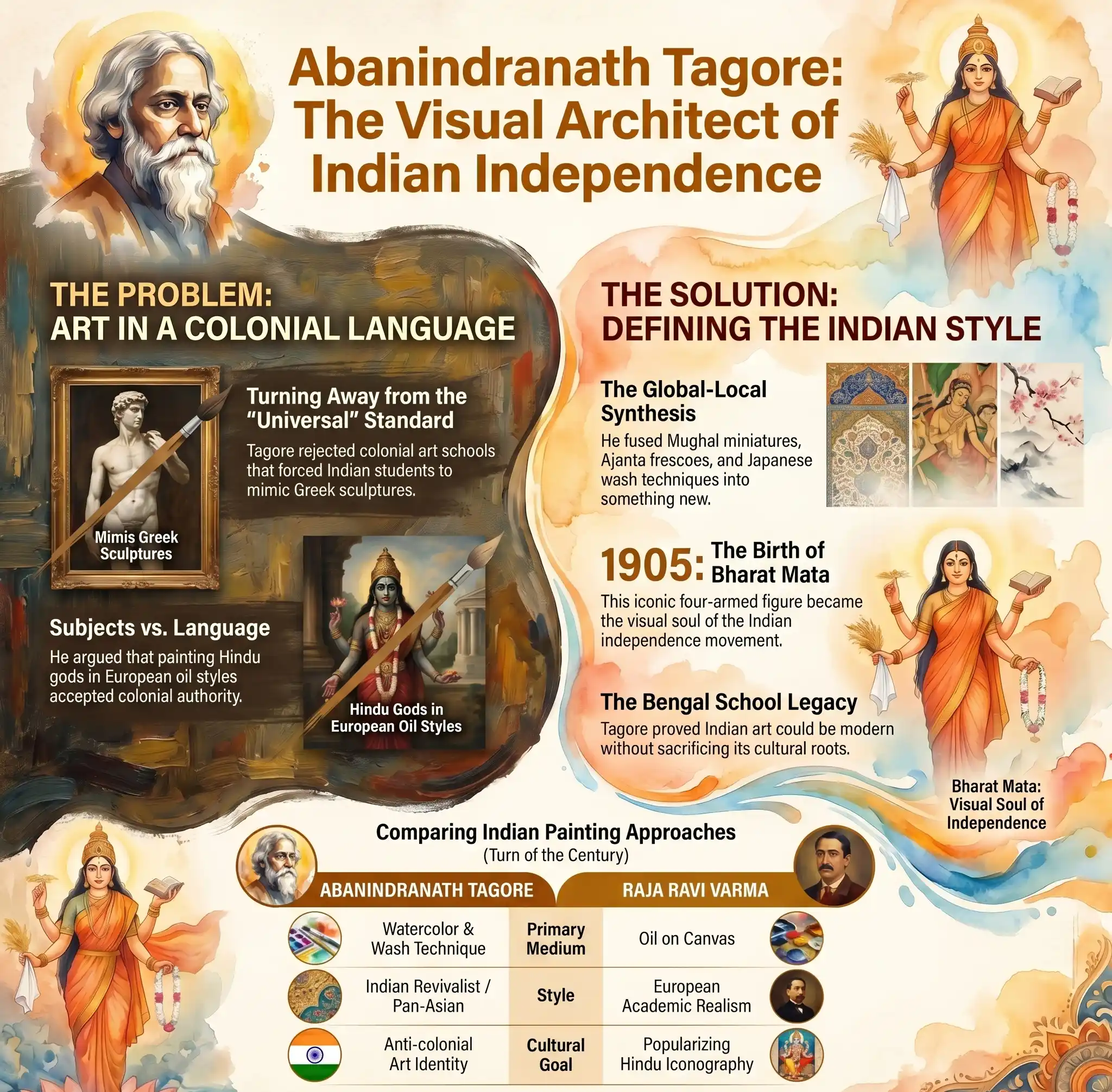
Havell taught him about Indian art history—not as antiquarian study, but as the science of a tradition. He showed him manuscripts, miniatures, how Mughal and Rajput painters solved problems of composition and light. He showed him that India had a visual language, different from Europe’s, and it had not disappeared. More importantly, he validated what Abanindranath was beginning to feel: that this language was worth recovering.
Around 1897, Abanindranath began his *Krishna Lila* series—twenty paintings depicting the life of Krishna and the gopis. They are tiny, intimate, designed to be held. The compositions draw on Indo-Persian miniatures. The narrative style flows from Bengali Vaishnava literature. Colours are jewel-like, figures graceful rather than naturalistic. The entire approach to storytelling in paint has shifted. He had mastered European technique. Now he was deliberately refusing it.
For the first time in colonial history, an art movement born in the colonies became so powerful that imperial institutions adopted it.
What drove this shift was philosophy. Abanindranath came to believe Western art was fundamentally *materialistic*—reproducing material surfaces with accuracy. But this could never reach the spiritual, the sense of divinity, the inner life of the sacred. Indian art was different. It made the invisible visible. It showed the presence of the divine through flatness, stylization, every deliberate gesture—in service of something Western realism could never reach.
This became his mission. India did not need to copy Europe. India needed to remember itself. And that meant returning not just to techniques, but to the spiritual foundation that had always animated Indian art.
Building the movement
By the early 1900s, Bengal was in ferment. In 1905, the British Viceroy, Lord Curzon, announced the partition of Bengal—dividing the province along religious lines, officially for administrative efficiency, actually to weaken the nationalist movement. The response was swift: the Swadeshi movement, calling for boycotts of British goods and institutions, and for the recovery of Indian economic and cultural independence.
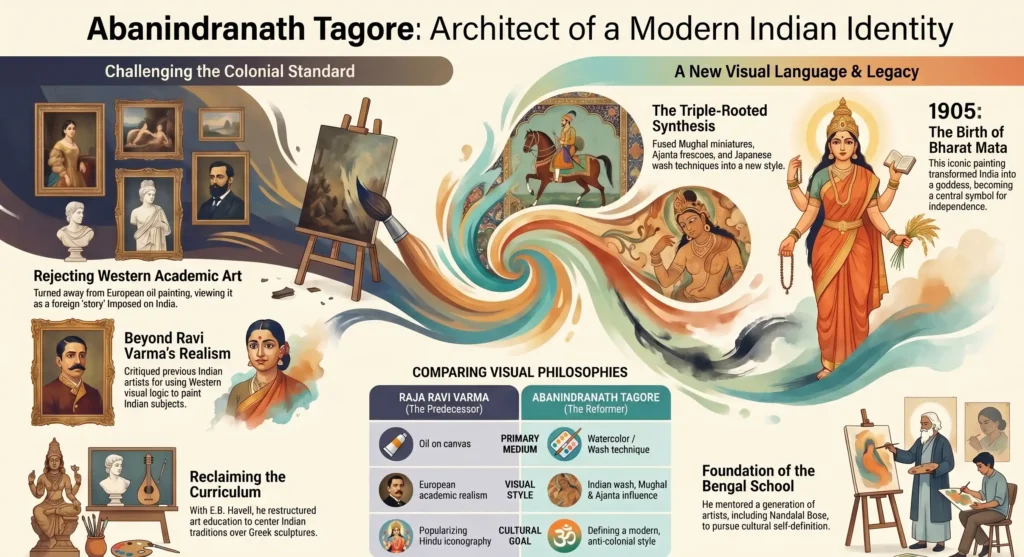
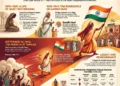
Abanindranath’s *Bharat Mata*, painted in 1905, became the visual embodiment of Swadeshi. It depicted India as a four-armed goddess, clad in saffron, holding a book, sheaves of paddy, a piece of white cloth, and a rosary. Each object was symbolic. Each gesture meant something. It was a painting that could be reproduced, circulated, understood by ordinary people as an image of what they were fighting for.
But Abanindranath understood that paintings alone were not enough. You needed institutions. You needed to teach the next generation a different way of seeing.
In 1907, alongside his brother Gaganendranath, Abanindranath founded the Indian Society of Oriental Art. It was not just a studio or a school. It held annual exhibitions. It published high-quality reproductions. It distributed illustrated journals. It gave the Bengal School of Art visibility and legitimacy. It showed that this was not one man’s eccentricity. It was a movement.
He taught artists who became legendary. Nandalal Bose, who would later help design the Indian flag. Asit K. Haldar. Kshitindranath Majumdar. Jamini Roy. Kaliprasanna Maharaj. Generation after generation learned from him that there was an alternative to the colonial aesthetic.
These artists did not all paint the same way. Nandalal Bose developed his own style, combining traditional themes with modern nationalist ideas. Jamini Roy found inspiration in folk art and Kalighat pats. Kshitindranath blended styles. But they all learned the foundational lesson: that Indian art did not need European validation. That the tradition was worth returning to. That spiritual depth mattered more than material accuracy.
What this meant
For the first time in the history of British colonialism, an art movement born in the colonies became so powerful that even the imperial institutions adopted it. Abanindranath’s work, which had begun as a rejection of British aesthetic authority, was eventually promoted by British art institutions as a valuable form of Indian expression. It was a small irony: the colonizer had taught the colonized to value their own tradition so effectively that the colonizer had to acknowledge it.
But that was the real power of what Abanindranath had done. He had not just painted beautiful paintings. He had created a philosophical framework that allowed an entire generation to reject the colonial aesthetic without feeling like they were rejecting modernism itself. He had shown that there was an Indian way to be modern.
The life that followed
Abanindranath lived until 1951, long enough to see Indian independence, long enough to see his movement transform into the foundation of modern Indian art. He was given the title Companion of the Order of the Indian Empire by the British—a honour he accepted while never ceasing to oppose what they represented. He wrote children’s books that became classics. He painted, he taught, he thought, he remained restless until the end.
But the most important work was done in those years after 1887, when a young artist made a choice. He had been trained to believe that European ways were superior. He had the skill to succeed within that system. He could have made a comfortable career, copying European forms, being praised for his technical competence. Instead, he turned away. And in turning away, he gave India permission to turn away too.
If you think you have remembered everything about this topic take this QUIZ
Results
QUIZ START
#1. In which intellectually vibrant Calcutta household was the pioneer artist Abanindranath Tagore born on August 7, 1871?
Previous
Next
#2. What major European framework did Abanindranath Tagore deliberately turn away from to build an authentic Indian modern visual style?
Previous
Next
#3. Which progressive British Principal of the Government School of Art in Calcutta collaborated with Abanindranath to restructure the curriculum around Indian traditions?
Previous
Next
#4. The visit of which Japanese art critic in 1902 directly influenced Abanindranath Tagore’s mastery of the soft tonal wash technique?
Previous
Next
#5. Which iconic painting did Abanindranath Tagore create in 1905 during the Partition of Bengal, transforming it into a powerful nationalistic symbol?
Previous
Next
#6. Where is Abanindranath Tagore’s highly celebrated and heavily analyzed masterpiece, Bharat Mata, currently housed?
Previous
Next
#7. Which legendary Indian artist, known for leading the Kala Bhavana at Santiniketan, was one of Abanindranath Tagore’s most famous students?
Previous
Next
#8. According to the Quick Comparison Table, what primary artistic medium distinguished Raja Ravi Varma’s popular work from Abanindranath Tagore’s style?
Previous
Finish
Who was Abanindranath Tagore and what is his significance in Indian art history?
Abanindranath Tagore was a painter, writer and art theorist born in Calcutta in 1871. He is considered the founder of the Bengal School of Art and the first major figure to articulate and practice a distinctly Indian approach to modern painting. By drawing from Mughal miniature traditions, Ajanta frescoes and Japanese wash techniques, he built a visual language that was simultaneously rooted in Indian sources and technically sophisticated enough to engage with international modernism.
What is the Bengal School of Art and what did it stand for?
The Bengal School was an art movement that emerged in Calcutta in the early twentieth century under Abanindranath’s leadership. It stood for the development of an Indian visual language rooted in Indian artistic traditions rather than European academic conventions. It drew from Mughal painting, Ajanta frescoes and Japanese wash techniques and produced artists including Nandalal Bose, Asit Kumar Haldar and Surendranath Ganguly.
What is Bharat Mata and why is it considered such an important painting?
Bharat Mata, painted in 1905, depicts India as a four-armed goddess figure holding grain, cloth, a book and a garland. It was made during the Partition of Bengal and the Swadeshi movement and became an immediate symbol of Indian nationalist sentiment. Its importance lies in the fact that it fused political meaning with genuine aesthetic achievement, making its nationalist argument through the visual language of the Bengal School rather than through illustration or propaganda.
How did Japanese art influence Abanindranath Tagore?
The Japanese art critic Okakura Kakuzo visited Calcutta in 1902 and introduced Abanindranath to Japanese wash painting techniques and to the broader argument that Asian civilizations shared an aesthetic inheritance worth preserving. Abanindranath learned the Japanese wash technique and absorbed it into a practice that also drew from Mughal and Ajanta traditions, producing a synthesis that was distinctly his own.
How is Abanindranath Tagore different from Raja Ravi Varma?
Raja Ravi Varma worked brilliantly within European academic conventions, painting Indian subjects in oil using the techniques and compositional logic of the Western tradition. Abanindranath rejected this approach entirely, arguing that Indian subjects required Indian visual languages. Where Ravi Varma sought to bring Indian painting into alignment with European standards, Abanindranath sought to establish that Indian standards were sufficient and worth developing on their own terms.
Sources & References
Britannica, “Abanindranath Tagore” (2026) — Born August 7, 1871 Jorasanko Calcutta, died December 5, 1951; celebrated Indian artist pioneered Bengal School of Art; painted Bharat Mata 1905; depicted India as four-armed goddess clad in orange sari during Swadeshi Movement; work became emblematic of Indian anti-colonial resistance.
Wikipedia, “Abanindranath Tagore” (n.d.) — Principal artist and creator of Indian Society of Oriental Art 1907; first major exponent of Swadeshi values in Indian art; founded influential Bengal School of Art; sought to modernize Mughal and Rajput styles to counter Western models; believed Western art was “materialistic,” India needed to return to traditions for spiritual values.
Wikipedia, “Bharat Mata (painting)” (n.d.) — Abanindranath nephew of Rabindranath Tagore; studied Sanskrit College 1880s, painted in European naturalistic style early (e.g., The Armoury); around 1886/1887 relative Gyanadanandini Devi arranged meeting with E.B. Havell, curator of Government School of Art; meeting resulted in exchanges with Havell gaining native art collaborator, Tagore gaining teacher about “science” of Indian art history.
Artflute, “Who Is Abanindranath Tagore? History, Artistic Style and Legacy” (2026) — Around 1897 shift in style after encounter with E.B. Havell; Havell held radical ideas that Indian art had value, colonial institutions destroying Indian aesthetic traditions; solution was recover and reinterpret Indian forms; Havell saw Tagore’s restlessness; Krishna Lila series represents shift away from European academic training.
DAGWorld, “Abanindranath Tagore” (n.d.) — Meeting with E.B. Havell pointed Tagore toward study of Mughal and Rajput painting; became active proponent of nationalist revivalist art; established Bengal School; influential teacher trained Nandalal Bose and Asit Haldar; inspired entire generation reimagining definition of Indian modern art; retained European-trained realist base with selective assimilation of Ajanta frescos, Kalighat pats, Mughal, Japanese, Persian elements.
Indian Culture Portal, “The Swadeshi Movement and the Bengal School of Art” (n.d.) — Bengal School of Art art movement late 19th century Kolkata, soon spread; modern and nationalist approach; Abanindranath Tagore and E.B. Havell main proponents of Indianizing art education; rejected colonial art schools, set up nationalist school in Calcutta; Tagore wanted to paint Indian subjects in Indian style, took inspiration from Mughal and Pahari miniature paintings; founded journal Indian Society of Oriental Art.
Indian Society of Oriental Art, Wikipedia (n.d.) — Founded Calcutta 1907 by brothers Gaganendranath and Abanindranath Tagore; organized art exhibitions, taught students, published high-quality reproductions and illustrated journals; followed annual exhibitions at Government School of Art showing latest works of artists in new movement initiated by Abanindranath under E.B. Havell guidance; first officers were Lord Kitchener (President), Norman Blount and Abanindranath Tagore (Secretaries).
Paripurna Datta is the founder and editor of Curious Indian, an independent editorial publication focused on Indian history, culture, science, society, and the stories behind them. He oversees research, editorial standards, and the publication's long-term direction.
Paripurna Datta is the founder and editor of Curious Indian, an independent editorial publication focused on Indian history, culture, science, society, and the stories behind them. He oversees research, editorial standards, and the publication's long-term direction.