How the Warli tribe painted in circles and triangles, and the world only looked when a man picked up the brush.
The women who painted for no one
On the northern edge of the Sahyadri Range, in the villages around Dahanu and Jawhar in Maharashtra, weddings still happen the same way they have for a thousand years. A young woman is married. On the wedding day or the day before, the suvasini—the married women of the village—gather inside the hut. They take clay, mix it with cow dung, spread it on the inner walls. Then they take a bamboo twig, point it, and dip it in rice paste. And they begin to paint.
The ritual is called making the chowk, the wedding square. At the centre, always, is the Palaghata Devi—the goddess of fertility, of abundance, of the safe passage from one life into another. Around her, in simple lines and dots and triangles, the painters draw everything the couple will need: horses to carry them, fish in the river, birds, trees, the tools of farming, the seasons turning. Sometimes a train appears, modern and incongruous, because the Warli painters painted what they saw, even if they didn’t fully understand it.
The paintings were not made to last. The walls were mud. The monsoon came, the rain fell, the pigment faded. A few years later, if there was another wedding, the walls were plastered over and the suvasinis painted again. No one took photographs. No one wrote records. The art existed only to serve the wedding, the ritual, the blessing of the new couple. And then it vanished.
For about a thousand years, this is how it was. The women painted. The walls held the paintings for a season or two. Then the walls were bare again, and the women painted the next wedding.
Shekhawati Murals and the Stories Painted on Desert Walls
The visit to Delhi
S.H. Raza and the Bindu: How a Dot Held the Universe
In the early 1970s, something changed. Someone—the sources do not say who, but it was someone outside the community—invited the Warli artists to Delhi. The women went, carrying their work. And they were accompanied, almost incidentally, by a man named Jivya Soma Mashe, who had been painting Warli art as a hobby.
Jivya Soma Mashe was not a suvasini. He was not painting for a wedding. But he was looking at the walls his community had painted for centuries and asking a different question: what if you painted on paper? What if you painted not for a wedding ritual, but for art itself?
At some point during or after that Delhi visit, Jivya Soma Mashe met Bhaskar Kulkarni, an artist and educator who would become crucial to what happened next. Kulkarni saw in Warli painting something that had not been seen before—not a ritual object, temporary and ceremonial, but a visual language that could stand on its own. He encouraged Jivya Soma Mashe to paint on paper instead of walls. He showed him that the geometric forms—the circles, the triangles, the opposing shapes that made human bodies—could be powerful in a gallery, on a white page, scaled up to be studied and admired.
In 1975, Jivya Soma Mashe’s work was exhibited at the Chemould Prescott Road gallery in Mumbai. A year later, it appeared at the Palais de Menton in France. The international art world took notice. Warli painting had been painted for a thousand years, but it had been discovered.
What was lost, what was gained
How Abanindranath Tagore Built a Distinctly Indian Art Movement
The irony is sharp enough to draw blood. A thousand-year tradition kept alive by women, painted in their homes, for their ceremonies, suddenly entered the world through a man. And once it entered that world—the world of galleries and exhibitions and commercial sale—it did not go back.
In the years that followed, Warli painting moved from walls to canvas and paper. It moved from the hands of married women performing a ritual to the hands of male artists selling work in galleries. Bhaskar Kulkarni had trained women students once; they did not complete the training. For decades, the commercial Warli painting world became overwhelmingly male, even as the ritual paintings on village walls remained women’s work.
The Warli community, living in villages around Dahanu and Jawhar and Talasari, continued to paint the chowks for weddings. The suvasinis mixed their rice paste, crushed their bamboo twigs, drew their circles and triangles and horses. But now the art had two lives: one in the villages, still ritual and temporary; one in the wider world, on canvas and paper, permanent and priced and discussed in art books.
In 2014, Warli painting received the Geographical Indication tag, a legal mark of origin that tied the art form to the community and region. It was meant as protection. It was also, in a sense, a monument to a thousand-year-old tradition that had already changed.
The geometry of need
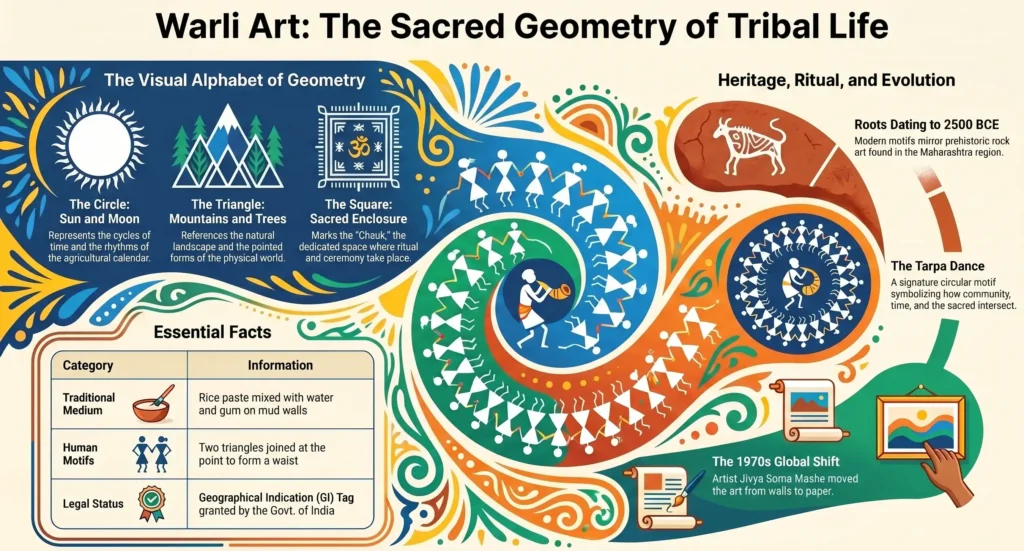
But if you step back from the history of who exhibited whom and when, there is something else worth seeing. The Warli painters were using circles, triangles, and squares not because they were artists exploring form, but because those shapes answered a need. A circle is the easiest form to draw when you have only a crushed bamboo stick and rice paste. Opposing triangles, joined at the tip, make a human body—quickly, clearly, enough. A square is a frame, an order, a boundary.
With these three shapes, the Warli painters built an entire visual language. They drew fertility and abundance. They drew the seasons and the work of farming. They drew horses and fishermen and dancers. They drew gods and goddesses and the everyday transactions between humans and the nature that kept them alive. All of it in dots and lines and triangles. No colours but red and white. No perspective, no shadow, no illusion of depth.
What the Warli painters had, in other words, was necessity. And necessity forced them to distil everything down to its outline, its essential form.
When Bhaskar Kulkarni and Jivya Soma Mashe brought this art to the galleries, what they were showing the world was not a primitive version of something more sophisticated. They were showing a visual language that had solved a problem perfectly—how to say everything you need to say with almost nothing. The world looked at it and called it revolutionary. The Warli had been doing it for centuries.
The Gold and Gems of Tanjore Painting: Devotion in Art
If you think you have remembered everything about this topic take this QUIZ
Results


#1. Which tribal community from the Palghar district of Maharashtra is responsible for developing the ancient Warli painting tradition?
#2. What primary medium is traditionally used by Warli artists to paint their geometric figures on dark mud walls?
#3. In the geometric vocabulary of Warli art, what natural feature or landscape element does the triangle represent?
#4. What is the name of the iconic, circular dance composition that depicts a community of figures moving around a central musician playing a horn-shaped wind instrument?
#5. Similar visual motifs to modern Warli figures have been identified in local prehistoric rock art dating back to which approximate period?
#6. Who was the highly celebrated 20th-century artist who transitioned Warli painting onto paper and brought it to global attention in the 1970s?
#7. What sacred central image is still painted at the heart of a traditional Warli wedding mural to depict a goddess?
#8. According to the Quick Comparison Table, what distinguishes the primary color style of Warli painting from Gond art?
Who are the Warli and where do they live?
The Warli are one of the largest tribal communities in Maharashtra, living primarily in the Palghar district in the northern part of the state. The region covers forested hills and coastal plains at the edge of the Western Ghats. The community has maintained its distinct cultural traditions including its painting practice across centuries of political and social change in the surrounding region.
What materials are used in traditional Warli painting?
Traditional Warli painting uses a white pigment made from rice paste mixed with water and gum, applied with a bamboo stick that has been chewed at one end to create a flexible brush. The background is typically the dark surface of a mud wall, which provides the contrast against which the white figures are visible. Contemporary Warli artists working on paper or canvas recreate this contrast using brown or ochre backgrounds.
What is the Chauk in Warli painting?
The Chauk is the sacred central image of a traditional Warli wedding mural. It depicts the goddess Palaghata, associated with fertility and the harvest, surrounded by concentric squares and other geometric forms that mark out the sacred space of the ritual. Painting the Chauk is one of the most significant acts in the Warli wedding ceremony, performed by senior women of the community.
How did Warli painting reach an international audience?
The primary figure in the tradition’s wider recognition was Jivya Soma Mashe, a Warli artist who began painting on paper in the 1970s and whose work attracted attention from urban Indian artists and galleries. His exhibitions in India and abroad introduced the tradition to audiences outside the Warli community and generated the interest that eventually led to the widespread commercial adoption of Warli motifs across multiple industries.
What does the Geographical Indication tag mean for Warli painting?
The GI tag formally recognizes Warli painting as a product originating specifically from the Palghar district of Maharashtra and connected to the Warli community. It provides a degree of legal protection against misrepresentation and appropriation by establishing that products claiming to be authentic Warli art must meet defined standards of origin and craft. It is an important tool in protecting the community’s cultural ownership of the tradition, though enforcement in a global commercial context remains an ongoing challenge.
Sources & References
Incredible India, Ministry of Tourism. “The enduring tribal artistry of Maharashtra: Warli Paintings.”
Vikaspedia. “Warli Painting: The Traditional Tribal Art of Maharashtra.”
Sahapedia. “Warli Painting.”
Sarmaya. “A Return to the Land: A History of Warli Paintings.”
MapAcademy. “Warli Painting: A Traditional Form of Mural Art.”
Museum of Modern Art, New Delhi. “Exhibit: Warli Painting,” November 2023.