An Indian citizen who wants to visit Arunachal Pradesh, Nagaland, Mizoram or Manipur needs a permit. The rule behind it was written in 1873, to protect British money, and has been turned into something else entirely
Say you live in Delhi, or Pune, or Kolkata, and you want to see the monastery at Tawang, or the hills of Nagaland, or Aizawl on its ridges.
Before you go, you will need to apply for a piece of paper. Online, these days. You will give your name, your ID, the dates of your visit, where you plan to go. If it is approved, you will get a permit valid for a fixed number of days. Without it, you are not supposed to enter.
It is not a visa. You are an Indian citizen, going to an Indian state. And yet you need permission.
The piece of paper is called an Inner Line Permit. And the story of why it exists begins not with tribes, but with tea.
Tea and timber
In the second half of the nineteenth century, the British were turning the Assam valley into one of the great tea-growing regions of the world. Plantations spread along the foothills. Timber companies eyed the forests beyond them. Traders pushed further and further into the hills.
The hills were not empty. They belonged to peoples who governed themselves and did not take kindly to strangers taking their land and their forests. Every time a planter or trader pushed too far, there was trouble, and trouble often meant the government sending an expensive military expedition into the hills to punish somebody.
The government decided it would rather not. So in 1873 it passed the Bengal Eastern Frontier Regulation.
The line
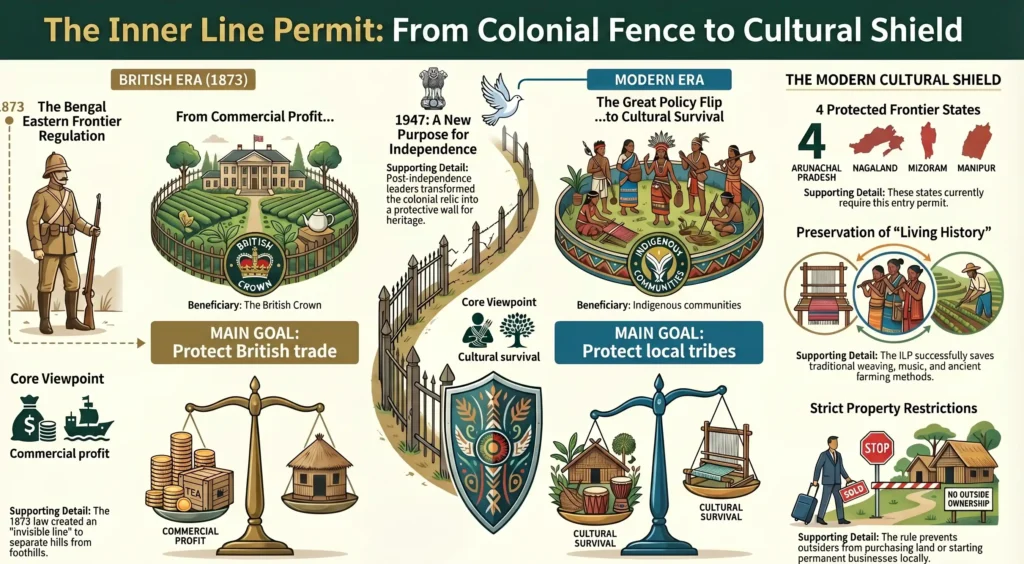
The Regulation allowed officials to draw a line on the map, the Inner Line, in certain frontier districts. Beyond that line, a British subject, which in practice meant the ordinary people of British India, could not go without a pass. Nor could any outsider acquire land or its products there without official permission.
It is worth being clear about why. Official accounts today sometimes describe the line as protecting the identity of the hill peoples, and in practice it did leave them largely alone. But the push behind it was British commercial interest: to keep the tea gardens secure, avoid costly wars, and stop independent traders from stirring up the hills. Some accounts add that it also protected the British hold on trade in the region.
The push behind the line was not the hill peoples’ way of life. It was the tea gardens, and the cost of war.
The same words, a new meaning
Then, in 1947, the British left. The Regulation did not.
Independent India kept it, with one change. Where the law had said British subjects, it now said citizens of India. The line stayed where it was, around the hills that became Arunachal Pradesh, Nagaland and Mizoram.
But over the decades, its purpose turned almost upside down. The rule written to protect British trade became, for the tribal communities of those states, a shield. Small communities, with their own languages, customs and ways of holding land, feared being swamped by settlers from more crowded parts of India, buying up land and changing who lived where. The Inner Line gave them a way to control who came in and who could stay.
Manipur
Manipur had once had an Inner Line of its own, but it was removed in 1950. For years afterwards, many groups in Manipur campaigned to bring it back, worried about the number of people coming in from outside.
On 11 December 2019, by a presidential order, the Inner Line was extended to Manipur. It was the same week that Parliament passed the Citizenship (Amendment) Act. That was not a coincidence. The new citizenship law specifically did not apply to areas covered by the Inner Line. Extending the line to Manipur put the state outside the new law’s reach. In the same period, Nagaland extended the Inner Line to Dimapur.
So a regulation written in 1873 to protect tea money became, in 2019, a boundary in a twenty-first-century argument about citizenship.
Two rights
Not everyone thinks the Inner Line is a good idea.
Its critics say that a citizen of India should be free to travel, work and live anywhere in India. They argue that permits discourage investment and tourism, and some argue that it can be used to shut out people who have lived in a place for a long time. Challenges to the 2019 order and to the Manipur permit system have been taken to the Supreme Court.
Its supporters say that for small indigenous communities, the right to remain the majority in their own homeland, to keep their land and their culture, matters more than the convenience of visitors. Without the line, they fear, they would become strangers in their own hills.
Both sides are arguing about something real. That is why the argument has not gone away.
The paper
So when you print out your permit and pack it for the trip, you are carrying more than a travel document. You are carrying a line drawn on a map by colonial officials worried about their tea gardens, kept by a free India, and turned by the people who live beyond it into a way of saying: this land is ours, and you are welcome here, but on our terms.
If you think you have remembered everything about this topic take this QUIZ
Results


#1. In which year was the original Bengal Eastern Frontier Regulation passed by the British?
#2. What was the primary reason the British colonial government created the invisible boundary?
#3. How did the purpose of the Inner Line Permit change after India gained independence?
#4. Which of the following states is NOT mentioned as requiring an Inner Line Permit to enter?
#5. What is the document called that foreign tourists need to visit these protected states?
#6. According to the text, what is a major modern argument for removing the permit system?
#7. How can Indian citizens apply for an Inner Line Permit today?
#8. Which organization studies these areas and reports that the permit helps save traditional weaving and music?
What exactly is this special travel document?
It is an official travel paper issued by the state government that allows an Indian citizen to enter a protected state for a limited amount of time.
Why do Indian citizens need permission to travel inside India?
Certain states have very small indigenous populations. The government requires permission to prevent massive crowds from settling there and taking over the local land and resources.
Which states currently require this entry pass?
If you want to visit Arunachal Pradesh Nagaland Mizoram or Manipur you must obtain this specific entry pass before crossing the border.
Is it difficult to get this permission paper today?
It is actually quite easy now. You can apply for it online through official state government websites by uploading your basic identity documents and a photograph.
Can outsiders buy land in these protected areas?
No, the primary rule of this system is that non residents are completely forbidden from purchasing land or permanent property inside these boundaries.
Sources & References
Bengal Eastern Frontier Regulation, 1873, read with modern scholarship on the historical Inner Line — the colonial boundary regime, limits on outside commercial expansion and the effort to reduce frontier conflict.
Government of Arunachal Pradesh, e-ILP portal, “Bengal Eastern Frontier Regulation 1873” — the sections creating the Inner Line and the permit, and the change from “British subjects” to “citizens of India”.
PolSci Institute, “Inner Line Permit: Regulating Access to Northeast India’s Tribal Regions” (25 May 2026) — the removal of the ILP from Manipur in 1950 and its extension in December 2019.
The Tribune, “SC seeks Manipur’s reply on plea against Inner Line Permit” (2022) — the British commercial monopoly behind the Regulation and the challenge to the Manipur ILP.