How Curzon’s plan to divide Bengal backfired, and what it left behind
In 1905, a British Viceroy took a pen and drew a line across the map of Bengal.
He drew it to make his enemies weaker. Bengal was the beating heart of Indian nationalism, and he wanted to break that heart in two. But a line on a map is a strange and dangerous thing. This one did not do what he intended. It did something else entirely, and in fact it did two things at once, and the two pulled in opposite directions for the next forty years.
The line set fire to Indian nationalism, uniting the country against British rule as nothing had before. And it cut along a hidden seam of religion, a seam that would not close even after the line itself was rubbed away, and that would one day tear Bengal apart for real.
This is the story of the Partition of Bengal, and of a single line that cut both ways.
Bengal united is a power
By the early 1900s, Bengal was the most important province in British India, and the most troublesome.
It was vast, home to some eighty million people, and it stretched across what is now West Bengal, Bangladesh, and beyond. Its capital, Calcutta, was the capital of British India itself, and the great engine room of Indian thought, journalism and politics. If nationalism had a home, it was here.
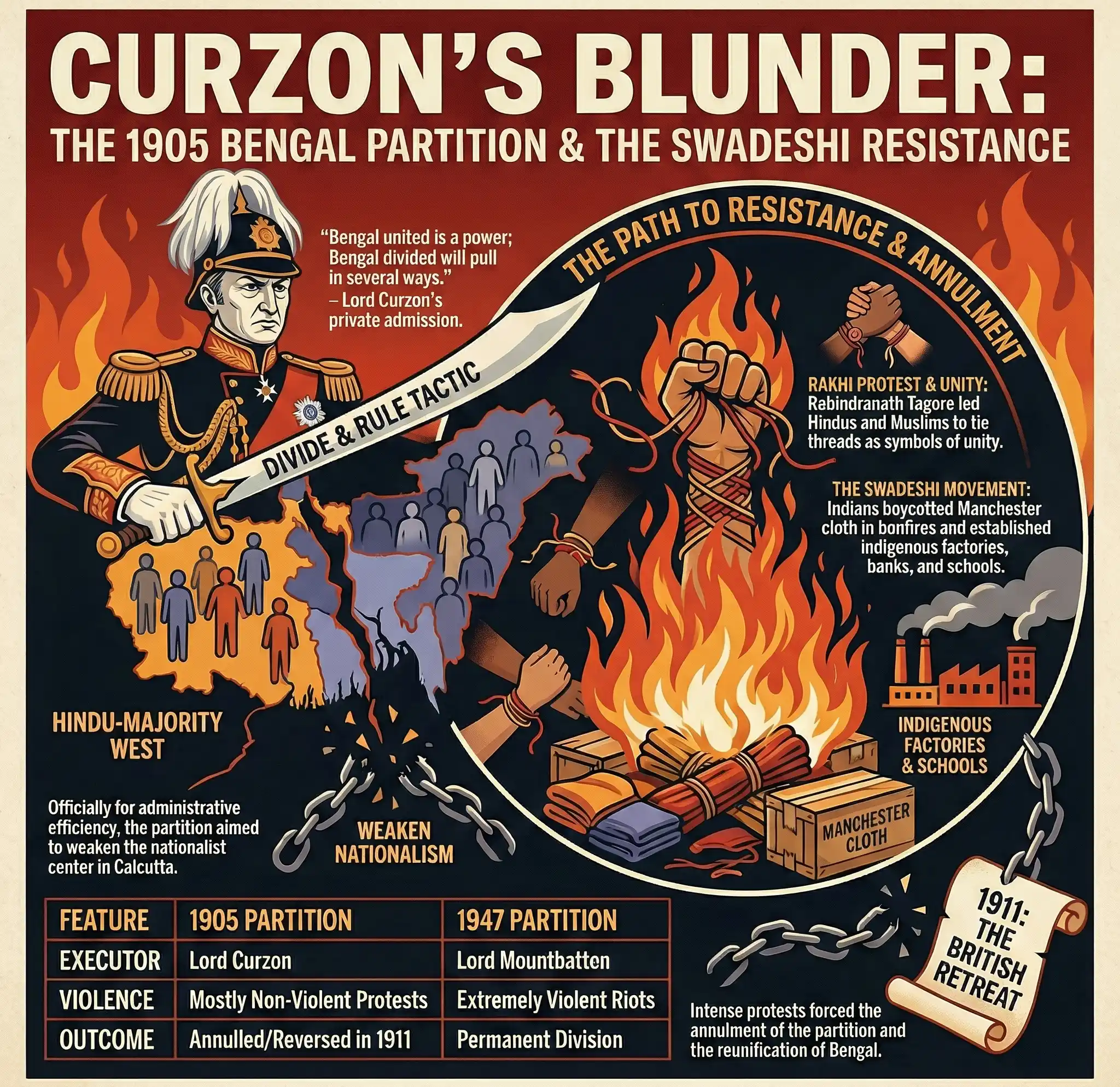
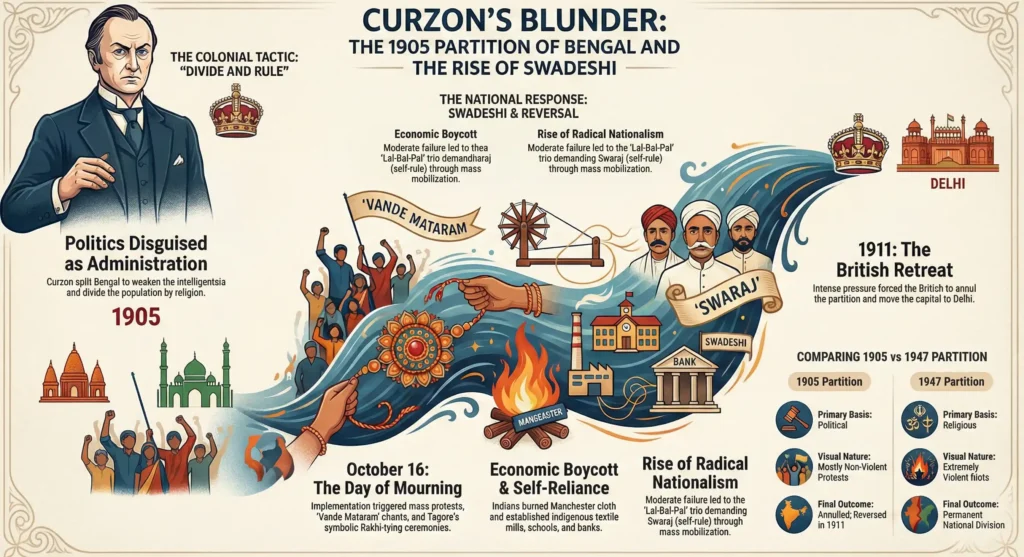
The Viceroy, Lord Curzon, was a proud and high-handed man, and he looked at the restless, clever, articulate Bengalis and saw a threat. Officially, he announced that Bengal was simply too large to govern well and needed to be split for the sake of good administration. But the real thinking behind the plan was blunter than that.
A united Bengal was a power. A divided Bengal, the reasoning went, would pull itself apart. The line was drawn, above all, to make Indians weak.
Muslim League Founded 1906: The Beginning of Communal Politics in India
The seam of faith
The way Curzon chose to cut Bengal was the truly fateful part.
He split it into two new provinces. In the west lay a Hindu-majority Bengal, with its capital at Calcutta. In the east lay a new province, Eastern Bengal and Assam, with a Muslim majority and its capital at Dhaka. On paper it looked like a tidy administrative fix. In truth it set the interests of one community against those of another.
And here honesty asks for a harder point than the simple story usually allows. The line was not only a trick played on a passive people. Eastern Bengal had long been poorer and more neglected than the west, and many of its Muslims were peasants who had been dominated for generations by mostly Hindu landlords and professionals based in Calcutta. For some of them, the new province was not an insult but an opening: for the first time, they would be a majority, with their own capital and their own political voice.
That is precisely what made the seam so dangerous. It was not invented out of nothing. It ran along a real fault in Bengali society, and once a British pen had traced that fault onto a map, it became far harder to ignore.
A day of mourning
Among the nationalists of Calcutta and beyond, the reaction to the partition was volcanic.
When it took effect on 16 October 1905, much of Bengal went into mourning. In countless homes no cooking fires were lit that day, a gesture of grief called Arandhan. People walked barefoot to the river to bathe in its waters, singing as they went. And through the streets rose a cry that would echo through the whole freedom struggle: Vande Mataram, “I bow to thee, Mother,” a hymn to the motherland taken from a Bengali novel.
A protest against a line on a map had become something much larger: an outpouring of love for a country that did not yet officially exist.
Tagore’s thread
The most beautiful answer to the partition came from the poet Rabindranath Tagore.
Curzon had chosen a day to divide Bengalis from one another. Tagore turned that same day into a festival of binding them together. He called on Hindus and Muslims to tie rakhis, the sacred threads of protection, around one another’s wrists, as a sign that no government line could cut the bond between them.
Against the empire’s line, drawn to divide, Tagore set a simple knot of string, meant to unite.
In those same charged months, Tagore wrote a song for his beloved homeland, “Amar Sonar Bangla,” My Golden Bengal. There is a deep and bittersweet irony in what became of it. Decades later, in 1971, that song would become the national anthem, not of a united Bengal, but of the separate nation of Bangladesh.
Jallianwala Bagh Massacre 1919: Inside the Tragedy That Ignited a Revolution
Swadeshi
The anger of 1905 did not stay a matter of songs and processions. It became a strategy, and a powerful one.
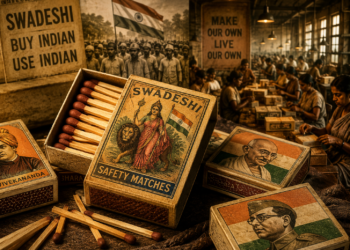
Bengal’s leaders concluded that polite petitions to the British had failed and always would. So they reached for a new weapon: the Swadeshi movement, the boycott of British goods and the embrace of Indian ones. Bonfires were lit of expensive cloth from the mills of Manchester. Indians began building their own mills and banks and factories. Students walked out of British-run schools, and new national colleges were founded to replace them, one of which would grow into a great university.
Swadeshi taught India a lesson it never forgot: that ordinary people, simply by refusing to buy, could make the mightiest empire on earth flinch.
It was also a turning point inside the freedom movement itself. The failure of the polite Moderates to stop the partition discredited their gentle methods and lifted a bolder generation of leaders who demanded self-rule and open defiance. The tools sharpened in Bengal in 1905, the boycott and the mass campaign, were the very tools Gandhi would one day wield across the whole of India.
The line erased
In the end, the protests simply would not stop, and the British could not rule a province in permanent revolt.
In 1911, at a magnificent royal assembly in Delhi, King George V announced that the partition of Bengal would be undone. The Bengali-speaking lands were joined back together. It was a genuine and famous victory, the first time mass agitation had forced the Raj into a full retreat.
But the victory was not clean. In the very same breath, the British moved the capital of India from Calcutta to distant Delhi, a quiet blow to the pride and power of troublesome Bengal. And the reunion angered many Muslims of the east, who had gained a province of their own and now saw it taken away. What looked like a simple triumph had loose and dangerous threads hanging from it.
The seam that stayed
Curzon’s line lasted just six years on the map. Its effects lasted far longer, and they ran in two directions at once.
On one side, the partition had shown Indians their own strength. It had taught them that unity, boycott and mass action could bend an empire, a lesson that led in a straight line to Gandhi and, in time, to freedom itself. In that sense, the divide had united a nation.
On the other side, something darker had been set loose. The idea that Bengal, and India, could be sorted and split along the line of religion had been drawn in ink that would not wash out. The Muslim League was founded the very next year, in 1906. And forty-two years after Curzon’s pen first touched the map, in 1947, Bengal was cut in two once more, this time for good and in terrible bloodshed, into West Bengal and East Pakistan. Tagore’s golden Bengal became, in the end, two Bengals.
That is the hard truth hidden inside a famous victory. The Partition of Bengal united India against the British, exactly as the history books proudly record. It also helped teach India to divide itself, which the history books say more quietly. A line on a map, it turns out, is never only a line. Long after the ink has faded, people go on seeing the border it taught them to see.
Non-Cooperation Movement 1920-1922: The Day India Said “No” to the British
If you think you have remembered everything about this topic take this QUIZ
Results


#1. Which British Viceroy was responsible for the Partition of Bengal in 1905?
#2. On which date was the Partition of Bengal officially implemented, observed as a day of mourning?
#3. What was the official reason given by the British for partitioning Bengal?
#4. Which song, taken from Bankim Chandra Chatterjee’s novel Anandmath, became the anthem of the resistance?
#5. Who encouraged Hindus and Muslims to tie ‘Rakhis’ on each other’s wrists as a symbol of unity during the protests?
#6. The Partition of Bengal triggered which major political movement involving the boycott of British goods?
#7. In which year was the Partition of Bengal annulled by King George V?
#8. Rabindranath Tagore’s song “Amar Sonar Bangla,” written during the protests, later became the national anthem of which country?
The Midnight of August 15: Freedom, Partition, and the Blood on the Map
Why did Lord Curzon partition Bengal in 1905?
Curzon claimed it was for “administrative efficiency” as Bengal was too large, but the real reason was to weaken the Bengali nationalist movement by dividing Hindus and Muslims.
When was the Partition of Bengal annulled?
It was annulled in 1911 by King George V during the Delhi Durbar.
What was the Swadeshi Movement?
It was a movement launched in reaction to the partition, advocating the boycott of British goods and the use of Indian-made (Swadeshi) products.
How did Rabindranath Tagore protest the partition?
Tagore organized the Rakhi Bandhan festival, encouraging Hindus and Muslims to tie Rakhis on each other’s wrists as a symbol of unity.
What happened to the capital of India in 1911?
Along with the annulment of the partition, the British shifted the capital of India from Calcutta to Delhi to reduce the influence of Bengali nationalism.
Sources & References
- Encyclopaedia Britannica (“Partition of Bengal”) — the 1905 division, the reasons behind it, and its annulment in 1911.
- Encyclopaedia Britannica (“Swadeshi movement”) — the boycott of British goods and the nationalist upsurge it produced.
- Royal Collection Trust (the Delhi Durbar of 1911) — King George V’s durbar, the reversal of the partition, and the move of the capital to Delhi.
- Encyclopaedia Britannica (“Rabindranath Tagore”) — the poet’s part in the protest and the songs he wrote during it.
Author


Exploring the Soul of Bharat through History, Science, Culture, and its Diversity
Our Mission
Curious Indian is a definitive knowledge portal dedicated to chronicling the events, personalities, and cultural shifts that defined the Indian subcontinent. From the ancient Vedic Period to the complexities of 21st-century politics, our goal is to provide deep-dive analysis that inspires.
Editorial Standards & E-E-A-T
Every article published under our brand undergoes a rigorous fact-checking process. We prioritize primary historical records, academic citations, and credible archives to ensure our readers receive accurate, high-authority information.
Historical Integrity Directly sourcing from ASI archives and academic journals.Topical Authority Comprehensive clustering of Indian Science, Biographies, and Wars.Managed by Paripurna Datta and TEAM | Dedicated to the Knowledge of India.