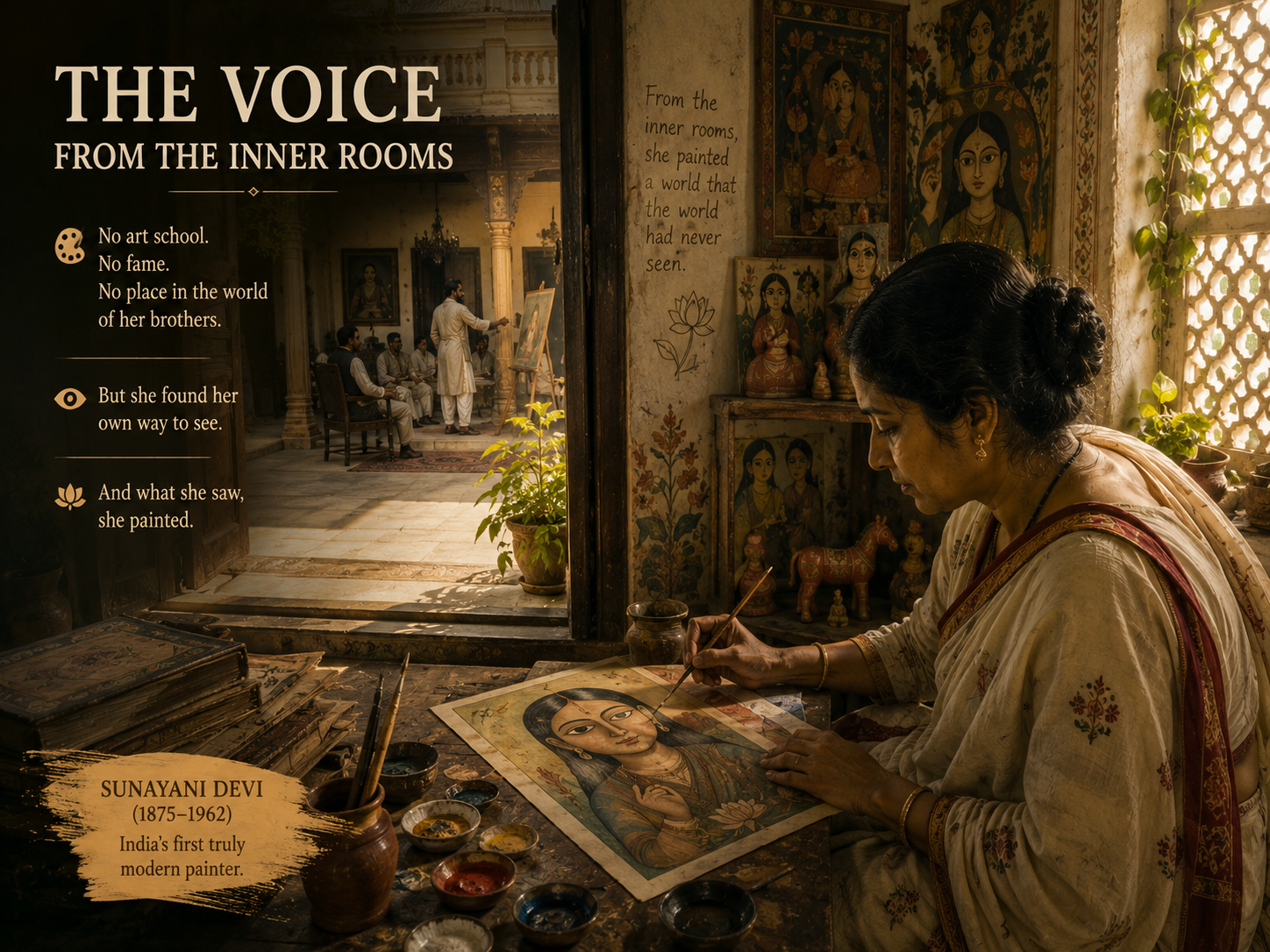
How a self-taught woman of the Tagore household became a forgotten pioneer of modern Indian art
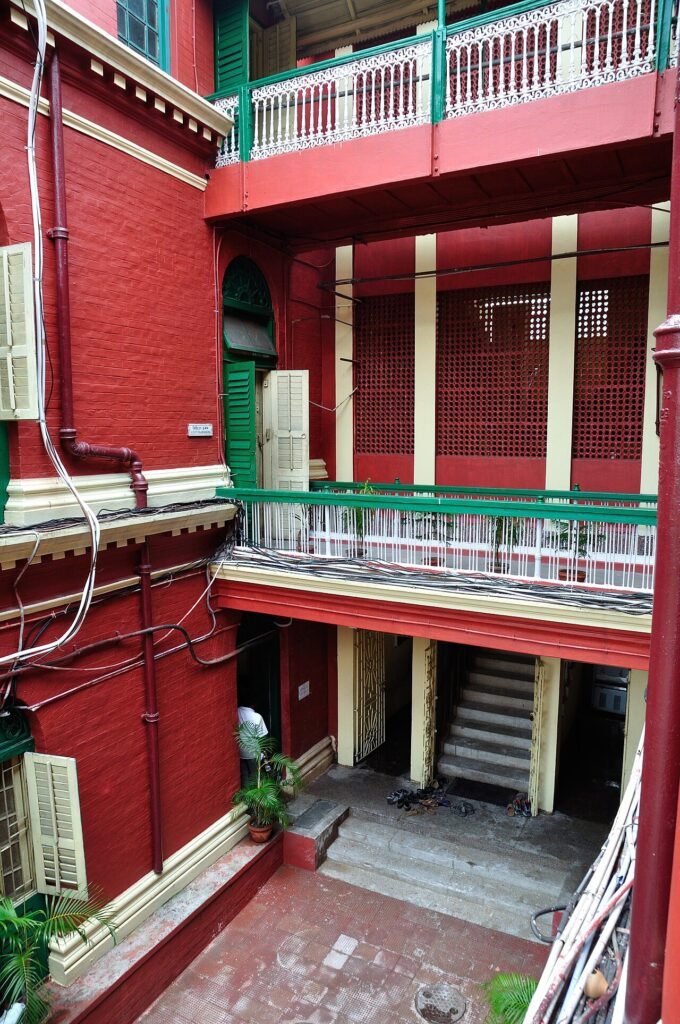
In one of the most famous families in all of India, the Tagores of Calcutta, a house overflowing with poets and painters, there ran a strict and invisible line. The men lived and worked in the grand outer rooms, where the visitors arrived and the fame was made. The women lived in the inner rooms behind them, out of sight of the world.
Sunayani Devi was one of those women. She was married off at eleven, she was never sent to any art school, and she had no place at all in the celebrated art world that her own brothers led. And yet, quietly, from inside those inner rooms, she found a voice, a voice so completely her own that one great scholar would one day call her the first truly modern painter in all of India. This is her story.
A house full of geniuses
To be born a Tagore in those days was to be born into a whirlwind of art and ideas.
Sunayani’s uncle was Rabindranath Tagore, the poet who would go on to win the Nobel Prize. Two of her own brothers, Abanindranath and Gaganendranath, were among the leading painters of the age, the very men at the head of the new Bengal School of art. You might imagine, then, that a girl growing up in such a household would naturally be swept up into all of it.
But she was a girl, and the rules were simply different for girls. While her brothers studied and experimented and held exhibitions, Sunayani was married at the age of eleven and set firmly on the path expected of every woman of her class: to be a wife, to run a home, and to remain in the inner rooms. The art was all around her, everywhere she looked, and yet almost none of it was truly meant for her.
Source: Wikimedia Commons · Creator:Michel Barthélémy Ollivier · CC0
Vedic Period: From Nomadic Hymns to Iron Age Kingdoms
Vikram Sarabhai Biography: The Man Who Built India’s ISRO
Stealing time to paint
She could not help herself, though. She had watched her brothers paint all her life, and the longing to do it herself would not go away.
Source: Wikimedia Commons · Biswarup Ganguly · CC BY 3.0
So, already a grown woman in her thirties, with a whole household to run, she simply began. She taught herself, with no teacher and no training of any kind, painting in the few spare hours she could quietly steal from her daily duties. It was, at first, the easiest thing in the world for people to dismiss: just a housewife’s little hobby, an amateur dabbling with colours in her idle afternoons.
A voice that owed nothing to her brothers
But then something quite remarkable happened. When Sunayani painted, she did not copy her brilliant, famous brothers at all. Her work looked nothing whatsoever like theirs.
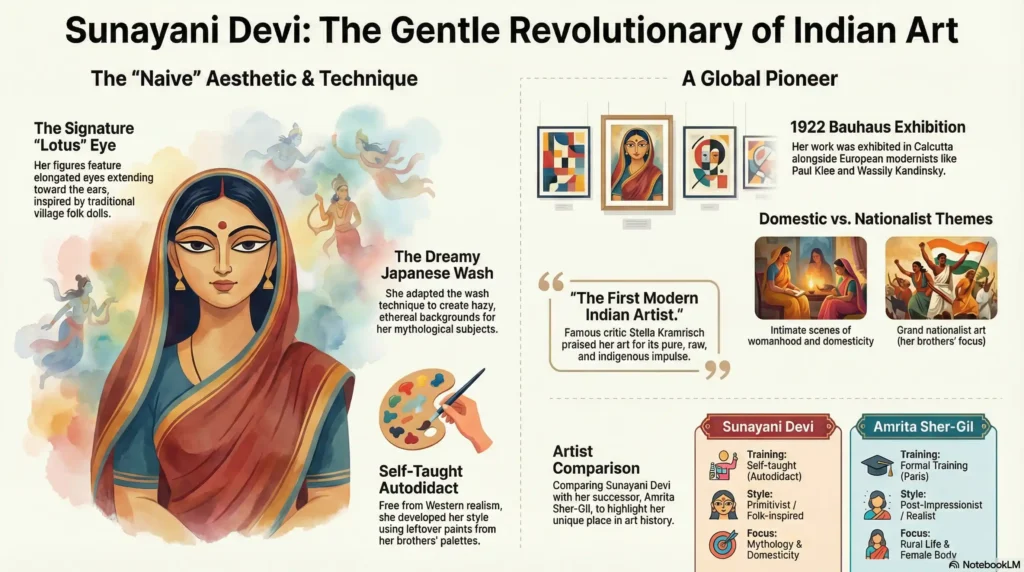
Where their art was polished and refined and deeply learned, hers was simple, dreamy and childlike, full of soft rounded figures with large, gentle eyes. And it did not spring from any grand tradition or art school. It came instead from the humble folk art she had known her whole life: the cheap Kalighat pictures sold near the temple, the little painted clay dolls, the flowing patterns that women drew on their own floors. She reached right past the lofty styles the men so admired, and drew instead from the everyday art of ordinary Bengali homes.
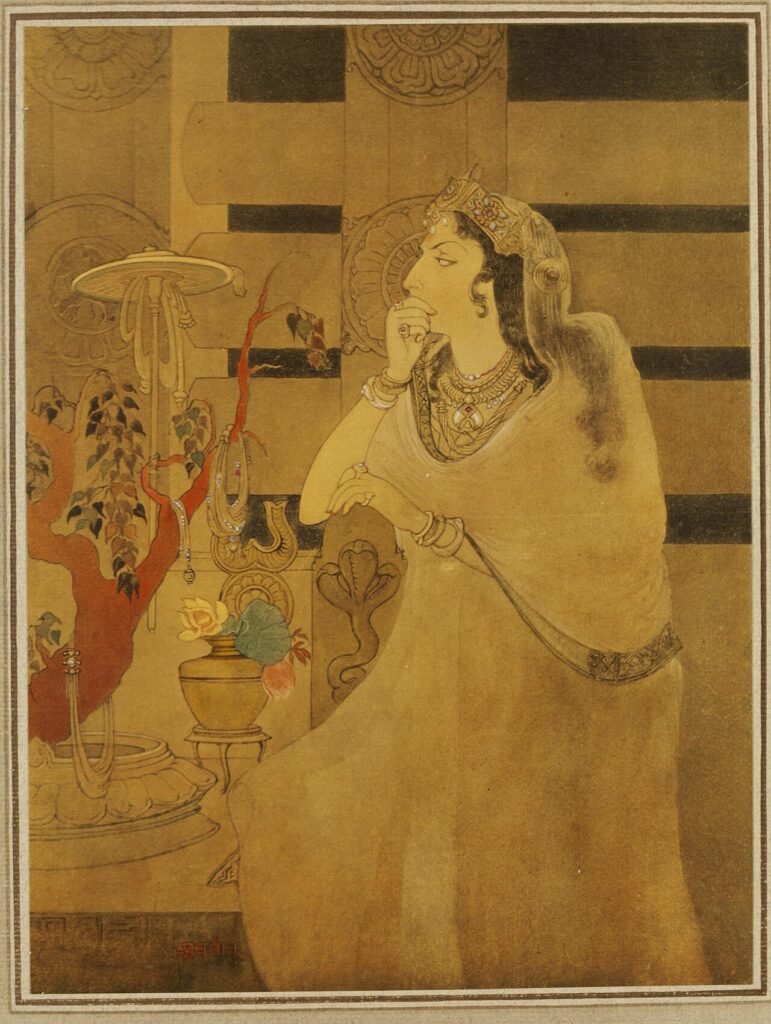
Source: Wikimedia Commons · Abanindranath Tagore · Public domain
Sunayani Devi’s paintings owed nothing to her famous brothers. Their art was polished and learned; hers was simple and dreamlike, drawn from the folk art of ordinary homes.
And she painted her own world. Again and again she painted women, and quiet scenes of domestic life, and they carry within them a faint but unmistakable sadness, a loneliness, a longing for some freedom that lay just out of reach. Without ever once saying so aloud, she was painting the hidden inner life of women exactly like herself.
Birbal Sahni: The Scientist Who Unlocked India’s Prehistoric Forests
The first modern painter in India
For a long while, that very simplicity was held against her. Critics called her “naive,” a mere untrained amateur. But a few clear-eyed people saw the truth of it, which was really the exact opposite.
A brilliant art historian named Stella Kramrisch studied Sunayani’s paintings and declared that her so-called limitations were, in fact, her greatness, that her untrained, childlike honesty was a rare and precious kind of grandeur.
Kramrisch went so far as to call Sunayani Devi the first modern painter in India. What had been dismissed as amateurish was seen at last as something bold and new.
And here is the part that truly ought to be better known. In turning away from the grand old styles and toward the simple folk art of Bengal, Sunayani was doing something genuinely new, and she did it years before the famous male painter Jamini Roy, who would later be celebrated the world over for that very same folk-inspired turn. The quiet woman in the inner rooms had pointed the way forward, ahead of the men.
Forgotten, and found again
For a time, the world did take notice of her. Her paintings were shown in exhibitions in Calcutta and Allahabad, in London, and even across America, and her work hung alongside the European modernists at a famous exhibition held in Calcutta in 1922.
But it did not last. In the 1940s, a run of hard times fell upon her family, and Sunayani quietly set down her brush and stepped away from the art world for good. And then, as so very often happens to the women who came first, she was largely forgotten, her name slipping slowly into the deep shadows cast by her famous brothers.
The Battle of Saraighat That Stopped a Mughal Empire
What she proved
It is only now, long afterward, that Sunayani Devi is finally being remembered as she deserves, and her story is well worth holding onto.
She had been handed every possible reason to remain invisible. She was a woman in an age that expected its women to stay quietly in the inner rooms. She had no training at all. She was married off as a child and buried in the endless work of a household. And yet every single one of those things that was meant to keep her small became, in her own hands, the very source of her originality. Because she could not paint like the trained men, she painted like no one else alive. Because she had no grand studio, she painted the small, close world that she actually knew, and she made it beautiful and true.
From inside the inner rooms, with nothing but a few stolen afternoons and a brush, one quiet woman found a voice that the whole loud and brilliant house around her could never quite drown out. It only took the world about a hundred years to finally hear it.
Mylswamy Annadurai: The Village Boy Who Conquered the Moon and Mars
If you think you have remembered everything about this topic take this QUIZ
Results


#1. To which illustrious family did Sunayani Devi belong?
#2. At what age did Sunayani Devi begin her serendipitous journey into painting?
#3. What term did art critics later use to describe Sunayani Devi’s unique, self-taught style?
#4. Sunayani Devi drew heavy inspiration from which local bazaar art form of Calcutta?
#5. What is the most striking and characteristic physical feature of the figures in her paintings?
#6. Which famous Austrian art historian was a huge admirer and called her the “first modern Indian artist”?
#7. In 1922, Sunayani Devi’s works were exhibited in Calcutta alongside European modernists from which famous movement?
#8. According to the text, who was the famous grandfather of Sunayani Devi’s husband, Rajanimohan?
Who was Sunayani Devi?
Sunayani Devi was a self-taught Indian artist from the Tagore family and one of the first female modernists of the Bengal School of Art.
What is unique about her painting style?
Her style is characterized by the “Wash technique,” elongated lotus-shaped eyes, and a “Naive” or “Primitivist” approach inspired by Kalighat folk art.
Did she receive formal art training?
No, unlike her brothers Abanindranath and Gaganendranath, she was entirely self-taught.
Which famous art critic praised her work?
Stella Kramrisch, a renowned art historian, praised her work for its purity and indigenous roots.
What are her most famous themes?
She primarily painted scenes from Hindu mythology (Krishna, Radha, Gopis) and domestic female life.
Sources and references
- Wikipedia (“Sunayani Devi”) and DAG — her dates (1875–1962), her birth into the Tagore family, her lack of formal training, her start in painting in her thirties, and Stella Kramrisch’s description of her as the first modern painter in India whose limited skill was “a strength rather than weakness.”
- Paintphotographs and Bengal Biennale — her self-taught, “primitive” folk-inspired style transcending the norms of the Bengal School, her domestic and mythological subjects, and her recognition despite lacking training and painting for only about fifteen years.
- GetBengal (“forgotten first modern woman artist”) — the gendered separation of the Tagore household, her marriage at eleven, her folk and pata influences, her work being free of the leading Tagore-School artists’ influence, and her anticipation of the folk turn later taken up by Jamini Roy.
- The Heritage Lab and Critical Collective — her place in the Bengal Renaissance, her melancholic domestic scenes reflecting a yearning for freedom, and her exhibitions including the 1922 Bauhaus show in Calcutta.
- Original Curious Indian article (“Sunayani Devi”) — her position as a woman’s voice within the male-dominated Bengal School, her original folk-rooted style, and her later fading from the art world.