Kothavadi, the 1960s: a primary schoolteacher sat at his sewing machine after school hours, and his eldest son sewed on the buttons. The boy grew up to send India to Mars for a fraction of what anyone else spent
In the village of Kothavadi, about twenty-five kilometres from Coimbatore, a primary schoolteacher named Mylswamy earned around 120 rupees a month. He had five children. It was not enough.
So when school was over, he sat down at the sewing machine at home. He stitched blouses for the women of the village, and shirts and trousers for the men. A blouse earned him about fifty paise. In a month the tailoring brought in about another hundred rupees.
From the time he was in Class III, his eldest son sat beside him and sewed on the buttons. For each piece, the boy was paid a few paise.
The boy’s name was Annadurai. He had been named after C.N. Annadurai, the founder of the DMK.
From Class III, the boy sewed on the buttons, at a few paise a piece.
Nothing wasted
In that house nothing was thrown away. Annadurai was the eldest, which meant his clothes would be worn next by a younger brother. So he looked after them. His textbooks would be used by the next child too. His parents told him so, and at the end of every school year his books had no scribbles in them and no folded corners. They looked new.
The family owned five cents of land, with a small house on it. That was all. There was no farmland.
His school was a cowshed at first. In the mornings the children led the cattle out, cleaned the dung off the floor, and sat down to learn. When he was in Class III they got a proper building, but no playground, so the children cleared the ground around it and made one.
Shivkar Bapuji Talpade: (1864- 1916)
The cloth
Once a year, for the festival, Annadurai and his sister each got one new set of clothes.
The cloth did not come from their father’s pocket. The village headman had children of about the same age, and each year he gave the tailor cloth to stitch festival clothes for them. Annadurai’s father cut that cloth with great care. He laid out the pieces for the headman’s children so that the waste left over was big enough to make another set, for his own son and daughter.
Those were the children’s festival clothes: made from what was left over. And of course, they had to be kept in good condition, so the next child could wear them after.
He cut the headman’s cloth so carefully that the leftovers made his own children’s festival clothes.
Five paise
The boy learned the lesson thoroughly. He saved the little five-paise and three-paise coins his father gave him until he had five rupees, bought a chicken with it, and started keeping poultry. He opened an account at the village post office.
In high school he sometimes walked instead of taking the bus, to save the fare. When he did take the bus, he worked out a small scheme. The fare was six or seven paise, and conductors never bothered to give back the small change. So he got to the stop early and collected the fares from the other students. Bought together, the change adds up, and with careful planning he could buy tickets for five or six students and ride free himself. He called it a win-win: “for me, my friends and the conductor.”
He also came first in the district in his school-leaving exams, and first in his college.
Manjul Bhargava: (1974- Present)
Mars
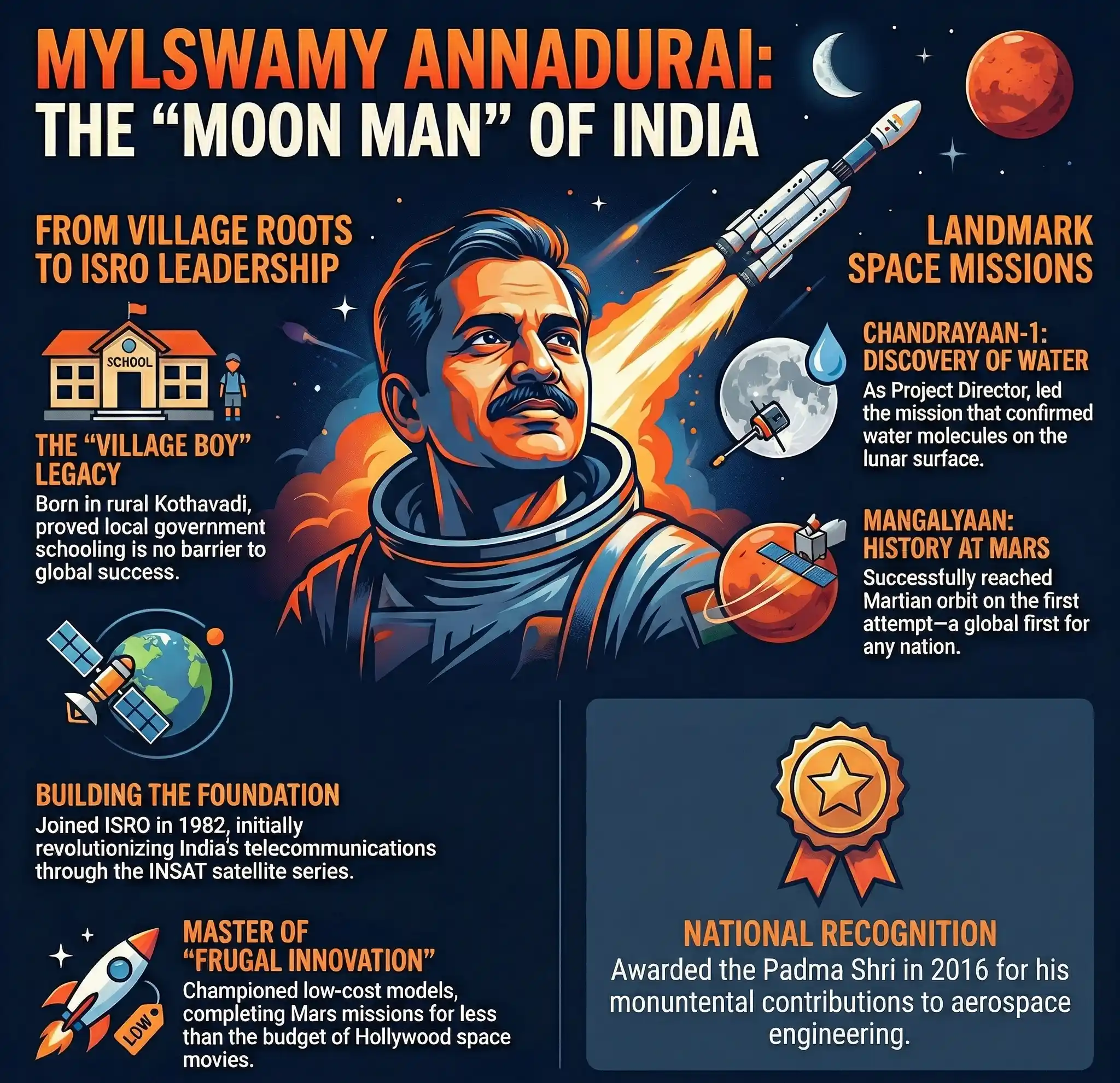
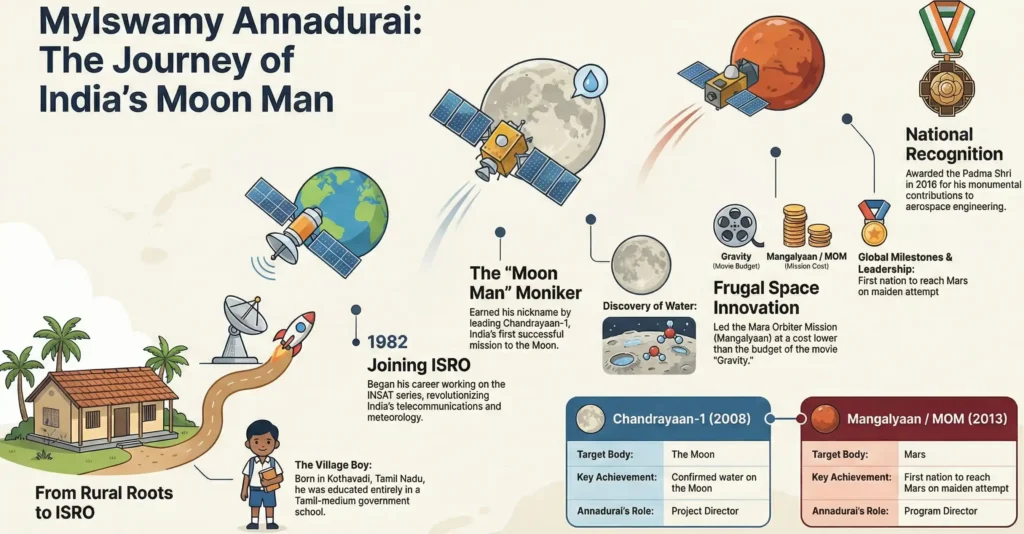
Annadurai joined ISRO in 1982. In 2008, as project director, he led Chandrayaan-1, India’s first mission to the Moon. Then he became programme director of the Mars Orbiter Mission, Mangalyaan.
In September 2014 Mangalyaan reached orbit around Mars at the first attempt. The whole mission cost around 450 crore rupees. By Annadurai’s reckoning, NASA’s Mars orbiter MAVEN, launched around the same time, cost about ten times as much.
People around the world asked how India had done it so cheaply. There were many answers. One of them goes back to a sewing machine in Kothavadi, and a teacher bent over a length of the headman’s cloth, working out how to cut it so that nothing would be wasted and there would be enough left over for his own children.
His son had been watching.
Venkatraman Ramakrishnan: (1952- Present)
If you think you have remembered everything about this topic take this QUIZ
Results


#1. What popular nickname was given to Dr. Mylswamy Annadurai by the Indian media and scientific community?
#2. In which year did Dr. Annadurai officially join the Indian Space Research Organisation (ISRO)?
#3. During his early career at ISRO, Dr. Annadurai worked extensively on which series of communication satellites?
#4. What groundbreaking discovery was made by the Chandrayaan-1 mission under his leadership as Project Director?
#5. Which 2013 mission made India the first nation in the world to successfully reach its target orbit on the very first attempt?
#6. What is the title of the book authored by Dr. Annadurai in Tamil to inspire young regional students about space science?
#7. In recognition of his monumental contributions to science and engineering, which civilian honor was awarded to him in 2016?
#8. What was a defining characteristic of the Mangalyaan mission that Dr. Annadurai championed?
Why is Mylswamy Annadurai called the “Moon Man of India”?
He earned this title because he was the Project Director for Chandrayaan-1, India’s highly successful first mission to the moon, which placed the country among the elite space-faring nations.
What was the biggest discovery of the Chandrayaan-1 mission?
Under Annadurai’s leadership, the Chandrayaan-1 mission provided the first concrete, widespread evidence of water molecules on the lunar surface.
Did Mylswamy Annadurai study in an English-medium school?
No, he studied entirely in the Tamil medium in local government schools during his childhood, proving that regional language education is not a barrier to reaching the pinnacle of global science.
What was his role in the Mars Orbiter Mission (Mangalyaan)?
He served as a key Program Director for the Mars Orbiter Mission, utilizing his expertise in satellite configuration to help India reach Mars on its first attempt at a remarkably low cost.
What prestigious civilian award has he received?
Dr. Annadurai was awarded the Padma Shri by the Government of India in 2016 for his exceptional contributions to science and technology.
Sources & References
The Weekend Leader, P C Vinoj Kumar, “How the son of a poor school teacher launched himself into the orbit of India’s greatest scientists” (11 March 2017) — his father’s tailoring, the buttons, the festival cloth, the school in the cowshed, the savings and the bus fares, in Annadurai’s own words.
The South First, “2 ISRO scientists, alumni of TN government schools, recall how teachers set them on a Moon trajectory” (28 August 2023) — his government schools and the makeshift classroom.
The Better India, “What Links India’s Chandrayaan Missions to a TN Village?” (1 August 2018) — his family, his exam results and his ISRO career.
The Quint, “An Interview With Dr Mylswamy Annadurai” (7 September 2019) — his Tamil-medium schooling and joining ISRO.
Author


Exploring the Soul of Bharat through History, Science, Culture, and its Diversity
Our Mission
Curious Indian is a definitive knowledge portal dedicated to chronicling the events, personalities, and cultural shifts that defined the Indian subcontinent. From the ancient Vedic Period to the complexities of 21st-century politics, our goal is to provide deep-dive analysis that inspires.
Editorial Standards & E-E-A-T
Every article published under our brand undergoes a rigorous fact-checking process. We prioritize primary historical records, academic citations, and credible archives to ensure our readers receive accurate, high-authority information.
Historical Integrity Directly sourcing from ASI archives and academic journals.Topical Authority Comprehensive clustering of Indian Science, Biographies, and Wars.Managed by Paripurna Datta and TEAM | Dedicated to the Knowledge of India.