
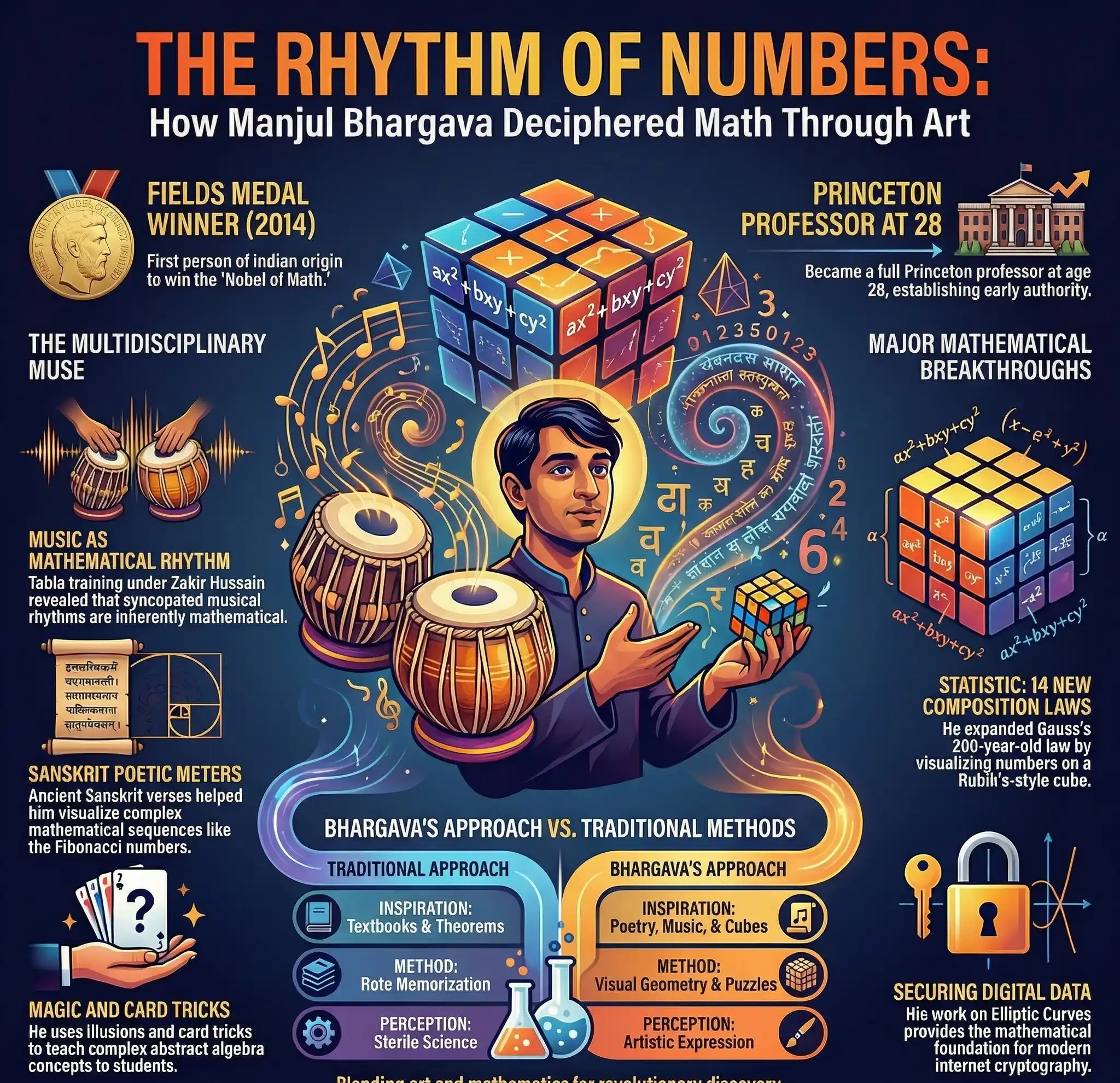
Princeton, 1998: late one night a graduate student picked up a pocket-sized Rubik’s Cube, numbered its corners, and found a shortcut through the highlight of a 200-year-old masterpiece
In 1801, a twenty-four-year-old German named Carl Friedrich Gauss published a book in Latin called Disquisitiones Arithmeticae. It is still one of the great classics of number theory, the mathematics of whole numbers. One of its highlights was a law for combining certain algebraic expressions, called binary quadratic forms, to make a third. Gauss needed about twenty pages of calculation to set it out.
For nearly two hundred years, mathematicians admired it and struggled through it. It was one law, and it stood alone.
In the late 1990s a graduate student at Princeton was one of the people struggling through those twenty pages. His name was Manjul Bhargava. He was sure there had to be a better way.
Gauss needed twenty pages. The student was sure there had to be a better way.
The toy
Bhargava’s room at the Graduate College was full of mathematical toys. He had been that way since he was a small boy on Long Island, when his mother, a mathematician, gave him sums to do in his head to calm him down, and he worked out how many oranges were in the pyramids stacked in the kitchen.
One of the toys was a Pocket Cube: a small Rubik’s Cube made of just eight pieces, all of them corners, two by two by two.
Late one night he picked it up and wondered whether its shape could tell him anything about Gauss’s law. He put a number on each of the eight corners.
Then he thought about cutting the cube in half. Cut it front to back, and you get two faces of four numbers each. Each set of four numbers can be read as a small square grid, and a simple calculation with the two grids gives a binary quadratic form: exactly the kind of object in Gauss’s law.
But there are three ways to cut a cube in half: front and back, left and right, top and bottom. So the eight numbers on one small cube gave him three forms. And when he checked how the three were related, they fitted Gauss’s law exactly. Composed together, the three cancelled each other out.
Eight numbers on a toy, three ways to cut it, and Gauss’s twenty pages fell into place.

Venkatraman Ramakrishnan: (1952- Present)
Just playing
He had not set out to do this. “I don’t know what problem I’m trying to solve; I’m just playing around,” he said years later. The problem, he said, only shows itself afterwards.
And the cube was only the beginning. Gauss had found one composition law. Working outward from the cube, with other shapes and other arrangements of numbers, Bhargava found twelve more that nobody had ever seen, laws for higher kinds of forms that had been waiting to be discovered for two centuries. They became his doctoral thesis, Higher Composition Laws, written under Andrew Wiles, the man who had proved Fermat’s Last Theorem.
Brahmagupta
There was one more thing in the cube that very few people could have seen.
Gauss’s law had an ancestor. More than a thousand years before Gauss, in 628 CE, the Indian mathematician Brahmagupta had written down a rule of the same family: multiply two numbers of a certain shape together, and the answer has the same shape again. Brahmagupta wrote in Sanskrit, and few mathematicians read him in the original.
Bhargava had. His maternal grandfather, Purushottam Lal Bhargava, was a scholar of Sanskrit in Jaipur. When the boy visited, the two of them took long walks in the early morning and talked about India, and poetry, and even a little mathematics. Bhargava first came to know Brahmagupta as a child, he has said, because most of his writings are in Sanskrit.
So when the cube gave up its three forms, he could see the line running through them: from a Sanskrit text of 628, through Gauss’s Latin of 1801, to eight numbers on a toy in a student’s room in New Jersey.
Har Gobind Khorana: (1922- 2011)
The cube
In 2014 Manjul Bhargava was awarded the Fields Medal, the highest honour in mathematics. The citation was for new methods in the geometry of numbers. The work began, in a real sense, with a night he had nothing in particular to solve, and a small cube with eight corners.
The year he won it, the shelves of his office in Fine Hall still held Rubik’s Cubes.
Daulat Singh Kothari : (1906–1993)
If you think you have remembered everything about this topic take this QUIZ
Results


#1. In what year did Manjul Bhargava win the prestigious Fields Medal?
#2. Who was Manjul Bhargava’s doctoral advisor during his Ph.D. at Princeton University?
#3. Which classical Indian musical instrument did Bhargava study under Ustad Zakir Hussain?
#4. Bhargava achieved global fame by generalizing a 200-year-old law originally created by which mathematician?
#5. According to the article, what common object helped Bhargava visualize a way to simplify complex math and discover new composition laws?
#6. At what age was Manjul Bhargava offered a full tenured professorship at Princeton University?
#7. Bhargava’s breakthrough provided crucial new tools for understanding Elliptic Curves. What modern technology relies heavily on the math behind Elliptic Curves?
#8. Which famous mathematical sequence does Bhargava point out was actually described centuries earlier by ancient Indian scholars like Pingala?
What did Manjul Bhargava win the Fields Medal for?
He won the 2014 Fields Medal for developing powerful new methods in the geometry of numbers, which allowed him to generalize Gauss’s composition laws and bound the average rank of elliptic curves.
What are “Bhargava Cubes”?
It is a visual, geometric framework invented by Bhargava (inspired by a Rubik’s cube) that drastically simplified a 200-year-old mathematical law by Carl Friedrich Gauss and revealed 14 new mathematical composition laws.
Is Manjul Bhargava Indian?
He was born in Canada and raised in the United States, making him a Canadian-American. However, he is of Indian descent and maintains deep cultural and academic ties to India.
How does music relate to his mathematics?
An accomplished tabla player, Bhargava uses the rhythmic, syncopated patterns of Indian classical music to visualize and solve complex algebraic sequences in his mind.
What was his role in India’s education system?
He was an active member of the drafting committee for India’s National Education Policy (NEP) 2020, strongly advocating for a multidisciplinary approach to learning that discourages rote memorization.
Sources & References
Princeton Alumni Weekly, Merrell Noden, “At Play in the Fields of Math” (November 2014) — the Pocket Cube in his Graduate College room, his childhood, his grandfather, Brahmagupta and the thirteen composition laws.
International Mathematical Union, “The Work of Manjul Bhargava” (Fields Medal release, 2014) — how slicing the cube produces the binary quadratic forms.
Slate / New Scientist, “Manjul Bhargava Fields medal: A Rubik’s cube inspired Gauss law of composition extension” (17 August 2014) — his own account of the Rubik’s cube link.
Manjul Bhargava, “Higher Composition Laws I: A New View on Gauss Composition and Quadratic Generalizations”, Annals of Mathematics 159 (2004) — the published work.
Author


Exploring the Soul of Bharat through History, Science, Culture, and its Diversity
Our Mission
Curious Indian is a definitive knowledge portal dedicated to chronicling the events, personalities, and cultural shifts that defined the Indian subcontinent. From the ancient Vedic Period to the complexities of 21st-century politics, our goal is to provide deep-dive analysis that inspires.
Editorial Standards & E-E-A-T
Every article published under our brand undergoes a rigorous fact-checking process. We prioritize primary historical records, academic citations, and credible archives to ensure our readers receive accurate, high-authority information.
Historical Integrity Directly sourcing from ASI archives and academic journals.Topical Authority Comprehensive clustering of Indian Science, Biographies, and Wars.Managed by Paripurna Datta and TEAM | Dedicated to the Knowledge of India.