R.D. Burman built the sound of modern Indian film music out of bottles, combs, keys and a percussionist’s back
The tinkling that opens Chura Liya Hai Tumne is a spoon hitting a glass.
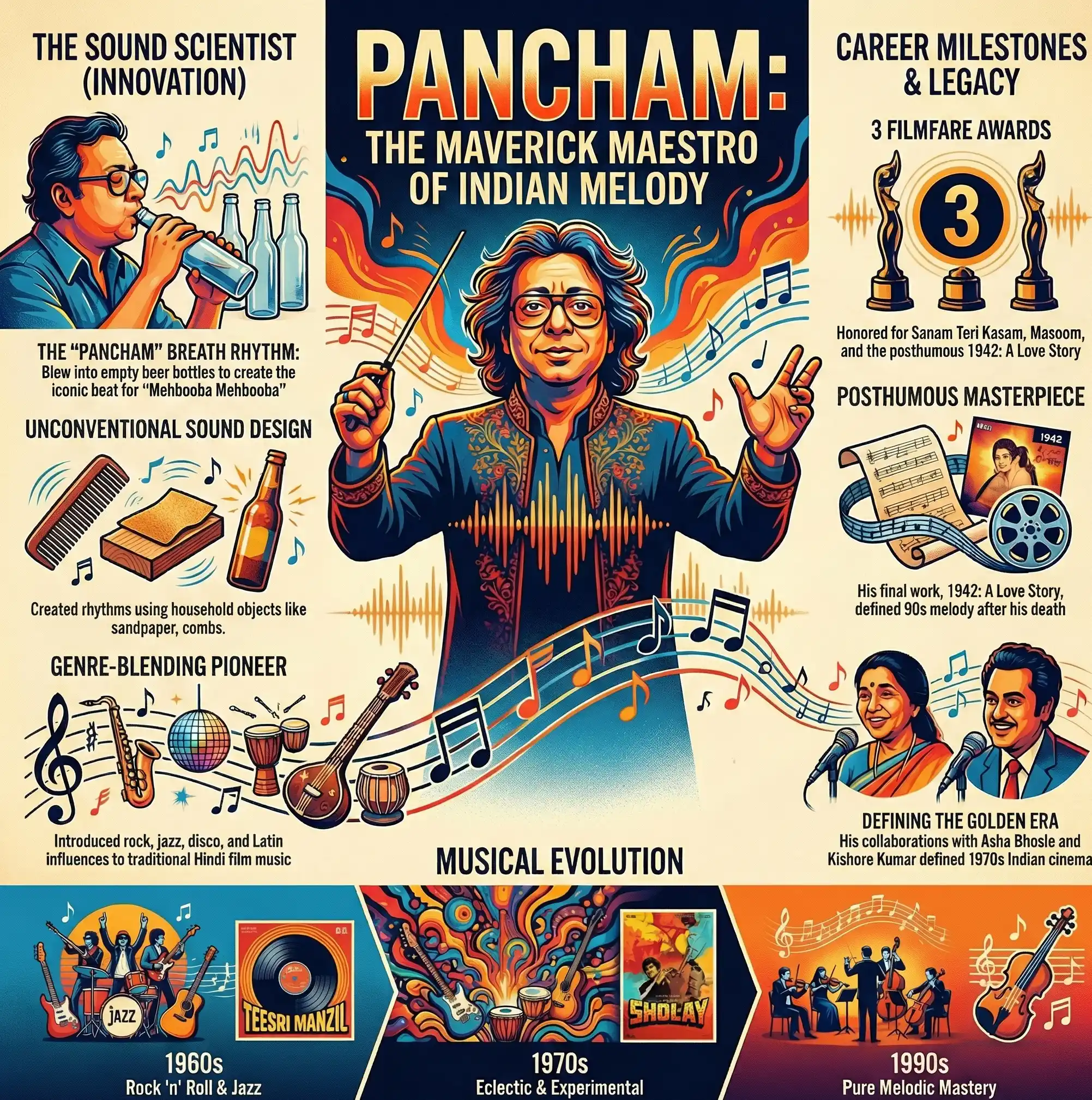
Not an instrument imitating a spoon hitting a glass. A recording of the actual thing, made in a studio in Bombay in 1973 and dropped into the top of a love song, where it has stayed ever since. The opening of Mehbooba Mehbooba, two years later, is R.D. Burman and his men blowing across the necks of beer bottles.
He was not decorating the songs. He was building the rhythm section out of whatever happened to be in the room, and doing it years before anybody in India had a word for that.
The training underneath
The junk only works because the man deploying it knew exactly what he was doing.
He learned sarod from Ali Akbar Khan and tabla from Samta Prasad, and counted Salil Chowdhury as a teacher. He was the only child of S.D. Burman, which meant the household was a working music studio. He wrote a tune as a boy that his father put into Pyaasa, and another at seventeen that went into Funtoosh, both credited to the older man.
This matters because the experiments are often described as playfulness. They are not. They are a trained musician deciding that the list of permitted instruments was too short.
The Logical Revolution of Nagarjuna Sunyata
The catalogue of objects
Once you start listening for it, it is everywhere in his work.
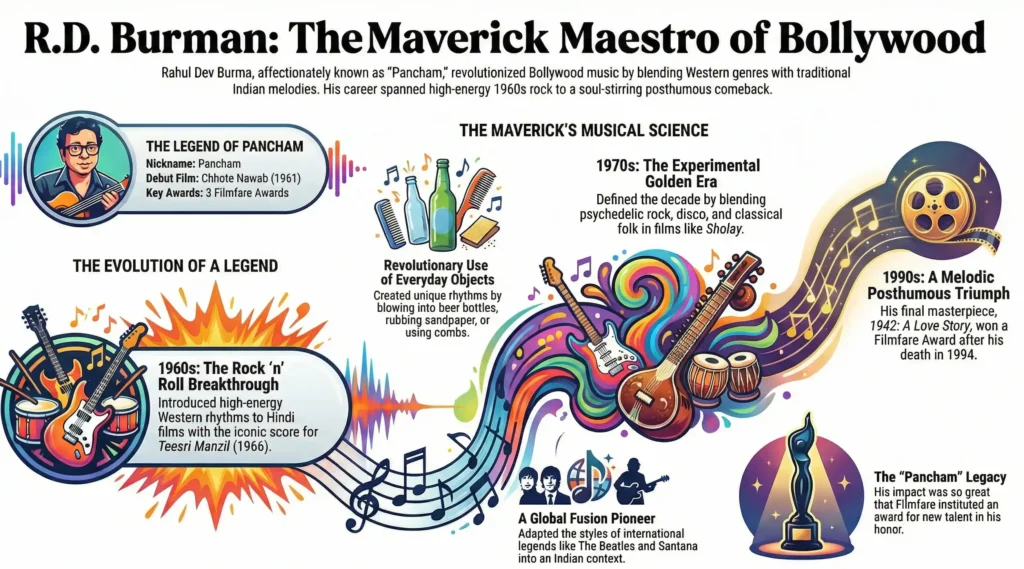
Soda bottles filled to different levels and blown across, for Khusboo. A scraping comb standing in for a guiro on Mere Saamne Wali Khidki Mein. Sandpaper rubbed and bamboo sticks knocked together to make a train. A bunch of keys used for the rhythm that Rekha mimes on screen with the jewellery at her waist. A singer asked to gargle, and the gargle kept in.
He did the same with atmosphere. Pedestal fans were used to get an echo on one song, and sheets of asbestos were shaken to make thunder on another. The studio itself was part of the instrument list.
On one track the percussion is Burman playing a beat on the bare back of Amrutrao Katkar, one of his own musicians. On another the rhythm is his own breathing. He would take the sound from anywhere and he did not care what it was supposed to be.
Why it still sounds new
The usual line is that he Westernised Hindi film music, and it is not quite right.
He certainly borrowed from rock and jazz and Latin percussion, and he was open about it. But the deeper thing he did was to widen the definition of an instrument, which is a different move altogether. He was doing foley and something close to sampling before either was an idea anyone in the industry would have recognised.
That is why records he made in 1973 do not sound like period pieces. The texture was never tied to a fashion, because it was not taken from one.
The late eighties
The industry decided he was finished, and told him so in the way industries do.
His films stopped working. Producers went to younger composers making cheaper, faster dance music, much of it assembled out of ideas he had introduced. He had a heart attack in 1988 and surgery after it, and by the early nineties he was getting very little work.
It was not that the work had stopped being good. Sagar in 1985 and Ijaazat in 1987 are both among his best scores, and Ijaazat won Asha Bhosle a National Award. They simply arrived while the market was looking elsewhere.
He was in his early fifties, and he had spent about twenty-five years as the most inventive man in the business.
15 July 1994
He died of cardiac arrest on 4 January 1994, at fifty-four.
Six months later Vidhu Vinod Chopra released 1942: A Love Story, the last thing he scored. The film itself did not do well at the box office, which is the part usually left out. The songs did, enormously, and at the Filmfare ceremony in February 1995 it took nine awards including Best Music Director.
He was not there to collect it. Filmfare now gives an award in his name to new composers, which is either a fine tribute or a slightly awkward one, given how the last few years of his working life actually went.
The Pingala Binary System and Ancient Math
If you think you have remembered everything about this topic take this QUIZ
Results


#1. What was R.D. Burman’s popular nickname?
#2. R.D. Burman’s debut film as an independent music director was:
#3. Which 1966 film established R.D. Burman’s signature rock ‘n’ roll style with hits like “O Haseena Zulfon Wali”?
#4. R.D. Burman won a posthumous Filmfare Award for which film’s music, released after his death in 1994?
#5. Who was R.D. Burman’s father, a legendary composer in his own right?
#6. For the song “Mehbooba Mehbooba” in Sholay, what unique method did R.D. Burman use to create the rhythm?
#7. R.D. Burman received formal training in which instrument from maestro Ali Akbar Khan?
#8. The Filmfare “R.D. Burman Award” instituted in 1995 is given to honor:
Mastering Political Power Through the Lens of Chanakya Neeti
Why was R.D. Burman called Pancham?
It is said he was nicknamed Pancham because as a child, his cry sounded like the fifth note (Pa) of the Indian musical scale.
Who was R.D. Burman’s wife?
He was married to the legendary playback singer Asha Bhosle from 1980 until his death in 1994.
What was R.D. Burman’s last famous album?
His last major success was the soundtrack for 1942: A Love Story, which was released after his death.
Did R.D. Burman win any National Awards?
While he won three Filmfare Awards, he did not win a National Film Award during his lifetime.
What was R.D. Burman’s first film as an independent music director?
His debut as an independent music director was for the film Chhote Nawab in 1961.
Sources & References
Anirudha Bhattacharjee and Balaji Vittal, R.D. Burman: The Man, The Music (2011) — the standard account of his studio methods and career.
Chaitanya Padukone, R.D. Burmania: Panchamemoirs (2016) — first-hand recollections of the recording sessions and the sound experiments.
Encyclopaedia Britannica (“S.D. Burman”) — the family, and the father’s career that surrounded his childhood.
Filmfare, 40th Filmfare Awards, February 1995 — the nine awards for 1942: A Love Story, including the posthumous Best Music Director.
Author


Exploring the Soul of Bharat through History, Science, Culture, and its Diversity
Our Mission
Curious Indian is a definitive knowledge portal dedicated to chronicling the events, personalities, and cultural shifts that defined the Indian subcontinent. From the ancient Vedic Period to the complexities of 21st-century politics, our goal is to provide deep-dive analysis that inspires.
Editorial Standards & E-E-A-T
Every article published under our brand undergoes a rigorous fact-checking process. We prioritize primary historical records, academic citations, and credible archives to ensure our readers receive accurate, high-authority information.
Historical Integrity Directly sourcing from ASI archives and academic journals.Topical Authority Comprehensive clustering of Indian Science, Biographies, and Wars.Managed by Paripurna Datta and TEAM | Dedicated to the Knowledge of India.