He set out the whole of Sanskrit in about four thousand instructions, and scholars argued over one of them for twenty-five centuries
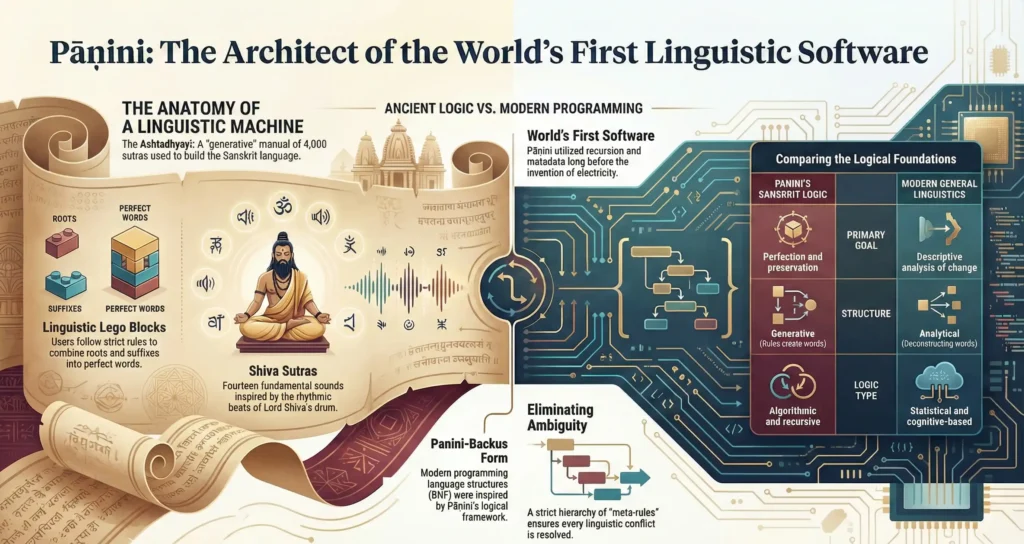
The Ashtadhyayi does not describe Sanskrit. It generates it.
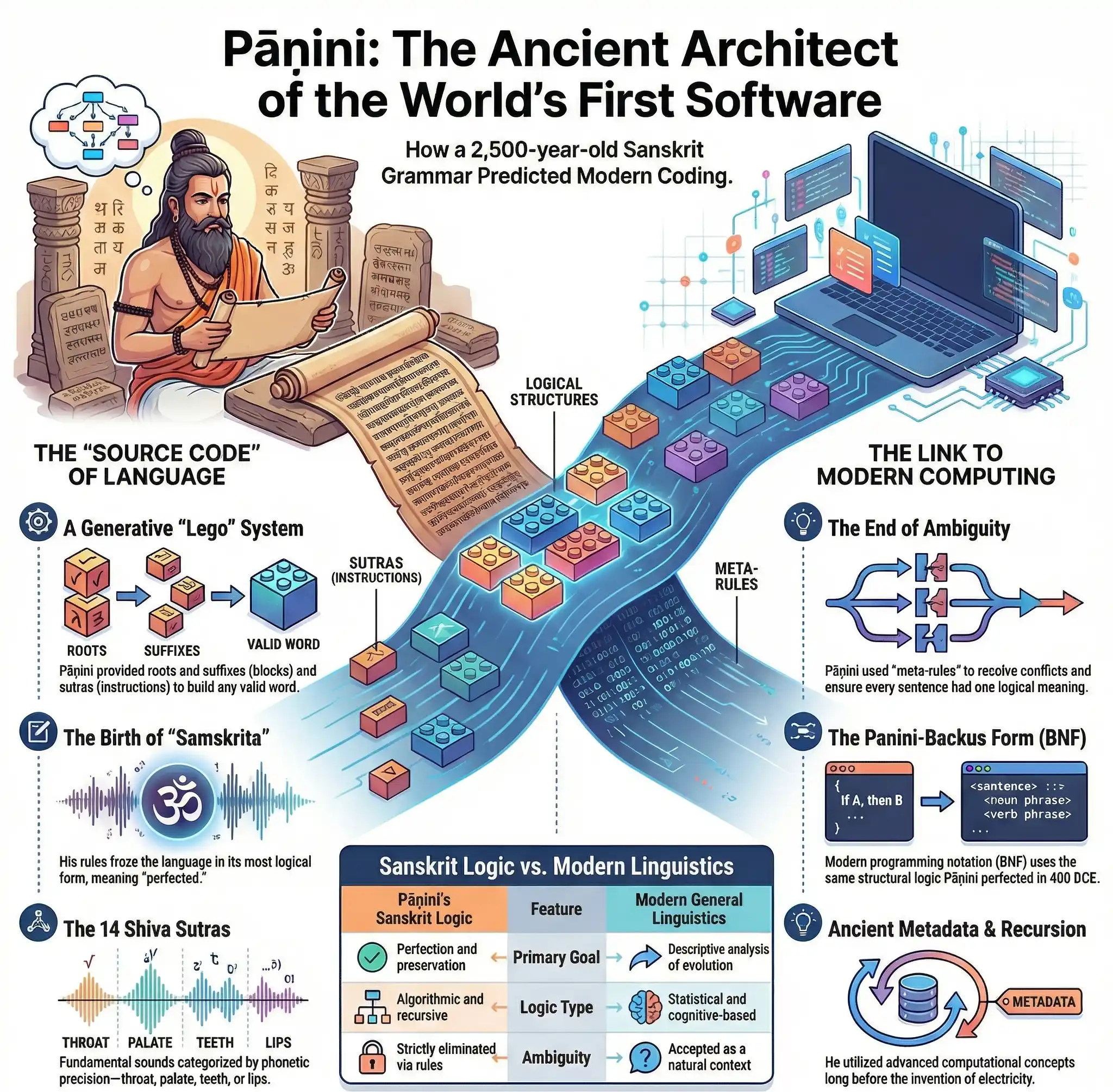
You feed in a root and what you want to do with it, and roughly four thousand short rules, arranged in eight chapters, turn it into the correct word. There is no dictionary of forms, because forms are not stored. They are produced, every time, by running the rules.
Anyone who has written software will recognise what that is. Anyone who has written software will also know what happens next.
When two rules fire at once
Sometimes two rules apply to the same word at the same moment, and they give different answers. A system of this kind needs a rule about rules, and Panini wrote exactly one: sutra 1.4.2, vipratishedhe param karyam.
For two and a half thousand years that was read as meaning that when two rules of equal strength conflict, the one appearing later in the book wins. Read that way, the machine sometimes produces words that are simply wrong.
So the tradition patched it. Commentators from Katyayana and Patanjali onward, and every school after them, added extra principles and exceptions to force the correct output. The patches worked, mostly, and nobody was happy with them.
A device built for economy had acquired two thousand years of workarounds sitting on top of a single ambiguous instruction.
8 Defining Chapters in the Vikram Sarabhai Biography
December 2022
Rishi Rajpopat, a doctoral student at St John’s College, Cambridge, submitted a thesis arguing that the traditional reading of 1.4.2 was simply the wrong reading.
Param, he argued, does not mean the rule later in the text. It means the rule applying to the right-hand side of the word. Take the conflicting rules, apply the one that operates on the right, and the correct form falls out with no additional machinery at all.
His supervisor had given him one piece of advice six months earlier: if the solution is complicated, you are probably wrong. Rajpopat spent nine months getting nowhere, shut the books for a month, and came back to it.
The thesis appeared on 15 December 2022 and Harvard University Press published his book on it in 2025. Senior Sanskritists have called the solution revolutionary. It is worth saying that not every specialist treats a question this old as closed, and the discussion is still going on.
A graduate student read one word differently and two thousand years of scaffolding came off the building.
The man
Almost nothing is known about him. He came from Shalatula, near the Indus in Gandhara, in what is now northern Pakistan, probably around the fifth century BC.
He names earlier grammarians in his own text, which means he was not beginning the subject but finishing it. Whatever tradition stood behind him did not survive except through him, because after the Ashtadhyayi nobody needed the earlier books.
6 Unfoldings in the Subrahmanyan Chandrasekhar Biography
How it is built
The first thing in the work is a list of fourteen short lines containing the sounds of Sanskrit. They are not in alphabetical order, or in the order of the mouth. They are arranged so that every group of sounds the grammar will ever need to refer to appears as one unbroken run.
That lets any such group be named by its first sound plus a marker, in two syllables instead of a list. It is a data structure, designed to make the rules that follow as short as possible.
The rest works the same way. Rules inherit terms from earlier rules so nothing is stated twice. Metarules govern how the other rules are read. The tradition’s own joke was that a grammarian rejoices at saving half a short vowel as much as at the birth of a son.
All of it was composed to be memorised and recited, in a period when the text was not being written down at all.
Why linguists care
Leonard Bloomfield called it one of the greatest monuments of human intelligence. The idea of a grammar as a finite set of rules that generates an infinite set of correct sentences is the foundation of modern linguistics, and Panini got there first by about twenty-four centuries.
Computer scientists noticed the resemblance to the notation used to define programming languages. The immediate practical consequence of the 2022 reading is that the Ashtadhyayi can now be implemented properly as a program, which is a strange sentence to write about a book from the fifth century BC.
He wrote a machine, in a language with no writing, and it has been running ever since.
7 Secrets of Padmanabhaswamy Temple Treasure
If you think you have remembered everything about this topic take this QUIZ
Results


#1. What is the name of Pāṇini’s monumental work on Sanskrit grammar?
#2. Pāṇini is often compared to modern computer scientists because his grammar functions like a:
#3. According to legend, what inspired Pāṇini to discover the 14 fundamental sounds of Sanskrit?
#4. The Ashtadhyayi is comprised of approximately how many sutras (aphorisms)?
#5. Why is Pāṇini’s grammar described as “generative”?
#6. Which modern computer science concept is strikingly similar to the logic used by Pāṇini?
#7. Pāṇini classified Sanskrit sounds based on:
#8. The Backus-Naur Form (BNF) used in computer programming languages is often historically referred to as:
How did Panini’s work influence computers?
His use of formal rules to define language structure is the exact same logic used to create programming languages like Fortran, Java, and Python.
Where was Panini born?
He was born in Shalatula, which was part of the ancient Gandhara kingdom, located near the modern-day town of Lahor in Pakistan.
Is the Ashtadhyayi still used today?
Yes, it remains the standard for anyone studying traditional Sanskrit and is a major subject of study in both linguistics and computer science departments worldwide.
Why is Panini called the Father of Linguistics?
He was the first person in recorded history to create a complete, scientific, and descriptive analysis of a language’s grammar and phonetics.
Read More: https://curiousindian.in/charaka-4th-century-bce/
Sources & References
University of Cambridge (“Solving grammar’s greatest puzzle”, December 2022) — Rajpopat’s reinterpretation of rule 1.4.2 and the reaction of Sanskrit scholars.
R.A. Rajpopat, In Panini We Trust: Discovering the Algorithm for Rule Conflict Resolution in the Astadhyayi (PhD thesis, University of Cambridge, 2022) — the argument itself.
Encyclopaedia Britannica (“Panini”) — his date, his origin at Shalatula in Gandhara and the structure of the Ashtadhyayi.
George Cardona, Panini: A Survey of Research — the scholarly tradition of commentary and the earlier attempts to resolve rule conflict.
Author


Exploring the Soul of Bharat through History, Science, Culture, and its Diversity
Our Mission
Curious Indian is a definitive knowledge portal dedicated to chronicling the events, personalities, and cultural shifts that defined the Indian subcontinent. From the ancient Vedic Period to the complexities of 21st-century politics, our goal is to provide deep-dive analysis that inspires.
Editorial Standards & E-E-A-T
Every article published under our brand undergoes a rigorous fact-checking process. We prioritize primary historical records, academic citations, and credible archives to ensure our readers receive accurate, high-authority information.
Historical Integrity Directly sourcing from ASI archives and academic journals.Topical Authority Comprehensive clustering of Indian Science, Biographies, and Wars.Managed by Paripurna Datta and TEAM | Dedicated to the Knowledge of India.