He took other people’s arguments apart while insisting he was asserting nothing of his own
His opponents thought they had him. You say all things are empty, they said. Is that statement empty? If it is, it carries no weight and refutes nothing. If it is not, then at least one thing is not empty and your position collapses on its own terms.
His answer was that he had no position. If I had a thesis, he wrote, the fault would land on me; since I have none, there is nothing to land on.
It is either the most elegant move in Indian philosophy or a way of never being pinned down, and people have been arguing about which for eighteen hundred years.
What emptiness is not
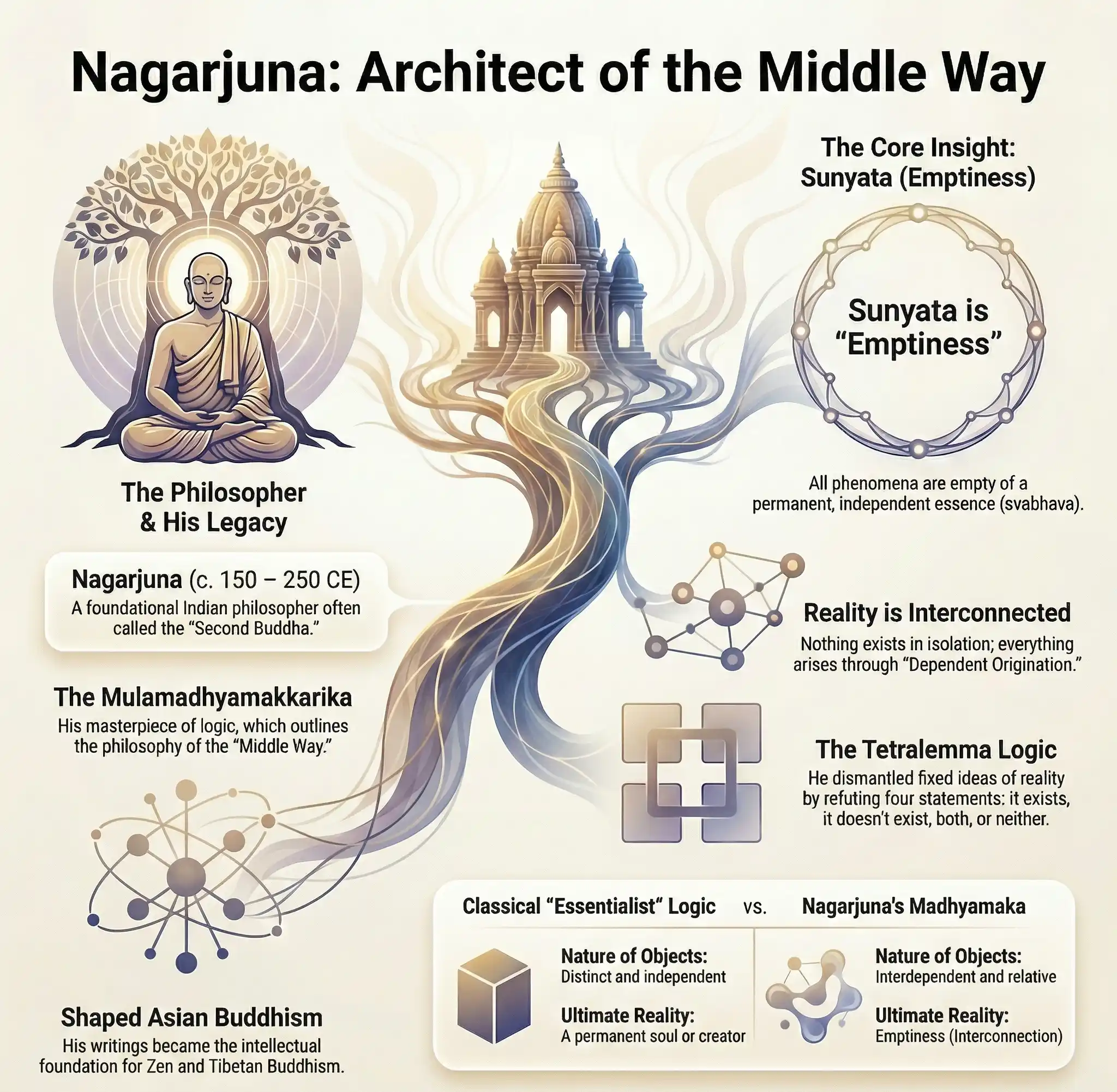
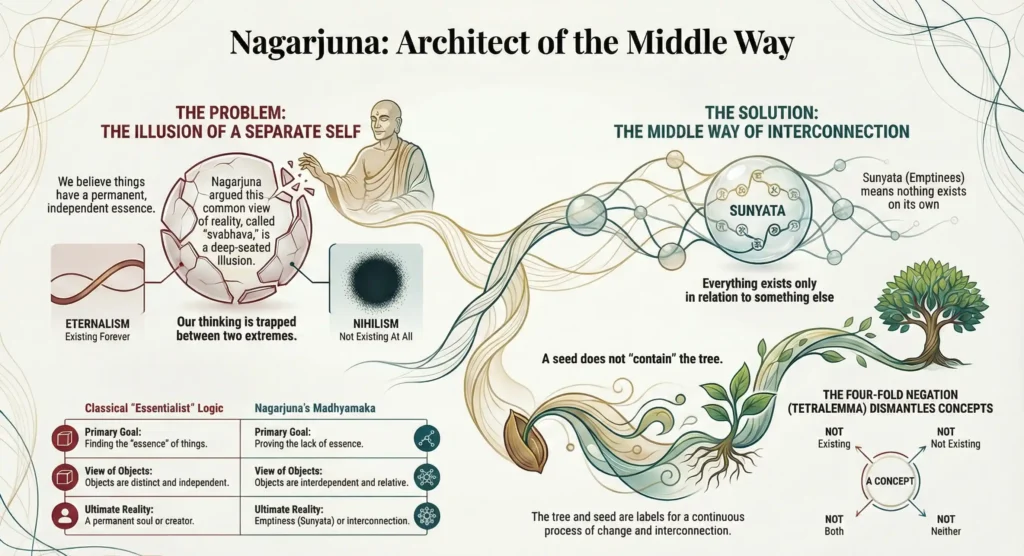
Shunyata is usually translated as emptiness, and the translation causes trouble immediately, because it sounds like a claim that nothing exists. Nagarjuna is not saying that, and he spends a good deal of the Mulamadhyamakakarika saying he is not.
The claim is about a particular way of existing. Svabhava means own-being: having your nature from yourself, independently, not borrowed from anything else. A fire depends on fuel. A chariot depends on its parts and on somebody’s use of it. A person depends on a body, a history, a name, a set of conditions none of which is the person.
Take the dependencies away and you are not left with the thing in a pure state. You are not left with anything. That is what he means by empty: not non-existent, but not standing on its own.
8 Defining Chapters in the Vikram Sarabhai Biography
Four corners
His instrument is the catuskoti, the four-cornered negation. For any proposition there are four options: it is true, it is false, it is both, it is neither. He rejects all four.
A reader trained on two-valued logic looks for the fifth option and there is not one. That is the point of the exercise. The four corners are not a menu he is choosing from; they are the shape of the net, and the argument is designed so that nothing is caught in it.
The book
The Mulamadhyamakakarika opens with eight denials: no arising and no ceasing, no permanence and no annihilation, no coming and no going, no difference and no identity.
Twenty-seven chapters then apply that treatment to the things philosophy is built out of. Causation. Motion, in a chapter that takes apart the idea of a moving thing in a way that would be recognised by anyone who has read Zeno. Time. The senses. The self. Suffering. The Buddha himself.
In the twenty-fifth chapter he turns it on the goal of the whole enterprise, and concludes that between nirvana and the ordinary cycling world there is not the slightest difference to be found. He is not being provocative. It follows from everything before it.
He dismantles his own tradition’s furniture with the same tool he used on everyone else’s, and does not exempt the destination.
6 Unfoldings in the Subrahmanyan Chandrasekhar Biography
Emptiness is empty too
The move that saves the system from becoming what it attacks is that emptiness is itself empty. It is not a hidden substance underneath appearances, not an absolute, not the real behind the unreal. It is the absence of independent existence, and that absence does not independently exist either.
Alongside it runs the doctrine of two truths. At the conventional level things function perfectly well: fire burns, debts fall due, the bus fare must be paid. At the level of ultimate analysis nothing is found standing on its own. Neither truth cancels the other, and confusing the two is the error he spends most of his time correcting.
The man and the other men
He probably lived in the second century, in southern India, with some connection to the Satavahana court; one of his surviving works is a letter of advice in verse to a king. The site at Nagarjunakonda in Andhra Pradesh carries his name.
Beyond that, care is needed. Later tradition runs together at least three people called Nagarjuna: this philosopher, an alchemist of the rasashastra tradition who belongs several centuries later, and a physician credited with editing the Sushruta Samhita. Popular accounts often hand all of it to one man, who then appears as a chemist, a doctor and a metaphysician at once. He was one of those things.
There is also the story that he recovered the Perfection of Wisdom texts from the nagas at the bottom of the sea, which is how the name is usually explained and which is hagiography rather than biography.
7 Untold Stories of Battle of Asal Uttar 1965 Victory
What it became
Madhyamaka became the philosophical spine of Mahayana Buddhism. It went to Tibet, where he is treated as second only to the Buddha, and to China and Japan, where it fed into Chan and Zen.
In the twentieth century Western philosophers found him, and he has been read next to Wittgenstein, next to scepticism, and next to the paradoxes of self-reference in the foundations of logic, with the same argument recurring each time: can a person really make no claim while writing four hundred and fifty verses about it?
The objection was raised in his own lifetime. He answered it, and nobody has agreed since on whether the answer works.
7 Secrets of Padmanabhaswamy Temple Treasure
If you think you have remembered everything about this topic take this QUIZ
Results


#1. What is the central meaning of Nagarjuna’s doctrine of ‘Sunyata’ (Emptiness)?
#2. The ‘Catuskoti’ or the four-fold negation is a logical tool used by Nagarjuna. What was its primary purpose?
#3. Nagarjuna’s most famous masterpiece is titled ‘Mulamadhyamakakarika’. What does this title translate to?
#4. In Indian tradition, Nagarjuna is also celebrated as a ‘Rasasiddha’. What does this imply about his other skills?
#5. What is the ‘Naga King Legend’ associated with Nagarjuna’s discovery of wisdom?
#6. According to the ‘Quick Comparison’ table, how does Nagarjuna’s view of objects differ from classical logic?
#7. Modern quantum physicists have found inspiration in Nagarjuna’s logic because he predicted a world where:
#8. Nagarjuna served as a high-ranking monk at which world-famous ancient Indian university?
Does “Emptiness” mean that nothing exists?
No. Nagarjuna argues that things exist, but they don’t exist independently. They are “empty” of a separate self, much like a wave is not separate from the ocean.
Why is he called the “Second Buddha”?
Because he systematized the Buddha’s most profound teachings on wisdom and provided the logical proof that allowed Mahayana Buddhism to spread across the world.
What is the Middle Way?
It is the philosophical position that avoids the extremes of “everything exists permanently” and “nothing exists at all,” finding truth in the interdependent nature of reality.
How did he influence modern physics?
Many physicists, including those studying quantum entanglement, find parallels between Nagarjuna’s “Dependent Origination” and the way subatomic particles interact.
What is his most important book?
The Mulamadhyamakakarika (Fundamental Verses on the Middle Way) is his most influential work, consisting of 27 chapters of dense, logical verse.
Read More: https://curiousindian.in/baudhayana-8th-to-7th-century-bce/
Sources & References
Stanford Encyclopedia of Philosophy (“Nagarjuna”) — his dates, the structure of Madhyamaka, and the scholarly problem of the several figures bearing the name.
Nagarjuna, Mulamadhyamakakarika, translated by Jay L. Garfield as The Fundamental Wisdom of the Middle Way (Oxford University Press, 1995) — the eight negations and the chapters on motion and on nirvana.
Nagarjuna, Vigrahavyavartani, translated by Jan Westerhoff as The Dispeller of Disputes (Oxford University Press, 2010) — the objection about self-refutation and his reply that he holds no thesis.
Encyclopaedia Britannica (“Nagarjuna”) — his association with the Satavahana court and his place in the Mahayana tradition.
Author


Exploring the Soul of Bharat through History, Science, Culture, and its Diversity
Our Mission
Curious Indian is a definitive knowledge portal dedicated to chronicling the events, personalities, and cultural shifts that defined the Indian subcontinent. From the ancient Vedic Period to the complexities of 21st-century politics, our goal is to provide deep-dive analysis that inspires.
Editorial Standards & E-E-A-T
Every article published under our brand undergoes a rigorous fact-checking process. We prioritize primary historical records, academic citations, and credible archives to ensure our readers receive accurate, high-authority information.
Historical Integrity Directly sourcing from ASI archives and academic journals.Topical Authority Comprehensive clustering of Indian Science, Biographies, and Wars.Managed by Paripurna Datta and TEAM | Dedicated to the Knowledge of India.