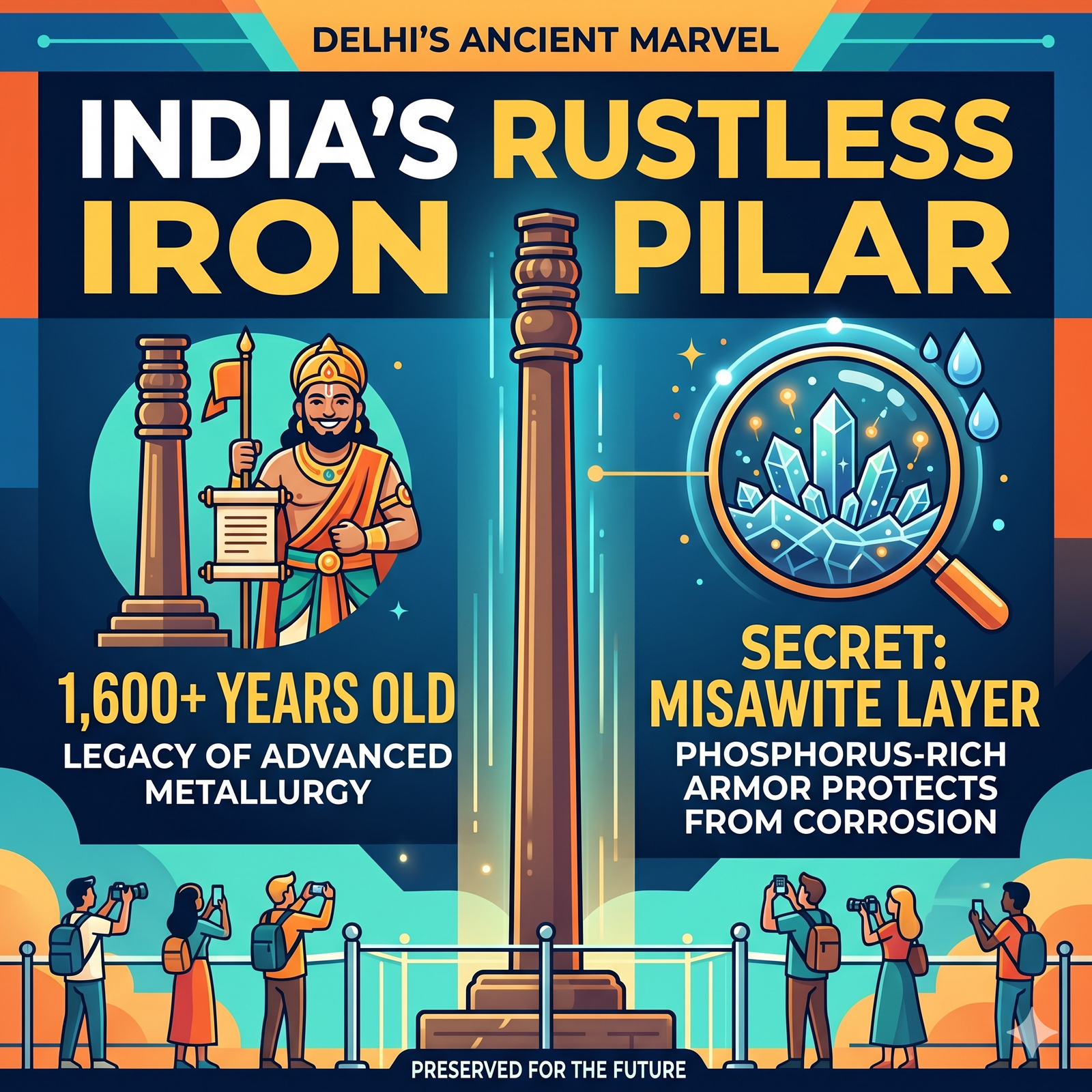
Standing quietly in the middle of the famous Qutub Minar complex in New Delhi is a true scientific marvel that has completely frustrated modern chemists and materials scientists. It is a massive twenty-two-foot-tall solid iron pillar that has been exposed to the harsh sun, heavy monsoon rains, and massive pollution of the city for over sixteen hundred years. Yet, it absolutely refuses to rust. Built during the golden age of the Gupta Empire, this ancient monument is living proof that ancient Indian blacksmiths possessed a level of advanced metallurgical knowledge that the rest of the world would not discover for centuries. By understanding the secret chemical layer protecting this pillar, we uncover the absolute genius of ancient Indian engineering.| Feature | Details |
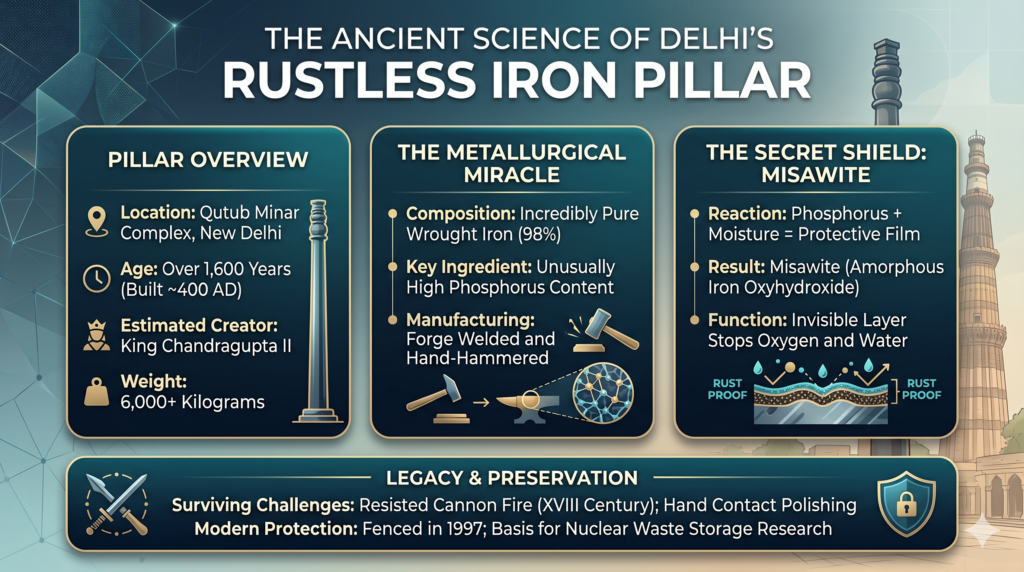
| Location | Qutub Minar Complex, New Delhi |
| Estimated Age | Over 1,600 years (approx. 400 AD) |
| Alleged Creator | King Chandragupta II (Gupta Empire) |
| Total Weight | Over six thousand kilograms |
| Scientific Secret | A protective passive layer of “Misawite” |
When tourists visit the capital city of India, they are usually drawn to the towering red sandstone beauty of the Qutub Minar. But if you walk just a few steps into the courtyard of the Quwwat-ul-Islam mosque, you will find something much older and infinitely more mysterious. It is a completely unpainted, dark metal column jutting straight out of the stone floor. At first glance, it looks like a simple iron pole. But to structural engineers and global historians, Delhi’s rustless iron pillar is one of the most magnificent artifacts on the entire planet.
If you leave a modern iron bicycle out in the rain, it will start to turn orange and flake away with rust in a matter of weeks. So how has a massive iron pillar completely survived extreme weather, invading armies, and modern acidic pollution for sixteen entire centuries? The answer lies in a beautiful blend of ancient history, royal ambition, and brilliant microscopic chemistry.
Devika Rani Biography: The Architect of Bollywood’s Golden Era
The King Behind the Pillar
Before we look at the science, we must look at the history carved directly into the metal. Halfway up the dark pillar, there is a beautifully preserved inscription written in the ancient Brahmi script. The poetic Sanskrit verses declare that the pillar was erected as a “Dhwaja” or standard (flagpole) dedicated to Lord Vishnu. It praises a powerful and victorious king named “Chandra.”
Historians from the Archaeological Survey of India universally agree that this king was Chandragupta II, one of the greatest emperors of the Gupta dynasty, often referred to as the Golden Age of India. The pillar was originally erected outside a massive Vishnu temple complex, likely in Udayagiri, Madhya Pradesh. It was later transported hundreds of miles to Delhi, a massive logistical achievement in itself, to serve as a glorious trophy in the courtyard of a new ruling empire.
The Metallurgical Miracle
For decades, European scientists who visited colonial India were absolutely baffled by the pillar. They took small samples of the metal back to their modern laboratories, completely expecting to find that the pillar was made of some rare, exotic alloy or modern stainless steel. They were completely shocked by the results.
The Relentless Pursuit of Excellence by Legendary Filmmaker K. Asif
The pillar is made of incredibly pure wrought iron, about ninety-eight percent pure. However, it contains an unusually high amount of phosphorus. Modern steelmakers usually try to completely remove phosphorus from iron because it can make the metal brittle. But the ancient Indian blacksmiths intentionally left it in, and they processed the massive column using a highly labor-intensive technique called “forge welding.” They heated massive lumps of iron and violently hammered them together by hand, squeezing out the impurities but locking the phosphorus inside.
The Magic Shield of Misawite
The true secret to its survival was finally unlocked by modern experts at the Indian Institute of Technology (IIT) Kanpur. They discovered that the high amount of phosphorus in the ancient iron interacts with the moisture in the air to create a microscopically thin, completely invisible protective film over the entire pillar.
This special chemical layer is known scientifically as “misawite” (an amorphous iron oxyhydroxide). Think of misawite as a magical, invisible coat of armor. Once this incredibly thin layer forms on the outside of the iron, it completely stops the oxygen and water in the air from reaching the raw metal underneath. It stops the rusting process before it can even truly begin. The ancient Indian blacksmiths might not have known the modern periodic table of elements, but their hands-on mastery of heat and local iron ore created a permanent shield against the forces of nature.
Inside the Bhushan Kumar T-Series Success Journey
Surviving Cannons and Human Hands
The weather is not the only thing this massive pillar has survived. History has thrown immense violence at this monument. In the eighteenth century, the invading Persian king Nadir Shah reportedly ordered his troops to fire a heavy cannonball directly at the pillar to break it and find hidden treasure inside. The pillar did not shatter. The cannonball only left a visible dent on the side, proving the incredible structural strength of the forge-welded iron.
For many years, it was a highly popular local tradition for visitors to stand with their backs against the pillar and try to wrap their arms completely backwards around it. The legend said that if your fingers touched, your deepest wishes would come true. However, the continuous touching and rubbing by millions of sweaty human hands were actually starting to polish away the magical misawite layer, causing minor rusting at the base.
Secrets Behind Kamal Haasan’s Cinematic Journey
Protecting the Protector
To save the monument from being loved to death by tourists, the government finally stepped in. In 1997, a decorative iron fence was erected entirely around the base of the pillar to keep human hands away. Today, the pillar stands quietly behind its protective fence, continuing to silently mock the limits of modern industrial engineering.
Institutions like the National Metallurgical Laboratory continue to study its composition, hoping to use the ancient Indian recipe to create completely rust-proof containers for storing highly dangerous nuclear waste in the modern world. It is incredibly humbling to think that the solutions to our future scientific problems might already be written in a 1,600-year-old piece of iron.
Quick Comparison Table
| Feature | Modern Structural Steel | Delhi Rustless Iron Pillar |
| Phosphorus Content | Extremely low (removed purposely) | Unusually high (intentionally retained) |
| Rust Resistance | Very poor without modern chemical paint | Incredible natural resistance |
| Manufacturing | Factory-melted and mass-poured | Hand-hammered and forge-welded |
| Protective Layer | Artificial zinc galvanization or paint | Natural microscopic “misawite” film |
Curious Indian Fast Facts
- The pillar is incredibly heavy, weighing over six thousand kilograms (about the same as three large modern SUVs).
- While it stands twenty-two feet tall above the ground, an additional three feet of the massive pillar is buried deeply underground to keep it perfectly upright.
- The ancient forge-welding technique was so precise that you cannot see a single joint or seam on the entire massive column.
- A very similar, even larger ancient iron pillar exists in Dhar, Madhya Pradesh, but it was unfortunately broken into pieces by invading armies.
- Ancient Indian steel, specifically “Wootz steel,” was so highly prized globally that it was exported to the Middle East to forge the legendary Damascus swords.
Conclusion
Delhi’s rustless iron pillar is much more than an old piece of metal stuck in the ground. It is a towering monument to the absolute brilliance of ancient Indian science. While modern society often believes that advanced technology was only invented in the last hundred years, this silent pillar completely rewrites that arrogant narrative.
Mapping the Global Reach of the D Ramanaidu Movie Legacy
The blacksmiths of the Gupta Empire utilized local resources, extreme patience, and brilliant empirical observation to create a product that modern, billion-dollar steel factories struggle to replicate naturally. When you stand in the shadow of the Qutub Minar and look closely at the dark, smooth surface of the iron, you are looking at the perfect marriage of human art and advanced chemistry. It is a permanent, standing reminder that the ancient soils of India hold scientific secrets that are completely timeless. Know more at Indian Council of Historical Research.
If you think you have remembered everything about this topic take this QUIZ
Results


#1. Where is the ancient rustless iron pillar located?
#2. According to the text, which historical period is known as the “Golden Age of India” during which the pillar was built?
#3. What is the approximate weight of the iron pillar?
#4. Which specific element was intentionally left in the iron by ancient blacksmiths to help prevent rust?
#5. What is the name of the microscopic protective film that forms on the pillar to stop the rusting process?
#6. Why did the government erect a fence around the pillar in 1997?
#7. How did ancient Indian blacksmiths process the metal to create the massive column?
#8. How much of the pillar’s total length is buried underground to keep it upright?
Why doesn’t the Delhi iron pillar rust?
It refuses to rust because its unusually high phosphorus content reacts with the environment to form a microscopic, highly protective chemical layer called “misawite,” which acts as a permanent shield against moisture and oxygen.
Who actually built the iron pillar?
Historical inscriptions on the pillar in the Brahmi script point to King Chandragupta II of the powerful Gupta Empire, making the pillar over 1,600 years old.
Was the pillar originally built in Delhi?
No, it is widely believed that the pillar was originally erected in front of a massive Vishnu temple in Udayagiri, Madhya Pradesh, and was later moved to Delhi by subsequent rulers as a glorious trophy.
Can tourists still touch the pillar today?
No, for many decades tourists could touch and hug the pillar, but a protective fence was installed in 1997 because the constant rubbing from human hands was beginning to damage the protective chemical layer.
What is the pillar actually made of?
It is made of incredibly pure wrought iron (about 98% pure) that was manually heated and hammered together using an ancient technique known as forge welding.