The anatomy of the divine
Explore a Dravidian temple
Tap a numbered pin on the temple — or a name below — to explore each part.
The gateway tower
Gopuram
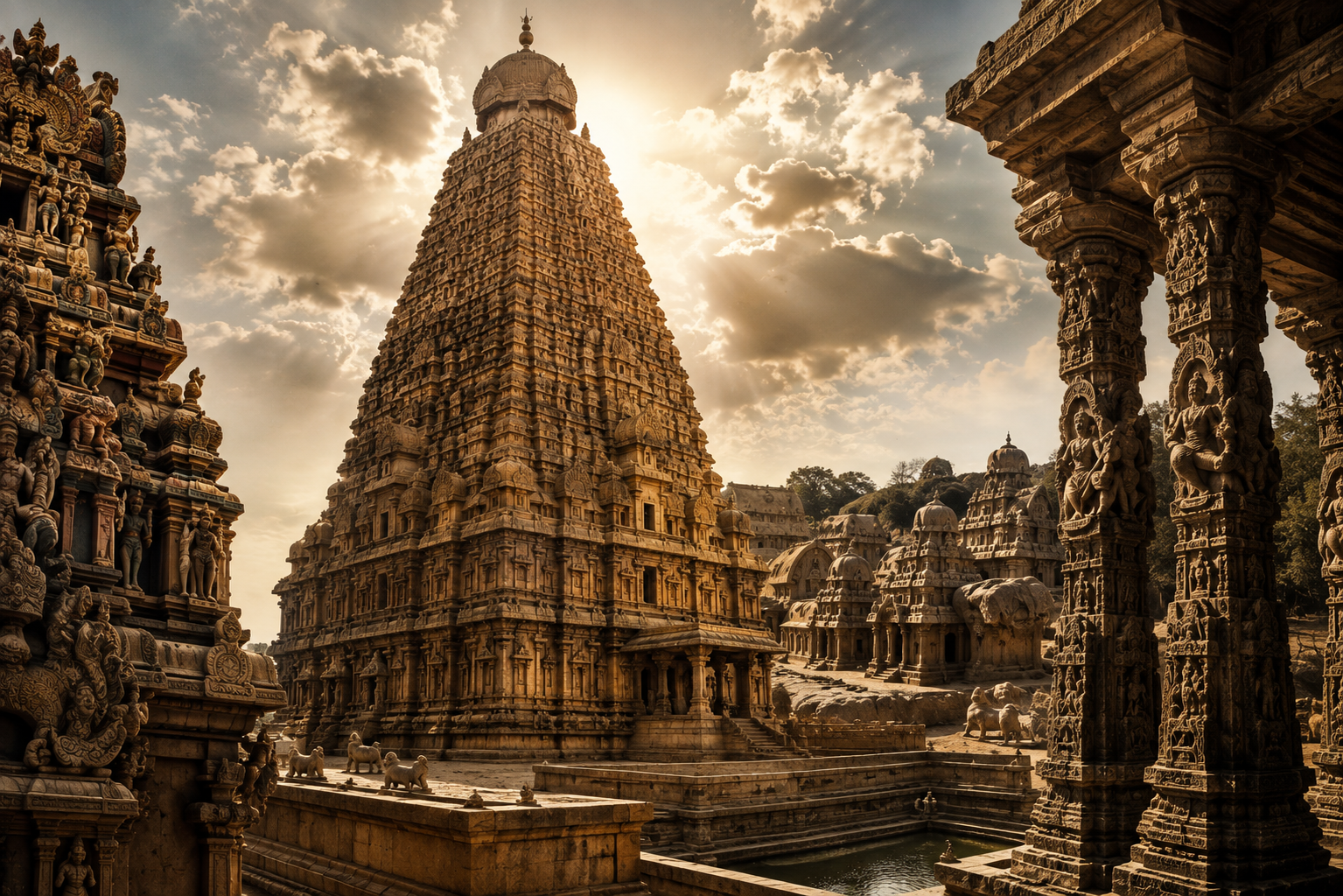
The huge, ornate tower over the temple’s entrance. Covered in thousands of colourful sculptures, it can be seen from miles away and welcomes visitors into the temple city. In the later Pandya and Nayak periods, these gateways grew even taller than the temple itself.
The pillared hall
Mandapa
A hall held up by rows of carved columns — a forest of stone. In the Vijayanagara style its pillars became rearing horses and mythical Yali beasts. Some halls, like at Hampi, even have pillars that ring like musical instruments when tapped.
The inner sanctum
Garbhagriha
Deep inside, in the darkest and most sacred room, sits the garbhagriha — the “womb chamber” that holds the main deity. The whole temple is built around this small, still space, leading the devotee from the busy outside world into the quiet spiritual core.
The sanctum tower
Vimana
The pyramid-shaped tower that rises directly above the sanctum. It stands for Mount Meru, the sacred mountain at the centre of the universe. In the great Chola temples it was the tallest part of all — the Brihadeeswarar Vimana climbs an astonishing 216 feet.
The 80-ton capstone
Kumbam
Crowning the Vimana is the Kumbam, a rounded capstone carved from a single block of granite. At Thanjavur this stone weighs about 80 tons — as much as a passenger plane. How 11th-century builders lifted it 200 feet into the air, without cranes, is one of the temple’s great mysteries.
The sacred tank
Water tank
Every Dravidian temple has a stepped water tank within its walls. It was used for ritual bathing, but it was also clever engineering — the water cooled the air and helped manage the groundwater of the whole area, long before anyone used the word “sustainable”.

5 Timeless Secrets of Rajasthani Miniature Painting and Courtly Life
What “Dravidian” means in stone
Dravidian is simply the name for the temple style of the south, and it looks quite different from the temples of the north.
It began around the 7th century with the Pallava kings, grew grand under the Cholas, and carried on through the Pandyas, the Vijayanagara emperors and the Nayaks. Each dynasty added to it.
Its favourite material was granite, one of the hardest stones on earth, brutally difficult to cut. And here is the first surprise. These huge temples use no cement and no mortar at all. The stones are simply locked together and held by their own weight.
The Purulia Arms Drop Mystery 1995: When the Sky Rained Guns
A stone city, from gate to god
A big Dravidian temple is less a single building than a small walled city, and it is built to lead you slowly inward.
You enter under the gopuram, a towering gateway covered from top to bottom in hundreds of carved figures, tall enough to be seen from far across the fields. Inside is the mandapa, a hall held up by rows and rows of carved pillars, like a forest turned to stone. And deep in the middle, in the darkest, quietest room, sits the garbhagriha, the “womb chamber” that holds the main god. The whole giant complex is built around that one small, still space.
Above the sanctum rises the vimana, a stepped pyramid of stone. It stands for Mount Meru, the sacred mountain that Hindu belief places at the centre of the universe. And somewhere within the walls there is always a stepped water tank, used for holy bathing, but also quietly cooling the air and steadying the groundwater of the whole area.
From caves to the sky
The story did not begin with towers. It began with people chipping at rock.
At Mahabalipuram, on the coast, the Pallava kings carved whole small shrines and chariots straight out of single giant boulders. These “Rathas” were cut from the top downward, out of one piece of living rock. They were the first sketches in stone.
Then the Cholas took that idea and made it enormous. They stopped carving into rock and started building upward, block by block, aiming for the sky. That is when the style reached its full height, in every sense.
Amitabh Bachchan: Shahenshah of Bollywood (1942-Present)
The giant of Thanjavur
The greatest of them all is the Brihadeeswarar Temple at Thanjavur, built by the Chola emperor Raja Raja Chola I and finished in 1010 CE.
The most astonishing thing is how quickly it went up. This mountain of stone was raised in only about seven years. Its vimana climbs 216 feet, the tallest tower of its kind ever built. And the whole thing is made of granite, even though the nearest source of granite lay about 60 kilometres away.
The tower stands 216 feet tall, uses around 130,000 tons of granite hauled from far away, and was built in roughly seven years, a thousand years ago.
The 80-ton puzzle at the top
The hardest question sits right at the very top of the tower.
Crowning the vimana is the kumbam, a rounded capstone cut from a single block of granite. It weighs about 80 tons, as much as a full passenger plane. Somehow, builders in the 11th century lifted this monster stone nearly 200 feet into the air, with no cranes and no machines.
The best answer we have is beautifully simple. It is believed they built a long, gentle earthen ramp, said to stretch about six kilometres from the temple. Up this slope, elephants and workers dragged the giant stone, a little at a time, in a job that may have taken years. Once it was in place, they cleared the earth away, leaving the tower complete.
The shadow that hides at noon
So what about that vanishing shadow? The truth is a clever trick of shape, not magic.
The base of the tower is very wide, and it narrows so gently as it rises that at midday the shadow falls neatly onto the temple’s own base, instead of stretching across the ground. In the early morning and the late evening, a long shadow does appear as normal.
But the noon effect is so striking that the legend of the “shadowless tower” was born, and it has stuck for a thousand years.
No cement, and still standing
The secret to how these temples survive is that nothing holds them together at all, at least nothing you could pour from a bag.
The stones were cut with grooves and bumps that lock into one another like a giant jigsaw, and the sheer weight of the granite, pulled down by gravity, keeps the whole thing steady. This “dry” building has a hidden gift. During an earthquake, the stones can shift very slightly against each other instead of snapping, so the temple bends a little and does not crack. That is how these towers have ridden out a thousand years of tremors and monsoons while newer, stiffer buildings have fallen.
The stones that sing
Travel to the ruins of Hampi, once the capital of the Vijayanagara Empire, and you meet a different wonder. At the Vittala Temple there are pillars that make music.
Tap one of these slender stone columns and it rings with a clear note. Some sound like a drum, others like the string of an instrument. They are lithophones, stone tuned to sing, shaped by carefully changing each pillar’s height, width and thickness.
There is a famous story about them. Puzzled British officers, unable to believe that solid rock could ring, cut two of the pillars open to look for hidden metal rods or hollow tubes inside. They found nothing but solid granite. They had destroyed the pillars for no reason, and proved that the old builders understood how stone sings better than their visitors did.
The temples the sea took back
Back at Mahabalipuram there is an old story of the “Seven Pagodas”, seven beautiful shore temples so lovely that a jealous sea rose up and swallowed six of them, leaving only one.
For a long time historians called this a sailor’s tale. Then came the great tsunami of 2004. Just before the wave struck, the sea pulled far back, and for a few moments people on the shore saw the outlines of walls and stone lions rising from the seabed. The legend, it turned out, had a grain of truth buried under the water.
Why the walls are covered in carvings
There is a reason every surface of these temples is crowded with sculpture, and it is a kindly one.
Most ordinary people in those days could not read. So the carvings became a picture-book in stone, telling the great stories of the Ramayana and the Mahabharata, along with scenes of dancers, animals and everyday life. Anyone who walked in could “read” the walls, whether or not they knew a single letter.
Tap to reveal
Mysteries of the stone builders
Each of these puzzled people for years. Tap a question to reveal the secret.
The secret
It is really an illusion. The Vimana’s base is so wide, and it narrows so gently, that at midday the shadow falls neatly onto the temple’s own base instead of stretching across the ground. A shadow does appear in the early morning and late evening — but the noon trick is so striking that the “shadowless tower” legend was born.
The secret
The favourite theory is beautifully simple. Builders are believed to have raised a gentle earthen ramp stretching nearly four miles from the temple. Elephants and workers then dragged the giant capstone up the slope, inch by inch, in a job that may have taken years. Once it was in place, the earth was cleared away — leaving the tower standing tall.
The secret
The pillars at Hampi’s Vittala Temple are lithophones — stone that rings. The builders tuned them by carefully changing each pillar’s height, width, and thickness, so different columns sound like drums or strings. British officers were so baffled that they cut two pillars open, expecting hidden metal rods or hollow tubes. They found only solid granite — and destroyed the pillars for nothing.
The secret
Nothing is glued at all. The stones were cut with grooves and bumps that lock together like a giant jigsaw, and the sheer weight of the granite, pulled down by gravity, keeps everything in place. This “dry masonry” can even flex a little during an earthquake instead of cracking — which is how these temples have stood for over a thousand years.
The secret
For centuries, locals told of seven shore temples so beautiful that the gods, out of jealousy, sent a flood to swallow six of them. Historians called it folklore — until the 2004 tsunami briefly pulled the sea back. In those moments, bystanders glimpsed submerged walls and granite lions rising from the seabed, hinting that the drowned temples were real after all.
What the stones are really saying
It is humbling to stand among these temples. We tend to think of ourselves as the clever ones, with our machines and our steel. Yet a thousand years ago, with little more than chisels, ramps, elephants and enormous patience, people raised granite towers we still cannot fully explain.
A tower that hides its shadow. A pillar that sings. A temple that needs no cement and shrugs off earthquakes. None of it is magic. It is skill, piled as high and as carefully as the stones themselves. The mysteries are really just an invitation, left by the old builders, to come closer and look again.
If you think you have rememberd everything about this topic take this QUIZ
Results


#1. What is the most widely accepted theory explaining how the 80-ton granite capstone was placed atop the Brihadeeswara Temple? ? Hint
Consider the method that would require a massive, long-term construction project outside the temple itself to achieve a gentle slope.
#2. What did British colonial officers discover when they cut open two of the musical pillars at the Vittala Temple in Hampi? ? Hint
The reality of the pillars’ construction was far simpler than the complex machinery the investigators expected.
#3. According to the text, what happened when a British engineer tried to dislodge the Hanging Pillar of Lepakshi? ? Hint
The engineer’s experiment revealed that the pillar’s ‘floating’ nature was not decorative but functional.
#4. What is the unique construction method used for the Pancha Rathas at Mahabalipuram? ? Hint
Think about the concept of ‘subtraction’ in carving, rather than ‘addition’ in building.
#5. What is the scientific explanation for the Brihadeeswara Temple’s tower appearing ‘shadowless’ at noon? ? Hint
The shadow exists, but its location at a specific time of day creates the famous illusion.
#6. The Brihadeeswara Temple has survived six major earthquakes primarily because of what architectural feature? ? Hint
The temple’s resilience comes from how its individual stone components fit together without binding agents.
#7. How do the musical pillars of Hampi produce different musical notes? ? Hint
Think about how the size and shape of an object, like a guitar string or a drum, affects the sound it makes.
#8. The text identifies the Brihadeeswara Temple as the world’s first temple to be constructed entirely from what material?
This material is known for being extremely hard, and the text notes there were no quarries for it within a 60km radius of the temple.
Frequently Asked Questions (FAQs)
What is the main characteristic of Dravidian temple architecture?
The most distinct feature is the pyramid-shaped tower known as the Vimana (over the sanctum) or Gopuram (over the entrance), along with extensive pillared halls (Mandapas) and large water tanks.
How was the 80-ton capstone of the Brihadeeswarar Temple raised?
Historians believe a 4-mile long earthen ramp was constructed, allowing elephants and workers to drag the massive granite stone to the top of the 216-foot tower.
Do the musical pillars in Hampi really produce sound?
Yes. The pillars in the Vittala Temple are carved from resonant stone (lithophones). When tapped, they produce distinct musical notes representing different instruments.
What materials were used in Dravidian architecture?
The primary materials were hard rocks like granite, soapstone, and sandstone. Notably, they did not use cement or mortar; the structures rely on gravity and interlocking stone techniques.
Why are there so many sculptures on Dravidian temples?
The sculptures served as a visual library for the public. In an era when many could not read, these carvings told stories from epics like the Ramayana and Mahabharata, as well as depicting scenes of daily life, dance, and culture.
Sources and references
- Encyclopaedia Britannica (“Brihadishvara Temple”) — construction under Rajaraja I between 1003 and 1010 CE, the pyramidal vimana over 200 feet high representing Mount Meru, the granite construction, the 80-ton octagonal kumbam said to have been raised on a gently sloping ramp about 4 miles (6 km) long, and the 1987 UNESCO World Heritage designation.
- Google Arts & Culture (“Brihadeesvara Temple”) and Studio Matrx — the 216-foot (66 m) vimana of thirteen receding tiers as the tallest of its kind, the interlocking (mortar-free) technique, the 80-ton monolithic capstone, and the Dravida tradition’s origins in the Pallava style.
- UPSC/heritage notes (rrbcontents, thanjavur.info, templepurohit) — the roughly 130,000 tonnes of granite, the nearest granite source about 60 km away, the seven-year construction, the monolithic Nandi, and the mortise-and-tenon interlocking stonework.
- Original Curious Indian article (“7 Secrets of Dravidian Temple Architecture”) — the anatomy of a Dravidian temple (gopuram, mandapa, garbhagriha, vimana, kumbam and water tank), the shadow illusion explained by the wide, gently tapering base, and the account of the Hampi musical pillars being cut open by British officers.
- Reporting and archaeology on Mahabalipuram — the Pallava monolithic Rathas carved from single boulders, the “Seven Pagodas” legend, and the 2004 tsunami briefly exposing submerged structures offshore.
Author


Exploring the Soul of Bharat through History, Science, Culture, and its Diversity
Our Mission
Curious Indian is a definitive knowledge portal dedicated to chronicling the events, personalities, and cultural shifts that defined the Indian subcontinent. From the ancient Vedic Period to the complexities of 21st-century politics, our goal is to provide deep-dive analysis that inspires.
Editorial Standards & E-E-A-T
Every article published under our brand undergoes a rigorous fact-checking process. We prioritize primary historical records, academic citations, and credible archives to ensure our readers receive accurate, high-authority information.
Historical Integrity Directly sourcing from ASI archives and academic journals.Topical Authority Comprehensive clustering of Indian Science, Biographies, and Wars.Managed by Paripurna Datta and TEAM | Dedicated to the Knowledge of India.