How the world’s largest democracy chose a new government in 2014
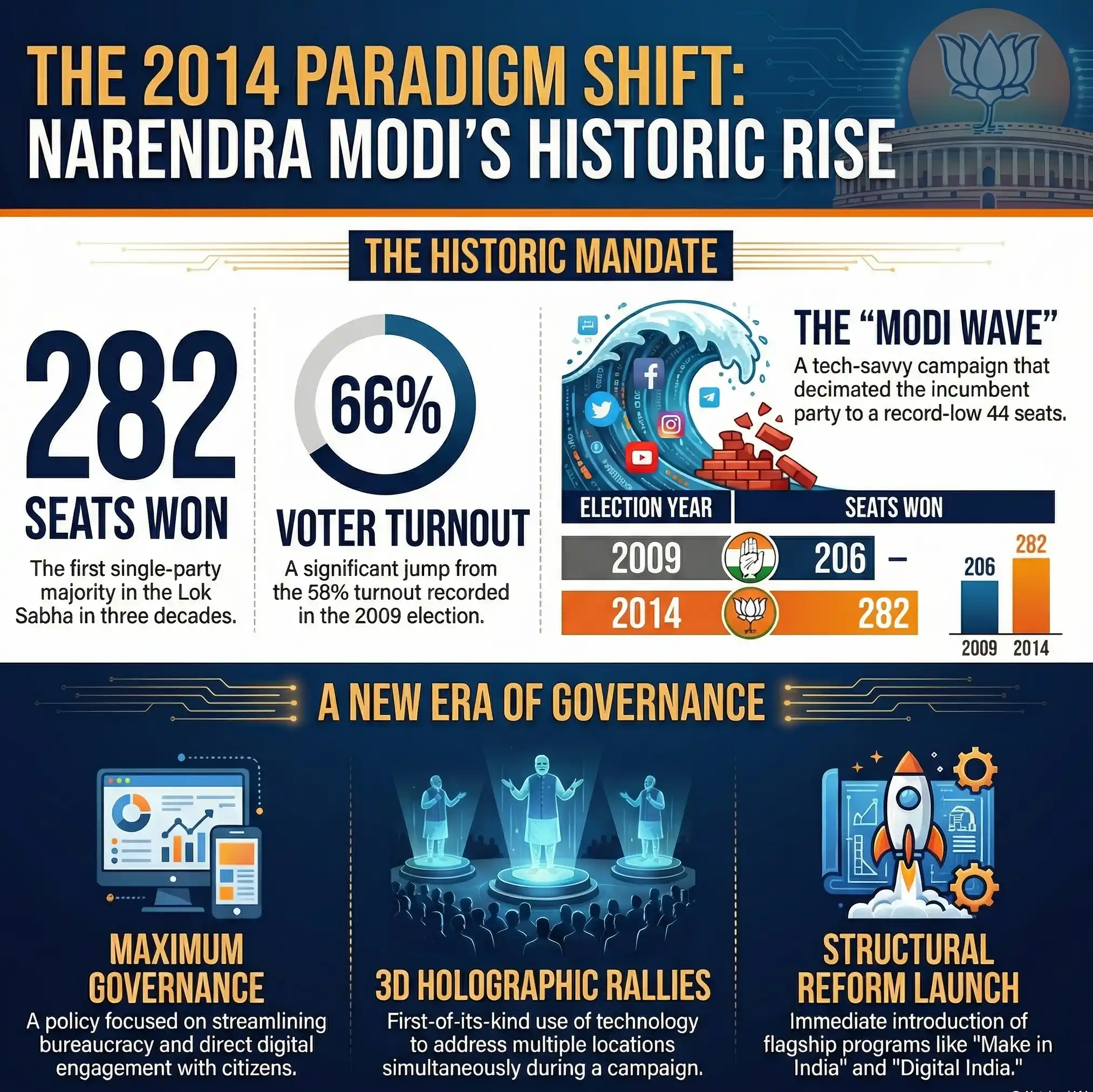
In the spring of 2014, more than half a billion people went to the polls across India, in what was, at that time, the largest single act of democratic voting the world had ever seen.
Over several weeks, in the heat and the dust, in great cities and in villages so remote that officials had to reach them on foot, by boat and even by mule, hundreds of millions of ordinary Indians, rich and poor, of every faith and language and caste, walked to a booth and pressed a button. When the counting was done, they had done something India had not seen in a quarter of a century. They had handed a single party enough seats to govern on its own, and they had chosen a new Prime Minister, Narendra Modi.
This is a short account of that election, and of what it meant for the world’s largest democracy.
The end of an era
To understand why 2014 mattered, it helps to know what came before it.
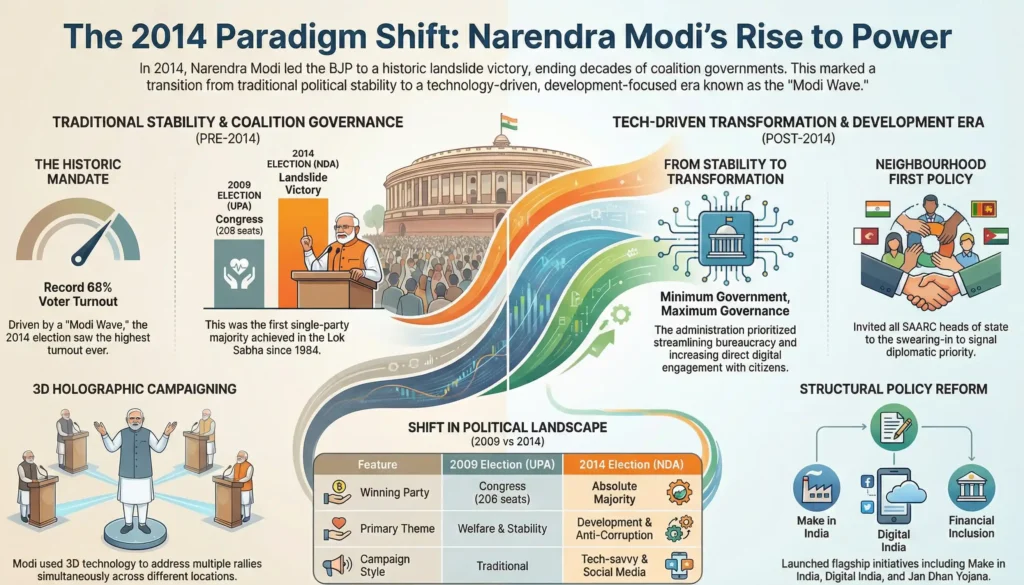
For twenty-five years, since the late 1980s, no single party had been able to win a majority in the Indian Parliament on its own. The country had been governed by coalitions, alliances of many parties that had to bargain and compromise at every turn to hold power together. By 2014, after a decade of coalition government led by the Congress party, a great many voters were restless. There was a widespread mood of frustration, sharpened by a run of corruption scandals and a sense that the government had lost its way, and a hunger for change and for a single, decisive leader who could simply act.
That mood was the ground on which the election was fought.
Amitabh Bachchan : The Shahenshah Who Conquered Hearts
A different kind of candidate
The man who met that mood was Narendra Modi, the long-serving chief minister of the state of Gujarat, and part of his appeal lay in his own story.
He had not come from the political dynasties or the privileged families that had long dominated Indian public life. He had grown up in a small town in a family of modest means, and as a boy had helped at his father’s tea stall on a railway platform. He rose through a lifetime of work in political organisation to the top of his party and then to the leadership of the country.
For many voters, especially the young, the rise of a tea-seller’s son to the doorstep of the nation’s highest office was itself the point: a sign, they felt, that in a democracy a person could come from anywhere and still reach the very top.
His campaign was run on a scale and with an energy India had rarely seen, built around the promise of development and jobs, of clean and decisive governance, and of “good days” to come. He used new technology, vast rallies and a disciplined organisation to reach voters directly, often going around the traditional media altogether.
The mandate, and the man India argues about
The result was clear-cut. His party won a majority of seats in Parliament on its own, the first time any single party had managed that since 1984, and he was sworn in as Prime Minister in May 2014.
Here, honesty asks for a plain and careful statement. Narendra Modi is one of the most consequential, and one of the most fiercely debated, figures in modern Indian public life. To his many supporters, he is a strong and decisive leader who has raised India’s standing in the world and given a voice to millions who felt overlooked. To his many critics, aspects of his politics have raised deep concerns about the direction of the country and the place of its minorities. These are live disagreements, argued over with great passion by serious people on every side.
It is not the task of this piece to settle those arguments. A history written while a leader still holds office cannot pretend to deliver a final verdict, and it is wiser not to try.
What can be said plainly, and without taking a side, is that his arrival in 2014 marked a genuine turning point in Indian politics, and that Indians will be weighing and debating its meaning for a long time to come.
Raj Kapoor (1924–1988): The Greatest Showman of Indian Cinema
The thing beneath the noise
So, setting aside for a moment the fierce arguments that surround any powerful leader, what is worth quietly remembering about that spring?
Perhaps this. In a country of more than a billion people, poor and staggeringly diverse, held together by little more than a shared agreement to settle its differences at the ballot box, hundreds of millions of ordinary citizens peacefully changed their government. No tanks moved. No shots were fired. A powerful governing party, told by the voters that its time was up, handed over the keys and walked away, and a new government took its place.
A governing party, told by the voters that its time was up, simply handed over power and walked away. For most of human history, and in much of the world still today, power does not change hands so gently.
That can sound ordinary, even dull. It is neither. Across most of history, and in much of the world even now, power is taken and held by force, and the losers of an election do not calmly step aside. That it happens in India, election after election, whichever side you are on and whoever wins, is the quiet and genuinely remarkable thing underneath all the noise. And it belongs, in the end, not to any single leader or party, but to the hundreds of millions of ordinary people who, every few years, walk to a booth and, with the simple press of a button, remind whoever holds power exactly who they answer to. Whatever anyone makes of any one result, that is the part worth honouring.
8 Defining Chapters in the Vikram Sarabhai Biography
The Purulia Arms Drop Mystery 1995: When the Sky Rained Guns
If you think you have remembered everything about this topic take this QUIZ
Results


#1. Narendra Modi led the BJP to a single-party majority in the 2014 elections by winning how many seats?
#2. Which famous slogan was the centerpiece of the BJP’s 2014 election campaign?
#3. Narendra Modi is the first Prime Minister of India to be:
#4. Which technology did Narendra Modi use to address multiple rallies simultaneously during the 2014 campaign?
#5. Which constituency did Narendra Modi choose to retain after winning both seats he contested in 2014?
#6. Which flagship scheme was launched in 2014 with the aim of making India open-defecation free?
#7. The 2014 election campaign initiative “Chai Pe Charcha” was launched to counter opposition remarks about Modi’s background as a:
#8. Narendra Modi’s swearing-in ceremony in 2014 was unique because it was attended by the heads of state of which group?
When did Narendra Modi become Prime Minister?
He was sworn in on May 26, 2014.
Which constituency did Narendra Modi represent in 2014?
He contested and won from both Vadodara (Gujarat) and Varanasi (Uttar Pradesh), eventually retaining the Varanasi seat.
What was the BJP’s seat count in the 2014 election?
The BJP won 282 seats, securing a majority on its own.
Who was the Prime Minister before Narendra Modi?
Dr. Manmohan Singh of the Congress party was the Prime Minister from 2004 to 2014.
What was the “Modi Wave”?
It refers to the massive surge in popularity and voter support for Narendra Modi across India during the 2014 elections, driven by his charisma and development promises.
Sources & References
- Encyclopaedia Britannica (“Narendra Modi”) — his life and his rise to the office of Prime Minister.
- Election Commission of India (the 2014 Lok Sabha election) — the conduct, scale and results of the vote.
- Encyclopaedia Britannica (“India”: recent political history) — the end of the coalition era and the 2014 mandate.
- PRS Legislative Research (2014 general election results) — the seat and turnout figures for the election.
Author


Exploring the Soul of Bharat through History, Science, Culture, and its Diversity
Our Mission
Curious Indian is a definitive knowledge portal dedicated to chronicling the events, personalities, and cultural shifts that defined the Indian subcontinent. From the ancient Vedic Period to the complexities of 21st-century politics, our goal is to provide deep-dive analysis that inspires.
Editorial Standards & E-E-A-T
Every article published under our brand undergoes a rigorous fact-checking process. We prioritize primary historical records, academic citations, and credible archives to ensure our readers receive accurate, high-authority information.
Historical Integrity Directly sourcing from ASI archives and academic journals.Topical Authority Comprehensive clustering of Indian Science, Biographies, and Wars.Managed by Paripurna Datta and TEAM | Dedicated to the Knowledge of India.