How an illiterate boy-king bet his empire on the idea that everyone should belong
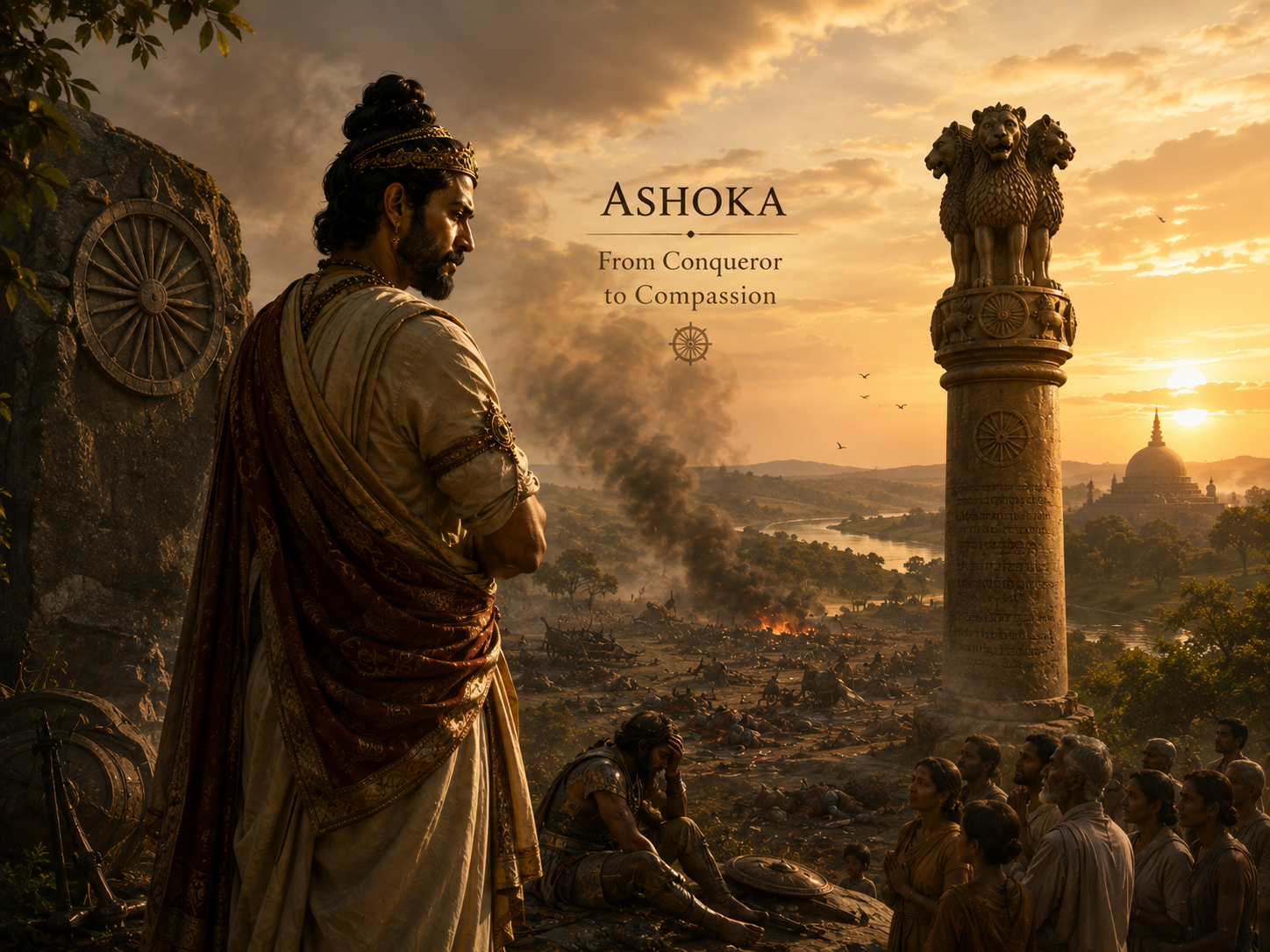
Most kings are remembered for the wars they won. Ashoka is remembered for a single moment, standing in the middle of the greatest victory of his life, when he looked at what he had done and was so sickened by it that he swore he would never fight a war again.
He was the most powerful man in India, the master of almost the entire subcontinent. And in a strange way, he was defeated by his own triumph. This is the story of how one of history’s most fearsome conquerors became one of its gentlest rulers.
Reign of Harshavardhana: The Empire of Benevolence
The making of a warrior king
Ashoka came to the throne around 268 BCE. He was the grandson of Chandragupta, the man who had founded the mighty Mauryan empire, and by Ashoka’s day that empire already stretched across almost all of India.
In his early years, the old stories say, Ashoka was a hard and ruthless man. Later legends even gave him the nickname “Chandashoka,” meaning Ashoka the Fierce. How much of that dark reputation is true, and how much was added by storytellers long after his death, we cannot really be sure. But what is certain is that he set out, just as his father and grandfather had, to make the great empire complete.
Rise of Jainism and Buddhism 6th Century BCE
The river that ran red
One piece of land had always held out against the Mauryas: a proud, independent kingdom on the eastern coast called Kalinga, in what is now the state of Odisha. In about 261 BCE, in the eighth year of his reign, Ashoka marched to take it.
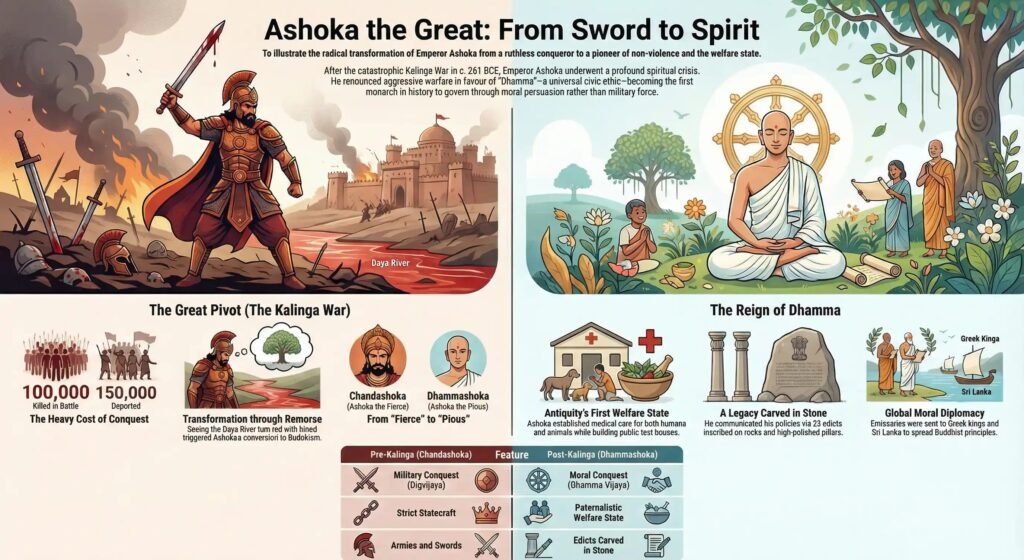
The war he unleashed was one of the bloodiest in all of ancient history. By his own account, carved later into stone for everyone to read, around 100,000 people were killed, another 150,000 were torn from their homes and marched away, and many, many more died of the hunger and disease that always follow war. The river beside the battlefield, they say, ran red.
And then something happened that almost never happens to a victorious king. Ashoka walked out across the field of his own great victory, and instead of triumph, what he felt was horror.
In his own words, carved into stone for all his people to read, Ashoka confessed that after Kalinga he felt a deep and lasting sorrow for the suffering he had caused.
The vow
Standing in that ruin, the conqueror broke. He is said to have asked himself a simple, terrible question: what have I done, and is this victory or is it defeat?
And then he made a choice that no emperor of his power had ever made before. He put down the sword. He decided that he would never again wage a war of conquest. He turned to the teachings of the Buddha, and he resolved to try to rule his people by goodness instead of by fear. In his own words, he set aside the beat of the war drum and took up instead what he called the drum of dharma, the drum of righteousness. The fierce king was gone, and in his place stood a very different man.
A conscience carved in stone
Here is the part that makes Ashoka truly one of a kind. He did not simply change quietly, inside his own heart. He wanted his people to know, and to change alongside him.
So he had his new beliefs carved onto great rocks and tall polished stone pillars, all across his enormous empire, in the everyday languages his subjects actually spoke, so that ordinary people could read them or hear them read aloud. No ruler had ever done such a thing before, using the very stones of his kingdom to speak his own conscience to his people.
What he asked of them he called Dhamma. It was not a religion that he forced upon anyone; he left his people free to follow their own faiths, and told them plainly to respect one another’s. Instead, it was a simple code of kindness: be truthful, care for your parents and your elders, be gentle to your servants and to animals, do no harm to living things, and make room for those who believe differently from you.
The emperor who planted trees
And Ashoka tried hard to live it all out, not just to preach it.
He had wells dug and shade trees planted along the roadsides for weary travellers, and rest-houses built for them to sleep in. He arranged care for the sick, and, remarkably for his age, not only for people but for animals as well. He appointed special officers whose whole task was to travel the length of the empire making sure that his people, right down to the prisoners and the poorest, were being treated fairly. Some historians call his empire the closest the ancient world ever came to a true welfare state.
Reign of Akbar 1556-1605: The Golden Age of the Mughal Empire
The king who sent out peace
Having given up the conquest of land, Ashoka poured his energy into spreading something else entirely: the gentle teaching he now lived by.
He sent missionaries out across Asia and far beyond it, reaching even the Greek kingdoms to the west. Most famously of all, he sent his own son across the sea to the island of Sri Lanka. And so, because of this one changed king, a faith that had begun as a small movement in a single corner of India grew, over the centuries, into one of the great religions of the whole world.
The king who was almost forgotten
And then, strangely, Ashoka was very nearly lost to history.
As the centuries rolled on, his empire crumbled, and the strange old writing on his pillars became a puzzle that no one alive could read. For a very long time, the world simply forgot that he had ever existed. It was not until 1837 that a British scholar named James Prinsep at last cracked the ancient script, and Ashoka’s own words came flooding back to life after more than two thousand years of silence.
When they did, India rediscovered one of the greatest figures in its entire history. And when India became a free nation in 1947, it chose, out of all its many kings and heroes, to make this one man’s symbols its very own.
The four lions that Ashoka set atop a pillar at Sarnath are today the national emblem of India, and his wheel of dharma turns at the centre of the Indian flag.
Victory, and defeat
It is only fair to remember that Ashoka did not give Kalinga back, nor break apart his empire, nor step down from his throne. He remained a powerful emperor to the end of his days, and his change of heart was in how he chose to rule, not in surrendering his power.
But that is exactly what makes him so rare. Here was a man who had won everything a conqueror could ever want, and who then stood up before all his people and declared, in effect, that the winning had been a terrible mistake. A famous historian once wrote that among the many thousands of kings’ names scattered across all of history, the name of Ashoka shines out almost alone, like a single bright star. Perhaps that is because so very few of the powerful have ever been able to look at their own great victory and find the courage to call it a defeat.
Reign of Chandragupta Maurya: The First Empire of India
If you think you have remembered everything about this topic take this QUIZ
Results


#1. Prior to his spiritual transformation, for what specific reason was Ashoka known as ‘Chandashoka’?
#2. What primary strategic advantage did the independent state of Kalinga hold that motivated Ashoka’s invasion?
#3. According to Major Rock Edict XII, how did Ashoka view the act of disparaging other people’s faiths?
#4. Which specific administrative measure did Ashoka implement to ensure the welfare of his subjects and the promotion of Dhamma?
#5. How did the linguistic approach in Ashoka’s edicts vary in the northwestern frontiers, such as Kandahar?
#6. Which pair of individuals is credited with establishing Buddhism as a pan-Asian religion by travelling to Sri Lanka?
#7. What was the historical significance of the Maski edict discovered in 1915?
#8. Despite his commitment to non-violence (Ahimsa), how did Ashoka maintain order among the ‘forest tribes’?
Which war changed the life of Emperor Ashoka?
The Kalinga War (c. 261 BCE).
What is “Dhamma” in the context of Ashoka?
Dhamma was Ashoka’s policy of a universal civic ethic based on non-violence, tolerance, and social responsibility.
Which script was primarily used for Ashoka’s Edicts?
The Brahmi script (used to write the Prakrit language).
Who deciphered the Ashokan Edicts?
James Prinsep in 1837.
What are the modern national symbols derived from Ashoka?
The Lion Capital of Sarnath (National Emblem) and the Ashoka Chakra (in the National Flag).
Sources and references
- Wikipedia (“Kalinga War”) and Major Rock Edict XIII — the war ending around 261 BCE against the independent kingdom of Kalinga, the figures of 100,000 killed and 150,000 deported given by Ashoka himself, and his recorded remorse and turn toward dharma and ahimsa.
- Britannica and the World History Encyclopedia — Ashoka as the third Mauryan emperor (reigned c. 268–232 BCE), grandson of Chandragupta, and his reorientation of rule around dhamma stressing compassion, truthfulness, respect for elders and tolerance among faiths.
- Anantam IAS and CrackTarget (on the edicts) — the inscriptions carved on rocks and pillars in Brahmi, Kharosthi, Greek and Aramaic, the welfare measures and Dhamma Mahamattas, and James Prinsep’s 1837 decipherment of Brahmi that recovered Ashoka’s identity.
- Accounts of Ashoka’s legacy — the spread of Buddhism through missionaries including his son Mahinda to Sri Lanka, the Third Buddhist Council, and the Lion Capital of Sarnath becoming India’s national emblem with the Ashoka Chakra on the flag.
- Original Curious Indian articles (“Ashoka the Great” and “Reign of Emperor Ashoka”) — the “Chandashoka to Dharmashoka” transformation (noted as partly later legend), the River Daya running red, the exchange of the war drum for the drum of dharma, and Dhamma as a universal civic ethic rather than an imposed religion.
Author


Exploring the Soul of Bharat through History, Science, Culture, and its Diversity
Our Mission
Curious Indian is a definitive knowledge portal dedicated to chronicling the events, personalities, and cultural shifts that defined the Indian subcontinent. From the ancient Vedic Period to the complexities of 21st-century politics, our goal is to provide deep-dive analysis that inspires.
Editorial Standards & E-E-A-T
Every article published under our brand undergoes a rigorous fact-checking process. We prioritize primary historical records, academic citations, and credible archives to ensure our readers receive accurate, high-authority information.
Historical Integrity Directly sourcing from ASI archives and academic journals.Topical Authority Comprehensive clustering of Indian Science, Biographies, and Wars.Managed by Paripurna Datta and TEAM | Dedicated to the Knowledge of India.