How the Battle of Talikota ended South India’s last great empire
If you go to Hampi today, in the state of Karnataka, you walk through miles of broken stone. Roofless temples, snapped pillars, empty palace floors, all scattered across a strange landscape of giant boulders.
It looks ancient and peaceful, the way ruins usually do.
But this was not a city that faded slowly over the centuries. This was a city that was killed, quickly and on purpose, in the space of a few months. And almost all of it goes back to a single day: 23 January 1565.
On that day, near two small villages in the Deccan, an empire that had ruled much of southern India for more than two hundred years was broken apart in an afternoon. History remembers the fight by the name of a nearby town: Talikota.
The richest city in the world
To feel the size of the loss, you first have to know what Hampi was before.
In the middle of the 1500s, Hampi was the capital of the Vijayanagara Empire, the last of the great Hindu kingdoms of the south. And it was no modest place. By many accounts it was one of the largest cities on earth at the time, perhaps second only to Beijing.
A Portuguese visitor named Domingo Paes, who saw it with his own eyes, struggled to put its grandeur into words.
He wrote that the city was “as large as Rome and very beautiful,” packed with palaces and temples, its markets heavy with gold and diamonds.
Something like half a million people are thought to have lived there. It was rich, proud, and — on that January morning — about to be wiped off the map.
Reign of Akbar 1556-1605: The Golden Age of the Mughal Empire
The old man’s clever game
At the head of this empire sat not its official king, a figurehead named Sadashiva Raya, but the man who really ran things: his son-in-law and regent, Aliya Rama Raya.
Rama Raya was old — by many accounts already past eighty — and he was clever. To the north of his empire lay a cluster of Muslim kingdoms known together as the Deccan Sultanates, and for years he had kept them from ever becoming a real threat by one simple, ruthless trick.
He played them against each other. One year he would help one sultan crush his neighbour; the next he would switch sides and prop up the loser. As long as they were busy fighting one another, none of them was ever strong enough to face Vijayanagara.
It was smart. It was also, in the end, exactly what destroyed him.
By treating the sultans as pieces on a board, and sometimes humiliating them, Rama Raya slowly taught his neighbours one dangerous lesson: the only way any of them would ever be safe was to stop fighting each other and turn on him together.
The enemies join hands
That is precisely what they did.
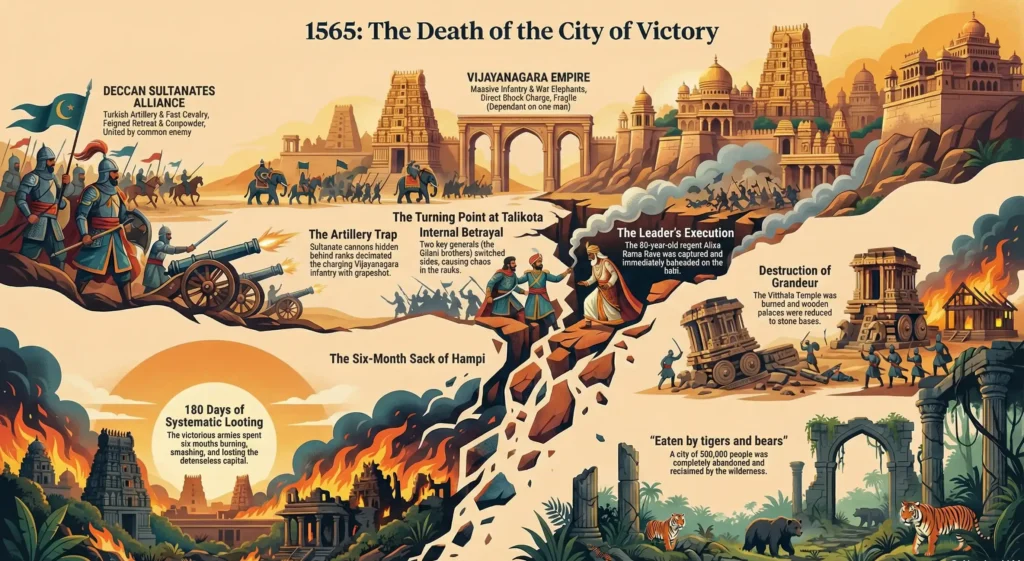
Four of the Deccan Sultanates — Bijapur, Ahmednagar, Golconda and Bidar — buried their old quarrels and formed a grand alliance, sealed with marriages between their ruling families. They shared a single goal: to bring down Vijayanagara for good.
In January 1565, the two sides met on a plain south of the Krishna River, near the villages of Rakkasagi and Tangadigi. (The battle is named after Talikota only because the sultans had camped there on the way in.)
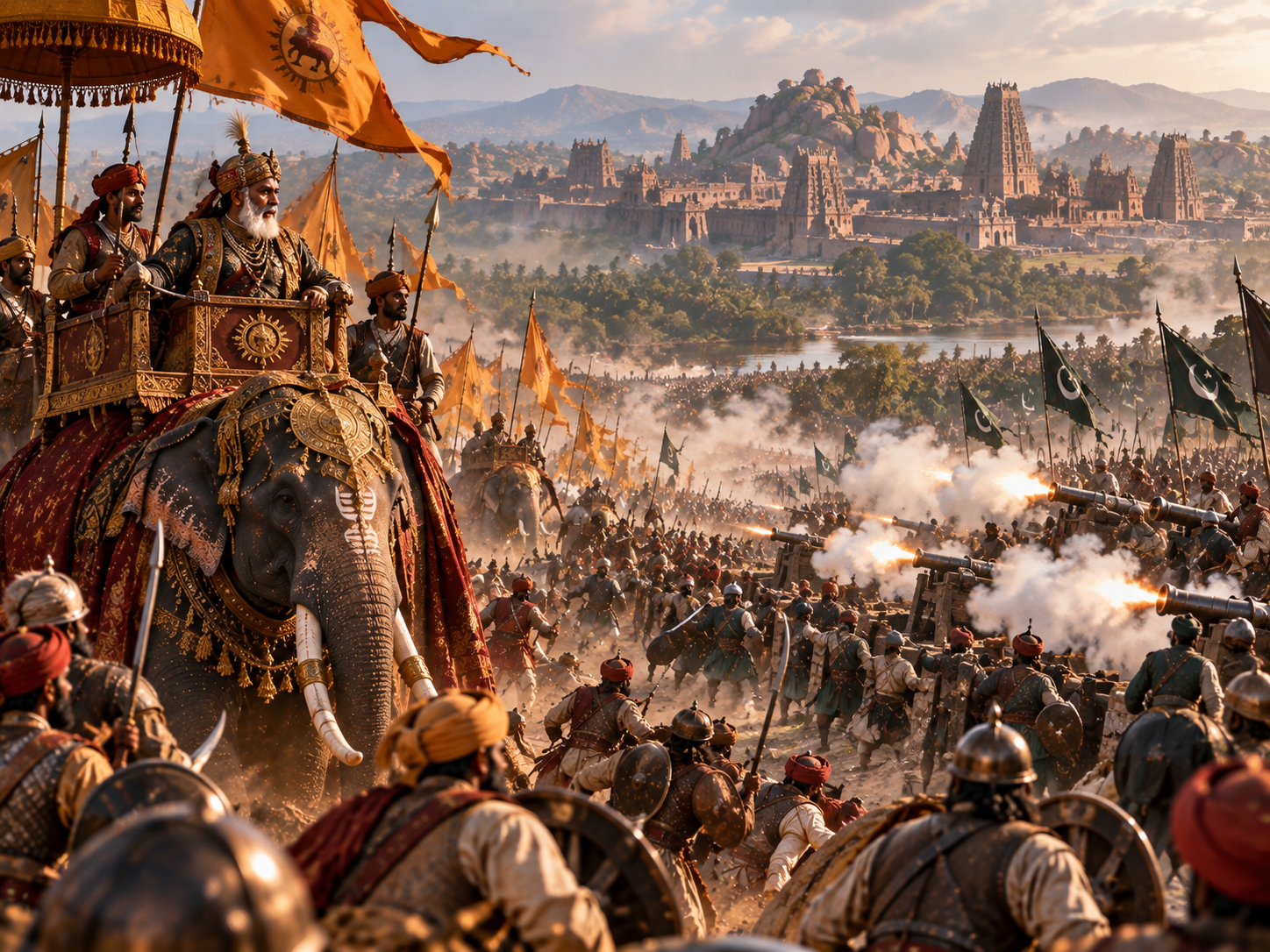
Rama Raya’s army was huge, well over a hundred thousand strong, thick with cavalry and war elephants. The old regent, too frail to ride, directed the centre from a litter, with his brothers leading the wings.
But the sultanates had one thing Vijayanagara had failed to keep up with.
Third Battle of Panipat 1761: The Day the Maratha Dream Died
The trap on the plain
That thing was guns.
The sultans had hired skilled Turkish gunners and brought heavy cannon that could throw shot across long distances. Vijayanagara, for all its wealth, had never taken this new gunpowder warfare seriously — and it was about to pay for that.
At first the battle went well for Rama Raya. His vast numbers pushed the sultanate wings backwards, and for a while it looked like just another victory.
Then the trap sprang.
The sultanate centre pretended to fall back, luring the Vijayanagara soldiers forward. Then its ranks opened — and behind them stood rows of heavy cannon, chained together in a line. They fired at close range into the packed crowd, spraying out bags of nails and scrap metal that tore the charge to pieces.
And while the guns did their work, Rama Raya was betrayed from within.
By many accounts, two of his own senior commanders — Muslim generals he had trusted and treated almost like sons — switched sides at the worst possible moment and turned on the army. What order remained collapsed into panic.
One head on a spear
In the chaos, Rama Raya’s elephant was cut off and surrounded. The old man was pulled down and captured, then dragged before Hussain Nizam Shah, the sultan of Ahmednagar.
The sultan did not wait. He had Rama Raya beheaded on the spot.
Then the head was lifted onto a spear and paraded before the battlefield.
When the Vijayanagara soldiers saw their leader’s head raised above the crowd, whatever fight was left in them broke. The great army did not merely lose. It shattered, and ran.
An empire that had stood for more than two centuries had, in a single afternoon, lost its ruler and its army both.
Death of Tipu Sultan: The Fall of the Tiger of Mysore
Six months
The worst was still to come, and it did not fall on the soldiers. It fell on the city.
Hampi had no army left to protect it. The victors rested a few days, then marched on the capital and did something history has rarely seen done to a city so great.
For six months, they looted, burned and smashed. Temples were shattered and their images broken, palaces were set alight, and the gold and jewels of the richest city in the south were carted away on elephants.
The stone survived, because stone is hard to burn. Almost nothing else did. A city that had held perhaps half a million people was emptied and left to the jungle. The broken temples and bare palace floors you can walk through at Hampi today are simply what six months of deliberate destruction leave behind.
Why it still matters
The Battle of Talikota is not only the story of a lost fight. It is a story about how even the strongest-looking thing can be brittle underneath.
Vijayanagara had more men, more money and more history than its enemies. What it did not have was foresight. Its whole safety rested on the cleverness of one very old man and on his rivals staying divided — and when that game finally failed, there was no backup plan. It had also let itself fall behind on the very thing that decided the day: gunpowder.
The empire did not vanish overnight on paper. A branch of the royal family limped on for another hundred years or so from smaller capitals, but the great days were over and never returned. A British historian, Robert Sewell, later wrote the first major English account of Vijayanagara and gave it a title that says everything: A Forgotten Empire.
That may be the saddest part. The ruins at Hampi are not just the leftovers of a battle. They are a quiet reminder that a whole world — one of the richest, busiest, most dazzling places on the planet — can be reduced to broken stone, and then slowly forgotten, because of the choices of the people who were meant to protect it.
Reign of Aurangzeb 1658-1707: The Zenith and Decline of the Mughals
If you think you have remembered everything about this topic take this QUIZ
Results


#1. The Battle of Talikota, which led to the fall of the Vijayanagara Empire, was fought on which date?
#2. Who was the de facto ruler and regent leading the Vijayanagara forces during the battle?
#3. The battle was fought between Vijayanagara and an alliance of how many Deccan Sultanates?
#4. Which specific military advantage did the Sultanates possess that played a decisive role in their victory?
#5. The battle is historically named “Talikota,” but it was actually fought near which two villages?
#6. What was the fate of the magnificent capital city of Hampi after the battle?
#7. Which two generals in the Vijayanagara army reportedly betrayed Rama Raya at a critical moment?
#8. Aliya Rama Raya was known for his diplomatic strategy of “divide and rule.” Which rival powers did he pit against each other?
When was the Battle of Talikota fought?
It was fought on January 23, 1565.
Who was the leader of the Vijayanagara forces?
Aliya Rama Raya, the regent and de facto ruler, led the forces.
Who defeated the Vijayanagara Empire?
A coalition of four Deccan Sultanates: Bijapur, Ahmednagar, Golconda, and Bidar.
Why is Hampi in ruins?
After the defeat at Talikota, the victorious Sultanate armies sacked, looted, and burned the capital city of Hampi for six months, leaving it in ruins.
Did the Vijayanagara Empire end immediately?
The city was destroyed, but the empire limped on for another century from new capitals like Penukonda and Chandragiri, though it never regained its power.
Sources & References
- Encyclopaedia Britannica (“Vijayanagar”) — the empire, Aliya Rama Raya’s regency, the defeat at Talikota in 1565, and the collapse that followed.
- New World Encyclopedia (“Battle of Talikota”) — the alliance of the four Deccan Sultanates, the course of the battle, the role of artillery and the betrayal, and the death of Rama Raya.
- UNESCO World Heritage Centre (Group of Monuments at Hampi) — Hampi as the imperial capital, its grandeur, and the surviving ruins.
- Robert Sewell, A Forgotten Empire: Vijayanagar — an early, foundational history of the empire drawing on Portuguese eyewitness accounts, including Domingo Paes’s description of the city.
Author


Exploring the Soul of Bharat through History, Science, Culture, and its Diversity
Our Mission
Curious Indian is a definitive knowledge portal dedicated to chronicling the events, personalities, and cultural shifts that defined the Indian subcontinent. From the ancient Vedic Period to the complexities of 21st-century politics, our goal is to provide deep-dive analysis that inspires.
Editorial Standards & E-E-A-T
Every article published under our brand undergoes a rigorous fact-checking process. We prioritize primary historical records, academic citations, and credible archives to ensure our readers receive accurate, high-authority information.
Historical Integrity Directly sourcing from ASI archives and academic journals.Topical Authority Comprehensive clustering of Indian Science, Biographies, and Wars.Managed by Paripurna Datta and TEAM | Dedicated to the Knowledge of India.