How Qutb al-Din Aibak and Iltutmish rose from slavery to found an empire that ruled for 300 years
The Delhi Sultanate was one of the most powerful empires that India ever knew. For more than three hundred years, its sultans ruled the north of the country from the great city of Delhi, shaping its politics, its cities, its art, and its whole future.
And it began in one of the most astonishing and unlikely ways that any empire ever has. It was founded, and then it was built, by slaves. The man who founded it had been bought and sold as a boy. And the man who truly built it had been a slave too, owned, at one point, by the founder himself. This is the strange and remarkable story of the empire that slaves built.
The kingdom left behind
To understand how it all began, we go back to the warlord Muhammad Ghori, who had conquered the north of India in a series of long and hard campaigns.
But Ghori did not actually want to live in India. His home, and his heart, lay far away in Afghanistan, to the northwest. So, having won these rich new lands, he did something that would end up changing everything. He handed the conquered territories over to his most trusted and capable generals, to rule in his name, and then he went home. And then, in the year 1206, Muhammad Ghori was murdered, and he left no son behind him to inherit his empire. So a great question suddenly hung in the air over India: who now would rule these conquered lands?
Timur’s Invasion of Delhi 1398: The Massacre That Shook India
The empire founded by a slave
The answer turned out to be a man named Qutb al-Din Aibak. And here is the truly extraordinary thing about him. Aibak was not a prince, nor a nobleman, nor the son of any king. He was a slave. As a boy, he had been bought and sold like a piece of property.
But he was no ordinary slave, because he belonged to a strange and remarkable world. In those days, among the Turkish peoples of Central Asia, there was a custom that can seem almost impossible to us today. Clever, promising enslaved boys were not simply put to hard labour. Instead, their masters gave them the very finest education, trained them up as elite soldiers, and raised them to become trusted officers, and generals, and governors.
In this strange world, a slave could rise. He could be handed an army, and then a whole province, and, in the very rarest of cases, he could rise all the way up to a throne.
Aibak was one of these men. He had served Muhammad Ghori faithfully, had led his armies across India, and had governed his Indian lands for him. So when his master was killed in 1206, Aibak simply took the crown for himself. A former slave declared himself the Sultan of Delhi, and the Delhi Sultanate was born.
Reign of Muhammad bin Tughluq: The Visionary Failure of Medieval India
The slave who built the empire
Aibak did not rule for very long. He died in a fall from his horse during a game of polo, only about four years after he had taken the throne. And the man who truly built the empire, upon the foundation that Aibak had laid, was, incredibly, another slave.
His name was Iltutmish, and his story is even more remarkable than Aibak’s own. For Iltutmish had been bought and sold several times over in his life, and one of the men who had once owned him was none other than Aibak himself. The slave had become the son-in-law of his own former master, and then, in time, his successor upon the throne.
Iltutmish, the man who truly built the Sultanate, had been sold as a slave more than once, and once even to Aibak, the founder himself. The slave became his master’s son-in-law, and then his heir.
And Iltutmish turned out to be a genuinely great ruler, the real architect of the whole Sultanate. He made Delhi into the shining capital of his empire, and filled it with fine buildings. He won formal recognition from the Caliph in far-off Baghdad, the highest religious authority in the Muslim world, which gave his young kingdom real respect and legitimacy. He set up a proper system of government, and a standard coinage. And he did one thing that may well have saved India itself. In those very years, the most terrifying force the world had ever seen was sweeping across Asia: the Mongols, under Genghis Khan, who were burning great cities to the ground. Iltutmish, watching that storm draw near, was wise and careful enough to keep Delhi quietly out of its path, so that while much of Asia was laid waste, his own empire was spared. And near the end of his life, he made a choice that shocked his court: he named his own daughter, Razia, as his heir. But that is a story all of its own.
Colonial Architecture in India: Fusion of Empire, Craft and Modernity
What the slaves built
The empire that these two former slaves founded would go on to last for more than three whole centuries, ruled by a long succession of dynasties from the throne of Delhi. And it changed the face of northern India for good.
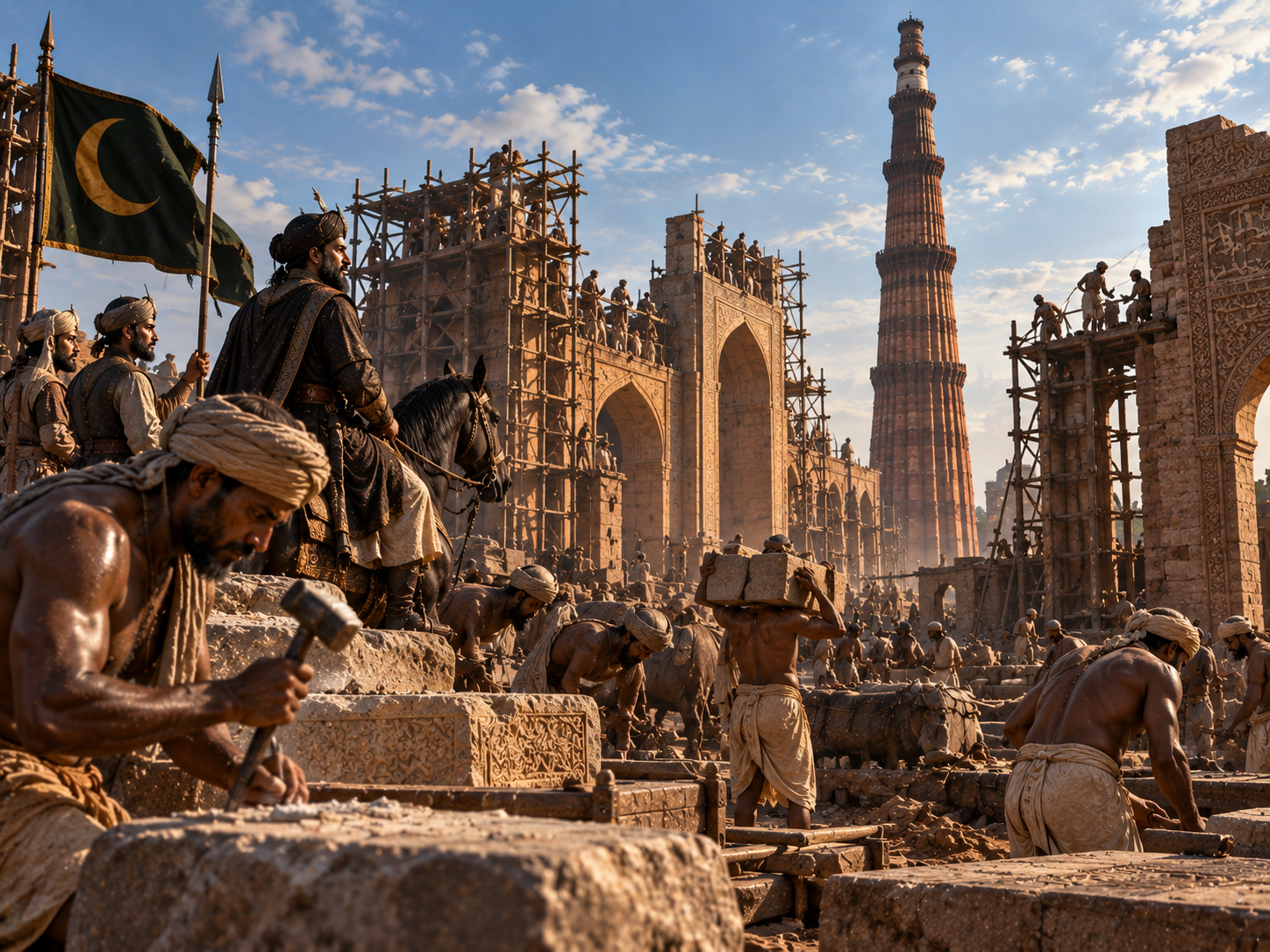
It brought with it a new ruling class, a new faith in the halls of power, and a new style of art and building. Its single greatest symbol still towers over the city of Delhi to this day: the Qutb Minar, a soaring tower of stone.
The Qutb Minar still rises over Delhi, a soaring tower of red stone begun by Aibak the slave-king and finished by Iltutmish the slave-king.
And through all of its early years, the Sultanate did something of enormous importance for the entire subcontinent. It stood like a great wall across the northwest, holding back the Mongols, generation after generation, and keeping out of India the very horror that had devoured so much of the rest of Asia. In time, this great state would set the stage for the mightiest Indian empire of them all, the Mughals, who would one day rise to take its place.
Kings from the very bottom
It is worth pausing, at the end, on just how strange and wonderful the beginning of this great empire truly was.
We are all used to the comfortable idea that kings are born to their crowns, that power passes quietly from father to son, and that the mighty come, as a rule, from mighty families. The Delhi Sultanate began in the very opposite way. Its first great rulers came instead from the very bottom of human society, from slavery itself, the lowest station a person could possibly hold. Bought and sold like mere goods, they rose, through their own talent and iron will and one strange twist of their world’s customs, to become the masters of a whole subcontinent.
Whatever else one may think of the empire that they built, and it was a mighty one that endured for three hundred years, there is something genuinely astonishing in its very origin. It stands as one of history’s most striking reminders that greatness does not always come from where we expect to find it, and that the person who ends up sitting on the throne is not always the one who was born anywhere near it. The Delhi Sultanate was, in the most literal sense there is, an empire built by slaves who made themselves into kings.
Bharat Mata: How Abanindranath Tagore Painted the Soul of a Nation
Reign of Alauddin Khalji 1296-1316: The Iron Fist of Delhi
If you think you have remembered everything about this topic take this QUIZ
Results


#1. Who founded the Delhi Sultanate in 1206 AD and was known as “Lakh Baksh”?
#2. How did Qutb-ud-din Aibak die in 1210 AD?
#3. Which was the first and only female ruler of the Delhi Sultanate?
#4. Which dynasty of the Delhi Sultanate was the first to be of Afghan origin?
#5. Who introduced the “Blood and Iron” policy and the Persian custom of Sijda (prostration)?
#6. The “Iqta System” introduced during the Sultanate period was related to:
#7. Which Sultan shifted the capital from Delhi to Agra in 1504?
#8. The Delhi Sultanate ended in 1526 with the defeat of Ibrahim Lodi in which battle?
Who established the Delhi Sultanate?
Qutb-ud-din Aibak established the Delhi Sultanate in 1206 AD.
Which was the first dynasty of the Delhi Sultanate?
The Mamluk (Slave) Dynasty was the first.
How many dynasties ruled the Delhi Sultanate?
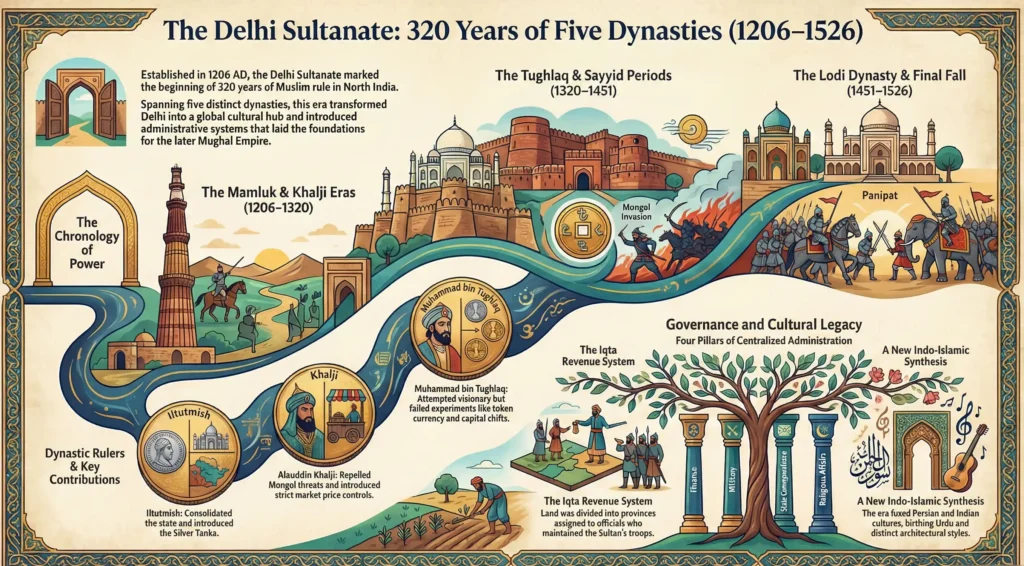
Five dynasties ruled: Mamluk, Khalji, Tughlaq, Sayyid, and Lodi.
Who was the only female ruler of the Delhi Sultanate?
Razia Sultan (daughter of Iltutmish) was the only female ruler.
When did the Delhi Sultanate end?
It ended in 1526 AD after the First Battle of Panipat.
Sources and references
- Britannica (“Mamluk dynasty, India”) and Drishti IAS — the Mamluk (Slave) dynasty (1206–90) as the first of the Delhi Sultanate dynasties, founded by Qutb al-Din Aibak, an enslaved soldier of Muhammad of Ghur, who took power when Muhammad was assassinated in 1206.
- NextIAS and ClearIAS — Aibak as a former Turkic slave-general, called “Lakh Baksh” for his generosity, the severing of links with Ghazni, the start of the Qutb Minar, and his death in a polo accident in 1210.
- WBPSC-UPSC and Xylem Learning — Iltutmish sold as a slave to Aibak and later becoming his son-in-law and successor, his role as the “real founder,” the making of Delhi as the capital, the Abbasid Caliph’s recognition, and the silver tanka and copper jital coinage.
- NextIAS and ClearIAS (on the Mongols and legacy) — the Mongol threat under Genghis Khan on the northwest frontier and Iltutmish’s careful avoidance of it, the completion of the Qutb Minar, and the Sultanate as the framework for later dynasties.
Author


Exploring the Soul of Bharat through History, Science, Culture, and its Diversity
Our Mission
Curious Indian is a definitive knowledge portal dedicated to chronicling the events, personalities, and cultural shifts that defined the Indian subcontinent. From the ancient Vedic Period to the complexities of 21st-century politics, our goal is to provide deep-dive analysis that inspires.
Editorial Standards & E-E-A-T
Every article published under our brand undergoes a rigorous fact-checking process. We prioritize primary historical records, academic citations, and credible archives to ensure our readers receive accurate, high-authority information.
Historical Integrity Directly sourcing from ASI archives and academic journals.Topical Authority Comprehensive clustering of Indian Science, Biographies, and Wars.Managed by Paripurna Datta and TEAM | Dedicated to the Knowledge of India.