Why Akbar built a dream Mughal capital, then walked away from it
Akbar, the greatest of the Mughal emperors, had almost everything a man could want. A vast empire, endless wealth, and power over millions. But he was missing the one thing he wanted most: a living son to carry on after him. His baby sons kept dying, one after another.
So the most powerful man in India did a humble thing. He went, on foot, to ask a holy man for help. That journey led to one of the strangest and saddest and most beautiful places in the whole country: a full royal city, built in pure joy, and then, almost at once, simply left empty. Its name is Fatehpur Sikri.
Mughal Gardens: Where Geometry Meets Paradise (A History & Travel Guide)
A son, and a city of thanks
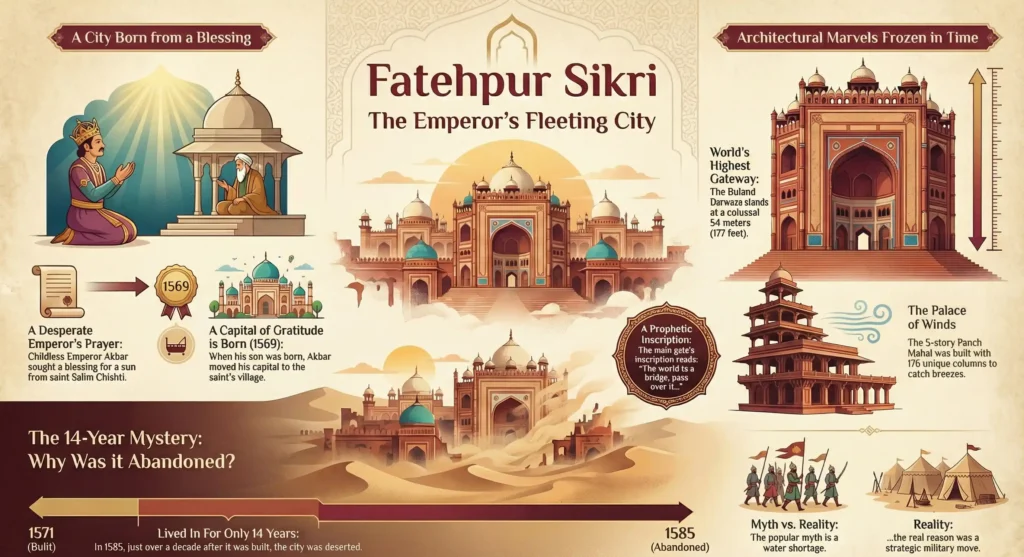
Near Agra, in a village called Sikri, lived a Sufi holy man named Shaikh Salim Chishti. Akbar came to him with his sorrow, and the saint promised that a son would be born.
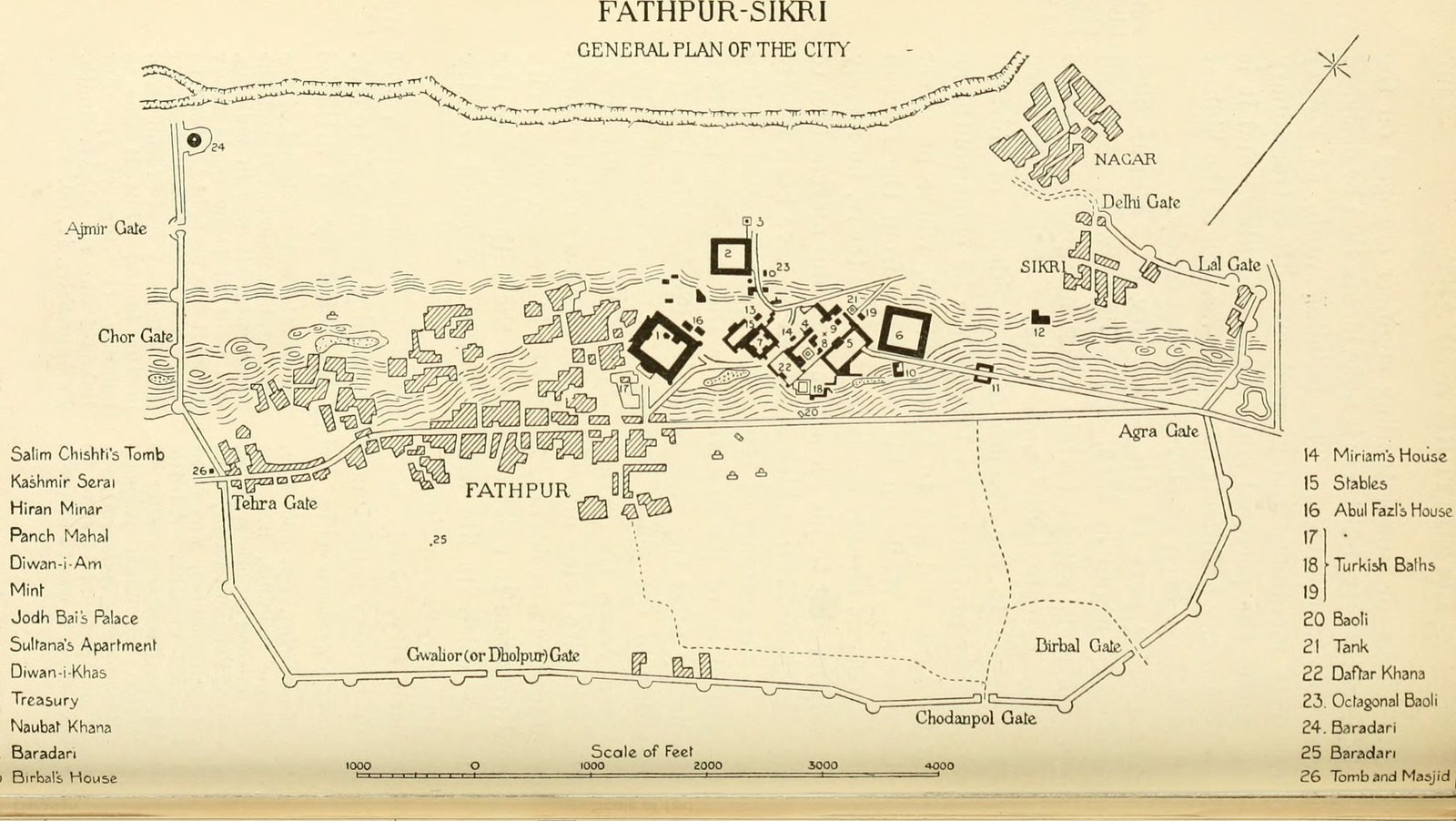
In 1569, in that very village, Prince Salim arrived, the boy who would one day rule as the emperor Jahangir. Akbar was overjoyed. In thanks, he decided to build his brand-new capital on the ridge at Sikri, close to the saint who had blessed him. After a great victory in the region of Gujarat, he gave the city its proud name: Fatehpur, the “city of victory.” Out of the red rock of the ridge, a whole capital rose in just a few years.
A city that tried to mix everything
Fatehpur Sikri was built to blend things together, and not only in stone. In its walls you can see Persian domes, Hindu pillars, and brackets carved in the style of Jain temples, all in the same warm red sandstone.
But the real blending Akbar wanted was between people. He built separate palaces for his wives, who came from different faiths, Hindu, Muslim and Christian. And in a special hall called the Ibadat Khana, the “house of worship,” he did something almost no ruler of his time would dare. He gathered wise men from many religions, Muslims and Hindus, Jains, Christians and Zoroastrians, sat them down together, and had them debate their beliefs while he listened late into the night.
Out of those long conversations, Akbar even tried to shape a new, gentle faith of his own. The whole city, in a way, was his great experiment: a test of whether people who prayed in very different ways could still live together as one.
The gate that told the truth
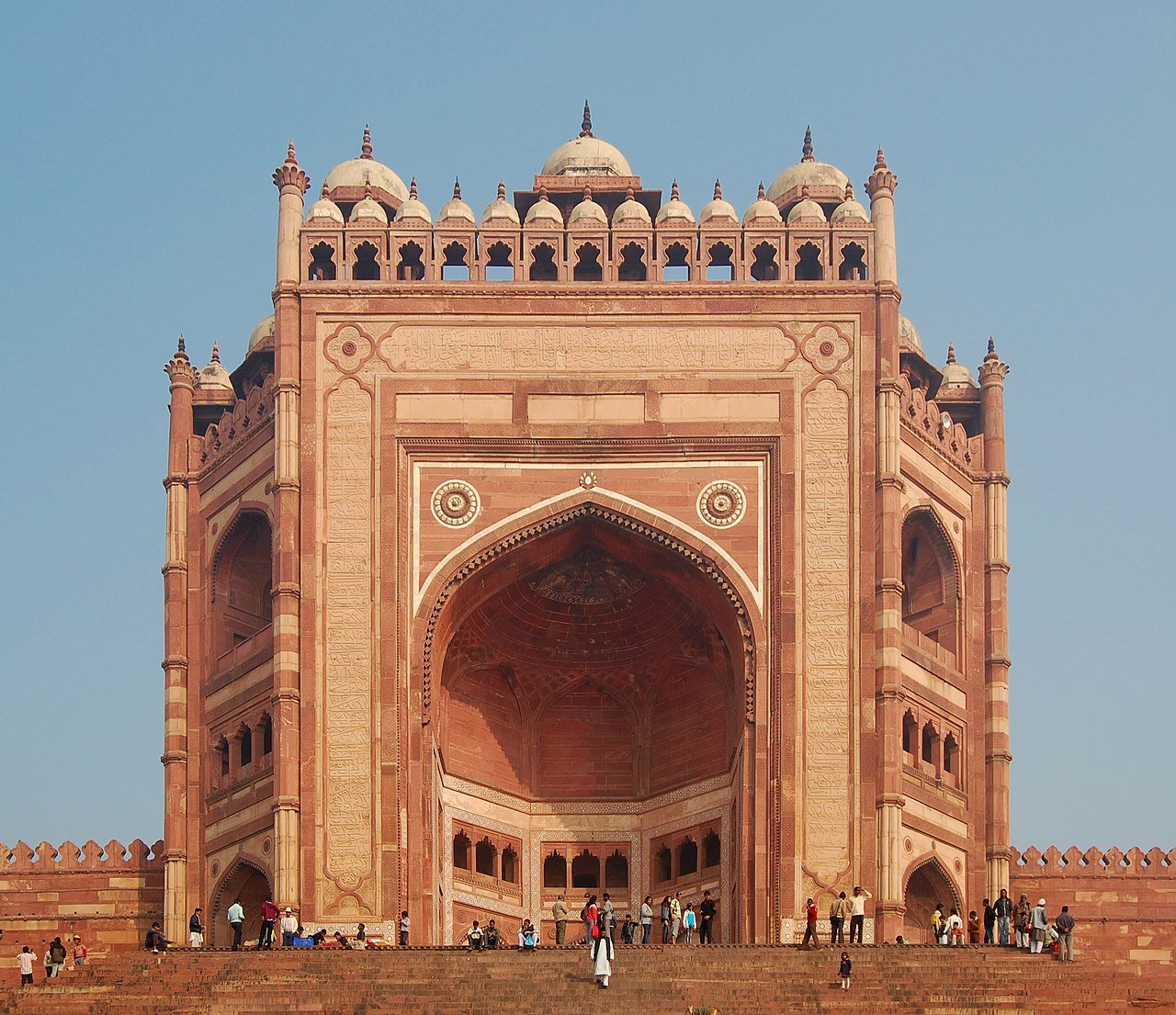
To mark his victory in Gujarat, Akbar raised an enormous gateway at the city’s mosque, the Buland Darwaza, the “gate of magnificence.” At about 54 metres, it is still the highest gateway in the world, and visitors feel tiny standing beneath it.
Carved into that gate are some words, said to be the words of Jesus.
The world is a bridge, pass over it, but build no houses on it.
It is a strange thing to write on the gateway of a shining new capital. You are meant to cross a bridge, not settle on it. And that quiet warning turned out to be far truer than anyone building the city could have guessed.
The jewels inside
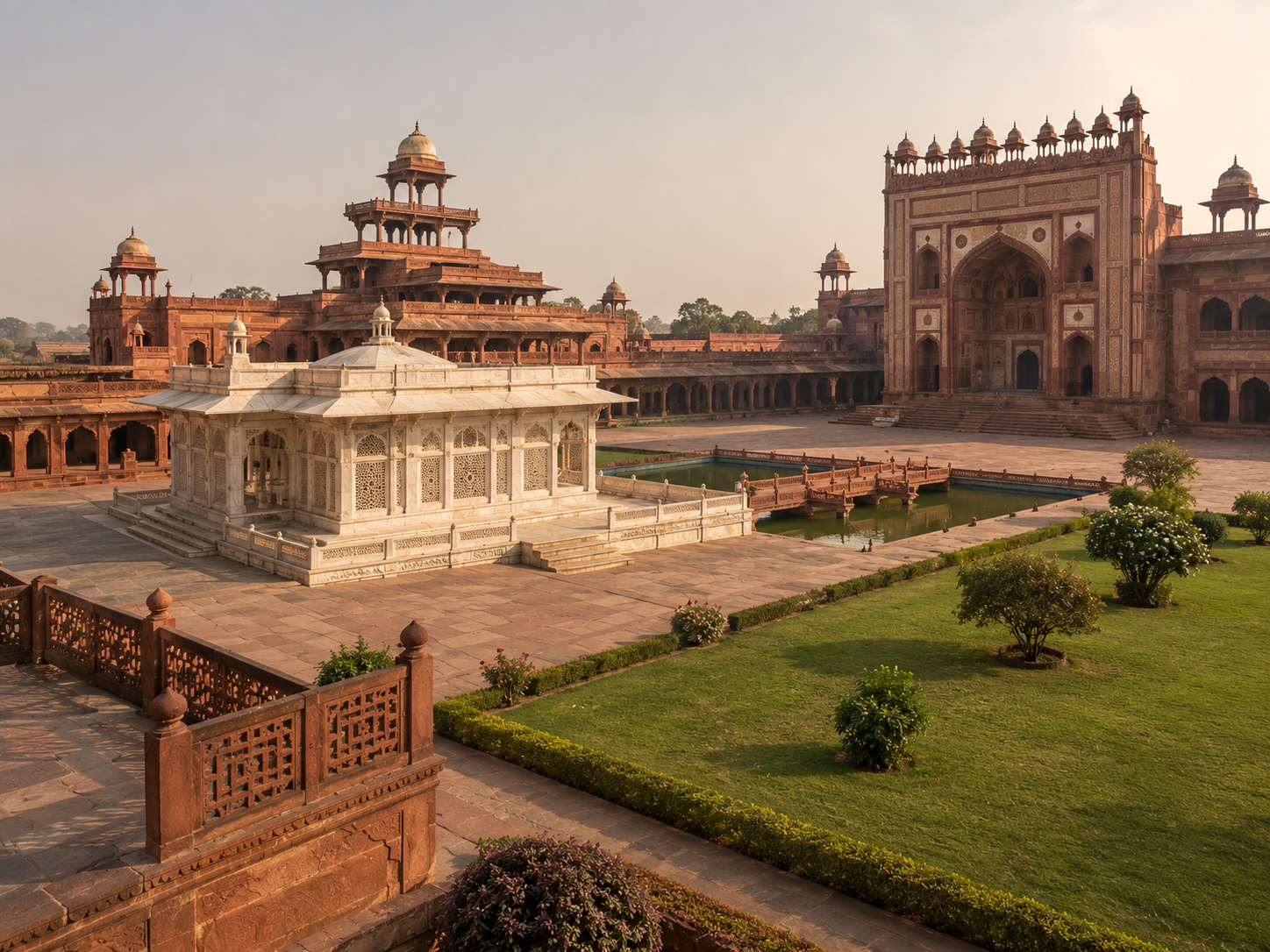
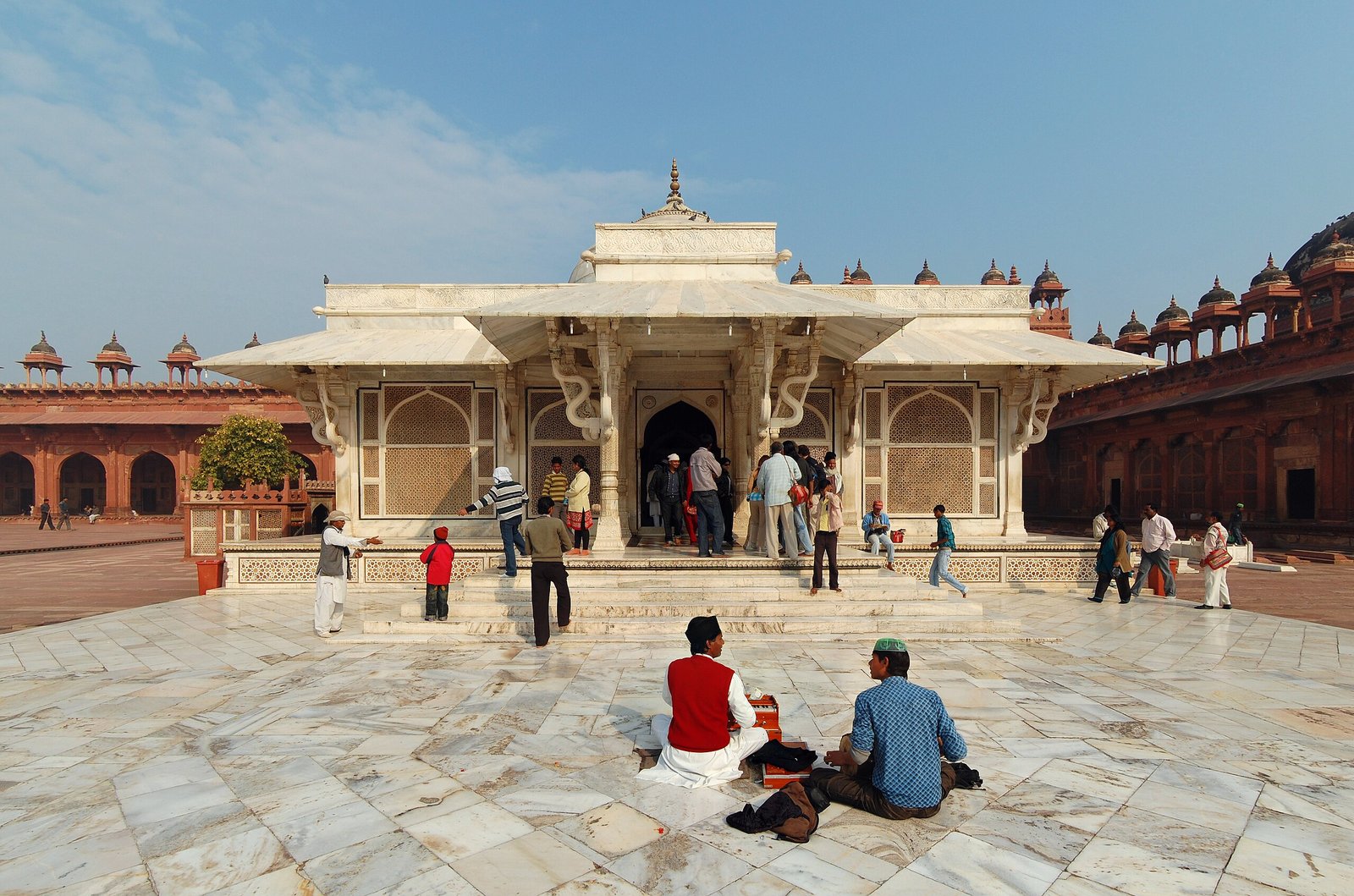
The city is full of wonders, each with its own character. In the middle of the great red courtyard glows the tomb of Salim Chishti, built of pure white marble, its stone screens carved as fine as lace. Even now, people come to tie threads to those screens and make a wish, many of them hoping, as Akbar once did, for a child.
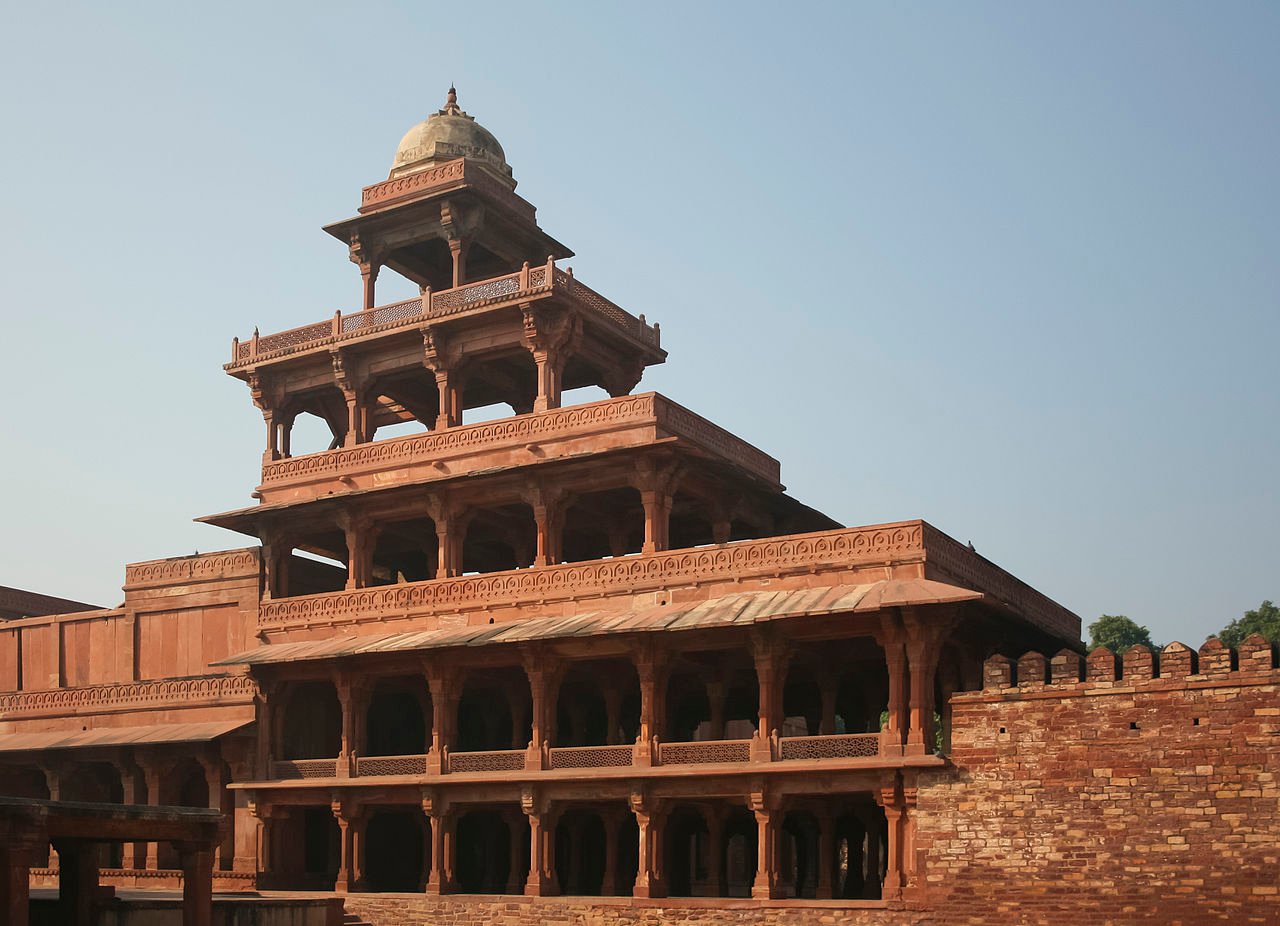
There is the Panch Mahal, an open palace of five storeys that grows smaller as it rises, built to catch the evening breeze and cool the royal family. It stands on 176 carved pillars, and no two of them are quite the same. There is the Anup Talao, the “peerless pool,” where Akbar’s legendary court singer Tansen is said to have performed. And there is the Hall of Private Audience, where the emperor’s seat rested on a single great pillar in the very centre of the room, as though he sat at the middle of the world.
The place gathered legends too. People still say that Akbar played a giant board game in one courtyard using living people, dressed in different colours, as the pieces.
The city empties
And then, in 1585, only about fourteen years after it had risen, Akbar packed up his entire court and left.
The popular story is that the city ran out of water. But that answer does not quite hold, because Fatehpur Sikri had a large man-made lake and clever waterworks to serve it. The likelier reason was harder and less romantic. Trouble was brewing on the empire’s north-western edge, and Akbar had to move his base to Lahore to defend his borders. He stayed away for years, and when he finally returned to the north, he settled again in Agra, not in his dream city on the ridge.
Slowly, the soldiers and servants and singers drifted away after him. The fires went cold, and the beautiful new capital was left to the wind.
A bridge, not a house
Fatehpur Sikri still stands today almost exactly as Akbar left it, a perfect, empty ghost city of red stone. That is the strange gift of its short life. Because no later king lived in it and changed it, we can walk straight into Akbar’s own moment, frozen and complete.
Wander its silent courtyards and you feel the sheer size of one man’s ambition. He wanted to build a grand capital, yes. But he also wanted, inside it, a place where India’s many faiths could sit in a single room and truly talk to one another. Both of those dreams faded. The city emptied in a handful of years, and the gentle shared faith he tried to begin mostly died with him.
Yet the great gate still carries his answer, for anyone who stops to read it. The world is a bridge. Akbar went ahead and built his house upon it anyway, and for a few short, shining years, that house was one of the wonders of the earth.
Mughal Gardens: Where Geometry Meets Paradise (A History & Travel Guide)

3 Ancient Secrets of Indian Rock-Cut Architecture: A Journey Through Stone
If you think you have rememberd everything about this topic take this QUIZ
Results


#1. What was the primary motivation for Emperor Akbar to build a new capital at the site of Sikri?
#2. The Buland Darwaza, the world’s highest gateway, was added to Fatehpur Sikri to commemorate which specific event?
#3. According to the provided text, what is the most likely historical reason for the abandonment of Fatehpur Sikri just 14 years after its completion?
#4. What was the unique architectural function of the five-story Panch Mahal?
#5. The inscription on the Buland Darwaza, quoting Jesus Christ, is described as a foreshadowing of what aspect of Fatehpur Sikri’s history?
#6. Which structure within Fatehpur Sikri is noted for being made of white marble, creating a stark contrast with the surrounding red sandstone buildings?
#7. According to a legend mentioned in the text, what did Akbar use as living game pieces for the game of Pachisi?
#8. What symbolic meaning is attributed to the massive, single pillar in the center of the Diwan-i-Khas (Hall of Private Audience)?
Why was Fatehpur Sikri abandoned?
While popular legend blames water scarcity, historians believe Akbar abandoned it in 1585 to move his capital to Lahore for military campaigns to secure the northwest frontier.
What is the height of Buland Darwaza?
It stands approximately 54 meters (177 feet) tall from the ground level, making it the highest gateway in the world.
Who built the Tomb of Salim Chishti?
Emperor Akbar commissioned the original tomb, but later Mughal emperors, including Jahangir, added the exquisite white marble and mother-of-pearl decorations.
How far is Fatehpur Sikri from Agra?
It is located approximately 37 to 40 kilometers west of Agra and can be reached in about an hour by road.
Sources and references
- Wikipedia (“Fatehpur Sikri” and “Buland Darwaza”) and UNESCO — the founding by Akbar, the capital’s span from 1571 to about 1585, the red-sandstone Indo-Islamic architecture, the 54-metre Buland Darwaza built to mark the Gujarat victory, and the 1986 World Heritage listing.
- ASI and heritage guides (Holidify, Taj Mahal tour guides) — the Ibadat Khana built in 1575 where Akbar held inter-faith debates and laid the foundations of the Din-i-Ilahi, the Panch Mahal’s 176 columns and wind-catcher design, the Anup Talao pool linked to the singer Tansen, and the palaces for wives of different faiths.
- The Buland Darwaza inscription — the saying attributed to Jesus (“Isa, son of Mariam”): that the world is a bridge to pass over rather than build houses upon, carved on the victory gate.
- Encyclopaedia Britannica and standard Mughal histories — the Salim Chishti prophecy, the birth of Prince Salim (the future Jahangir) in 1569, the naming of the city as “Fatehpur,” and Akbar’s move to Lahore around 1585 to secure the north-western frontier rather than a simple water shortage.
- Original Curious Indian article (“Fatehpur Sikri: The Ghost City”) — the tomb of Salim Chishti and its thread-tying tradition, the Diwan-i-Khas central pillar, the pachisi “living pieces” legend, and the framing of the abandonment as strategic rather than due to water.
Author


Exploring the Soul of Bharat through History, Science, Culture, and its Diversity
Our Mission
Curious Indian is a definitive knowledge portal dedicated to chronicling the events, personalities, and cultural shifts that defined the Indian subcontinent. From the ancient Vedic Period to the complexities of 21st-century politics, our goal is to provide deep-dive analysis that inspires.
Editorial Standards & E-E-A-T
Every article published under our brand undergoes a rigorous fact-checking process. We prioritize primary historical records, academic citations, and credible archives to ensure our readers receive accurate, high-authority information.
Historical Integrity Directly sourcing from ASI archives and academic journals.Topical Authority Comprehensive clustering of Indian Science, Biographies, and Wars.Managed by Paripurna Datta and TEAM | Dedicated to the Knowledge of India.