From a homesick Babur to the tomb-gardens that shaped the Taj Mahal
Babur, the first Mughal emperor, won India and then quietly hated it. He found the plains too hot, too dusty, and, in his own words, badly short of running water. He was homesick for the cool, green gardens of Kabul that he had left behind.
So one of the first things this conqueror did in his new land was build a garden. That single act of homesickness began a love affair that lasted two hundred years. For the Mughals, a garden was never just a patch of green to stroll in. It was an attempt to build heaven itself, right here on the hot Indian earth.
A map of paradise
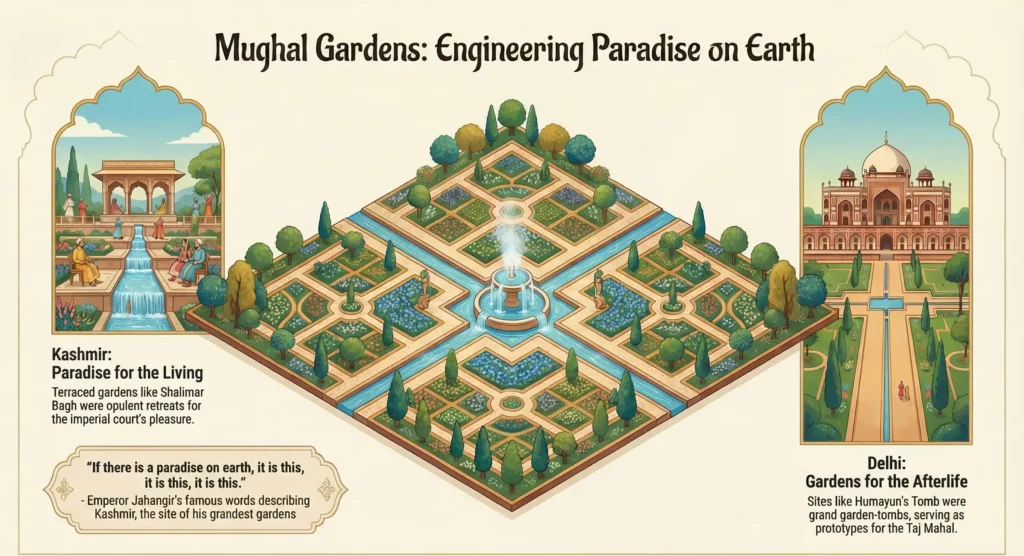
At the heart of every Mughal garden is a simple, powerful shape called the charbagh, which means “four gardens.”
The idea is a square, split into four equal parts by paths or by channels of running water. The number four was not chosen by accident. In Islam, paradise, or Jannat, is described as a place watered by four rivers: of water, of milk, of wine, and of honey. So the garden was made as a small model of heaven, drawn out in earth and water for people to walk inside.
Where the four channels crossed, at the very centre, the Mughals often placed something important, a pavilion or a tomb. That middle point stood for the meeting place of the human and the divine.
The Garden as an Air Conditioner
These gardens were beautiful, but they were also clever machines built to beat the heat.
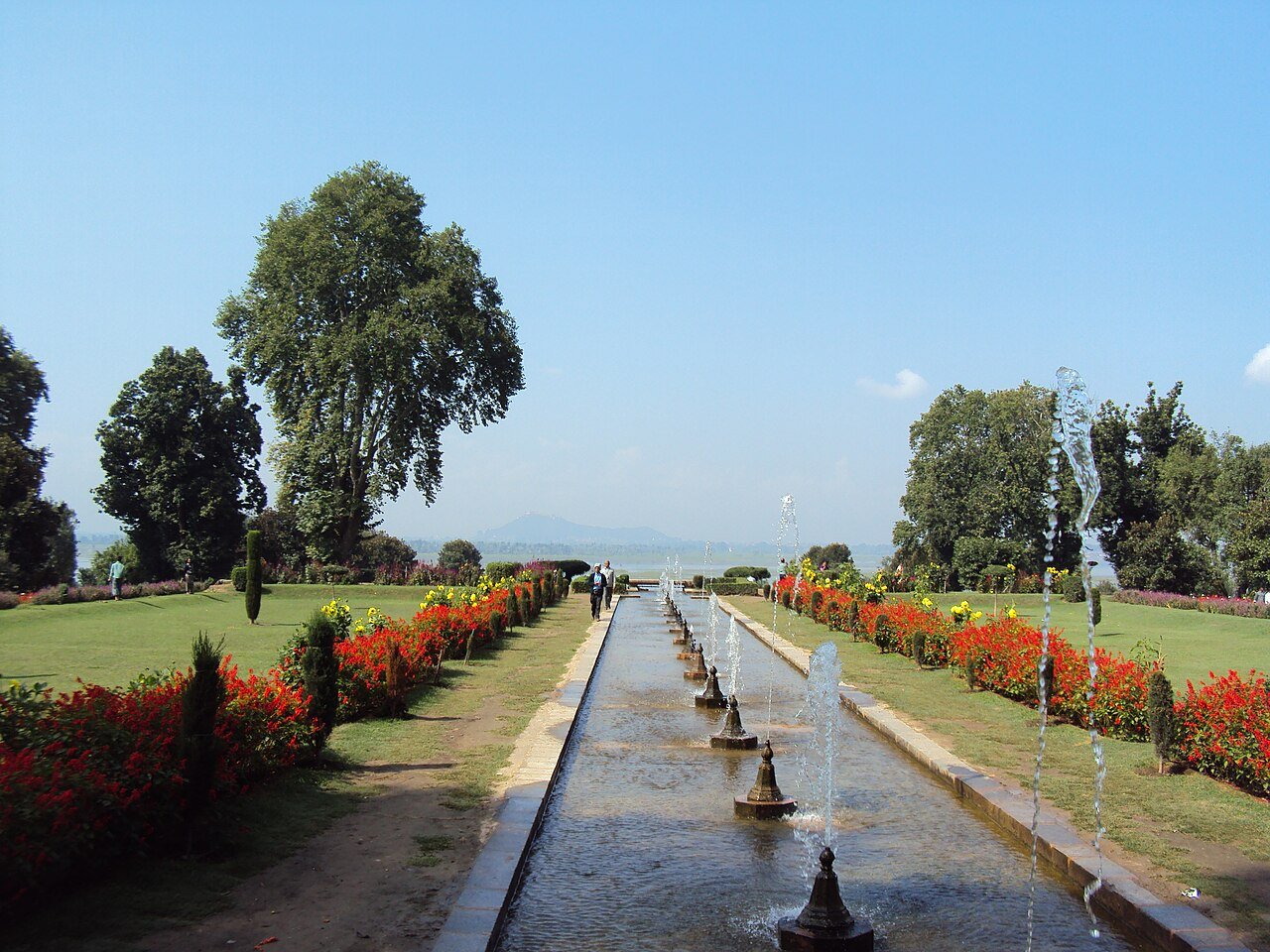
On the burning plains, the Mughals used the simple pull of gravity to send water flowing downhill through their channels and fountains. In places the water ran down carved stone ramps called chadars, rippling and hissing as it went, throwing a fine cool mist into the air and filling the garden with a soft, soothing sound.
Add the deep shade of the trees and the breeze skimming off the water, and a walled square became a pocket of cool air in a hot land. It was natural air conditioning, hundreds of years before the machine was invented.
Paradise found in Kashmir
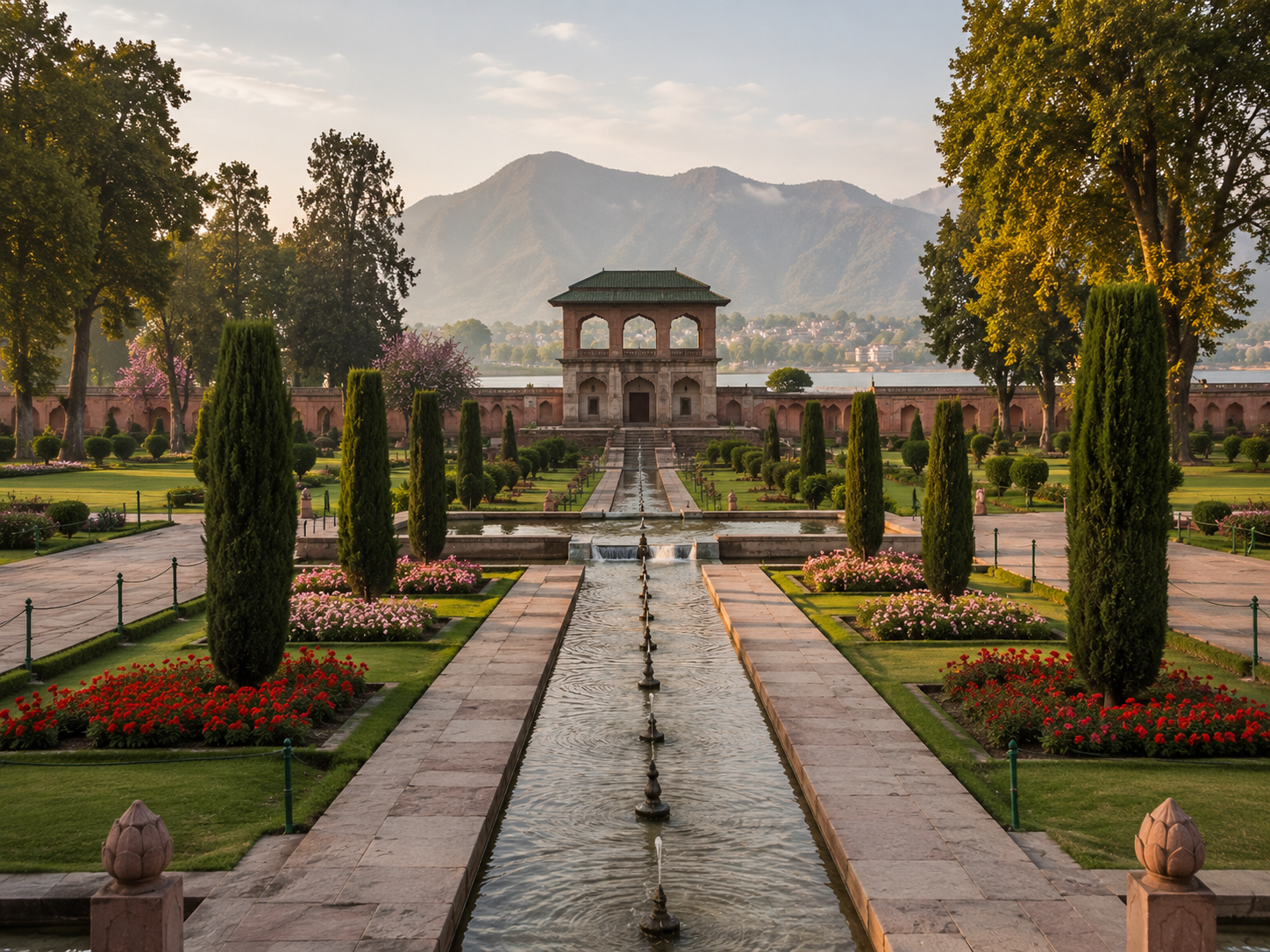
When the Mughals reached the cool valley of Kashmir, ringed by mountains and centred on a great lake, they felt they had walked straight into paradise without having to build it.
The most famous words about Kashmir were written by the 14th-century poet Amir Khusrau: “if there is a paradise on earth, it is this, it is this, it is this.” The emperor Jahangir is said to have spoken them, overwhelmed by the valley’s beauty.
Here the garden reached its finest form. Jahangir built the grandest of them all, the Shalimar Bagh, or “abode of love,” in 1619 for his wife Nur Jahan, and his son Shah Jahan later completed it. It falls in three descending steps, one terrace for the public court, one for the private court, and one for the royal women. On the highest terrace sits a pavilion of black marble, kept for the most private gatherings, surrounded by fountains and grand old chinar trees.
A short way off is the Nishat Bagh, the “garden of joy,” built by Nur Jahan’s brother Asif Khan in 1633. It rises in twelve terraces, one for each sign of the zodiac, and looks straight out over the shining water of Dal Lake.
There is even a jealous little tale attached to it. Shah Jahan is said to have envied the beauty of Nishat so much that he ordered its water supply cut off, until a loyal servant risked his life to quietly turn it back on.
5 Timeless Secrets of Rajasthani Miniature Painting and Courtly Life
Paradise for the dead
On the plains, the Mughals put the very same paradise-garden to a solemn new use. If the garden was a picture of heaven, then it was the perfect place to lay the dead to rest.
The first great example was Humayun’s Tomb in Delhi, built by the emperor’s widow, Bega Begum, and finished around 1570. It is a huge, exact charbagh with a great domed tomb standing at its centre, a dead emperor laid to sleep in the middle of a model of paradise.
Humayun’s Tomb, completed around 1570, was the first grand Mughal garden-tomb in India, and its design became the blueprint for the Taj Mahal.
That is the quiet link most visitors miss. The most famous building on earth, the Taj Mahal, is also a tomb set at the edge of a paradise garden, and it grew directly out of the pattern first perfected here in Delhi. Shah Jahan’s daughter Roshanara later built her own garden in the city too, now a green woodland that still remembers its royal past.
Life of Mahavira: From Prince Vardhamana to Great Conqueror
The order behind the beauty
Every Mughal garden was really making the same bold claim. It said that the heat, the dust and the messiness of the world could be tamed by human hands into something cool, ordered and close to perfect.
Look at the straight paths, the two matching halves, the water bent to obey a plan, the trees standing in neat rows. A Mughal garden was a place where a poet and a mathematician could both feel at home, because it was beautiful and exact at the same time.
Still paradise, if you look
Babur’s homesickness for one cool Kabul garden grew, over two centuries, into some of the loveliest spaces human beings have ever made. Heaven, drawn as four green squares around a thread of running water.
Walk under a chinar tree in Shalimar today, or follow the still channels around Humayun’s Tomb, and you are standing inside a stubborn and rather wonderful dream. The Mughals believed paradise did not have to wait for the afterlife. With enough water, stone and shade, they thought, it could be built right here, and walked through on an ordinary afternoon.
Mauryan Empire: How Chandragupta and Ashoka United a Subcontinent


7 Secrets of Dravidian Temple Architecture and the Shadowless Vimana
If you think you have rememberd everything about this topic take this QUIZ
Results


#1. What core concept from the Quran is represented by the geometric division of a Charbagh garden into four quadrants by water channels?
#2. Which Mughal garden was designed with twelve terraces, specifically to symbolize the signs of the Zodiac?
#3. What was the primary practical function of the ‘chadars’ or carved stone chutes in Mughal gardens?
#4. According to the source material, Humayun’s Tomb is architecturally significant because it established the prototype for which later, more famous structure?
#5. What was the personal motivation behind Emperor Babur building the first Mughal garden in India?
#6. What distinguishes the three descending terraces of Shalimar Bagh?
#7. According to the provided anecdote, what was the outcome of Shah Jahan’s jealousy towards Nishat Bagh?
#8. The Black Pavilion in Shalimar Bagh, located on the top terrace, was intended for what purpose?
FAQ:
What is the main feature of a Mughal Garden?
he Charbagh layout, which divides the garden into four quadrants using water channels or walkways, symbolizing the four rivers of Paradise.
Who introduced Mughal Gardens to India?
Emperor Babur, the first Mughal emperor, introduced the concept in the early 16th century because he missed the gardens of Central Asia.
Which is the largest Mughal Garden in Kashmir?
Shalimar Bagh in Srinagar is the most prominent and grandest of the surviving imperial gardens.
Are Mughal Gardens open to the public?
Yes, most historic gardens like Shalimar Bagh, Nishat Bagh, and the gardens surrounding Humayun’s Tomb are open to tourists daily.
Sources and references
- Wikipedia (“Mughal gardens”) and MIT course notes on Mughal gardens — the charbagh (four-part) layout, its link to the four rivers of paradise, Babur introducing the garden tradition from Central Asia, and Jahangir’s role in building the royal gardens of Kashmir.
- Encyclopaedia Britannica and heritage accounts — Shalimar Bagh built by Jahangir in 1619 for Nur Jahan and completed by Shah Jahan, its three terraces and black-marble pavilion, and Nishat Bagh built by Asif Khan in 1633 with twelve terraces overlooking Dal Lake.
- Sources on the “paradise on earth” couplet — the verse attributed to the 14th-century poet Amir Khusrau, its long association with Kashmir, its inscription at the Shalimar garden, and its popular link to the emperor Jahangir.
- Records on Humayun’s Tomb (ASI / UNESCO) — the tomb commissioned by Humayun’s widow Bega Begum and completed around 1570, its large and precise charbagh, and its status as the model that influenced the Taj Mahal.
- The Baburnama and general Mughal histories — Babur’s dislike of the Indian plains’ heat, dust and lack of running water, and his building of the first Mughal garden, the Ram Bagh, at Agra out of homesickness for Kabul.
- Original Curious Indian article (“Mughal Gardens”) — the chadar water chutes used for cooling mist and sound, the four rivers of honey, wine, milk and water, the anecdote of Shah Jahan cutting off Nishat’s water, and the Roshanara Bagh in Delhi.
Author


Exploring the Soul of Bharat through History, Science, Culture, and its Diversity
Our Mission
Curious Indian is a definitive knowledge portal dedicated to chronicling the events, personalities, and cultural shifts that defined the Indian subcontinent. From the ancient Vedic Period to the complexities of 21st-century politics, our goal is to provide deep-dive analysis that inspires.
Editorial Standards & E-E-A-T
Every article published under our brand undergoes a rigorous fact-checking process. We prioritize primary historical records, academic citations, and credible archives to ensure our readers receive accurate, high-authority information.
Historical Integrity Directly sourcing from ASI archives and academic journals.Topical Authority Comprehensive clustering of Indian Science, Biographies, and Wars.Managed by Paripurna Datta and TEAM | Dedicated to the Knowledge of India.