How the land of non-violence built the bomb, and why
On the morning of 18 May 1974, in the emptiness of the Rajasthan desert, India set off its first nuclear bomb. When it worked, the scientists sent their Prime Minister a short coded message of triumph.
“The Buddha has smiled.”
Stop and sit with everything packed into those four words. India, the land of ahimsa, the civilisation of Gandhi and of the Buddha himself, the culture that had preached non-violence to the world for two and a half thousand years, had just built the most violent weapon ever devised by human beings. And it had named that weapon after the gentlest teacher who ever lived, detonated it on his birthday, and told the world it was “peaceful.”
That was not a slip, or a joke. It was the perfect, deeply uncomfortable emblem of one of the hardest questions any nation ever has to answer. This is the story of India’s first nuclear test, and of the peaceful bomb.
The dangerous neighbourhood
To understand why the land of non-violence reached for such a weapon, you have to stand where India was standing in the early 1970s, and feel how exposed it felt.
In 1962, India had suffered a swift and humiliating defeat in a border war with China. Then, just two years later, in 1964, China exploded a nuclear bomb of its own. Overnight, a huge and hostile power on India’s own border held the ultimate weapon, and India had no answer to it. The fear was not abstract. In 1971, during India’s war with Pakistan, the United States sent a task force led by a nuclear-armed aircraft carrier steaming toward the Bay of Bengal, a naked act of intimidation against India.
The lesson New Delhi drew was as old as power itself: the strong do as they please, and the weak endure what they must, and a nation without the bomb could be bullied by any nation that had one.
Whatever anyone may think about nuclear weapons, the fear that drove India was not invented. It was real, and it was reasonable, and it demanded an answer.
The Emergency: When India’s Democracy Was Put in Chains
The secret in the sand
The answer was built in almost total secrecy, and the way it was done remains genuinely impressive.
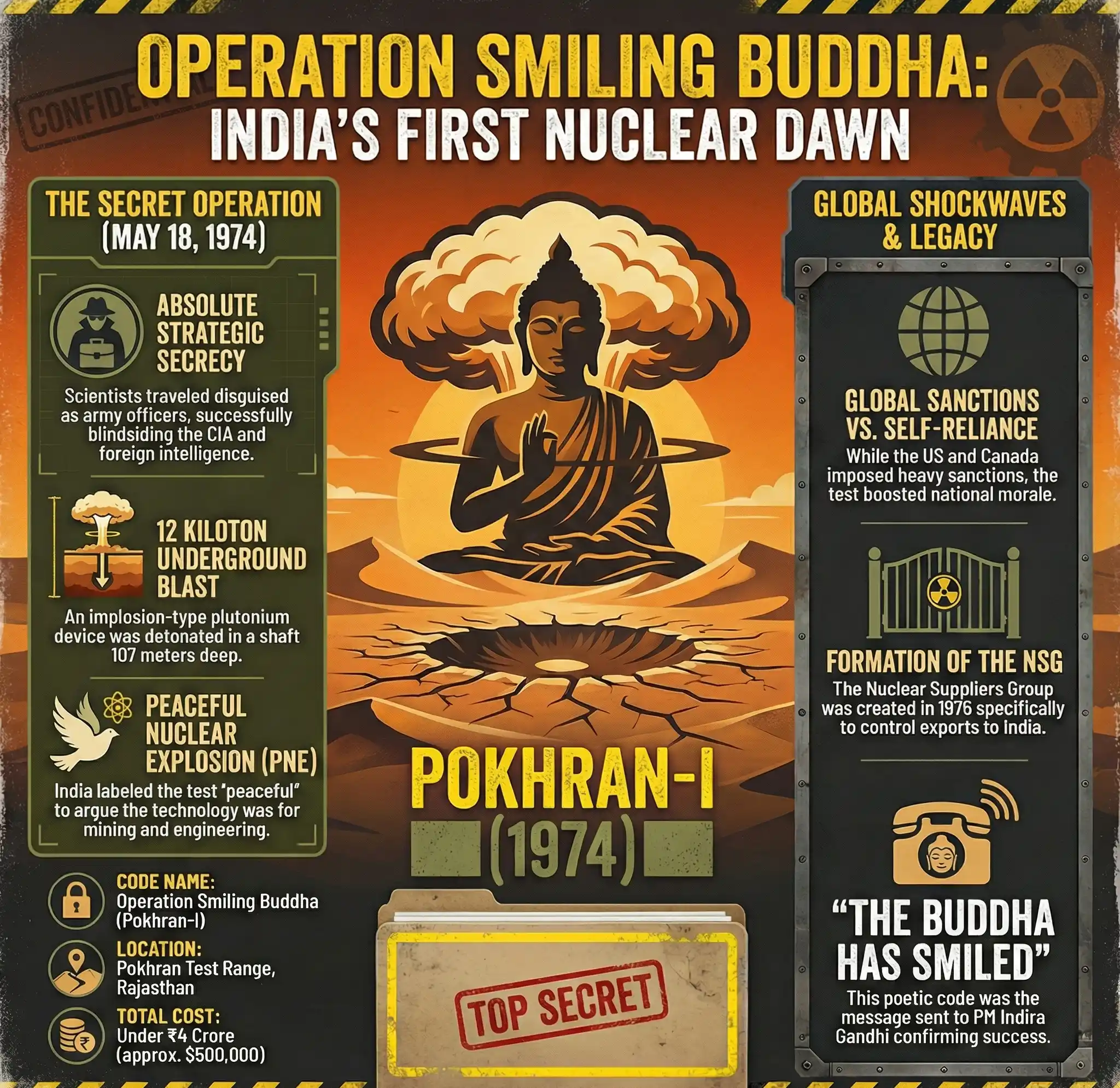
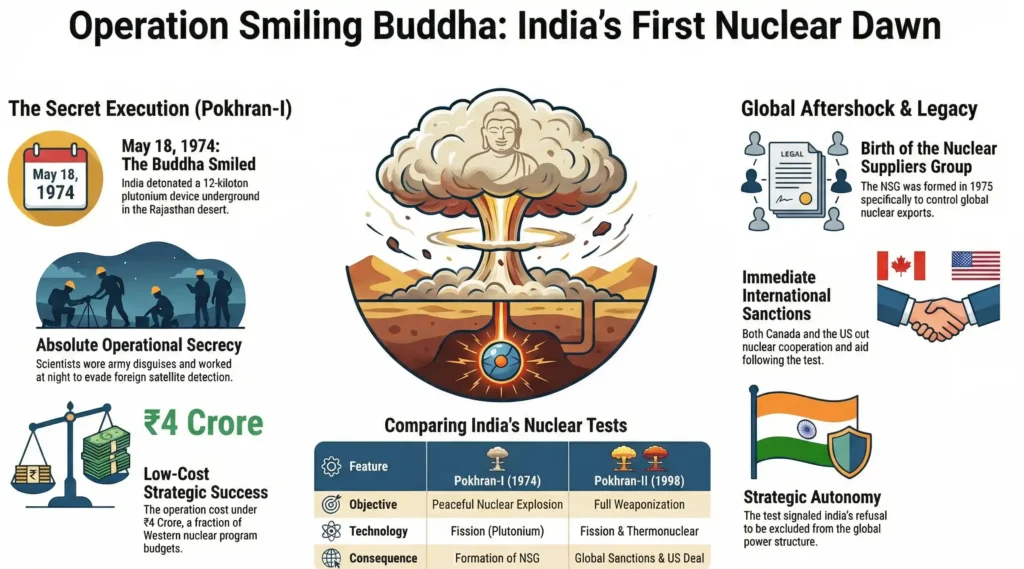
A small team from the Bhabha Atomic Research Centre, led by scientists like Raja Ramanna and Homi Sethna, worked in the deepest quiet. They travelled to the Pokhran test range disguised as army officers, so that foreign spies would notice nothing. Soldiers dug the deep shaft for the device by night, to hide their work from passing satellites. The operation was so tightly held that India’s own Defence Minister was reportedly told only days beforehand, and the mighty American intelligence machine never saw it coming at all.
And they did it on a shoestring. The whole test is estimated to have cost less than four crore rupees, a tiny sum, a fraction of what the rich nations had spent to master the same science.
A poor country’s scientists, working with limited money and borrowed time, mastered the most complex and terrible technology on earth, and did it for less than the price of a few fighter jets.
Judged purely as a feat of science and secrecy, it was brilliant, and the pride Indians took in it was fairly earned.
The peaceful bomb
The device was buried more than a hundred metres underground, so that when it fired there was no mushroom cloud rising over the desert, only the ground heaving and a crater forming. And on the strength of that, India told the world something almost no one believed. It called the blast a “Peaceful Nuclear Explosion,” insisting the technology was meant for peaceful jobs like mining and moving earth, not for war.
It strained belief, and it was meant to. You do not build an implosion device of plutonium, the same basic kind of bomb that destroyed Nagasaki, in order to dig canals. The “peaceful” label was a diplomatic fig leaf, and most of the world saw straight through it.
But beneath the fig leaf lay something that was not fake at all: a genuine and agonising moral question, the same one that every nuclear power has been forced to face.
Can it ever be right to build a weapon that could kill millions of people, in the name of keeping your own people safe? India, the very homeland of non-violence, looked that question in the eye and answered yes.
The Smiling Buddha is what that yes looks like. Not a lie exactly, and not a simple triumph either, but a nation’s uneasy attempt to wrap the most frightening decision it had ever made in the language of the peace it had always claimed to stand for.
10 Days of Darkness: The True Story of Operation Blue Star
The mirror
The world reacted with fury and alarm. Canada, which had supplied the reactor whose plutonium India used, angrily cut off all nuclear cooperation. The United States imposed sanctions. Shaken, the great powers banded together to form the Nuclear Suppliers Group, an exclusive club created in large part to lock India out and to stop anyone else from following its path. For years, India paid for its bomb in isolation.
But the deepest consequence was not the sanctions. It was a mirror.
Just as India had felt naked and afraid when China got the bomb, now Pakistan felt naked and afraid because India had it. Pakistan’s leader swore that his country would build a bomb of its own even if its people had to eat grass to pay for it, and in time it did exactly that. The very logic that had driven India, that no rival could be allowed to hold this power over us, now drove its neighbour with equal force.
India’s own search for safety taught its neighbour the very same fear, and drove it toward the very same terrible weapon.
This is the tragic engine of every arms race, and there are no clean hands in it and no single villain. India feared China; Pakistan feared India; each did what it believed it had to do to survive. And when the smoke cleared, the subcontinent held not one but two nuclear-armed rivals, glaring at each other across one of the most bitter borders on earth.
Safety and terror
So was the peaceful bomb a triumph or a tragedy? Here, more than almost anywhere, the honest answer is that it is truly both, and that serious, thoughtful, patriotic people still argue about where the balance lies.
On one side stands a real and weighty argument: that the bomb worked. Since India and Pakistan both openly became nuclear powers, they have skirmished and threatened and come to the brink, but they have never again fought the kind of full-scale war they fought three times in the decades before, because for both of them the cost of total war became simply unthinkable. By this reading, a terrible weapon has kept a terrible peace, and India’s scientists handed their country a shield that has so far never had to be used.
On the other side stands an unease just as serious: that a billion and a half people now live, permanently, under a weapon that could erase them in an afternoon, and that a safety bought this way is really a kind of mutual hostage-taking, in which each side’s security rests entirely on its power to annihilate the other.
Both of those things are true at the very same time. That is not a flaw in India’s story. It is the permanent condition of the whole nuclear age, ours as much as anyone’s.
In a dangerous world, nations come to believe the only way to be safe is to hold the power to destroy everything, until safety and terror become the very same thing.
The deepest meaning of the Smiling Buddha, then, is neither simple national pride, though the pride is real, nor simple national shame, for the fear that drove it was real too. It is the oldest and darkest paradox of power, and in India’s case that terrible thing was given the gentle, smiling face of the Buddha. India did not invent the paradox. On one May morning in the desert, it simply joined the small handful of nations condemned to live inside it. Whether that has made India safer, or the world more dangerous, or somehow both at once, is a question the Buddha’s smile has never quite answered, and perhaps never will.
Operation Vijay: How India Won the High-Altitude War of 1999
Pokhran-II Nuclear Tests 1998: How Operation Shakti Changed History
If you think you have remembered everything about this topic take this QUIZ
Results


#1. What was the official code name for India’s first nuclear test conducted in 1974?
#2. Who was the Prime Minister of India when the first nuclear test was conducted?
#3. The successful detonation led to the formation of which international group to control nuclear exports?
#4. On which significant day was the test conducted, leading to the message “The Buddha has smiled”?
#5. Which country immediately cut off nuclear cooperation with India, accusing it of violating agreements regarding the CIRUS reactor?
#6. The nuclear device was detonated in which location?
#7. How did the Indian government officially describe the 1974 test?
#8. Which legendary scientist was one of the key figures orchestrating the test alongside Homi Sethna?
What was the code name for India’s first nuclear test?
The code name was Operation Smiling Buddha (Pokhran-I).
When did India conduct its first nuclear test?
It was conducted on May 18, 1974.
Who was the Prime Minister of India during the 1974 nuclear test?
Indira Gandhi was the Prime Minister who authorized the test.
Why was it called a “Peaceful Nuclear Explosion” (PNE)?
India maintained that the test was for peaceful purposes, such as mining and earth excavation, rather than for building offensive weapons, to avoid violating international norms.
Which scientists were involved in the 1974 test?
Key scientists included Dr. Raja Ramanna, Dr. Homi Sethna, P.K. Iyengar, and Dr. R. Chidambaram.
Sources & References
- Encyclopaedia Britannica (“Smiling Buddha” and India’s nuclear programme) — the 1974 test, its security context, and its consequences.
- International Atomic Energy Agency (India’s 1974 statement, INFCIRC/207) — India’s official description of the test as a “peaceful nuclear explosion.”
- The Nuclear Suppliers Group (its origins) — the export-control group formed by the major powers in response to the 1974 test.
- Bhabha Atomic Research Centre (BARC) — the scientific institution that designed and conducted the test.
Author


Exploring the Soul of Bharat through History, Science, Culture, and its Diversity
Our Mission
Curious Indian is a definitive knowledge portal dedicated to chronicling the events, personalities, and cultural shifts that defined the Indian subcontinent. From the ancient Vedic Period to the complexities of 21st-century politics, our goal is to provide deep-dive analysis that inspires.
Editorial Standards & E-E-A-T
Every article published under our brand undergoes a rigorous fact-checking process. We prioritize primary historical records, academic citations, and credible archives to ensure our readers receive accurate, high-authority information.
Historical Integrity Directly sourcing from ASI archives and academic journals.Topical Authority Comprehensive clustering of Indian Science, Biographies, and Wars.Managed by Paripurna Datta and TEAM | Dedicated to the Knowledge of India.