How Aurangzeb won the largest Mughal empire and lost its future
Say the name Aurangzeb in India today and you will start an argument.
To many people he is the great villain of the country’s history: a fanatical emperor who taxed and persecuted non-Muslims, pulled down temples, and executed a Sikh Guru. To a number of modern historians, he is one of the most misunderstood rulers India has ever had, a man flattened by centuries of legend into a cartoon.
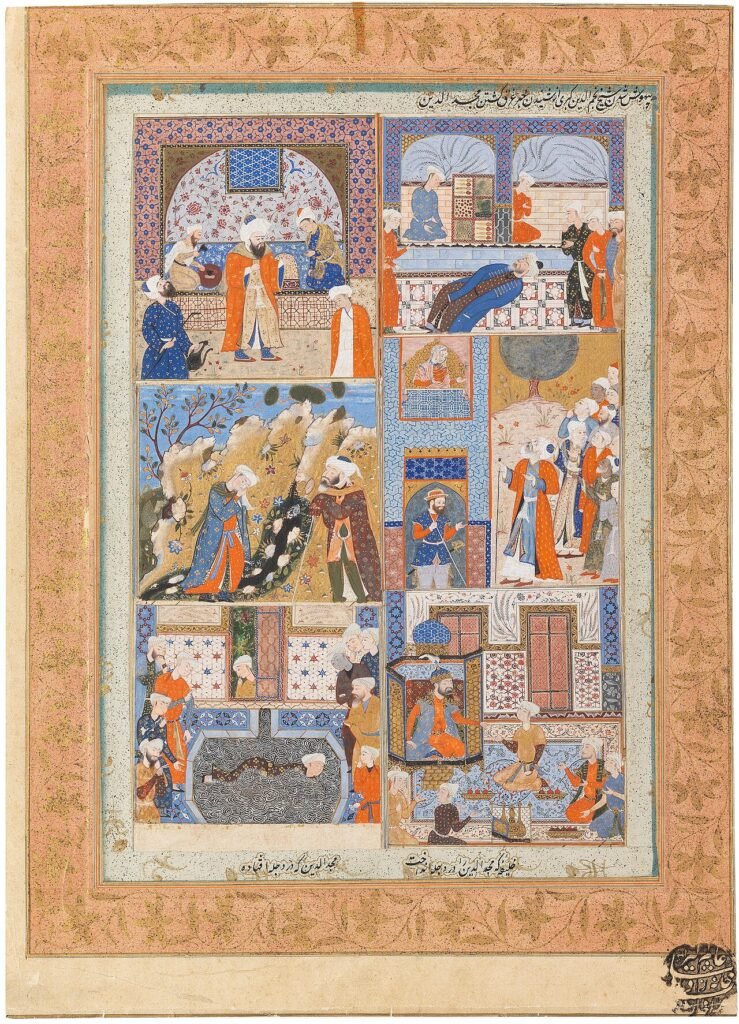
Source: Wikimedia Commons · Bonhams · Public domain
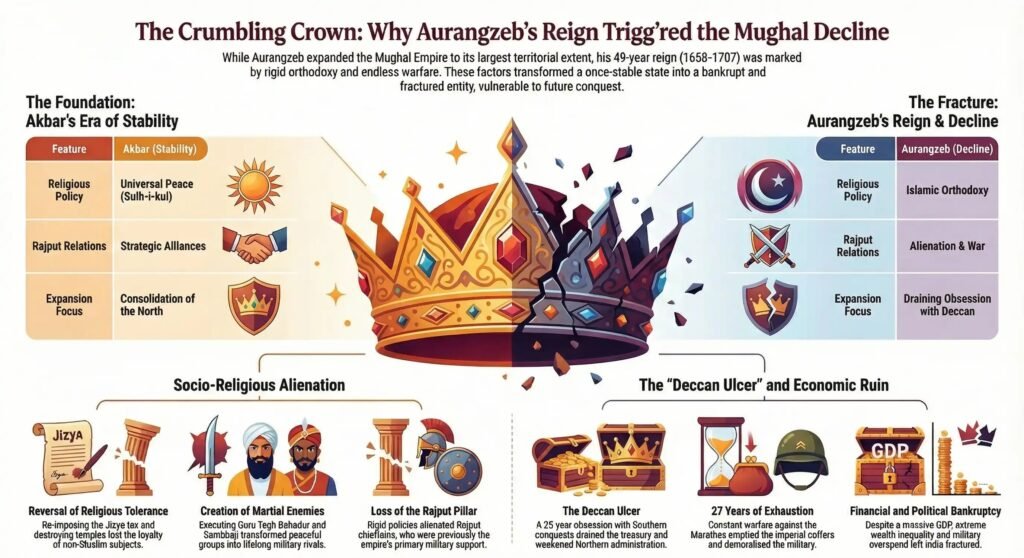
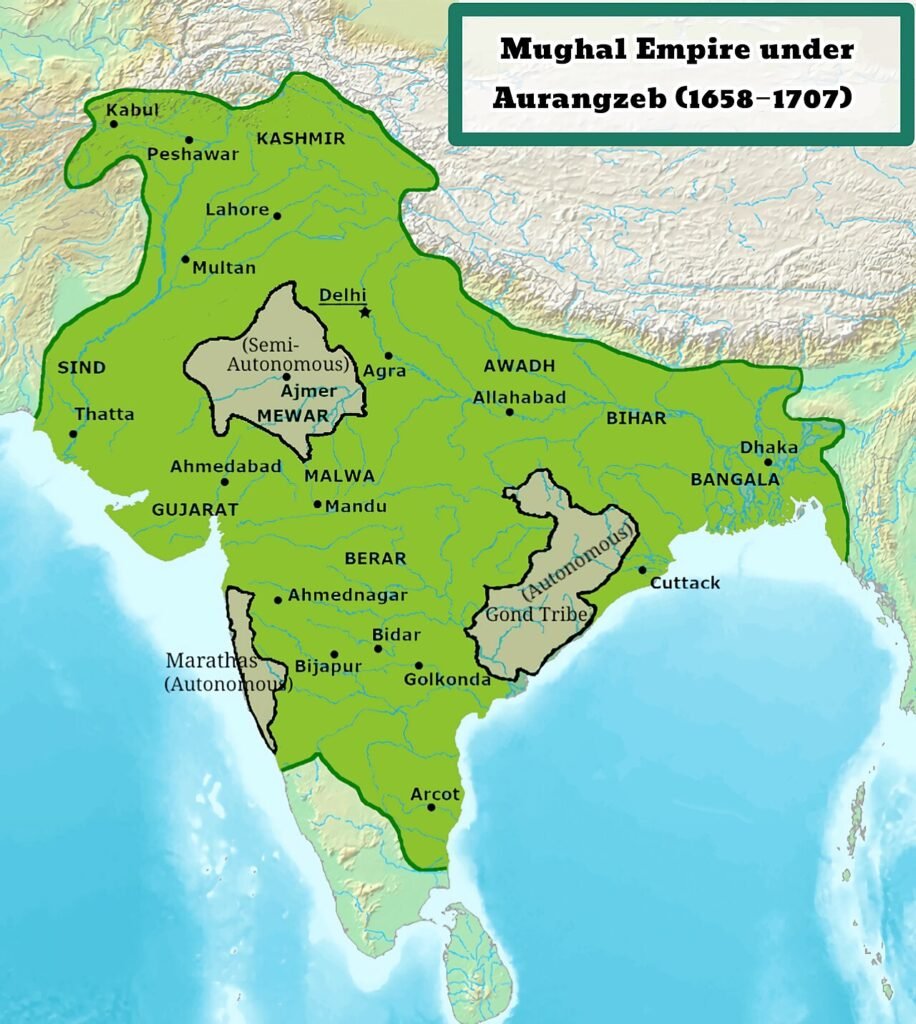
The truth, as usual, is more tangled than either side’s poster. Aurangzeb ruled for forty-nine years. He pushed the Mughal Empire to the largest it would ever be, stretching across almost the whole subcontinent. And his reign is also where that mighty empire began its long slide into ruin.
He is worth thinking about slowly, because he is a genuinely hard case. So let us try to look at the man, the good and the bad and the bitterly disputed, as clearly as we can.
The blood-soaked road to the throne
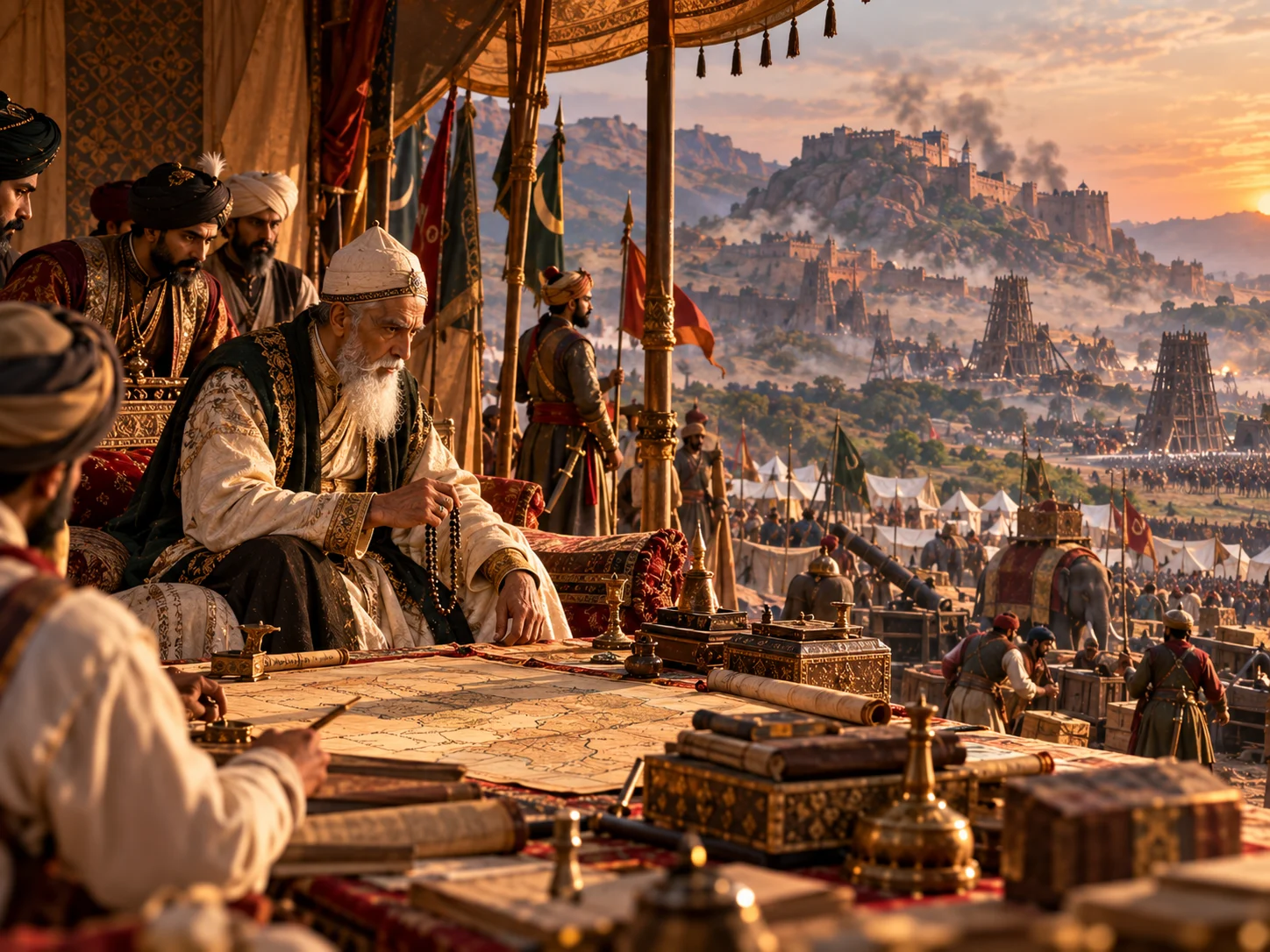
Aurangzeb did not simply inherit the throne. He fought his own brothers for it.
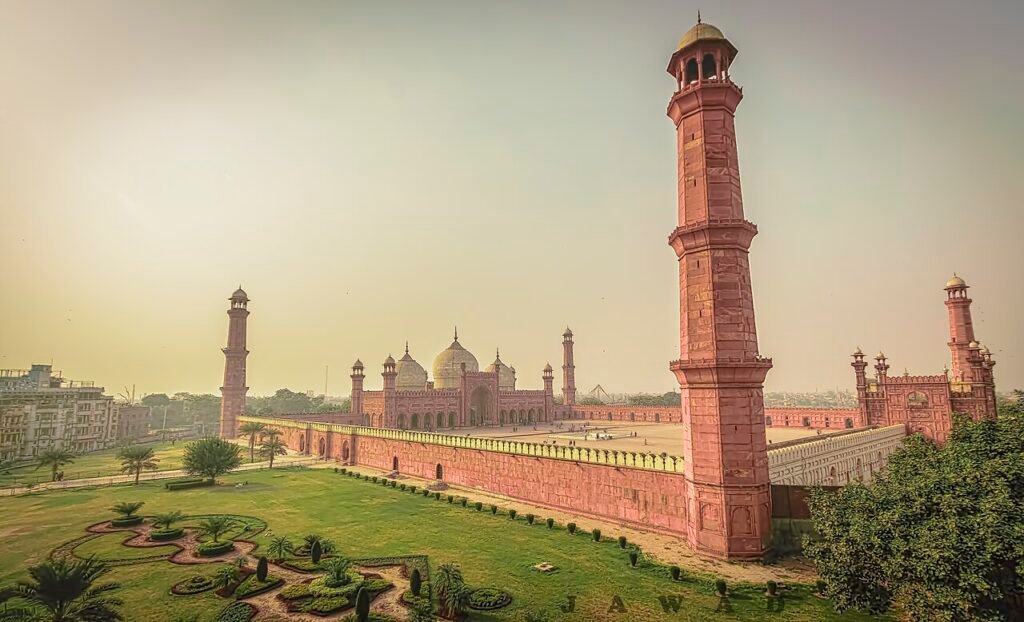
Source: Wikimedia Commons · jawad · CC BY-SA 4.0
When his father, Shah Jahan, fell ill in 1657, the four royal sons went to war over the succession. Aurangzeb turned out to be the sharpest general and the coldest tactician. He won the decisive battle at Samugarh in 1658, defeated his eldest brother Dara Shikoh, and had him put to death. He killed another brother, drove a third into exile, and locked his own father away in the Agra Fort for the rest of his life.
It was brutal. It is worth remembering, though, that this kind of savage fight to the death was not unique to him. Mughal succession had no fixed rule, and more than one emperor before him, including his own father, had climbed to power over the bodies of rivals. Aurangzeb was ruthless, but he was ruthless in a very Mughal way.
Martyrdom of Guru Tegh Bahadur: The Sacrifice for Human Rights
Source: Wikimedia Commons · Shishirdasika · CC BY-SA 4.0
The austere emperor
Here is the first thing that complicates the cartoon.
Most of the great Mughals loved luxury: wine, music, painting, palaces, pleasure. Aurangzeb did not. He was famously plain in his habits, almost severe. He prayed constantly, ate simply, and disapproved of the lavish court life of his forefathers.
He is said to have earned his own spending money by sewing caps and copying out the Quran by hand, and he asked that his funeral be paid for only from what he had earned himself.
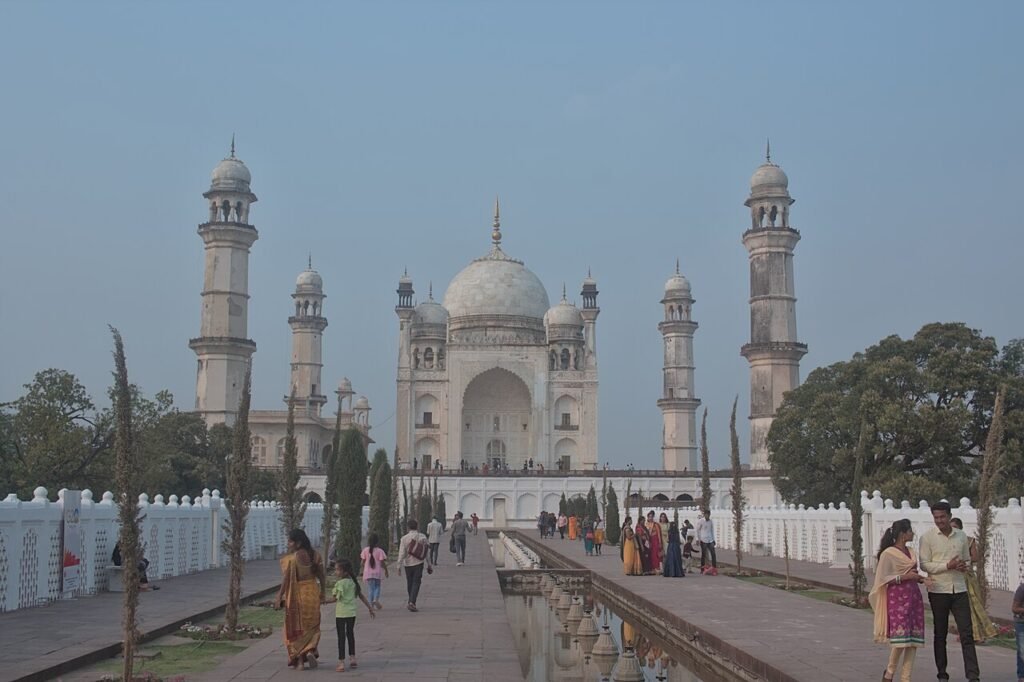
When he died, he was buried not in a jewelled tomb like the Taj Mahal but in a plain, open grave, exactly as he had wished. Whatever else he was, he did not live for his own comfort. He believed, with total seriousness, that he was serving God. That sincerity is part of what makes him so hard to judge, because it drove both his discipline and his harshness.
The religious policies
Now the hardest part, the part the arguments are really about.
Aurangzeb governed as a devout and orthodox Muslim, and some of his measures fell heavily on non-Muslims. He appointed officials to police public morals. In 1679 he brought back the jizya, a tax on non-Muslims that his great-grandfather Akbar had abolished a hundred years earlier. And he ordered the destruction of some prominent Hindu temples, among them the Kashi Vishwanath temple in Varanasi and the Keshavdeva temple in Mathura, with mosques raised on their sites.
Source: Wikimedia Commons · Historica.Arican1 · CC0
These are documented facts, and for many Hindus and Sikhs they were real acts of oppression, remembered bitterly ever since.
But the fuller historical picture is more complicated, and honesty requires stating it too. Aurangzeb also issued grants and orders of protection to certain Hindu temples, and he employed more Hindus in his administration, especially Rajputs and Marathas, than any Mughal emperor before him. Many historians now argue that his temple demolitions were usually aimed at particular places tied to rebellion or defiance, rather than a blanket war on Hinduism. Others reply that, whatever the motive, the weight of these policies on non-Muslims was real and heavy.
To some he is the proof of religious tyranny; to some historians he is a hard but fairly conventional ruler of his age, no saint and no monster. Both sides are pointing at real evidence.
The honest position is to sit with the discomfort. He was not the tolerant Akbar, and pretending otherwise helps no one. But he was also not a simple genocidal fanatic, and the caricature hides a more ordinary, and more interesting, truth.
Foundation of the Khalsa 1699: The Birth of the Saint-Soldiers
The martyrdom of a Guru
One event stands out, and it deserves to be told plainly.
In 1675, Aurangzeb had the ninth Sikh Guru, Guru Tegh Bahadur, executed in Delhi. By the tradition remembered among Sikhs, the Guru had stood up for the right of Kashmiri Hindus not to be forced to convert, and paid for it with his life.
That death changed history. It hardened the Sikh community, and it led directly to the tenth Guru, Gobind Singh, founding the Khalsa in 1699, the disciplined order of saint-soldiers who would resist Mughal power for generations. Like the martyrdom of Guru Arjan Dev two generations before, it turned suffering into steel.
The Deccan that ate the empire
If religion is what people argue about, the Deccan is what actually destroyed him.
For the last twenty-five years of his life, Aurangzeb marched south, set on crushing the Deccan sultanates and, above all, the Marathas. He took Bijapur in 1686 and Golconda in 1687. In 1689 he captured Sambhaji, the son of the Maratha founder Shivaji, and had him put to death with great cruelty.
He expected that to break the Marathas. Instead it did the opposite. Sambhaji’s killing turned the Maratha struggle into a furious, popular war that simply would not die.
He spent a quarter of a century trying to conquer the south, and it slowly bled his empire to death.
While the old emperor chased victory in the Deccan, the north he had left behind began to rot. Revolts spread, the administration weakened, and the treasury drained away into an endless, unwinnable war. He won the land and lost the empire.
Nadir Shah’s Invasion of Delhi 1739: The Massacre That Emptied India
Conqueror of the world, at what cost
Aurangzeb took the title Alamgir, “Conqueror of the World,” and in a narrow sense he earned it. When he died in 1707, the Mughal Empire was the largest it had ever been on the map.
But it was hollow. It was bankrupt, exhausted, and resented in too many corners to hold together. Within just a few decades of his death it broke apart, and India passed first toward the rising Marathas and then, in time, into the hands of the British.
Historians still argue about why. Some say Aurangzeb’s rigidity and his turn away from Mughal tolerance cracked the empire’s foundations. Others argue that no ruler could have held so vast and overstretched a realm together, and that the decay was structural, not merely personal. There is probably truth in both.
Why we still argue
So who was Aurangzeb?
He was a gifted general and a tireless administrator, personally honest and personally severe. He was also capable of great harshness, and some of his policies landed as real persecution on people who never forgot it. He expanded an empire and, in nearly the same breath, exhausted it.
In modern India he has become less a historical figure than a symbol, pulled one way by those who see only a bigot and the other by those who see only a maligned king. His name still sets off political storms centuries after his death.
Perhaps the most useful thing history can offer here is not a verdict but a caution. Real people, even powerful and dangerous ones, are almost always more complicated than the arguments we build around them. Aurangzeb was neither the devil of one story nor the hero of the other. He was a hard, brilliant, narrow man who ruled at the empire’s peak and set it on the road to its fall, and both of those things are true at once.
Death of Tipu Sultan: The Fall of the Tiger of Mysore
If you think you have remembered everything about this topic take this QUIZ
Results


#1. Which regnal title, meaning “Conqueror of the World”, did Muhi-ud-Din Muhammad adopt upon ascending the throne?
#2. During the War of Succession, which decisive 1658 battle saw Aurangzeb defeat the imperial armies to secure his path to the throne?
#3. Aurangzeb appointed specific officials to enforce Sharia law and monitor public morality. What were these officials called?
#4. In 1679, Aurangzeb re-imposed a tax on non-Muslims that had been abolished a century earlier. What was this tax called?
#5. Which Sikh Guru was executed in Delhi in 1675 after championing the rights of Kashmiri Brahmins against forced conversion?
#6. The term “Deccan Ulcer” refers to Aurangzeb’s obsession with conquering which two Shia sultanates?
#7. Why did Aurangzeb earn the moniker “Zinda Pir” (Living Saint) among his Muslim subjects?
#8. Which legendary Maratha leader escaped Mughal house arrest in Agra in 1666 by hiding in a basket of sweets?
How long did Aurangzeb rule?
Aurangzeb ruled for 49 years, from 1658 to 1707.
Why is Aurangzeb controversial?
He is controversial due to his reimposition of the discriminatory Jizya tax, the destruction of Hindu temples, and the execution of Guru Tegh Bahadur and Sambhaji.
Who did Aurangzeb defeat to become Emperor?
He defeated his eldest brother Dara Shikoh in the War of Succession.
What was the “Deccan Ulcer”?
It refers to Aurangzeb’s long, expensive, and ultimately futile campaign in the Deccan (South India) against the Marathas and Sultanates, which drained the empire’s resources.
Where is Aurangzeb buried?
He is buried in a simple grave in Khuldabad, near Aurangabad, Maharashtra.
Sources & References
- Encyclopaedia Britannica (“Aurangzeb”) — his reign from 1658 to 1707, the war of succession, the conquests, the religious policies, and the imperial decline.
- Shiromani Gurdwara Parbandhak Committee (Guru Tegh Bahadur) — the execution of the ninth Sikh Guru in 1675 and its place in Sikh history.
- Maharashtra State Gazetteers — the long Mughal–Maratha conflict, Shivaji and Sambhaji, and the Deccan wars.
- Richard M. Eaton, “Temple Desecration and Muslim States in Medieval India” — a scholarly study of the scale and political context of temple destruction.
- Audrey Truschke, “Aurangzeb: The Man and the Myth” — a modern academic reassessment of the emperor’s reputation and record.