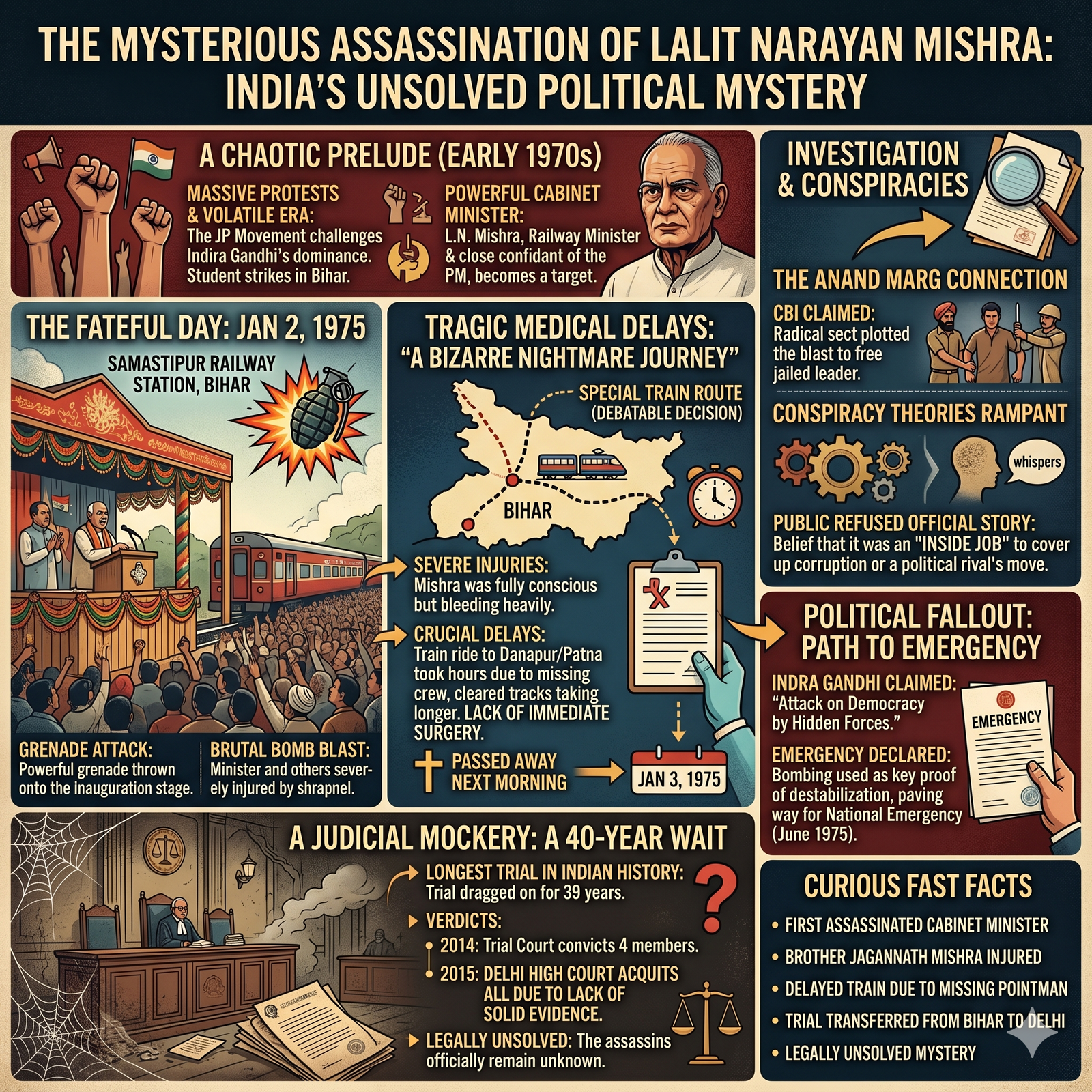
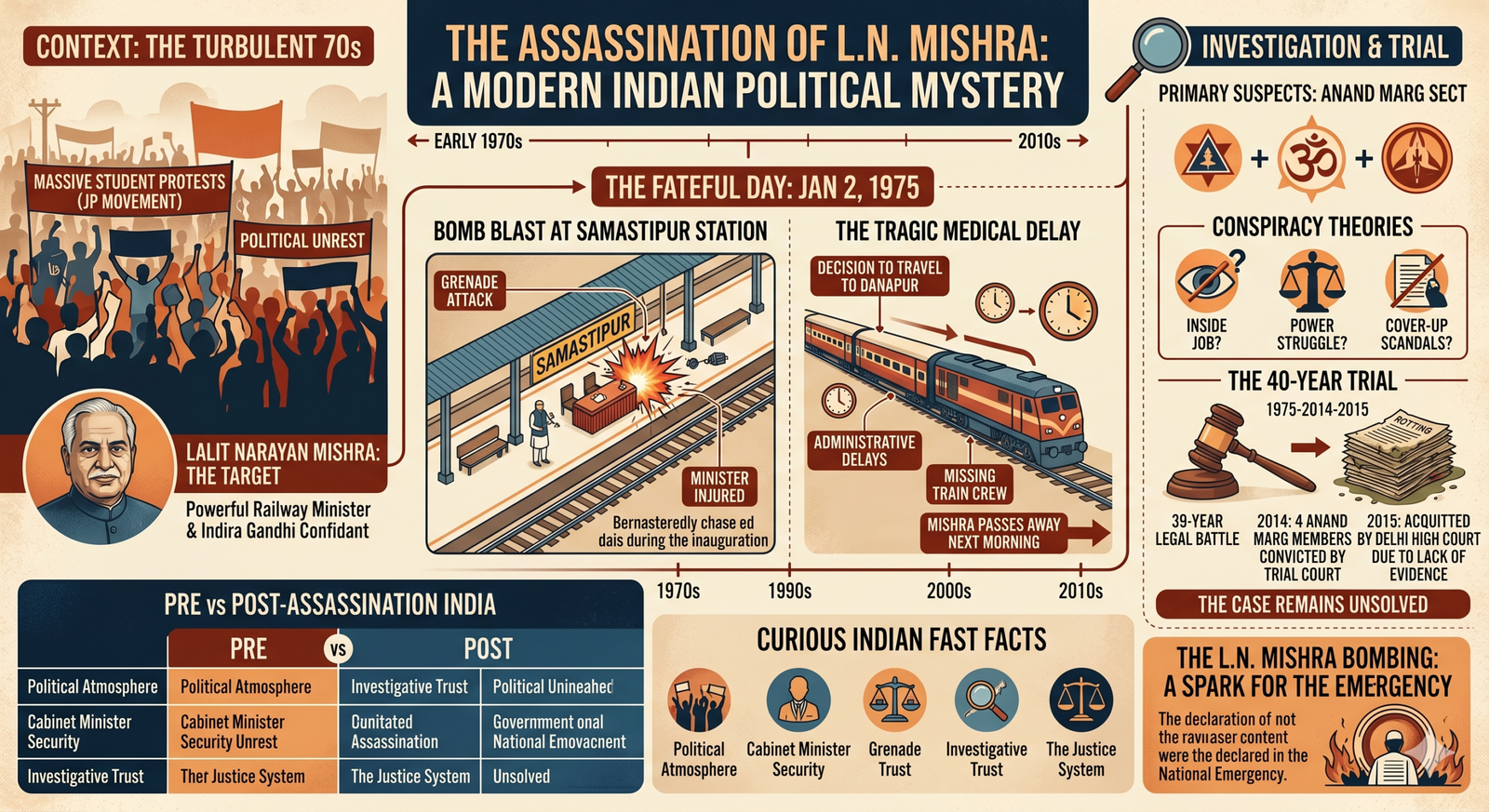
The nineteen seventies was one of the most chaotic and volatile decades in modern Indian history. Right in the middle of massive student protests and political unrest, a shocking event completely paralyzed the nation. On January 2, 1975, the powerful Railway Minister of India, Lalit Narayan Mishra, was assassinated in a brutal bomb blast at the Samastipur railway station in Bihar. This marked the very first time an independent Indian cabinet minister was killed in office. While the government officially blamed a radical religious sect called the Anand Marg, endless conspiracy theories, massive medical delays, and a trial that dragged on for nearly forty years turned the L.N. Mishra bombing into one of the darkest unsolved political mysteries of the entire Emergency era.| Feature | Details |
| Victim | Lalit Narayan Mishra |
| Position | Minister of Railways, Government of India |
| Date of Attack | January 2, 1975 |
| Location | Samastipur Railway Station, Bihar |
| Primary Suspects | Members of the Anand Marg sect |
The early nineteen seventies in India felt like a pressure cooker waiting to explode. The massive political dominance of Prime Minister Indira Gandhi was being heavily challenged by fierce opposition movements, particularly the massive anti-corruption protests led by Jayaprakash Narayan, famously known as the JP movement. The streets of Bihar were burning with student strikes and massive rallies.
In the middle of this intense political heat stood Lalit Narayan Mishra. He was one of the most powerful and influential politicians in the ruling government and a very close confidant of the Prime Minister. However, his immense power also made him a massive target. When he traveled to his home state of Bihar in the cold winter of nineteen seventy five, he walked straight into a deadly trap that would completely alter the course of Indian democracy.
Milestones of Balraj Sahni’s Acting Career
The Fateful Day in Samastipur
January 2, 1975, was supposed to be a day of great celebration for the Indian Railways. L.N. Mishra arrived at the Samastipur railway station to inaugurate a brand new broad-gauge railway line connecting Samastipur to Muzaffarpur. A massive crowd had gathered to listen to the powerful minister speak. Security was present, but in those days, political rallies were incredibly crowded and highly chaotic.
After giving his speech, Mishra stepped down from the grand dais and began walking toward his special railway saloon. Suddenly, a massive explosion ripped through the platform. A highly powerful grenade had been tossed directly onto the stage. The deafening blast completely shattered the festive atmosphere, leaving the minister and several others bleeding heavily on the ground.
The Mathematical Genius of Aryabhatta
The Tragic Medical Delay
What happened immediately after the blast remains one of the most heartbreaking and deeply controversial parts of the entire story. Even though he had suffered severe shrapnel injuries to his thighs and abdomen, L.N. Mishra was fully conscious and talking. Instead of rushing him to a nearby local hospital, a massive, highly debated decision was made to put him on a special train and send him all the way to Danapur, near Patna, for treatment.
The train journey turned into an absolute nightmare. Because of strange administrative delays, missing train crews, and completely cleared tracks taking much longer than expected, the severely bleeding minister did not reach the surgical operating table for several crucial hours. By the time he finally arrived at the hospital, he had lost a massive amount of blood. Tragically, the very next morning, the powerful cabinet minister passed away from his injuries, sending shockwaves across the entire nation.
The Anand Marg Connection
The assassination completely terrified the national government. The Central Bureau of Investigation (CBI) was immediately brought in to hunt down the killers. After a massive nationwide manhunt, the investigating agency pointed its fingers at a spiritual and political group known as the Anand Marg.
According to the official CBI chargesheet, the followers of this sect plotted the horrific assassination to pressure the government into releasing their jailed spiritual leader, Prabhat Ranjan Sarkar. Several members of the sect were arrested, and the government claimed the mystery was completely solved. However, the political opposition and the general public absolutely refused to believe this simple explanation.
How Bhāskara I Decoded the Secrets of 7th-Century Science
Conspiracy Theories and Political Fallout
Because L.N. Mishra was an incredibly powerful figure involved in massive political fundraising and several highly controversial government decisions, the public heavily suspected a massive inside job. Many opposition leaders openly claimed that Mishra had become too powerful and was assassinated by his own political rivals to cover up massive government corruption scandals.
The assassination deeply paranoid the central government. Prime Minister Indira Gandhi openly claimed that the bomb blast was a direct attack on democracy and warned that dark, hidden forces were trying to destabilize the country. This intense atmosphere of absolute fear, suspicion, and political violence perfectly paved the way for the government to declare the infamous National Emergency just a few months later, in June 1975. The tragic bombing was used as primary proof that the nation was completely spiraling out of control.
A Trial That Lasted Four Decades
If the assassination itself was a tragedy, the judicial process that followed was a complete mockery of justice. The murder trial of the L.N. Mishra bombing holds the dark record of being one of the longest criminal trials in Indian legal history. It dragged on for an absolutely staggering thirty nine years.
Over the decades, dozens of judges were transferred, hundreds of witnesses died of old age, and the original investigative documents began to literally rot away in dusty courtrooms. Finally, in the year 2014, a trial court convicted four members of the Anand Marg sect. However, in a massive twist, the Delhi High Court overturned the convictions just a year later, acquitting all the accused due to a severe lack of solid evidence. After forty years of waiting, the legal system essentially concluded that legally, nobody knew exactly who killed the Railway Minister.
Scientific Foundations of the Kanada Atomic Theory
Quick Comparison Table
| Feature | Pre-Assassination Era (Early 1970s) | Post-Assassination Era (Late 1970s) |
| Political Atmosphere | Growing public protests (JP Movement) | Intense government paranoia and the Emergency |
| Cabinet Minister Security | Relatively light and highly accessible | Drastically increased and heavily guarded |
| Investigative Trust | High trust in central agencies | Massive rise in public conspiracy theories |
| The Justice System | Believed to be relatively functional | Exposed as incredibly slow and heavily flawed |
Curious Indian Fast Facts
- L.N. Mishra was the very first cabinet minister in independent India to be assassinated while holding active office.
- His younger brother, Jagannath Mishra, was also injured in the exact same blast but survived and later became the Chief Minister of Bihar.
- The train carrying the bleeding minister was mysteriously delayed for over two hours because a railway pointman had gone missing.
- The trial was transferred from Bihar to Delhi by the Supreme Court to ensure fairness, yet it still took nearly 40 years to reach a verdict.
- Because the Delhi High Court acquitted the accused in 2015, the massive assassination officially remains an unsolved legal mystery today.
Conclusion
The L.N. Mishra bombing is not just a tragic story of a politician losing his life. It is a dark, bloody milestone that completely changed the psychological landscape of Indian politics. The blast at the Samastipur railway station shattered the illusion that top government officials were perfectly safe, introducing a new era of VIP security, political paranoia, and intense suspicion.
The incredible failure of the medical and judicial systems—first in failing to save his life during the delayed train ride, and then in failing to deliver a clear legal verdict after four decades—remains a massive stain on the administrative history of the country. When we look back at the chaotic events that dragged India into the dark days of the Emergency, the mysterious bomb blast in Bihar stands as the ultimate, terrifying spark that set the entire political system on fire.
Vedic Genius of Baudhayana Mathematics and Geometry
If you think you have remembered everything about this topic take this QUIZ
Results


#1. On what date was Railway Minister Lalit Narayan Mishra assassinated?
#2. What event was L.N. Mishra attending at the Samastipur railway station?
#3. Which spiritual and political group was officially blamed by the CBI for the bombing?
#4. Why was the decision to transport the injured minister to Danapur highly controversial?
#5. Which family member of L.N. Mishra was also injured in the same blast?
#6. How long did the murder trial for the L.N. Mishra bombing last?
#7. What was the outcome of the legal proceedings in 2015 at the Delhi High Court?
#8. How did the central government utilize the assassination politically?
Who was L.N. Mishra?
Lalit Narayan Mishra was a highly influential Indian politician and the Minister of Railways who was completely loyal to Prime Minister Indira Gandhi.
When and where did the assassination happen?
The tragic bombing occurred on January 2, 1975, right at the Samastipur railway station in Bihar, shortly after he inaugurated a new railway line.
Why is his death highly controversial?
It is controversial because despite his severe injuries, he was not taken to a nearby hospital but was instead put on a special train that suffered massive, unexplained delays, ultimately leading to his death the next day.
Who was officially blamed for the bombing?
The Central Bureau of Investigation (CBI) primarily blamed and arrested members of the Anand Marg spiritual sect, claiming they wanted to pressure the government to release their leader.
Was anyone ever officially punished for the crime?
While four men were convicted by a trial court in 2014 after a massive 39-year trial, they were completely acquitted by the Delhi High Court in 2015 due to a lack of evidence, leaving the case unsolved.