How a Bengali Play Exposed the Cruelty of the Indigo Planters, and Put a Priest in the Dock
In 1860, a quiet postmaster in Bengal wrote a play, and it frightened an empire.
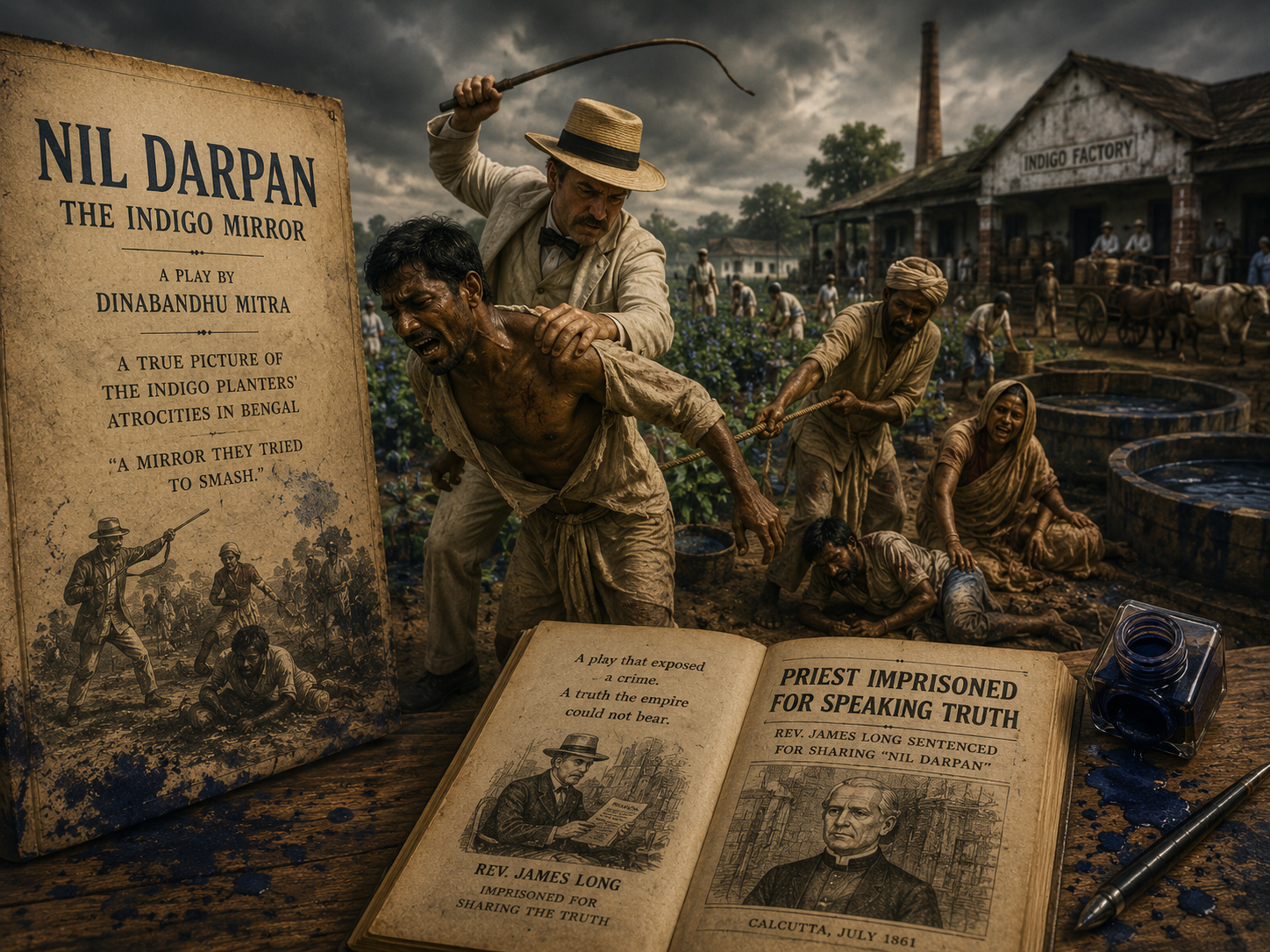
The play did not call for an army, or a rebellion, or a single act of violence. It did something far simpler, and, as it turned out, far more dangerous. It held up a mirror. Its name was Nil Darpan, which means “The Indigo Mirror,” and in it a writer named Dinabandhu Mitra showed colonial Bengal a true and unflinching reflection of what was being done, far out of sight, to the poorest farmers in the land. The reflection was so ugly, and so impossible to deny, that the powerful men it exposed did the only thing they could think of. They tried to smash the mirror. This is the story of what they saw in it, and of the priest who went to jail for holding it up.
The Blue that was Worth Blood
To understand the play, you first have to understand indigo. Indigo is a plant that yields a rich, deep blue dye, and in those days the cloth mills of the world craved it, which made it enormously profitable.
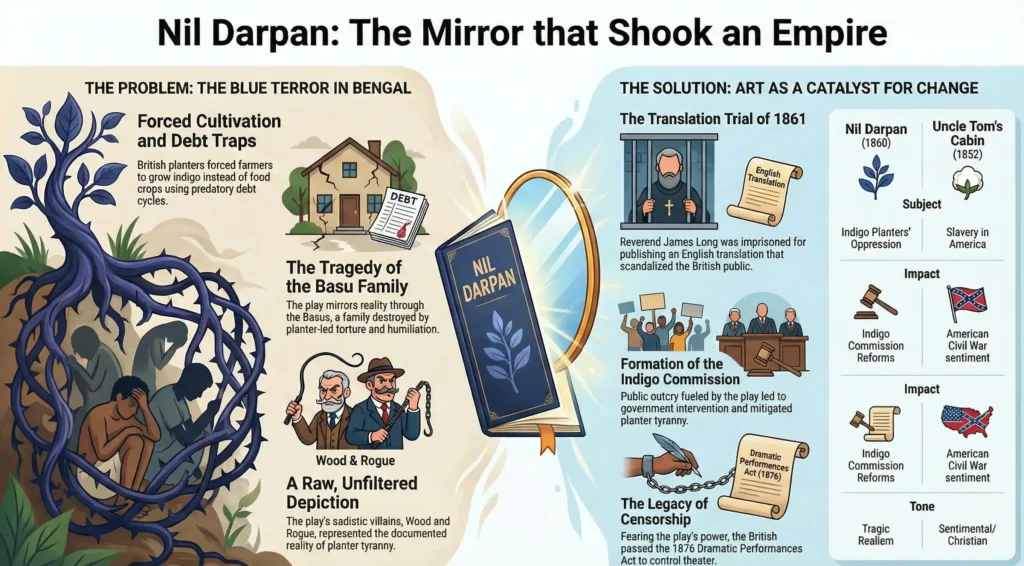
In Bengal, European planters grew rich on that blue. But they did not grow the crop themselves. Instead, they forced the local peasant farmers, known as ryots, to grow it for them, on the farmers’ own precious land. And the system they built was a cruel one. The planters trapped the farmers in debts they could never hope to repay, made them plant indigo where they desperately needed to grow food, and then paid them a pittance for the harvest.
Farmers who refused were beaten, their homes burned and their cattle seized. The indigo also poisoned the soil so it could not grow food. All of this suffering was hidden away, out in the distant fields.
Reign of Emperor Ashoka: The Transformation of a Tyrant
A Postmaster’s Play
Because it all happened far off in the countryside, out of sight of the cities and the newspapers, most people simply never saw it. And then a man named Dinabandhu Mitra put it on a stage.
Mitra was no fiery revolutionary. He was a mild, hardworking government postmaster who wrote plays in his spare time. But he had travelled through the indigo districts, and what he had seen there would not let him rest. So he wrote Nil Darpan, a play that follows one ordinary farming family as the indigo system slowly and completely destroys them. He knew very well how dangerous it was. He published it without his own name attached, calling himself only “a traveller,” so as to protect his government job. But the play refused to stay quiet. It tore through Bengal, and all at once, everyone was talking about the thing that had been kept hidden for so long.
Sunayani Devi: A Woman’s Voice in the Bengal School
The Farmers Who said No
The play caught fire so quickly because the farmers themselves had already risen up.
In 1859, in the district of Nadia, the ryots did something very brave and very simple. They refused to plant indigo, whatever it might cost them. Led by two local brothers, Bishnucharan and Digambar Biswas, whole villages swore a vow that they would sooner lose their land, their homes, and even their lives than sow the crop that was ruining them. For the most part it was a peaceful refusal, not a violent uprising but a vast, stubborn, collective “no.” And it crossed the lines that so often divided people, as Hindu and Muslim farmers stood together as one. In the city, a courageous newspaper editor named Harish Chandra Mukherjee took up their cause with fierce, ringing editorials. Slowly, the whole of Bengal was beginning to look into the mirror.
The Priest Who Went to Jail
Now the story takes a turn that says almost everything worth knowing about it.
The play was so powerful that the government itself wished to read it, and an English translation was prepared, most likely by the great Bengali poet Michael Madhusudan Dutt. The man who arranged to have that translation printed and shared was an Anglo-Irish priest, the Reverend James Long, a missionary who believed deeply that the writings of ordinary Indians were a true window into their suffering, one the rulers too often ignored.
The indigo planters were enraged. Here was their cruelty, set down in plain English for the whole world to read. They could not argue against the truth of it, so instead they attacked the man who had helped reveal it. They dragged Reverend Long into court, accused him of libel, and in 1861 he was found guilty, fined, and sent to prison for a month.
Stop and consider how strange that is. A British priest, jailed by British planters, for helping to expose the cruelty of British planters.
The moment Long was fined, a young Bengali writer named Kaliprasanna Singha stepped forward and paid the entire sum himself, on the spot, in an act of pure solidarity.
Reign of Chandragupta Maurya 321-297 BCE: The First Empire of India
The Mirror that Could not be Un-Shown
The trial was meant to silence the play. It did the exact opposite.
It made Nil Darpan famous across India and beyond, and it turned Reverend Long into a hero. The suffering of the indigo farmers was now impossible for anyone to ignore. An official government inquiry, the Indigo Commission, looked hard into the planters’ conduct and found, in the end, that the farmers had been telling the truth all along. Before very long, the cruel indigo system of Bengal collapsed.
One thing here is worth being very clear about. This mirror was held up, and this fight was won, by Indians and Britons together. It was the postmaster and the peasants, yes, but it was also the missionary who went to jail and the officials who refused to look away. It was never simply one people set against another. It was ordinary decency set against a brutal trade.
And the rulers had learned, to their alarm, just how much a stage could do. Nil Darpan became the very first play staged in Bengal’s new public theatre. In fact, the government grew so nervous of what a mere play might stir up that, years later, it passed a special law simply to censor Indian theatre.
Dadasaheb Phalke: The Father of Indian Cinema
What a Story can Do
It is easy to forget how much sheer power there can be in the simple act of making people see.
For years upon years, the indigo farmers had suffered and cried out, and had been ignored, because their pain was far away and terribly easy not to look at. Then one quiet postmaster gathered up that pain, turned it into a story, and held it up like a mirror, until a whole society was forced to gaze at its own reflection and feel ashamed. Petitions had failed. Complaints had failed. A play succeeded. Nil Darpan was, in a very real sense, the first time in India that a story became a weapon. It stands as proof that sometimes the single most dangerous thing you can do to an injustice is simply to show it, clearly and honestly, to everyone at once, and then refuse to let them turn away.
Subramania Bharati: The Mahakavi of Indian Nationalism
If you think you have remembered everything about this topic take this QUIZ
Results


#1. Who wrote the original Bengali play Nil Darpan in 1860?
#2. The play Nil Darpan exposes the brutal oppression of farmers forced by British planters to cultivate which crop?
#3. Who is widely believed to have translated Nil Darpan into English in a single night?
#4. Which Irish missionary was tried, fined 1,000 Rupees, and imprisoned for publishing the English translation of the play?
#5. Who paid the 1,000 Rupee fine on behalf of the publisher on the spot during the highly publicized trial?
#6. The famous novelist Bankim Chandra Chatterjee compared Nil Darpan to which influential American novel?
#7. Fearing the power of plays like Nil Darpan to incite rebellion, the British government passed which law to censor Indian theater?
#8. According to a famous anecdote, which legendary educationist was so enraged by the play that he threw his slipper at the actor playing the British planter?
Who wrote the play Nil Darpan?
Dinabandhu Mitra wrote the play in 1860.
Who translated Nil Darpan into English?
It was translated by Michael Madhusudan Dutt, though it was published by Reverend James Long.
What was the subject of the play?
It depicted the oppression of Bengali farmers by European Indigo planters.
Who was imprisoned for publishing the English translation?
Reverend James Long was imprisoned for one month.
Which British law was enacted to control plays like Nil Darpan?
The Dramatic Performances Act of 1876 was enacted to censor Indian theater.
Sources and References
- Wikipedia (“Nil Darpan” and “Dinabandhu Mitra”) — the 1858–59 play by Dinabandhu Mitra, published anonymously in Dhaka in 1860, its central place in the 1859 Indigo Revolt, and its role in the birth of Bengali public theatre.
- British Library “Untold Lives” blog and Scroll.in — the exploitation of the ryots through debt and coercion, Reverend James Long arranging the English translation (edited and prefaced by him), the 1861 libel trial brought by the planters and The Englishman newspaper, and Long’s one-month sentence and Rs 1,000 fine paid by Kaliprasanna Singha.
- Grokipedia and Medium (on the revolt) — the revolt beginning in 1859 in Nadia district, its leadership by Bishnucharan and Digambar Biswas, its largely non-violent and cross-community character, and Harish Chandra Mukherjee’s editorials in the Hindu Patriot.
- Wikisource and Osmanian — Bankim Chandra Chattopadhyay’s comparison of Nil Darpan with Uncle Tom’s Cabin, the translation attributed to Michael Madhusudan Dutt, and the Indigo Commission’s findings that led to the mitigation of the planters’ power.
- Original Curious Indian article (“Nil Darpan”) — Mitra publishing anonymously to protect his postmaster’s job, the play’s role in forming public opinion, the Indigo Commission, and the later Dramatic Performances Act of 1876 enacted to censor Indian theatre.
Author


Exploring the Soul of Bharat through History, Science, Culture, and its Diversity
Our Mission
Curious Indian is a definitive knowledge portal dedicated to chronicling the events, personalities, and cultural shifts that defined the Indian subcontinent. From the ancient Vedic Period to the complexities of 21st-century politics, our goal is to provide deep-dive analysis that inspires.
Editorial Standards & E-E-A-T
Every article published under our brand undergoes a rigorous fact-checking process. We prioritize primary historical records, academic citations, and credible archives to ensure our readers receive accurate, high-authority information.
Historical Integrity Directly sourcing from ASI archives and academic journals.Topical Authority Comprehensive clustering of Indian Science, Biographies, and Wars.Managed by Paripurna Datta and TEAM | Dedicated to the Knowledge of India.