How a Rajput Princess Became the Voice of Devotion That India Still Sings
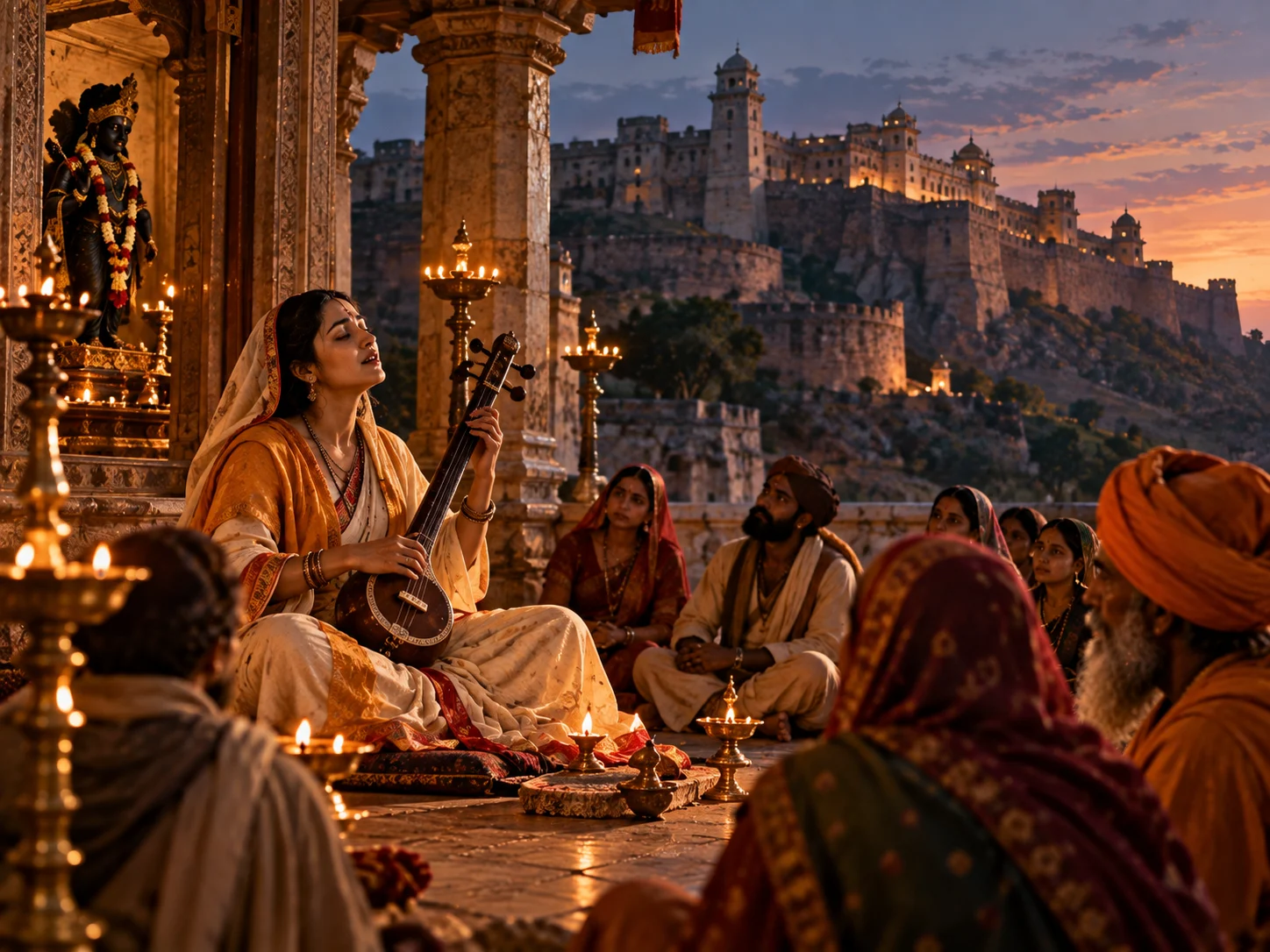
Mirabai walked away from one of the most powerful royal households in Rajasthan not in anger but in devotion, carrying nothing but her songs and an unshakeable certainty that Krishna was her only true husband. Her journey from the palaces of Mewar through the sacred lanes of Vrindavan to her final disappearance at Dwarka is one of the most quietly radical stories in Indian spiritual history, a story about a woman who chose the road, the temple courtyard, and the open sky over a life of guarded privilege. Centuries after her death, her bhajans still move through India like something alive, sung in villages, railway stations, and concert halls with equal feeling, carrying the voice of a woman who refused to pretend to be anything other than what she actually was.
Ustad Bismillah Khan and the Shehnai That Became His Prayer
The Woman Who Chose a God Over a Kingdom
There are stories of renunciation in almost every spiritual tradition. Saints who left wealth behind, monks who walked away from power, mystics who traded comfort for the open road. But very few of those stories belong to women, and fewer still to women who lived inside the iron social architecture of medieval Rajputana, where a princess was a political instrument, a daughter-in-law was a property of the clan, and individual spiritual desire was considered, at best, an eccentricity and, at worst, a dangerous act of disobedience.
Mirabai was all three things at once. She was a princess. She was a daughter-in-law of the most prestigious Rajput household in sixteenth-century India. And she was a woman who, from childhood, had decided with complete and untroubled certainty that Krishna was her husband, her lord, and her only real home. What happened between that childhood conviction and her disappearance into the sanctum of the Ranchhodrai temple at Dwarka is one of the most extraordinary spiritual journeys this country has ever produced.
A Childhood Shaped by Devotion
Why Peer Ali Khan Chose the Gallows Over Betraying His City
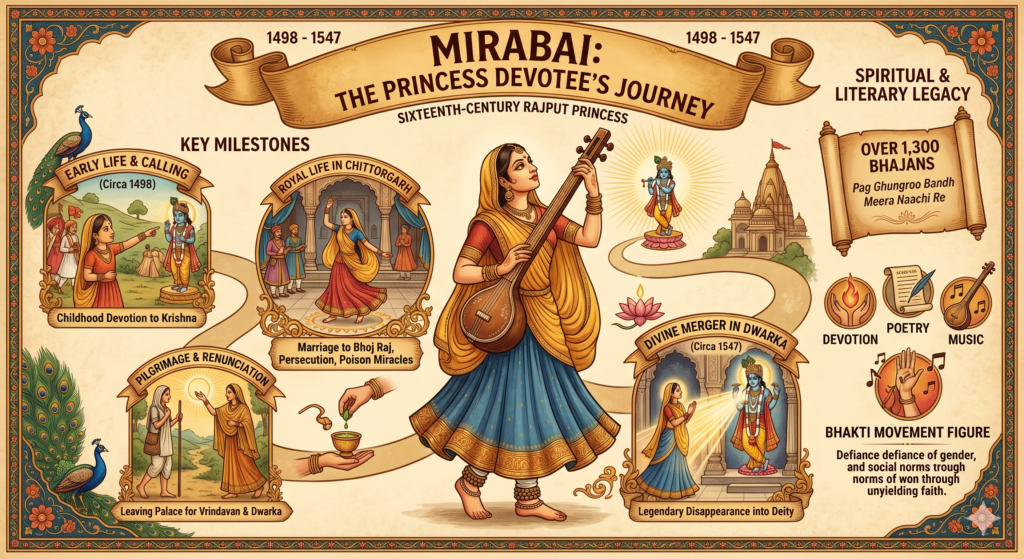
Mirabai was born around 1498 in Kudki, a small village in the Nagaur district of Rajasthan. Her father was Ratan Singh Rathore, a minor Rajput chieftain. Her mother died when Mirabai was very young, and she was raised largely by her grandfather Rao Dudaji, a devoted Vaishnava who filled the household with stories of Krishna and the texture of devotional practice.
The story most often told about Mirabai’s childhood is the one about the wedding procession. A bridal party passed through the village and the young Mirabai, watching from a window, asked her mother who her husband would be. Her mother, perhaps in a moment of gentle deflection, pointed to a small idol of Krishna in the household shrine and said, there, that is your husband. Whether the mother meant it spiritually or simply said it to redirect a child’s attention, Mirabai received it as sacred truth. From that day forward she treated the idol as her spouse with a completeness of feeling that never wavered across her entire life.
This early formation reflects a pattern consistent across the Bhakti tradition. Medieval India’s Bhakti movement repeatedly produced poets and saints whose devotion was rooted in a transformative childhood encounter with the divine. What made Mirabai different was the social context into which her devotion would collide.
The Marriage That Was Never Her Marriage
Why Paliwal Brahmins Left Kuldhara in a Single Night and Never Returned
Around 1516, Mirabai was married to Bhoj Raj Singh, the crown prince of Mewar, son of the legendary Rana Sanga. It was an alliance of political consequence. Mewar was the most formidable Rajput kingdom of the era, and the marriage was designed to strengthen ties between two royal houses. By every visible measure, Mirabai had arrived at the apex of what a woman of her birth could achieve.
She is said to have brought her Krishna idol with her to Chittorgarh, insisting it accompany her into her new home. The court at Mewar did not know what to make of her. Accounts drawn from oral tradition and later hagiographic texts describe a princess who spent her days not attending to royal duties but singing in the temple, dancing before the idol, and receiving sadhus and wandering holy men who came to hear her songs. This was not the behaviour the palace expected. The Mewar royal family, proud and orthodox in its Rajput values, found Mirabai’s public expressions of devotion embarrassing and eventually dangerous.
Her husband Bhoj Raj died young, around 1521, possibly from wounds sustained during battles against Mughal forces. With his death, Mirabai’s position in the palace became precarious. A widow in medieval Rajputana was expected to observe strict seclusion, ideally to perform sati, and at minimum to retreat entirely from public life. Mirabai did none of these things. She continued singing. She continued receiving pilgrims and saints. She continued dancing before Krishna with an abandon that the court could only interpret as madness or moral failure.
The Poison and the Persecution
What followed has entered Indian spiritual mythology with the force of legend, though multiple sources lend its outlines credibility. Mirabai’s brother-in-law, identified in most accounts as Vikramaditya Singh who became the next Rana of Mewar, reportedly made several attempts to end her life. The most famous of these involved a cup of poison sent to her as prasad, blessed food, which she is said to have drunk in full faith before her idol of Krishna and suffered no harm. Another account describes a basket containing a venomous snake that she opened to find a garland of flowers.
These stories, whether understood as literal miracles or as spiritual metaphors, carry a precise emotional logic. They communicate what Mirabai herself communicated in her bhajans repeatedly and without ambiguity: that a soul completely surrendered to Krishna existed in a different relationship with danger than ordinary life permitted. Fear, she sang, was for those who had something to lose. She had given everything away already.
The accounts of her persecution served a literary and theological function within the Bhakti tradition, reinforcing the idea that genuine devotion always meets worldly resistance and always transcends it. What matters is not whether each story is historically verifiable but that they all point to a consistent truth: a woman existed inside a world designed to control her absolutely, and that world could not hold her.
The Road to Vrindavan
At some point, the palace became impossible. The exact timeline is disputed among historians, but the broad shape of the story is consistent across sources. Mirabai left Chittorgarh, likely sometime in her late twenties or early thirties, and began the life of a wandering poet-saint that she had perhaps always been meant to live.
Her first significant stop was Vrindavan, the town on the banks of the Yamuna in present-day Uttar Pradesh that Hindu tradition identifies as the land of Krishna’s childhood. Vrindavan in the sixteenth century was being transformed into a major centre of Vaishnava devotion under the influence of the Chaitanya movement from Bengal. Mirabai arrived into this environment as both a pilgrim and a living presence of the tradition she was joining.
There is a celebrated account of her encounter with the saint Jiva Goswami, a senior disciple of Chaitanya Mahaprabhu who held to the strict rule that he would not meet with women. When Mirabai was turned away from his door, she is said to have sent word asking whether there was any true male devotee in Vrindavan other than Krishna himself. Jiva Goswami, understanding the point, came out to meet her. The story has been cited by scholars as an example of how Mirabai consistently challenged gender conventions not through argument but through the irresistible logic of her devotion.
In Vrindavan, Mirabai found what the palace had never allowed: a community of practitioners who recognized her as a peer. She sang in temples and courtyards. She danced before the images of Krishna. She lived as a renunciate, owning nothing, depending entirely on the charity of those who heard her voice and knew they were in the presence of something rare.
The Bhajans That Outlived the Palace
Across every road she walked, every temple courtyard she sang in, and every night she spent under the open sky, Mirabai composed. Her bhajans are among the most intimate spiritual documents in Indian literary history. They are not theological treatises. They are love letters, complaints, yearnings, celebrations, and sometimes desperate cries from a soul that aches for union with the divine as physically as a person aches for the presence of someone they love.
Her most famous compositions, including “Pag Ghungroo Bandh Meera Naachi Re” and “Mere To Giridhar Gopal,” carry within them a psychological complexity that rewards close reading. She refers to Krishna as her husband, her friend, and her liberator in the same breath. She speaks of the court’s mockery, the family’s poison, the loneliness of the road, and the absolute joy of devotion in a voice that feels contemporary across five hundred years.
Mirabai wrote in multiple languages including Rajasthani, Braj Bhasha, Hindi, and Gujarati, making her one of the most linguistically diverse poet-saints of the Bhakti period. Her compositions span intimate personal prayer to celebration of Krishna’s divine nature, from lament at separation to ecstatic union. Over a thousand bhajans have been attributed to her, and they have been preserved, performed, recorded, and transmitted continuously for five centuries.
What distinguishes her work is the absence of artifice. She does not perform devotion. She expresses it. The result is poetry that reads as immediate and genuine even when read across centuries, in languages not one’s own, in contexts utterly divorced from her own life. That immediacy is what has kept her alive.
The Final Disappearance at Dwarka
Vishwakarma Puja and the Ancient Theology Behind Worship of Tools
From Vrindavan, Mirabai eventually made her way to Dwarka in present-day Gujarat, the ancient city on the Arabian Sea coast that tradition identifies as Krishna’s kingdom. It is here that her story ends in the most extraordinary way that any life in Indian spiritual literature has ended.
The account, preserved across multiple devotional traditions, describes the priests of the Ranchhodrai temple at Dwarka closing the inner sanctum doors one evening with Mirabai inside. When the doors were opened the following morning, there was no trace of her. Her saree, it is said, had wrapped itself around the idol of Ranchhodrai, another name for Krishna, as though she had literally merged into the form of her beloved.
Historians place her death around 1547, making her approximately 49 years old. Whether the Dwarka account is understood as a supernatural event, devotional metaphor, or the community’s way of encoding the completeness of her surrender, it provides an ending that matches the life. A woman who had given everything to her god simply ran out of anything left to give except herself.
Why Mirabai Still Speaks
Five centuries have not quieted Mirabai. Her bhajans are sung every morning in temples across Rajasthan and Gujarat. They appear in film soundtracks, on concert stages, in school textbooks, and in the mouths of people who may not know a single fact about her life but know every word of her songs by heart. That particular kind of immortality, the kind that travels through the human voice rather than through stone monuments or academic archives, is the most durable kind there is.
She matters today for reasons that go beyond devotional history. She was a woman who looked at the most complete form of social control available in her era, the Rajput royal household with its codes of honour, its rigid gender rules, and its enormous political power, and she simply walked through it. Not in rebellion for its own sake. Not in anger. But because something inside her was larger than all of it, and she was wise enough, and brave enough, to follow that larger thing wherever it led.
The Mewar royal family’s relationship with Mirabai’s memory shifted dramatically over centuries, and today the Chittorgarh fort complex includes a temple dedicated to her that draws thousands of pilgrims annually. Major Indian classical musicians including M.S. Subbulakshmi have recorded her compositions, bringing them into the mainstream of Indian classical and semi-classical music performance. Filmmakers have adapted her story. Feminist scholars have claimed her as an inspiration. She has been read as a figure of spiritual authority, an example of female self-determination, a poet of genius, and a woman who simply loved deeply and refused to pretend otherwise.
But what endures most is the voice. The songs she composed while walking away from everything continue to move through India, sung by people who have never heard of Mewar, in contexts she never imagined, carrying forward a woman’s refusal to be anything less than completely, authentically herself. Most palaces of the sixteenth century are rubble or tourist sites. The songs Mirabai composed while walking away from one of them are alive in the mouths of people who know every syllable of “Mere To Giridhar Gopal” by heart.
She left the palace and found something larger. India has been finding her ever since.
Rukmini Devi Arundale and the Rebirth of Bharatanatyam
If you think you have remembered everything about this topic take this QUIZ
Who was Mirabai and why is she considered a saint?
Mirabai was a sixteenth-century Rajput princess from Merta in Rajasthan who became one of the most celebrated poet-saints of the Bhakti movement. She is considered a saint because of her complete and lifelong devotion to Lord Krishna, expressed through over a thousand bhajans that are still sung across India today. Her willingness to renounce royal privilege, endure persecution, and walk the life of a wandering devotee in pursuit of spiritual union with Krishna gave her the moral authority that the Bhakti tradition associated with genuine sainthood. She was recognized as a spiritual peer by major saints of her era and has been venerated continuously for five centuries.
What happened to Mirabai at Dwarka?
According to accounts preserved across multiple devotional traditions, Mirabai entered the inner sanctum of the Ranchhodrai temple at Dwarka during a period of prayer and was never seen again. When the temple doors were opened the following morning, she had disappeared and her saree was found wrapped around the idol of Ranchhodrai. This event is understood within the Bhakti tradition as her ultimate merger with Krishna, the completion of the lifelong devotional journey she had begun in childhood. Historians place this event around 1547, when she would have been approximately 49 years old.
Did Mirabai really survive poison?
The account of Mirabai surviving poison is one of the most widely preserved stories in her hagiographic tradition, appearing in at least three independent regional sources. According to these accounts, her brother-in-law Vikramaditya Singh sent her a cup of poison disguised as prasad, which she drank before her Krishna idol without harm. Whether understood as a literal miracle, a spiritual metaphor for the immunity of total devotion, or a symbolic narrative encoding her survival of political persecution, the story carries consistent emotional and theological meaning across the tradition. No contemporaneous historical documentation of the event exists, but its presence across multiple independent regional traditions suggests it reflects early and widespread belief rather than a single invented legend.
What is the relationship between Mirabai and the Bhakti movement?
Mirabai was one of the most significant figures of the medieval Bhakti movement in North and West India, a broad spiritual and social movement that emphasized direct, personal devotion to god over ritual orthodoxy, caste hierarchy, and priestly mediation. Her compositions in Braj Bhasha and Rajasthani contributed to the tradition of vernacular devotional poetry that the Bhakti movement placed at the center of Indian religious life. Her willingness to receive sadhus of all castes, to sing and dance publicly before the idol, and to prioritize her personal relationship with Krishna over every social obligation made her a living embodiment of Bhakti principles. Scholars consider her alongside Kabir, Tulsidas, and Surdas as one of the defining voices of the Hindi-Rajasthani Bhakti tradition.
Why are Mirabai’s bhajans still relevant today?
Mirabai’s bhajans remain relevant because they address emotional experiences that have no historical expiry date: longing, love, the courage to remain true to oneself in the face of social pressure, and the transforming power of complete surrender to something larger than personal circumstance. They are also simply extraordinary poems, direct, musical, imagistically rich, and emotionally precise in a way that translates across languages and centuries. They have been performed by classical musicians including M.S. Subbulakshmi, incorporated into Indian film music, taught in school curricula, and sung in temples every day across Rajasthan, Gujarat, and beyond. Their survival is not institutional. It is purely because they continue to speak to something true in human experience, which is the only reason any poem lasts.
Sources & References
Mirabai’s life and renunciation from Mewar — Born around 1498 in Kudki, Rajasthan, Mirabai was married to Bhoj Raj Singh, crown prince of Mewar, but after his early death around 1521 refused widowhood and seclusion, instead continuing her public devotion through song and dance, eventually leaving Chittorgarh to become a wandering renunciate poet-saint of the Bhakti tradition.
Childhood devotion to Krishna and formative influence — Raised by her grandfather Rao Dudaji, a devoted Vaishnava, Mirabai received Krishna worship as her religious formation from early childhood, reportedly telling her mother that a household idol of Krishna was her true husband, a conviction she maintained throughout her life with unwavering completeness.
The poison and persecution narratives — Multiple regional sources document accounts of Mirabai’s brother-in-law Vikramaditya Singh attempting to kill her through poison disguised as blessed food and a snake-filled basket, stories whose appearance across independent traditions suggest they reflect early widespread belief in her divine protection rather than a single invented legend.
Mirabai’s compositions in multiple languages — Mirabai composed over a thousand bhajans in Rajasthani, Braj Bhasha, Hindi, and Gujarati, addressing Krishna as husband, friend, and liberator with psychological complexity and emotional immediacy that has made her one of the most significant figures in medieval Bhakti devotional poetry.
Final merger with Krishna at Dwarka — According to accounts preserved across devotional traditions, Mirabai entered the inner sanctum of the Ranchhodrai temple at Dwarka around 1547 and disappeared, her saree found wrapped around the idol of Krishna, understood within the Bhakti tradition as her ultimate spiritual merger with the divine, completing a lifelong devotional journey that began in childhood.