How Rukmini Devi Arundale Brought Bharatanatyam Back from the Margins
There is a photograph of Rukmini Devi Arundale taken sometime in the 1930s, in full Bharatanatyam costume, her hands arranged in a mudra, her eyes directed slightly upward with an expression that is simultaneously concentrated and serene. She does not look like someone who has just done something socially radical. She looks like someone who has found the exact place she was meant to be. That quality, the serene certainty of a person who has located their purpose and will not be moved from it by convention or criticism, is the quality that runs through everything Rukmini Devi accomplished. And what she accomplished was not simply the revival of a dance form. It was the rescue of an entire tradition from the combined pressures of colonial contempt, middle-class shame, and well-intentioned but destructive social reform, and its reestablishment as a living, respected, and globally recognised classical art.
A Thousand Years Ending
For centuries, Bharatanatyam in its earlier form called Sadir was performed primarily by women of the Devadasi community, dedicated servants of the temple deity whose lives were organised around the ritual service of the god through dance, music, and religious ceremony. The Devadasi institution was complex, layered, and deeply misunderstood by the colonial gaze that encountered it in the nineteenth century. These women were not simply performers. They were custodians of a sophisticated artistic and ritual tradition that combined abhinaya, the expressive storytelling dimension of Indian dance, with nritta, the pure technical vocabulary of movement, in a practice that was simultaneously devotional, aesthetic, and social.
The British colonial administration and the Indian social reform movements of the late nineteenth and early twentieth centuries looked at the Devadasi institution and saw, almost exclusively, moral degradation. The reform campaigns that culminated in the Madras Devadasi Prevention of Dedication Act of 1947 were driven by genuine concern for the welfare of women who were caught in exploitative social arrangements, but the legislation they produced made no distinction between the practice of dedication and the artistic tradition it carried. When the institution was abolished, the tradition it sustained was left without its primary practitioners, its institutional home, or its social legitimacy.
By the early twentieth century, Sadir was performed in increasingly marginalised contexts, its association with the Devadasi community making it unacceptable to the respectable middle-class Tamil families who might otherwise have been its patrons and practitioners. The art form was dying. Not because it lacked beauty or depth or relevance, but because the social structures that had sustained it for a thousand years had been dismantled faster than new structures could be built to replace them. Into this world of collapse and loss stepped a woman who would do something that nobody else was positioned to do.
How Mirabai Left the Palace and Found Her God
Growing Up in the Theosophical World
Rukmini Devi Arundale was born on 29 February 1904 in Madurai into a Brahmin family with strong cultural interests. Her father, Nilakantha Sastri, was a Sanskrit scholar with Theosophical sympathies, and the family moved in the intellectual and spiritual circles that surrounded the Theosophical Society at Adyar in Madras, one of the most extraordinary cultural crossroads in early twentieth century India.
The Theosophical Society, founded by Helena Blavatsky and Henry Steel Olcott in New York in 1875 and relocated to Adyar in 1882, was by the early twentieth century under the leadership of Annie Besant, the British social reformer and Indian independence advocate who became one of the most influential figures in Indian public life of the period. The Adyar campus was a meeting ground for Indian nationalists, Western intellectuals, spiritual seekers, artists, and reformers, a place where ideas about Indian cultural identity, the relationship between ancient tradition and modern life, and the spiritual dimensions of artistic practice were in continuous, productive ferment.
Rukmini Devi grew up in this environment, absorbing its cosmopolitan intellectual atmosphere and its particular conviction that Indian cultural traditions carried a spiritual significance that deserved serious engagement rather than colonial dismissal or nationalist defensiveness. When she was nineteen, she married George Sydney Arundale, a British Theosophist and close associate of Annie Besant who was thirty years her senior. The marriage was unconventional by any standard of the era, and it immediately positioned Rukmini Devi within an international social and intellectual network that would prove crucial to her later work.
It was through the Theosophical network that Rukmini Devi encountered Anna Pavlova, the Russian prima ballerina, during a sea voyage in 1928. Their meeting would change the course of Indian dance history.
The Conversation That Changed Everything
The encounter between Rukmini Devi and Anna Pavlova on a ship crossing from Australia to England in 1928 is one of those moments that seems almost too perfectly symbolic to be historical fact, and yet it is documented, recalled by Rukmini Devi herself in later interviews and recorded in biographical accounts of both women.
Pavlova, who had encountered Indian dance during her tours of Asia and had incorporated elements of it into her own choreographic work, spoke to Rukmini Devi about the beauty of Indian classical dance traditions and asked why a woman of her intelligence and cultural background was not engaged with them. The conversation struck something open in Rukmini Devi. She had grown up surrounded by Indian classical music and had trained in Western ballet, but she had not yet considered Bharatanatyam as a serious artistic pursuit, partly because of precisely the social stigma that surrounded it.
Pavlova’s perspective, that of a world-class artist who saw the Indian tradition from outside the social anxieties that surrounded it in India, cut through those concerns with the directness that only an outsider can sometimes achieve. When Rukmini Devi returned to India, she began to learn. She studied Bharatanatyam under Pandanallur Meenakshisundaram Pillai, a master of the Pandanallur style who was among the most respected practitioners of the tradition. Learning from a traditional master was itself a statement, an acknowledgment that the knowledge she needed resided with the community that had always held it, even as she was simultaneously working to transform the social context in which that knowledge would be expressed.
The Dance That Broke Boundaries
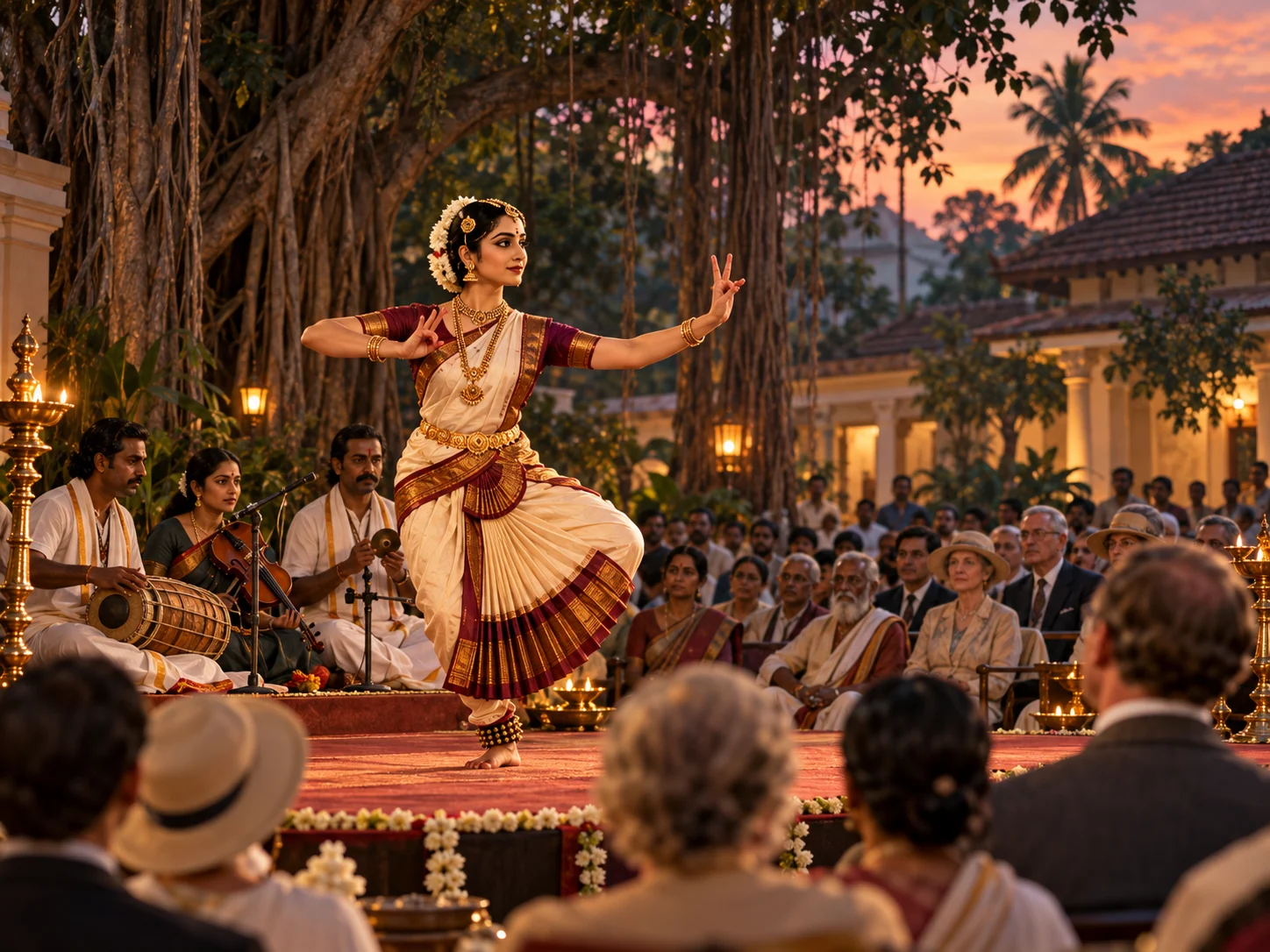
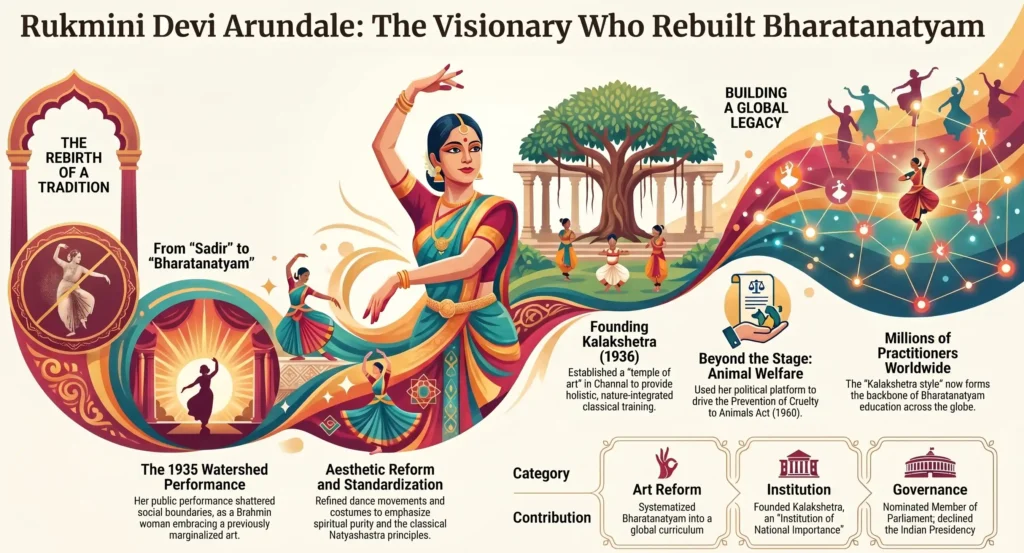
In 1935, Rukmini Devi performed Bharatanatyam publicly for the first time at the Diamond Jubilee celebrations of the Theosophical Society at Adyar. The performance was, by any contemporary account, a watershed moment in the history of Indian classical dance.
The social implications of what she did were not lost on anyone present. A Brahmin woman, the wife of a prominent Theosophist, performing a dance form that was publicly associated with the Devadasi community and therefore with sexual availability and social transgression, was making a statement that required considerable courage. The criticism came, as expected, from conservative quarters of Tamil Brahmin society. It came with force and with the particular venom reserved for women who cross social boundaries that have been carefully maintained. Rukmini Devi absorbed it and continued.
What she also did, with equal deliberateness, was begin to reshape the form of the dance itself. Working with traditional masters including Meenakshisundaram Pillai, she refined the abhinaya dimension of the tradition, emphasising its spiritual and aesthetic qualities while removing elements that she considered inappropriate or undignified. This curatorial process was not without controversy then and has been a subject of serious scholarly debate since, with scholars arguing that the modifications changed the tradition in ways that severed connections to the Devadasi community whose knowledge and practice had sustained it for centuries.
This scholarly debate is real and important. The historian Davesh Soneji’s research on the Devadasi tradition and its relationship to dance reform is among the most rigorous available, documenting how the revival of Bharatanatyam as a respectable middle-class art form came at the cost of the tradition’s connection to the Devadasi community whose knowledge and practice had sustained it. What the debate makes clear is that the history of Bharatanatyam’s revival is more complicated than the celebratory narrative that dominates most public accounts, and that a full reckoning with Rukmini Devi’s legacy requires holding that complexity honestly rather than resolving it prematurely in either direction.
Hemis Festival: Sacred Cham Dances That Offer Liberation in Ladakh
The Institution That Would Endure
In 1936, one year after her first public performance, Rukmini Devi founded Kalakshetra, which means temple of art in Sanskrit, on a plot of land in Thiruvanmiyur on the outskirts of Madras. The founding vision was ambitious to the point of audacity: to create an institution that would teach Bharatanatyam and Carnatic music to students from across India and the world, in a setting that integrated the natural environment, traditional craft knowledge, and classical artistic training into a single, coherent educational experience.
The campus that Rukmini Devi built, set among casuarina trees close to the sea, was designed to reflect the aesthetic principles she believed should govern classical Indian artistic education. Classes were held outdoors where possible. The natural light and air of the campus were considered part of the learning environment. Students were exposed not only to dance and music but to the textile traditions, temple sculpture, and classical literature that provided the cultural context for the art forms they were learning.
This holistic vision of artistic education was itself a philosophical statement. Rukmini Devi believed that art was not a skill to be acquired but a discipline through which the practitioner approached spiritual truth. The teaching of Bharatanatyam at Kalakshetra was therefore not simply the transmission of a technical vocabulary. It was the cultivation of a certain quality of human being. The Kalakshetra approach standardised the Pandanallur style of the tradition, emphasising purity of line, restrained expressiveness, and adherence to the aesthetic principles of the Natyashastra, the ancient Sanskrit treatise on performing arts.
This standardisation had lasting consequences for the way Bharatanatyam developed globally, as Kalakshetra graduates carried the institution’s aesthetic values into their own teaching and performance practices across India, Europe, North America, and Southeast Asia. Kalakshetra was declared an Institution of National Importance by the Government of India in 1994, eight years after Rukmini Devi’s death, a recognition that confirmed the institution’s centrality to India’s classical performing arts landscape.
A New Name for an Reclaimed Tradition
One of Rukmini Devi’s most consequential acts was something that might appear administrative rather than artistic: the renaming of the dance form from Sadir to Bharatanatyam. The new name, derived from the Sanskrit components Bha for bhava meaning expression, Ra for raga meaning melody, Ta for tala meaning rhythm, and Natyam meaning dance, was a declaration of the form’s classical credentials and its alignment with the theoretical framework of the Natyashastra.
The renaming did several things simultaneously. It severed the dance’s public association with the Devadasi community and with Sadir’s social stigma. It inserted the tradition into the legitimising framework of Sanskrit classical theory. It gave the form a name that was pan-Indian rather than specifically Tamil in its linguistic register, making it more accessible to audiences and practitioners from outside the Tamil cultural world.
The political dimensions of this renaming are significant. The renaming was not simply an aesthetic choice. It was an act of cultural politics that placed Bharatanatyam within the emerging narrative of Indian classical tradition at a moment when that narrative was being constructed in direct response to colonial claims about Indian cultural inferiority. What she was doing was not simply reviving a dance form. She was making an argument, in the most direct and embodied way possible, about the value and dignity of Indian artistic heritage at a moment when that argument urgently needed to be made.
The Advocate for All Living Things
Rukmini Devi Arundale was not only a dancer and institution builder. She was one of independent India’s most committed and effective animal welfare advocates, and this dimension of her life deserves attention alongside her cultural contributions.
Her concern for animal welfare was rooted in the same spiritual conviction that animated her approach to art. The Theosophical tradition in which she was formed held that all living beings participated in a single spiritual reality, and that the human treatment of animals was therefore a moral and spiritual question of the first order. Rukmini Devi took this conviction into the practical world of legislation and institution building with characteristic directness.
She was nominated to the Rajya Sabha, India’s upper house of Parliament, in 1952, and she used her platform there to advocate consistently for animal welfare legislation. She was a founding figure in the movement that led to the Prevention of Cruelty to Animals Act of 1960, one of India’s earliest and most significant pieces of animal welfare legislation. She founded the Animal Welfare Board of India and served as its first chairperson, building the institutional framework for animal welfare advocacy in India at a time when such work had almost no governmental support or public legitimacy.
The connection between her artistic vision and her animal welfare work was, for Rukmini Devi herself, entirely seamless. Both were expressions of the same fundamental conviction: that beauty, whether the beauty of a dance movement or the dignity of a living creature, is sacred and must be protected.
Ancient Agricultural Myths That Shape the Magh Bihu Harvest Festival
What She Left in the Body
The most direct form of Rukmini Devi’s legacy is not institutional or legislative or even scholarly. It is physical. It lives in the bodies of the dancers who have trained in the Bharatanatyam tradition she helped create and systematise, and in the bodies of their students, and in the bodies of their students’ students, across a chain of transmission that now spans the globe.
There are today estimated to be several million practitioners of Bharatanatyam worldwide, in India and in the Indian diaspora communities of North America, the United Kingdom, Southeast Asia, and beyond. Every one of those practitioners is connected, through the transmission chain of their training, to the decisions that Rukmini Devi made in the 1930s about how Bharatanatyam should look, how it should feel, what it should mean, and who should be allowed to practice it.
The Sangeet Natak Akademi, India’s national academy for music, dance, and drama, awarded Rukmini Devi its highest honour, the Sangeet Natak Akademi Fellowship, in 1967, recognising her contribution to Indian performing arts as foundational rather than merely significant. This is a form of immortality that is available only to those whose work becomes so thoroughly absorbed into the cultural fabric that it is no longer distinguishable from the tradition itself. Rukmini Devi’s contribution to Bharatanatyam has reached that point. When a dancer performs the alarippu that opens a Bharatanatyam recital today, in Chennai or London or Singapore or Chicago, they are performing within a framework that Rukmini Devi helped construct.
She was offered the Presidency of India in 1977 and declined. The reason she gave was characteristic: she felt her work at Kalakshetra was more important than any political office. The quiet certainty of that response, so consistent with the quality visible in that photograph from the 1930s, tells you everything you need to know about who she was and what she believed her life was for.
The Debt That the Tradition Owes
Rukmini Devi Arundale did not set out to become a historical figure. She set out to do something she believed mattered, and she did it with the particular combination of serene conviction and practical intelligence that characterises the rarest kind of cultural reformer. What she did was save a tradition. Not intact, not without compromise, not without the complex costs that all cultural rescues involve, but she saved it. The Bharatanatyam that exists today, practiced by millions of people across the globe, expressed in concert halls and dance studios and cultural centres from Chennai to Toronto, exists because in 1935 a Brahmin woman in Madras walked onto a stage and performed a dance that her society told her she should not perform.
The scholarly debates about what was lost in the revival are real and must be engaged with honestly. The Devadasi community’s contribution to the tradition they carried must be acknowledged with the seriousness and specificity it deserves. These are not comfortable truths, and a full reckoning with Rukmini Devi’s legacy requires holding them alongside her achievements, not resolving them prematurely in either direction.
And within that full reckoning, her achievement remains extraordinary. She looked at a tradition in the process of dying and decided, with the certainty of someone who has understood exactly what is at stake, that it must not be allowed to die. She built an institution to sustain it. She trained a generation of artists to carry it. She gave it a name that announced its classical credentials to the world. She performed it on stages from India to Europe at a time when doing so required a courage that most people would not have summoned. Her work is still being done, in dance studios across the world, in the bodies of dancers who may not know her name but who move within the tradition she rebuilt, gesture by gesture, in the silent poetry of a language she helped rescue from silence.
Ustad Bismillah Khan and the Shehnai That Became His Prayer
If you think you have remembered everything about this topic take this QUIZ
Results


#1. What was the traditional name of the dance form today known as Bharatanatyam before its 20th-century revival?
#2. Which community historically served as the primary custodians and ritual practitioners of this classical dance in the temples of Tamil Nadu?
#3. Meeting which legendary Russian prima ballerina on a ship in 1928 inspired Rukmini Devi Arundale to pursue her native dance traditions?
#4. Under which highly respected traditional master did Rukmini Devi study to master the rigorous Pandanallur style of the dance?
#5. In 1936, Rukmini Devi Arundale founded which famous international cultural institution in Chennai to systematize classical dance training?
#6. In the Sanskrit acronym established for the renamed dance form Bharatanatyam, what does the component “Bha” represent?
#7. Outside of her unparalleled contributions to the arts, which legislative milestone did Rukmini Devi help advocate for during her tenure in the Rajya Sabha?
#8. Which extraordinary national honor was offered to Rukmini Devi Arundale in 1977, which she famously declined to focus on her cultural institution?
Why is Rukmini Devi Arundale considered the mother of Bharatanatyam’s revival?
Rukmini Devi Arundale is credited with reviving Bharatanatyam because she took a tradition that was in severe social and institutional decline in the early twentieth century, learned it from traditional masters, performed it publicly at a time when doing so was considered socially transgressive, renamed it from Sadir to Bharatanatyam to establish its classical credentials, and in 1936 founded Kalakshetra, the institution that systematised its teaching and trained generations of artists who carried it across India and the world. Without her intervention at a critical historical moment, the tradition may not have survived in its current form.
What is Kalakshetra and why is it significant to Indian classical dance?
Kalakshetra, meaning temple of art, is a cultural institution founded by Rukmini Devi Arundale in 1936 in Chennai, Tamil Nadu. It was established to teach Bharatanatyam and Carnatic music in an environment that integrated natural surroundings, traditional craft knowledge, and classical artistic training. It standardised the Pandanallur style of Bharatanatyam, emphasising purity of line, restrained expressiveness, and alignment with the aesthetic principles of the Natyashastra. Declared an Institution of National Importance by the Government of India in 1994, Kalakshetra graduates have carried its aesthetic values into Bharatanatyam practice globally.
What was the controversy surrounding the Bharatanatyam revival and the Devadasi community?
Scholars including Davesh Soneji have argued that the Bharatanatyam revival led by Rukmini Devi and her contemporaries appropriated the artistic knowledge of the Devadasi community while simultaneously distancing the revived art form from that community’s social reality. The legislation that abolished the Devadasi institution removed the tradition’s original practitioners from its practice, and the middle-class Bharatanatyam that emerged from the revival did not always adequately acknowledge the Devadasi tradition it drew upon. This remains an active and important scholarly debate about the ethics and politics of cultural revival.
How did Rukmini Devi Arundale contribute to animal welfare in India?
Rukmini Devi was a committed animal welfare advocate rooted in her Theosophical conviction that all living beings participate in a single spiritual reality. As a nominated Member of Parliament in the Rajya Sabha from 1952, she consistently advocated for animal welfare legislation. She was a founding figure in the movement that produced the Prevention of Cruelty to Animals Act of 1960 and founded the Animal Welfare Board of India, serving as its first chairperson and building the institutional framework for animal welfare advocacy in India.
What is the significance of the meeting between Rukmini Devi and Anna Pavlova?
The meeting between Rukmini Devi Arundale and the Russian prima ballerina Anna Pavlova on a sea voyage in 1928 is considered a pivotal moment in the history of Indian classical dance. Pavlova, who had encountered Indian dance during Asian tours and incorporated its elements into her own work, spoke to Rukmini Devi about the beauty of Indian classical dance traditions and encouraged her engagement with them. This conversation, coming from a world-class artist who saw the tradition from outside Indian social anxieties, helped catalyse Rukmini Devi’s decision to learn Bharatanatyam and ultimately to dedicate her life to its revival
Sources & References
Rukmini Devi Arundale’s role in the revival and systematisation of Bharatanatyam — Rukmini Devi Arundale learned Bharatanatyam from master Pandanallur Meenakshisundaram Pillai, performed publicly in 1935 in an act of social transgression, renamed the tradition from Sadir to Bharatanatyam to establish classical credentials, and in 1936 founded Kalakshetra, which systematised the tradition’s teaching and trained generations of global practitioners.
The context of the Devadasi tradition and the legislation that dismantled it — The Devadasi institution, which had sustained Bharatanatyam through its role in temple ritual, was legislatively abolished through the Madras Devadasi Prevention of Dedication Act of 1947, leaving the tradition’s original practitioners marginalised and the art form in severe institutional and social decline in the early twentieth century.
The Anna Pavlova conversation and its historical significance — The 1928 meeting between Rukmini Devi Arundale and Russian prima ballerina Anna Pavlova, who had incorporated Indian dance into her own work, provided external artistic validation that catalysed Rukmini Devi’s decision to engage seriously with Bharatanatyam despite its social stigma within Indian society.
Kalakshetra Foundation’s institution building and global impact — Kalakshetra, founded in 1936 on principles of holistic artistic education integrating natural environment and traditional craft knowledge, standardised the Pandanallur style, declared an Institution of National Importance in 1994, and remains central to Bharatanatyam’s practice across India and the global diaspora.
Davesh Soneji’s scholarly framework for understanding the Devadasi-revival relationship — The historian Davesh Soneji’s research documents how the Bharatanatyam revival appropriated Devadasi knowledge while simultaneously distancing the revived tradition from the Devadasi community, raising important questions about the ethics and politics of cultural revival that remain active scholarly debate.